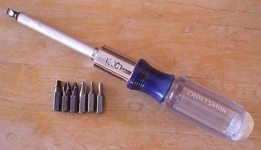
Ratcheting screwdrivers are nice to have, but this is where your money could be better spent on a cordless drill or impact driver in terms of productivity.
I use power tools to speed things up when it comes to disassembly, but jobs are usually faster with hand tools if things are cramped or if the job involves various fasteners screwed into different materials. Any time I'm threading screws back into wood or back into thin sheet metal after repairing something, I only use hand tools. It's too easy to strip threads or cause other issues if I don't, even with modern slip clutches. Also, for things like metal license plate clips, hand tools only every time.
With power tools it's also hard to feel for, find, and reuse the original thread grooves in plastics, or to feel exactly how tight I am torquing any fastener screwed into plastic. It's easier to avoid a crack than it is to fix one, and if you make new threads each time you screw into plastic you will only be able to take things apart once or twice before the holes start stripping out. If you keep reusing the original thread paths you can usually take things apart many times without issue.
I also agree with 4xdog, I don't use my ratcheting t-handles a lot. Probably 15% of the time and that's it. For any fasteners that become super easy to turn after popping loose I prefer a regular screwdriver. For rusty fasteners that remain hard to turn the entire way out, I prefer a ratchet or a speed handle.
A T handle seems a lot like a small ratchet with a hex bit holder, is there any advantage? The ability to use variable length extensions seems like a plus for the later. A ratcheting thumbwheel with a hex bit holder seems like another option
Thumbwheels are really for low torque situations only. They will wear out your fingers fast for anything more. All the ones I have tried also had too much backdrag for them to be useful for tight area work, so I don't own any anymore. Small ratchets are great for things like torx or hex head fittings. Anything that has a deep positive connection, because that connection won't be lost if the bit or socket tilts a little bit while ratcheting. A ratcheting t-handle is easier to keep aligned with the fastener head for things like slotted fasteners. Some phillips heads can get messed up pretty fast as well if the bit doesn't stay firmly aligned while turning. Ratchets also don't have a fully locked setting like my ratcheting t-handle does. Everything is the best option for certain situations and not the best option for others.
For dealing with light switch/outlet covers, use a Klein crank screwdriver. Nothing better.