To avoid these ads, REGISTER NOW!

Rate my insulation plan (northern minnesota)

ujjc001

Member
Joined
Nov 24, 2023
Messages
5
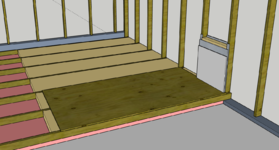
Hi all! Please let me know if I'm making any poor choices here. I have a detatched 1 car garage about 13x23 interior floor space give or take. I am planning to take about half of that over for an office if I don't get talked out of it. The walls are raised on the side 2 inches high with a 5.5 inch wide base, the back is 6 inches wide and about 10 inches high. To make a floor I thought about putting 2in xps down then 2x4 across that to tie into the walls, insulate with batts between that then a vapor barrier (not pictured) then t&g ply then a cheap floor covering. For the walls, the garage has vinyl siding, behind that tar paper, then wood boards which are full of knot holes and significan gaps everywhere, leaks like a sieve. I thought about .5 in polyiso right up to the boards, spray foam glued / sealed to the wall studs, then r13 fiber bats but uncompressed which is achieved by firring out the studs with another .5 poly iso, then cover that whole thing with another .5 to form a continous insulation barrier, taped edges. Then .5 sheetrock. Hopefully the attached sketch shows this well. Please let me know if I shoud do anything better, different, cheaper... I plan to heat this in the winter if I get it done since it will be an office. Cooling is only needed like 2 days a year if we're lucky.Screenshot 2023-11-24 222124.png
 
To avoid these ads, REGISTER NOW!
OP
U

ujjc001

Member
Joined
Nov 24, 2023
Messages
5
my one question is, the polyiso is faced with the reflective material, if that's on the first layer will that cause an issue- I could get normal xps in .5 too but trying to save a few bucks with the polyiso. I would maybe use eps if it was available in .5 but it's not available locally; I don't have any major issues with insects / rodents etc... so the polyiso could be replaced on the first layer w/ xps but I'm thinking keep the reflective poly on the final layer. But, I don't really know :)
 

billconner

Well-known member
Joined
Jul 20, 2021
Messages
6,970
Location
Thousand Islands NYS
I think the outer layer of poly iso will cause more problems then it solves. Not enough to keep the inner surface above dewpoint.

Put in batts and if you want, the inner layer of poly iso.

What are you doing overhead? Most important.

I'm insulating a previously unheated garage. Laying poly on slab, then 2x4 sleepers with foam between, ply, and wood flooring. I'm putting poly down first because I believe it should reallyb e on moist side which is usually the warm side, but not here.
 

Boogerman

Well-known member
Joined
Jan 28, 2021
Messages
833
Location
aspen cove hill
I'd skip the fiberglass in the floor, but put reflective bubble wrap insulation over the xps, with seams taped with aluminum tape. Lay the joists on top of that. No vapor barrier over any of that, you want any moisture that is in that space to be able to get out through the floor. The bubble wrap will act like about R20 in this situation, in a floor where most of the loss is through radiation. it will also be a vapor barrier to isolate any moisture coming up from the slab. You could also put a polyethylene sheet under the XPS, but the XPS is nominally waterproof so not a lot of advantage there. I like your wall section. If you caulk the inside polyiso edge joints, You'll do a lot for air infiltration.
 
To avoid these ads, REGISTER NOW!
OP
U

ujjc001

Member
Joined
Nov 24, 2023
Messages
5
I think the outer layer of poly iso will cause more problems then it solves. Not enough to keep the inner surface above dewpoint.

Put in batts and if you want, the inner layer of poly iso.

What are you doing overhead? Most important.

I'm insulating a previously unheated garage. Laying poly on slab, then 2x4 sleepers with foam between, ply, and wood flooring. I'm putting poly down first because I believe it should reallyb e on moist side which is usually the warm side, but not here.
The overhead has an attic floor and a decent space for storing stuff like Christmas decorations etc... I honestly haven't figured that bit out yet, it's going to remain unconditioned. No ridge vent but I figured I'd pop a side vent on each end, should provide plenty of air circulation and I'm going to be the only wet thing in this office... Would love suggestions for that as I'm I'll be pouring over the options. Thank you for the info!
 
Last edited:

Boogerman

Well-known member
Joined
Jan 28, 2021
Messages
833
Location
aspen cove hill
If the ceiling isn't sealed and insulated, the rest of the insulation is pretty much wasted, as 80% of the heat goes out the ceiling. You need R40 or so in the ceiling, in the climate you're in. More wouldn't hurt, up to about R60. You also need airtight barrier on the heated side to keep air from chimneying up into the attic space and out. Paying attention to sealing the transition from ceiling to walls will be necessary also.

Infiltration/exfiltration of air is the primary loss in any structure, after you make it air tight, then insulation starts helping. Your plan for polyiso on the inside of the walls continuous with taped joints, will do that for the walls as long as you caulk the edges. You need similar for the ceiling. My preference would be 6 mil plastic sheet continuous on the ceiling, and wrapped 12" down the walls to cover the top plate transition, with the polyiso overlapping that. Then, sheetrock over the plastic on the ceiling.
 
OP
U

ujjc001

Member
Joined
Nov 24, 2023
Messages
5
If the ceiling isn't sealed and insulated, the rest of the insulation is pretty much wasted, as 80% of the heat goes out the ceiling. You need R40 or so in the ceiling, in the climate you're in. More wouldn't hurt, up to about R60. You also need airtight barrier on the heated side to keep air from chimneying up into the attic space and out. Paying attention to sealing the transition from ceiling to walls will be necessary also.

Infiltration/exfiltration of air is the primary loss in any structure, after you make it air tight, then insulation starts helping. Your plan for polyiso on the inside of the walls continuous with taped joints, will do that for the walls as long as you caulk the edges. You need similar for the ceiling. My preference would be 6 mil plastic sheet continuous on the ceiling, and wrapped 12" down the walls to cover the top plate transition, with the polyiso overlapping that. Then, sheetrock over the plastic on the ceiling.
Yea, definitely going to insulate the ceiling a bunch just didn't decide on what yet. Especially since the attic already has a floor so I only have the 5.5 inches in the ceiling to work with unless I extend them all by 6.5 or so which... Yea, not sure how that would work. Probably will just do what I can in the 5.5 with batts, then add a foam board on that, just not a ton of headroom to begin with. However, I could drop my floor 2x4s down two inches, keep a solid 1/2 in xps first then 2 inch between the floor 2x's then maybe the radiant barrier, keeps a 1/2 inch air gap, but more head room for like a 2 inch on the ceiling which would probably do more for the total package then the floor... I suppose.... I could maybe wall off the attic hall too, pull the flooring out there, install the vapor barrier and then just loose fill the **** out of the attic space... I don't have anyone in my friends network who knows anything about this so I really appreciate being able to think this through with some smart folks who have thought about this before...
 

Boogerman

Well-known member
Joined
Jan 28, 2021
Messages
833
Location
aspen cove hill
You're slightly better off on a ceiling with a continuous unbroken insulating layer than with 2x's with interfilled polyiso spaces. The inevitable gaps and low insulating value of the 2x lowers the overall insulation considerably.

What I would recommend for the ceiling is: Install the 6" of insulation, use either unfaced high density fiberlgass or rockwool to get as much R value as you can. Then, put on a poly vapor barrier over the joists, and tape the seams. Lap down the walls 12", behind any wall insulation. This poly is the easy way to make sure you've stopped air exfiltration through the ceiling. The foam boards if well taped and installed continuous are also a good barrier, but the plastic is cheap insurance.

Next, attach 1" poly-iso for a R value of about 6. Just use a few nails into the joists to hold it, preferably with plastic washers. Use ring shank nails made for roofing underlayment for the plastic washers. Make sure you mark the joists for the drywall screws later. Tape all the foam joints with aluminum tape. If you attach 1/4" furring strips over the foam at the joists, that air gap will make the reflective surface of the polyiso very effective in cutting down radiation losses from the heated space, and it will feel much warmer. This is a good trick for any occupied space, if you have radiant reflective foil behind the sheetrock with a 1/4" to 1/2" air gap, the room will "feel" a few degrees warmer, and will have slightly lower heat loss overall. This is more important in the walls than the ceiling, as most ceiling losses are convective and conductive, but it still helps in the ceiling. Rip the furring strips off of a 2x4, you get about ten 1/4" strips per 2x4. You can now sheetrock over the ceiling using 2-1/2" screws.

This assembly will give you roughly a R27, and the radiant barrier and multiple material interfaces and vapor barrier will make it function more like a R30.
 
Last edited:
To avoid these ads, REGISTER NOW!
Top Bottom