To avoid these ads, REGISTER NOW!

Re-vamped compressor

sollauer

Member
Joined
Nov 19, 2011
Messages
8
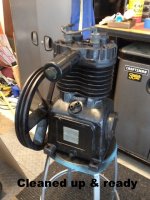
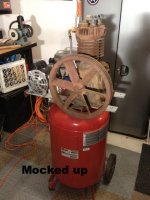
Greetings all- New here and love the site. In an effort to do away with as many modern, cheap sounding effects that fill the air in my shop, I wanted to rid myself of the oil-less compressor for obvious reasons. I mentioned this to my buddy John while we chatted at his shop and while we talked he wandered under a nearby tree and started digging in the pile of pine needles and yanked out a very old Devilbiss twin long stroke compressor pump and asked if this is what I was looking for. It had been given to him and at one point was submerged in a river for a time. We struck a good-for-both-of- us barter deal and I drug the rusty compressor home. When I pulled the case covers off, there was at least 5 pounds of mud and gravel in the case. After a thorough cleaning, the old pump was ready. I took the plastic shroud off my Craftsman compressor and extracted the tiny but very noisy oil-less piston pump assembly and took the grinder to the electric motor and removed the remaining cast aluminum mounting assembly. I used the same electric motor and created a mounting plate atop the upright tank- mounted them both and here is the result. Looks good and sounds better- (link below) I love resurrecting old equipment and seeing this old lung breathe life again has been satisfying. It's time spent in the shop working on things like this that offer a tranquil piece of mind that I think we all understand. Pics are of a stock unit, the pump when I acquired it, and the finished set up.
Cheers, Mark
 

Attachments

  • comp head before.jpg
    comp head before.jpg
    65.5 KB · Views: 275
  • Comp head finished.JPG
    Comp head finished.JPG
    118.5 KB · Views: 311
  • Mock up compressor.JPG
    Mock up compressor.JPG
    97.5 KB · Views: 326
  • finished compressor.jpg
    finished compressor.jpg
    43.3 KB · Views: 348
  • before compressor.jpg
    before compressor.jpg
    10 KB · Views: 162
To avoid these ads, REGISTER NOW!

larry_g

Well-known member
Joined
Apr 28, 2007
Messages
16,877
Location
oregon
Great job resurrecting the dead. Sounds good. One concern is that looks to be a plastic pipe from the head to the tank. If it is keep an eye on it as the high heat from the compressor may degrade it.

lg
no neat sig line
 

kbs2244

Well-known member
Joined
Nov 11, 2006
Messages
14,065
Sweet project.
I share your idea of making old stuff work again.
It can be dollar dangerous though!
You do “have to know when to hold them and when to fold them.”
 
OP
S

sollauer

Member
Joined
Nov 19, 2011
Messages
8
Great job resurrecting the dead. Sounds good. One concern is that looks to be a plastic pipe from the head to the tank. If it is keep an eye on it as the high heat from the compressor may degrade it.

lg
no neat sig line

Good catch- Its actually a steel braided type plumbing fitting- the type you use to connect a kitchen faucet to the hot and cold lines- and it blew out today! I am going to use a proper high pressure hose (something rated 300psi or better) with barbed fittings and hose clamps- hopefully that holds up-

Thanks for the compliments gentlemen!
 

larry_g

Well-known member
Joined
Apr 28, 2007
Messages
16,877
Location
oregon
Good catch- Its actually a steel braided type plumbing fitting- the type you use to connect a kitchen faucet to the hot and cold lines- and it blew out today! I am going to use a proper high pressure hose (something rated 300psi or better) with barbed fittings and hose clamps- hopefully that holds up-

Thanks for the compliments gentlemen!

I would have little hope for a barbed fitting either. Get a proper steel or copper line with flare or compression fittings. It's the heat from the compressor that will kill most lines.

lg
no neat sig line
 
OP
S

sollauer

Member
Joined
Nov 19, 2011
Messages
8
Definitely a little top heavy- in fact alot top heavy!, but I dont plan on moving it much. Will refit the new compression fitted copper line tonight and give her a whirl. Need to sort out why the unloader valve seems to keep open after it reaches the set tank pressure. Maybe the line on the head is supposed to be directed into the pressure switch??? Im working with two different era pieces so I need some sorting here yet.

Thanks for the compliments too!
 
To avoid these ads, REGISTER NOW!

isaac338

Well-known member
Joined
Aug 4, 2007
Messages
727
Location
Halifax, NS, Canada
Definitely a little top heavy- in fact alot top heavy!, but I dont plan on moving it much. Will refit the new compression fitted copper line tonight and give her a whirl. Need to sort out why the unloader valve seems to keep open after it reaches the set tank pressure. Maybe the line on the head is supposed to be directed into the pressure switch??? Im working with two different era pieces so I need some sorting here yet.

Thanks for the compliments too!


The unloader valve should remain open - there's meant to be a check valve after it which prevents the tank from losing its air through the unloader.

As for the line, if you can't get the copper into place, the suggestion for a hydraulic hose is a good one. I had mine custom made with 1/2" pipe fittings on either end, a swivel on one end, and it was only twenty or thirty bucks.
 
OP
S

sollauer

Member
Joined
Nov 19, 2011
Messages
8
The unloader valve should remain open - there's meant to be a check valve after it which prevents the tank from losing its air through the unloader.

As for the line, if you can't get the copper into place, the suggestion for a hydraulic hose is a good one. I had mine custom made with 1/2" pipe fittings on either end, a swivel on one end, and it was only twenty or thirty bucks.

The copper line will work out I think- little tight and tough to do without kinking, but Ive got a 10 ft roll to do 2'- so enough for more than one attempt!
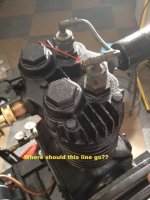
see the pic below and please pardon my ignorance on this- but is this the unloader and what should I do to check it? The tank fills up and when the auto shut off cuts in when the tank hits about 110-120psi and kills the motor, this valve seems to open up and let air bleed out. ????
Also- does this line on the head need to go down to the pressure switch to allow the head pressure to escape at shut off?? How does it tie in?
 

Attachments

  • photo (4).JPG
    photo (4).JPG
    109.6 KB · Views: 89
  • photo (5).JPG
    photo (5).JPG
    96.2 KB · Views: 90
Last edited:

isaac338

Well-known member
Joined
Aug 4, 2007
Messages
727
Location
Halifax, NS, Canada
Hard to tell from the pics, but normally the valve inside the pressure switch opens when the switch opens (so when the compressor turns off), and should probably be plumbed into that line on the head. There should be a check valve going into the tank, the idea being that when the compressor stops running, the pressure in the pump and line leading into the tank is bled off, but the pressure in the tank remains. That way the pump doesn't have to push against 120psi to get running again.
 

DekeT

Well-known member
Joined
Aug 12, 2011
Messages
2,234
Location
USA
Good catch- Its actually a steel braided type plumbing fitting- the type you use to connect a kitchen faucet to the hot and cold lines- and it blew out today! I am going to use a proper high pressure hose (something rated 300psi or better) with barbed fittings and hose clamps- hopefully that holds up-

Thanks for the compliments gentlemen!

Tractor Supply, or lots of other places sells hydraulic hose that comes with threaded ends. That would be better than barbed ends. I use it for connecting my tank to my steel lines. I don't know how well it would hold up to heat near the compressor head though.

Great job on the restoration. :thumbup:
 

KinzeMech

Well-known member
Joined
Jul 15, 2012
Messages
1,164
You don't want to use hydraulic hose for the pump output. Hydraulic hose can handle the pressure just fine, but not the temperature. The output of a single stage pump can reach as high as 500 degrees if you run it hard enough. Hydraulic hose works great for connecting air as long as you use it downstream of the tank. Air coming out of the tank is much cooler than air coming out of the cylinder head of the pump.
 

isaac338

Well-known member
Joined
Aug 4, 2007
Messages
727
Location
Halifax, NS, Canada
You don't want to use hydraulic hose for the pump output. Hydraulic hose can handle the pressure just fine, but not the temperature. The output of a single stage pump can reach as high as 500 degrees if you run it hard enough. Hydraulic hose works great for connecting air as long as you use it downstream of the tank. Air coming out of the tank is much cooler than air coming out of the cylinder head of the pump.

As useful as anecdotal evidence can be, my two-wire hydraulic hose has been on my compressor between the pump and receiver for almost a year with no problems at all; it seems to handle the heat from the 3-cylinder pump just fine.

I do a lot of sandblasting so that compressor has long periods of running non-stop.

Knock on wood, though, I guess.
 

CarterKraft

Well-known member
Joined
Dec 7, 2009
Messages
73
Location
DFW
a hydraulic hose shop can make the correct air compressor discharge hose for no more money than a hydraulic hose of the wrong spec. a truck shop might be able to do the same.
 
OP
S

sollauer

Member
Joined
Nov 19, 2011
Messages
8
a hydraulic hose shop can make the correct air compressor discharge hose for no more money than a hydraulic hose of the wrong spec. a truck shop might be able to do the same.

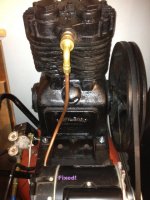
Thanks All- I used a copper tube (3/8" soft tube) and its working great now.
 

Attachments

  • Comp pipe.JPG
    Comp pipe.JPG
    108.2 KB · Views: 55
OP
S

sollauer

Member
Joined
Nov 19, 2011
Messages
8
Okay Gentlemen- I defer to experience here again. Compressor pumps fine. But just runs on and on and tank doesnt exceed 45 psi. I pulled the line off the head and it seems to be pumping an adequate amount of pressure from the head when running. Could I need a check valve? I should mention before this started happening, I was concerned that one side of the cylinder head was getting hotter than the other- to me indicating that perhaps only one side was really pumping (stuck valve or something was my thought) So I pulled the covers off the top of each side and pulled out the valve type pieces, cleaned them up and put back together- pump works fine, but now does not exceed 45 psi. What might I have screwed up there?? Thoughts????
 

GeneralDisorder

Well-known member
Joined
Sep 20, 2012
Messages
306
I kindly suggest that you put an amp meter on that little motor. It is very likely exceeding its full load amperage rating.

While the pump is running there should be nothing that prevents it from making more pressure unless the valves and or/rings aren't doing their job. Slippage is occurring back through the pump or blow-by past the rings.

GD
 
OP
S

sollauer

Member
Joined
Nov 19, 2011
Messages
8
The motor doesnt get vey hot at all, f thats an indicator of anything-

Any suggestions on how I can check to see that the valves/rings are doing what they need to be doing? As I said, there seems to be a fair amount of air being pumped out of the head-
 

GeneralDisorder

Well-known member
Joined
Sep 20, 2012
Messages
306
What kind of valves does it have? Looks like probably disc valves..... have they been polished so as to create an air-tight seal? We polish them with 1200 grit and then put them in the solvent tank and fill them up to insure they can hold a seal properly...

Did you replace the rings? Hone the cylinder? You need a very rough hone for the rings to seat properly due to the low speeds of the compressor.

The motor temp is not a good indicator - but at 45 psi you may not be overamping it anyway. You NEED an amp probe to set the max pressure of the machine - higher pressure = more amps as does faster RPM. So the faster you turn the pump the more amps it will draw and the higher the pressure the more amps it will draw. Compressors are not like most electric motor applications - the amperage draw "swings" by a LOT over the pressure range of the machine.

Electric motors are not like a combustion engine - you CAN pull higher amps on an electric motor than it was designed for and it will simply destroy it. If you have a 2 HP motor and you have it sheaved for a 5 HP amperage range it will keep spinning till it melts or catches fire trying to give you the 5 HP you are asking of it.

GD
 
Last edited:
To avoid these ads, REGISTER NOW!
Top Bottom