I'm rewiring my garage. Other than the obvious, (dedicated line for welder, drill press, compressor etc) what should I DEFINITELY include in my schematic?
I plan on installing 2 outlets per 4 feet on the wall, about waste height.
First, install those outlets so that the bottom of the boxes are AT LEAST 50 inches or so off the floor. You'll understand (and appreciate) why the first time you need to store a sheet of plywood or drywall.
Beyond that, every four feet is overkill. One double-gang box every 6-8 feet around the entire perimeter of the space will be more than adequate.
BUT... DO make a point of feeding each of the two duplexes in those boxes from a different breaker than the other one. In small shops (such as yours), two 20A circuits will normally handle the whole thing; in larger shops, split it up further as you see fit. Optionally, add a third 20A circuit for the workbench area, especially if it is a large-ish bench and/or you have any high-draw 120V tools (grinder, drill press, etc.) "permanently" installed there. Also optional (but recommended, especially if you do any automotive work), put one additional duplex at an appropriate spot in the ceiling, to power a hand-held trouble light on a retractable cord reel (it can be fed from one of the other outlet circuits, so as to avoid the need for a separate GFCI). And finally, note that at least in anything which might be considered a "residential garage", NEC now requires that ALL 120V outlets be GFCI protected. The simplest/easiest way to accomplish this is to use a GFCI duplex as the first outlet in each circuit, fed directly off the circuit breaker; then "daisy chain" all the other duplexes on that circuit via the GFCI's "Load" terminals. Use 12-2 NM-B wiring throughout.
4 boxes per 20amp breaker,
Again, that's overkill. As noted above, you simply won't need more than three circuits AT MOST for your general-purpose 120V outlets. Just how many of those hand-held tools do you think you're going to be running AT THE SAME TIME?!?
with Large amperage items on individual dedicated circuits
This depends somewhat on what you mean by "large amperage"; but at least for the most part, it's also covered by the above.
My garage is small, 29x10, 8 foot ceiling. How many lights should I plan on going with?
Given those dimensions, more important than "how many" will be "exactly where". By the time you get that optimized, "how many" will take care of itself.
anything I should look into for future proofing??
It will likely be convenient (and very possibly cheaper) to install a dedicated sub-panel in the garage, fed by ONE (generously sized) cable from your main service panel, then originate all of the various garage branch circuits from that. In selecting your sub-panel, bigger is better than smaller. When all is said and done, and you've installed EVERYTHING you can currently think of, you want to still have at least a half-dozen (perhaps more) unused breaker slots available for things you haven't thought of YET.
No.
Particularly given his eight-foot ceilings, four-foot fixtures will be FAR superior in terms of both placement and switching flexibility.
I have four 20 amp circuits in my 24 x 26. So far, that has been plenty. What I found mattered more that total outlets, is outlets per location. Basically, more quad (four per box) outlets vs closer spacing. For my computer to be plugged into one location I have a monitor, the computer and the the speakers. Three plugs taken up and less than 2 amps of loading.
That's where outlet strips come in. And at least one of them can be considered a "given" in the workbench area, if nowhere else. Wall warts, battery chargers, misc. small computer and/or A/V loads, etc. -- they're all in the same category in this respect: A lot of plugs, but not much load. So there's no need for separate outlets/circuits; just a convenient means of plugging things in.
With ceilings lower than 12' go with 32watt T8 lights, as t5's will give you hot spots. Hot spots as in super bright and dim areas. Also put half the lights on one switch and the othe half on another so you can adjust brightness as needed. I just put in 4-8' tandem t8's last week, fixtures+bulbs were ~$200 from local Lowes. A total of 16-4100k 32w bulbs.
I was with you until you got to the tandem (8-foot) fixtures. I would have used separate 4-foot fixtures; and I STRONGLY recommend same to the OP.
I would also add a couple of 240 lines, actually 3 either end and one near the middle of the shop. You will inevitably need them one day. This is along with your dedicated welder/compressor lines.
The problem with this is, until you KNOW what your 240V loads will actually be, you don't know what the current requirements (hence the wire size, breaker rating, outlet style/type, etc.) of each circuit needs to be, or even exactly WHERE within the shop they'll need to be located.
Really to give you better advice we need to know what are you doing in your shop? Mechanic, Bodyman, Wood, all of the above, or a place to hang and have a beer?
Agreed.
I agree with the advice already given, but I would fine tune it a little bit. Have extra outlets wherever you are likely to plug in any "wall wart" type transformers, and anywhere you could possibly have a wall wart type transformer do not install a quad receptacle. Instead install two separate duplex receptacles, one mounted to each side of a wall stud. That provides the separation necessary to provide clearance for multiples of even the largest wall transformer to plug in while still giving you good outlet density.
This is doing things the hard way.
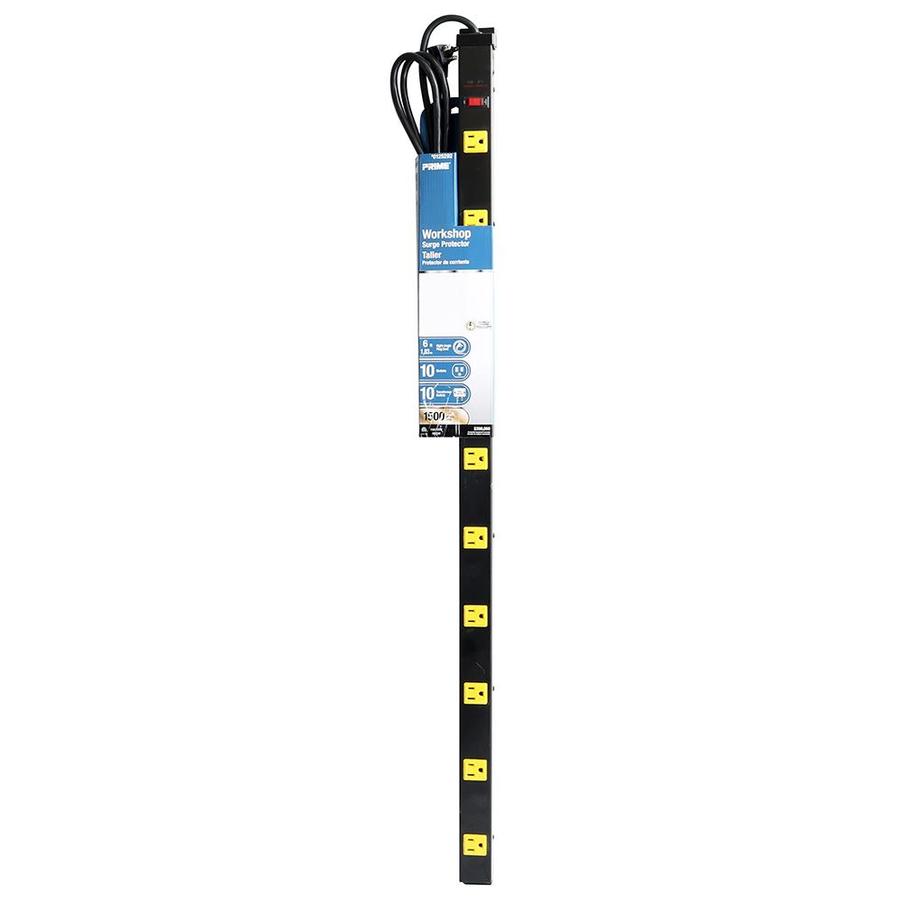
In at least MOST shops the proliferation of wall warts will naturally gravitate to the general area of the workbench. And as noted above the simple solution is one or more outlet strips. If you choose said outlet strips wisely, socket spacing is NOT a problem. For example, I recently used this one:
http://www.lowes.com/pd_125292-16503-UTPBS010_?PL=1&productId=1214065
on another project. Comes with mounting hardware for secure mounting, and seems sturdy enough for my purposes, anyway.
If you are going to have any sort of computer, modem, cable tv box, etc. in the garage try to have a dedicated 4 outlet box and circuit just for those items and also do not share that circuit's neutral leg with any other circuit. That will minimize any power tool use from affecting the computer, tv picture, internet connection, etc.
This is true, and not a bad idea. But OTOH, if you have any really sensitive electronics in there, they really ought to be fed from a GOOD true-online UPS anyway.
In as far as future proofing, I would at least run a couple extra circuits across the attic space and just terminate them in covered boxes at the ceiling. Any future changes then just need to go from the ceiling box and drop down the garage wall for anything new instead of being run all the way from the panel.
That could be a maintenance/troubleshooting nightmare, especially if the person doing that maintenance/troubleshooting is not the same person who installed it (and thus hopefully "remembers" what that oddball arrangement is/was supposed to be). Better to simply ensure that access to the sub-panel for chasing/fishing additional wires later is not impeded by other construction details.
I would also install at least one or two wall conduit stub outs in key areas for future data stuff like ethernet runs, cable tv cable, phone lines, etc. Just mount a box on the wall and then run conduit from the box up and into the attic space of the garage. Put a string in the conduit for pulling cable through it in the future and that is it. Very cheap and easy to do and it will save you a lot of hassle in the future if you end up sheetrocking or covering the walls.
Not needed until/unless the walls are sheetrocked; and if they are already closed, a major PITA to retrofit -- not to mention unnecessary, since such low-voltage stuff does NOT need to be encased in conduit (or even real workboxes, for that matter). Simpler & easier to just fish what you need, where you need it, WHEN you need it.
Last, but not least at this time of year is Christmas lights. You might want to mount a simple switched outlet up under the roof eaves outside the garage just for plugging in gutter mounted Christmas lights during the holidays.
Exterior lighting is a whole 'nother subject. Not to dismiss your suggestion; but it doesn't begin to cover the issue.
[The BBS software is nattering at me that the message is too long. So I'm breaking it here. Continued in next message...]