
You are using an out of date browser. It may not display this or other websites correctly.
You should upgrade or use an alternative browser.
You should upgrade or use an alternative browser.
Reamers: when to use, why to use and what type
- Thread starter ojh
- Start date
-The first type of reamer I learned how to use was a conduit reamer. It takes the burrs off cut-ends of conduit
-The next reamer I have used is a small 3/8" tapered reamer from Xcelite. It's just for enlarging small holes. Say you remove a nut and bolt from a piece of sheet metal or plastic, etc and the only replacement you have is a tiny bit bigger, ream the hole out slightly.
-Any more though, I carry a step-drill bit. It's kinda like an aggressive reamer, lol.
-The next reamer I have used is a small 3/8" tapered reamer from Xcelite. It's just for enlarging small holes. Say you remove a nut and bolt from a piece of sheet metal or plastic, etc and the only replacement you have is a tiny bit bigger, ream the hole out slightly.
-Any more though, I carry a step-drill bit. It's kinda like an aggressive reamer, lol.
CapriMikeC
Well-known member
Reamers are typically used to finish a hole to a precise diameter. They are not drills, they can only remove the last few thousandths to achieve the finish size.
Chucking reamers have shanks that are smaller diameters then the cutting flutes and are intended to be kinda flexible so they will follow the hole. Often, they have 6 straight flutes to create very round holes. They work well in drill presses and mills but can be used in hand drills with patience and care.
For example, you want to press fit a 1/4" dowel pin. Drill the hole to .242" (letter "C"), then follow with an undersize reamer like this to open the hole to .2490". Tappity tap tap the pin for a nice controlled predictable fit.
Chucking reamers have shanks that are smaller diameters then the cutting flutes and are intended to be kinda flexible so they will follow the hole. Often, they have 6 straight flutes to create very round holes. They work well in drill presses and mills but can be used in hand drills with patience and care.
For example, you want to press fit a 1/4" dowel pin. Drill the hole to .242" (letter "C"), then follow with an undersize reamer like this to open the hole to .2490". Tappity tap tap the pin for a nice controlled predictable fit.
JackOfDiamonds
Well-known member
You don't need an exact drill for each reamer. You just have to drill it slightly undersized first. How much undersized depends on the hole and the material. I usually think a 0.003-0.005" chip is nice so 0.006"-0.010" undersized is usually ok. I'm sure there's a rule of thumb.
Adjustable reamers are not as precise as real ones but they replace an infinite amount of regular reamers so they can get you out of a pinch.
Adjustable reamers are not as precise as real ones but they replace an infinite amount of regular reamers so they can get you out of a pinch.
californiaHank
Well-known member
- Joined
- Nov 20, 2015
- Messages
- 487
Yes.So we need to have a drill bit sized to a reamer (like a tap & die set) to make a precision hole?
How about the adjustable reamers, how to you set them to a precise cut and how is the proper way to do the taper?
Choose the reamer size necessary to get a reasonable percentage of thread engagement for the tap size you are using.
Choose a twist drill size slightly smaller than the reamer size.
Then drill, ream, and tap.
My limited experience is with 'one off' small projects and not with quantity manufacturing.
For small fasteners, I use fixed-size hand reamers and hand taps.
Good adjustable reamers are expensive. IMHO, small cheap adjustable reamers are mostly junk.
Making precision threaded holes by machine in larger sizes or in production quantities is a different game. That's where chucking reamers and specialized taps come into play.
CapriMikeC
Well-known member
So we need to have a drill bit sized to a reamer (like a tap & die set) to make a precision hole?
How about the adjustable reamers, how to you set them to a precise cut and how is the proper way to do the taper?
Precision is a relative term. Reamers make more consistent and rounder holes than conventional twist drills.
Creating threaded holes is so common, the proper size drills are readily available so the reamer usually isn't required.
Reamers are more often used for holes where a specific fit is required. Another example would be a slip fit for a shaft to pass through the hole without being sloppy. Or a precision bore that a bearing/bushing will be pressed into. In fact, there are standards used by engineers and machinists to define the fit so there is no ambiguity.
There are a few hundred things that can fall under the term of reamer. Are you a machinist, cook, carpenter, cooper, mechanic, mechanic, or something else. Each of the prior trades have and use reamers and they are different. I would suggest that you formulate a better question that will give you answers to your specific needs.
lg
no neat sig line
lg
no neat sig line
Monza Harry
Well-known member
For reamed holes from ~3/16" to ~1/4 drill 1/64" undersize for greater than 1/4" to ~1/2" minus 1/32", 1/2" to 3/4" go minus 3/64" 3/4" up to about 1-1/4" or 1-12" minus 1/16" dia. drill, for sub 3/16" number drills of progressively smaller under-sizes 1/16" dia. I went #54 @ 0.055", again these are for precision holes, I prefer spiral flute as straight flute can cause a 6 sided hole from aggressive feed rate and only a spiral flute or boring bar and head [or more involved machinery] will fix it then. For tougher materials a pipe reamer will reduce the torque required to tap for dry seal pipe plugs they will also extend pipe tap life [NPT I am talking about here].
The tapered reamer mentioned above is either a taper reamer [ for hand use only specified in angle used for ball joints and tie rod ends typically (automotive)] 7* and 10* are common, or from my limited experience with taper reamers the identical looking repairman's hand reamer.
For tighter fits use a smaller Depth of Cut [DOC] or a larger DOC for looser fits you can vary the size about 0.0005" to 0.00075" for trying to hit a press/slip fit. Very "guessy" as the reamer is used it does wear and change how it likes to cut. Then to get it to cut bigger for a few holes you can then "Scrape" the cutting edge with a piece of carbide to create a "Burr" and a slightly bigger hole than the reamer is. Again this is all less than 0.001" usually and in the 1/4"-Maybe 3/4" range, bigger and smaller I don't have the experience to help much with absolute certainty. Harry
P.S. I did not address material types ie; harder and or with more exaggerated grain structures (Ampco {Aluminum Bronze}), and as stated above this is just for the standard metal cutting trades .
The tapered reamer mentioned above is either a taper reamer [ for hand use only specified in angle used for ball joints and tie rod ends typically (automotive)] 7* and 10* are common, or from my limited experience with taper reamers the identical looking repairman's hand reamer.
For tighter fits use a smaller Depth of Cut [DOC] or a larger DOC for looser fits you can vary the size about 0.0005" to 0.00075" for trying to hit a press/slip fit. Very "guessy" as the reamer is used it does wear and change how it likes to cut. Then to get it to cut bigger for a few holes you can then "Scrape" the cutting edge with a piece of carbide to create a "Burr" and a slightly bigger hole than the reamer is. Again this is all less than 0.001" usually and in the 1/4"-Maybe 3/4" range, bigger and smaller I don't have the experience to help much with absolute certainty. Harry
P.S. I did not address material types ie; harder and or with more exaggerated grain structures (Ampco {Aluminum Bronze}), and as stated above this is just for the standard metal cutting trades .
slowtwitch73
Well-known member
The world of reamers is large.
What is ISO and where do we find a similar reference chart for 'inch' scales, for those of us that work on really old cars.Precision is a relative term. Reamers make more consistent and rounder holes than conventional twist drills.
Creating threaded holes is so common, the proper size drills are readily available so the reamer usually isn't required.
Reamers are more often used for holes where a specific fit is required. Another example would be a slip fit for a shaft to pass through the hole without being sloppy. Or a precision bore that a bearing/bushing will be pressed into. In fact, there are standards used by engineers and machinists to define the fit so there is no ambiguity.
metlmunchr
Well-known member
- Joined
- Sep 10, 2011
- Messages
- 1,280
International Standards Organization. The same charts are in Machinery's Handbook in inch dimensions along with explanations of various types and classes of fits and the combinations of tolerance classes typically used to achieve these fits.What is ISO and where do we find a similar reference chart for 'inch' scales, for those of us that work on really old cars.
FWIW, as a machine shop owner for 20 years and a lifelong old car hobbyist, I can't think of a single instance other than a purpose made kingpin bushing reamer, where I've ever needed or used any reamer in automotive work.
slowtwitch73
Well-known member
Between a complete drill index and the ability bore a hole in the lathe and mill, you likely don't need reamers, even if you are pressing bearings, shafts etc.
If you are doing a lot of work with precision ground locating pins, jigs, fixturing, etc, then maybe.
If you are doing a lot of work with precision ground locating pins, jigs, fixturing, etc, then maybe.
CapriMikeC
Well-known member
As metlmuncher suggests, Machinery's Handbook is filled with information. If you have local used book stores, you might get a second hand one for cheap. The vast majority of content changes little over the decades. Purchasing a new copy will probably include a PDF which makes searching as easy as control+f.
MBfreak
MEMBER EMERITUS
californiaHank
Well-known member
- Joined
- Nov 20, 2015
- Messages
- 487
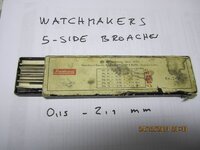
Different industries/trades have different terms for the same thing. Clockmakers traditionally call small tapered reamers 'broaches' and ones with straight sides 'reamers'. To add to the confusion, they also use various shapes of broaches for cutting non-round holes, like keyways.
Broaching and reaming seem to me to be more or less the same thing, but I'm sure there are people who would argue about the fine technical details of how the two words should be used.
Broaching and reaming seem to me to be more or less the same thing, but I'm sure there are people who would argue about the fine technical details of how the two words should be used.
I'm not a machinist but I've used reamers for lots of things. Hand reamers have a square end like a tap so you can turn them by hand with a tap wrench. Chucking reamers don't have the square tip and are chucked in a lathe or DP etc. As I understand it common drills are slightly barrel shaped, smaller at the tip and wider further up. As such they don't drill perfect holes and if you want perfect holes you use an under size drill and finish with a reamer.
Hand reamers come with a tapered sleeve that you put in the back side of your hole. This centers the reamer as you ream toward it from the opposite side.
Be careful buying used reamers. I see many sets with rusty blades. Blades have to be perfect. As I understand it, it is the front edge that does most of the cutting while the rest of the blade length serves to finish and keep the reamer straight.
Tapered reamers are handy because as mentioned, they cover the sizes of hundreds of fixed reamers. The blades slide in inclined tracks. There is a collet type keeper at each end of the blades. You loosen the front and tighten the back to increase the diameter of the reamer as the blades slide along the inclines.
Some rules:
Never turn a reamer backwards.
Use lots of cutting fluid.
Don't bite off more than you can chew.
Also some holes must be in perfect alignment. For example if you're reaming cam shaft bushings the left end has to aligned perfectly with the right end. You need a special long reamer to do both holes at once. Best to find a pro shop for those situations.
Hand reamers come with a tapered sleeve that you put in the back side of your hole. This centers the reamer as you ream toward it from the opposite side.
Be careful buying used reamers. I see many sets with rusty blades. Blades have to be perfect. As I understand it, it is the front edge that does most of the cutting while the rest of the blade length serves to finish and keep the reamer straight.
Tapered reamers are handy because as mentioned, they cover the sizes of hundreds of fixed reamers. The blades slide in inclined tracks. There is a collet type keeper at each end of the blades. You loosen the front and tighten the back to increase the diameter of the reamer as the blades slide along the inclines.
Some rules:
Never turn a reamer backwards.
Use lots of cutting fluid.
Don't bite off more than you can chew.
Also some holes must be in perfect alignment. For example if you're reaming cam shaft bushings the left end has to aligned perfectly with the right end. You need a special long reamer to do both holes at once. Best to find a pro shop for those situations.