To avoid these ads, REGISTER NOW!

Receptacle cracks- diagnose?

Kuma601

Well-known member
Joined
Dec 24, 2020
Messages
960
Location
Cali
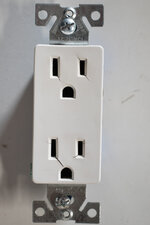
This was the receptacle behind the toaster oven when we went to clean behind the oven today. Scared me to see this and I was thinking that with cracks there would be scorch or similar signs of heat discoloration. The wires in the box felt a bit tacky but the insulator appeared fine, no signs of high heat or arcing. The back of the receptacle clean. The contractor had back stabbed this one and it is about 14 years old. The lower one is the one in use so why the top cracked is also? Cut back about 3/4" and used the screw terminals this time.

What is your diagnosis on what happened?
 

Attachments

  • receptacle-April 12, 2022-5647.jpg
    receptacle-April 12, 2022-5647.jpg
    104.3 KB · Views: 149
To avoid these ads, REGISTER NOW!
OP
K

Kuma601

Well-known member
Joined
Dec 24, 2020
Messages
960
Location
Cali
Thanks! That receptacle has the 1800 watt toaster oven attached to it. The receptacle was part of a bulk contractor pack from Cooper Electric when the kitchen was done. There were some left over from the remodel so it was replaced with a fresh one. She does use it for some baking so the oven is going at 30+ minute intervals at times. A GFCI or GFCI/AFCI version will be swapped in soon. I didn't want that one there in that type of condition.

These budget parts can be scary. Seeing it like that was :cautious:
 

Shiftless

Well-known member
Joined
Mar 9, 2014
Messages
14,579
Location
East Bay SFO
At the very least, if you MUST use that kind of receptacle rather than buying a better one, is to NOT use the back stab connections but instead use the normal, “wrap the wire around the screw and tighten it up“ method of connecting to your house wiring.
Don’t all the of back stab connector receptacles also have screws on the side?
 

quickfarms

Well-known member
Joined
Feb 14, 2021
Messages
1,027
Location
Southern California
There are two types of back stab connectors

the cheap ones use a spring to retain the wire and belong in the trash

the good ones clamp the wire between a washer under the screw and a metal plate and this attachment is better than just the screw
 

wyliesdiesels

Well-known member
Joined
Aug 14, 2012
Messages
20,067
Location
Modesto, CA
There are two types of back stab connectors

the cheap ones use a spring to retain the wire and belong in the trash

the good ones clamp the wire between a washer under the screw and a metal plate and this attachment is better than just the screw
incorrect. those receptacles types are not the cheapo "push-wire" terminals aka back-stabbed type, they are called "back-wire" and are very expensive (~$5ea @ home depot).

the spec-grade receptacles that are cheaper than the back-wired ones, also dont have the "push-wire" terminals and are called "side-wired". they have a plate underneath the screw that allows one to simply insert the wire under the plate and tighten the screw. this is different than the back-wired ones in that the screw doesnt **** the plate into the wire inside the wire hole, it just pushes the plate down onto the wire.
 

Norcal

Well-known member
Joined
Mar 16, 2008
Messages
13,769
Back in the 60's & 70's, there were back wire only receptacles, some accepted 8 conductors, 4-hots, 4-neutrals, they had a little more robust brass tabs that captured the conductors then today's push and pray models, still can't beat pressure plates for terminating receptacles for quality, and people can whine and snivel, flop themselves on the floor pounding their fists & kicking their legs in a tantrum, you buy a tract home or cheap spec home, still going to get cheap back stabbed devices, it's the nature of the beast, if it lasts beyond the warranty period, it did good & most do, it's a get it done cheap & quick then be gone thing.
 
To avoid these ads, REGISTER NOW!

Showkey

"MEMBER EMERITUS"
Joined
Aug 9, 2014
Messages
8,638
Location
Wausau WI
Cracked front and back stab wire connection are two completely different issues/problem.*

Pull or load the plug sideways often enough or with excessive torque the very best outlet will fail/crack the face. 🤔Especially common in hallways where the vacuum might be plugged in. 🤔

*Yes, low cost, poor quality outlets often more than one problem.
 

cybrdyke

Well-known member
Joined
Sep 9, 2014
Messages
3,449
Location
USA
Plugs pulled from the side...I'm guilty of pulling on the vacuum cleaner cord to unplug it.
Pushing things into the receptacle while there's a plug in it...happens when moving furniture, etc.
Using a commercial grade receptacle that's got a "too tight" grip...some folks have to wiggle the cord to get it to unplug.
Also, some receptacle faces and wall plates are made from nylon. Nylon dries out over time (ever seen a zip tie that's 20 years old?), making it easy to crack.
CD
 

tipsy

Well-known member
Joined
Jul 16, 2014
Messages
337
Location
Speedwell, Tennessee
Also possible that being so close to the toaster oven will heat the plastic. Enough cycles of that over the years and the plastic is gonna be brittle.
 

mike93lx

ALLIANCE MEMBER
Joined
Dec 9, 2013
Messages
37,859
Location
Richmond, VA
Also possible that being so close to the toaster oven will heat the plastic. Enough cycles of that over the years and the plastic is gonna be brittle.
If the receptacle is getting that hot, your cabinet above would be on fire
 

wyliesdiesels

Well-known member
Joined
Aug 14, 2012
Messages
20,067
Location
Modesto, CA
Also possible that being so close to the toaster oven will heat the plastic. Enough cycles of that over the years and the plastic is gonna be brittle.
Ive got outlets that are within inches of a very hot toaster oven and they dont exabit this behavior. something else is up
 
OP
K

Kuma601

Well-known member
Joined
Dec 24, 2020
Messages
960
Location
Cali
What I'm going to do next time she fires the toaster oven up for some baking is take a temp reading of the receptacle after she's pulled the goodies out. My suspicion is that the prior toaster oven was the initial cause. It may have generated enough heat but not an excessive amount that would bring on a melt-burn scenario. Enough cycles and it could be a contributing factor accelerating the plastic to dry-crack like that. The examples I see online show burnt receptacles with cracks. This receptacle pictured was 14 years old. The house has some originals dating back to the build in '68.

The remodel box looks as if it were new. The wall cover plate is clean as well.

Appreciate the insights.
 

engineer2

Well-known member
Joined
Dec 13, 2009
Messages
11,824
Location
Chicago burbs
If it says "Made in China" on it, you've identified the problem.
For as cheap as they are, get a news one and inspect all the others that might be the same kind.
 

jagwinn

Well-known member
Joined
Apr 10, 2013
Messages
487
Location
Virden, Illinois
Astronaut John Glenn is supposed to have said: "My life depended on 150,000 pieces of equipment - each bought from the lowest bidder."
 

Miss the Pontiacs

Well-known member
Joined
Nov 7, 2016
Messages
16,520
Location
Saskatchewan Canada
I thought I seen Eagle on the metal. I looked on the net, I did find Cooper Eagle mentioned. Possibly their low end receptacle. I would redo the back stab on screw terminal replace at least replace the damaged ones.
 

dogdog

Well-known member
Joined
Nov 15, 2011
Messages
12,711
Thanks! That receptacle has the 1800 watt toaster oven attached to it. The receptacle was part of a bulk contractor pack from Cooper Electric when the kitchen was done. There were some left over from the remodel so it was replaced with a fresh one. She does use it for some baking so the oven is going at 30+ minute intervals at times. A GFCI or GFCI/AFCI version will be swapped in soon. I didn't want that one there in that type of condition.

These budget parts can be scary. Seeing it like that was :cautious:
Buy the commercial version of that for 50% more worth the price. Contractors will use the cheapest grade they can buy bulk price.
 
OP
K

Kuma601

Well-known member
Joined
Dec 24, 2020
Messages
960
Location
Cali
She did roasting session so took the IR to see what and where heat is venting on this particular oven. The oven has a partial vent on the right rear which is just offset from the receptacle by a couple inches. Took the IR across the back wall to see what readings came up when the elements are drawing power/glowing. From left to right it was 101F-117F. The receptacle measure at 117F. Pulled the oven forward to give it more airspace and it dropped to 110F.

I'll update to a better receptacle. (y)
 
To avoid these ads, REGISTER NOW!
Top Bottom