To avoid these ads, REGISTER NOW!

Recommend a 12" combination square

pendragon1998

Well-known member
Joined
Mar 24, 2012
Messages
3,733
Location
NE Georgia
A combination square for woodwork strikes me as the wrong tool for the job. It can work, but wouldn't offer any advantages over more traditional woodworking or carpentry layout tools as far as I can see. An Empire, Stanley, or Johnson can always be checked for squareness before purchase easily enough and are inexpensive if one was really intent on going with that style of tool.


Psul Sellers disagrees with you.
 
To avoid these ads, REGISTER NOW!

Gizmosity

Well-known member
Joined
Jun 17, 2014
Messages
377
Location
SW Wisconsin
My Starrett combination square is getting difficult to read with my old eyes...(I am the third generation in my family to own it). So I recently picked up an Empire combination square at HD. When I got it home, I could not measure a difference in accuracy between the two.
I was pleasantly surprised.


:willy_nil
 

Wamsutta

Well-known member
Joined
Jan 8, 2014
Messages
10,883
Location
Amarillo, Texas
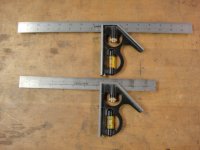
combosq4piece.jpg
 

derosa

Well-known member
Joined
Oct 19, 2010
Messages
1,078
Location
Oceanside, NY
Combination squares can be slightly adjusted with a file, I've never splurged on a starret, would lime to though. But put a straight edge on a board, I used plywood the last time, runs line then flip the square over and run a line, any gap is how far its out use the file to lightly shave down the groove the ruler runs in and repeat the test. Took maybe 20 min to get a craftsman one dead on. Worth the little time if used for precision.

A combination square for woodwork strikes me as the wrong tool for the job. It can work, but wouldn't offer any advantages over more traditional woodworking or carpentry layout tools as far as I can see. An Empire, Stanley, or Johnson can always be checked for squareness before purchase easily enough and are inexpensive if one was really intent on going with that style of tool.
I think the quote below answers your question beautifully. I have 3 12" and 2 4" in my wood shop, also have a pair of regular squares that I virtually never use. Combination squares just work better for the smaller work I do and even for the trim I've been doing.
I use my 4" Swanson square a lot more often than my 12" Contractor Grade Stanley. Highly recommend the Swanson for the price; I also have a POS 4" Empire Square that won't lock; bought the Swanson to replace it.

Some of the things I use my combination square for:

Marking screw hole distances/lines from the edge of a board.

Marking and measuring for depth of cut on the table saw.

Marking miters on rough 2x stock, it's easy to miss the length when you're marking something with rounded edges.

Anything I feel needs to be more marked more accurately than with a coarsely graduated speedsquare.

Measuring small parts where a tape measure is too cumbersome.

Finding centers for turning on the lathe.

Squaring up small assemblies.

With the head removed, it's a great layout ruler.

Checking for accuracy of cuts on the table saw (right angle and square)

As a precision straightedge (look for light between the blade and the object being checked.)

Measuring thickness of steel angle, plate, etc.

If I don't keep them out of sight my wife would be opening and stirring paint cans with them... so I leave the old beater Empire rules hanging above the bench and keep the good ones in my toolbox. ;)
 

jeeper46

Well-known member
Joined
Dec 6, 2016
Messages
479
Location
Canton, Mi
I have a nice Starrett set from my days as a Diemaker, but I like good old Machinist combination squares, so I have a number of them around-Lufkins, mainly, plus a couple of good quality Craftsman ones-I find them cheap at swap meets and yard sales. There's always one hanging on my miter saw table-I don't see anything wrong with using a precision square to mark a 2x4. My vote is to find a quality used one on ebay, vs. buying a new one at the big box store.
 

Two Speed

Well-known member
Joined
Sep 20, 2014
Messages
1,283
Location
Ontario Canada
Long version: A while back I found that my Stanley 12" combination square was not, well, square. I thought I was just cutting inaccurately, but it turned out my lines were off because of the unsquare square. (It took me a stupidly long time to realize this.)

Didja try squaring your square? All it takes is a small file. Take out the straight edge, and look in the base of the gap that the thumbscrew draws the straight edge against, you should see a raised nub on either side, file the appropriate nub a bit and check. Even if you spend one million bucks on a high quality square, you still might need to square the square.


Alex.
 
Last edited:
OP
D

dwasifar

Well-known member
Joined
May 28, 2017
Messages
2,098
Didja try squaring your square? All it takes is a small file. Take out the straight edge, and look in the base of the gap that the thumbscrew draws the straight edge against, you should see a raised nub on either side, file the appropriate nub a bit and check. Even if you spend one million bucks on a high quality square, you still might need to square the square.


Alex.

At the time, I did not know you could do that. I do now, but I'm not sure this one was within fixable range. As I recall, drawing a line across a 1x12, flipping, and drawing another line resulted in two lines that diverged probably 3/16" at the far end.

It's really a mystery to me why I didn't check it earlier. Not one of my more shining moments.
 

tclark

Well-known member
Joined
Feb 23, 2016
Messages
71
Not sure if they have a combination square, but Woodpecker makes some pretty nice woodworking layout tools.
 

dnschmidt

Well-known member
Joined
Oct 3, 2014
Messages
7,285
Location
Phoenix, AZ
When I buy a Recip Saw I buy a Sawsall. When I buy a SDS hammer drill I buy BOSCH, when I buy a combination square it's Starrett. IT'S JUST THE WAY IT IS!
 
OP
D

dwasifar

Well-known member
Joined
May 28, 2017
Messages
2,098
Warning: Long post ahead.

I bought a PEC blem 12" combination square from Taylor Tool, as some of you suggested. It arrived today and it's nice. If there's a blemish, I don't see it. The brand name on the ruler has been obscured but otherwise it looks perfect to me.

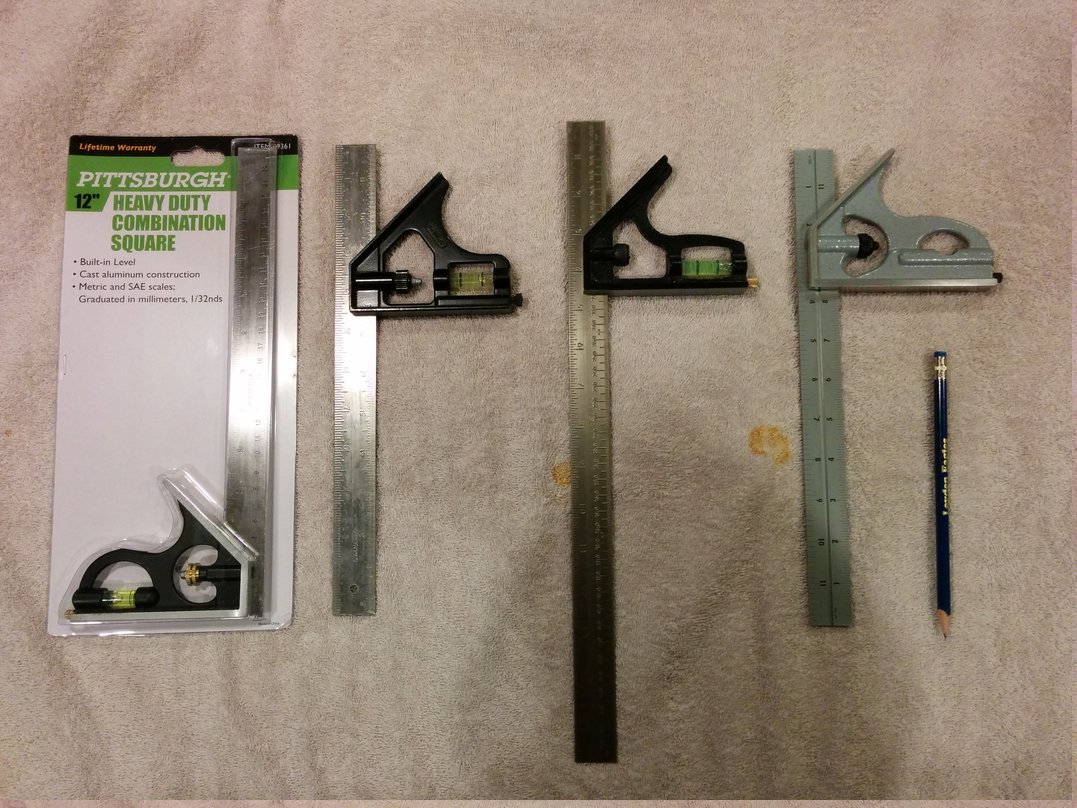
I decided to do a little comparo for the edification and amusement of you, the reader.

Included in this comparison are the new PEC 12"; a Johnson 16"; the Stanley 12" I've been mostly using up until now; and, to represent the bargain bin, a Pittsburgh 12" purchased from Harbor Freight specially for this occasion.

IMG_20170629_211823.jpg

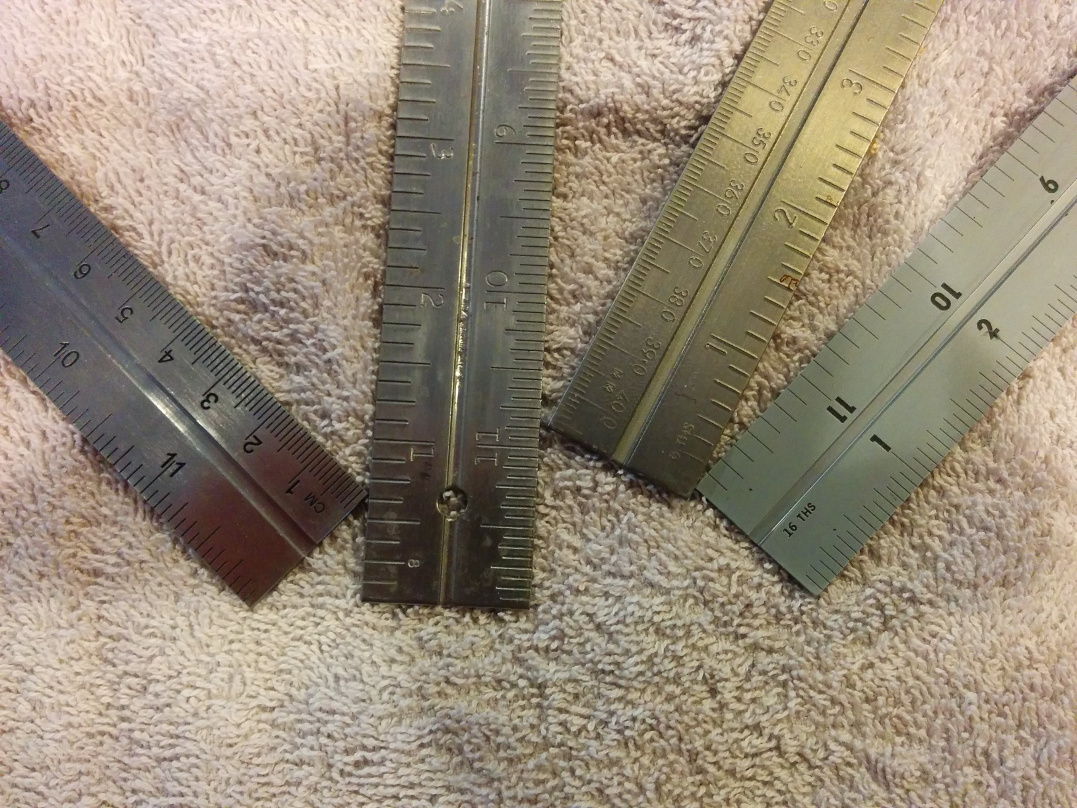
IMG_20170630_064424.jpg


Country of origin:
Pittsburgh: China (duh)
Stanley: Not marked, presumably China
Johnson: USA
PEC: USA

Price:
Pittsburgh: $7
Stanley: $10 (approx.)
Johnson: $17
PEC: $33 (remember it's a blem, though; perfect would be $75)

Weight:
Pittsburgh: 196g
Stanley: 284g
Johnson: 354g (but remember this is a longer one than the others)
PEC: 422g

It's interesting that the PEC is over twice as heavy as the lightweight Pittsburgh. But the PEC has a larger head than all the others, about half an inch longer on the base.

Finish:
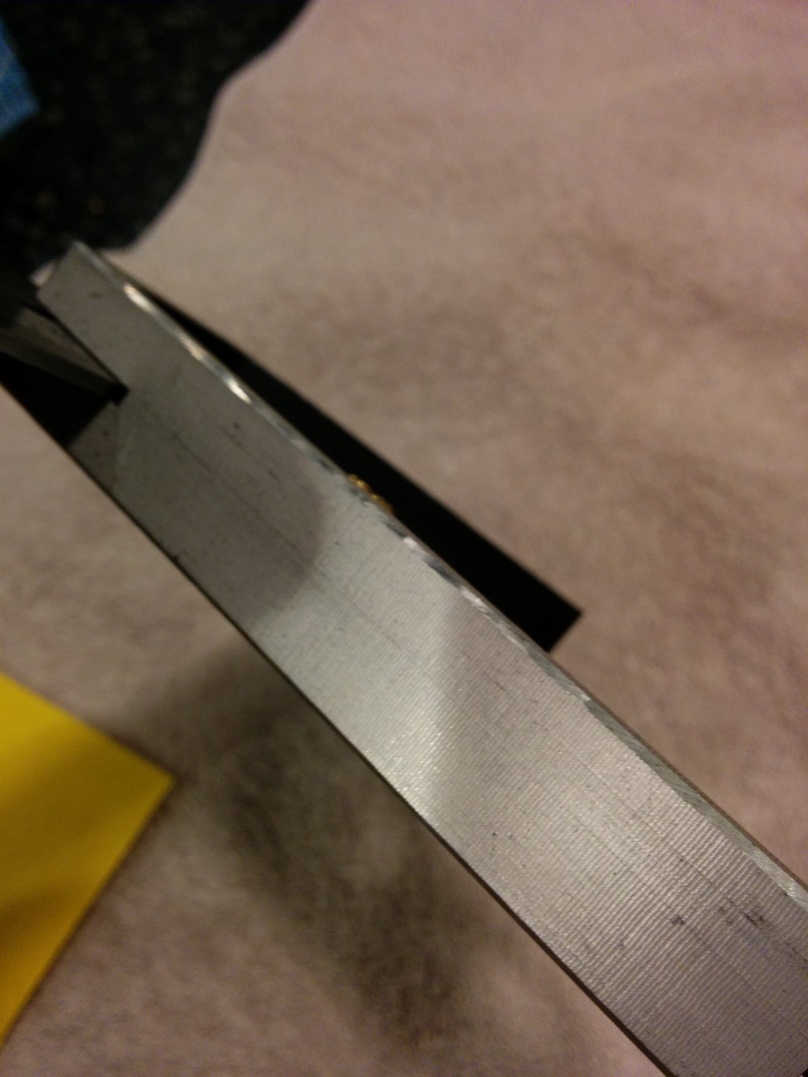
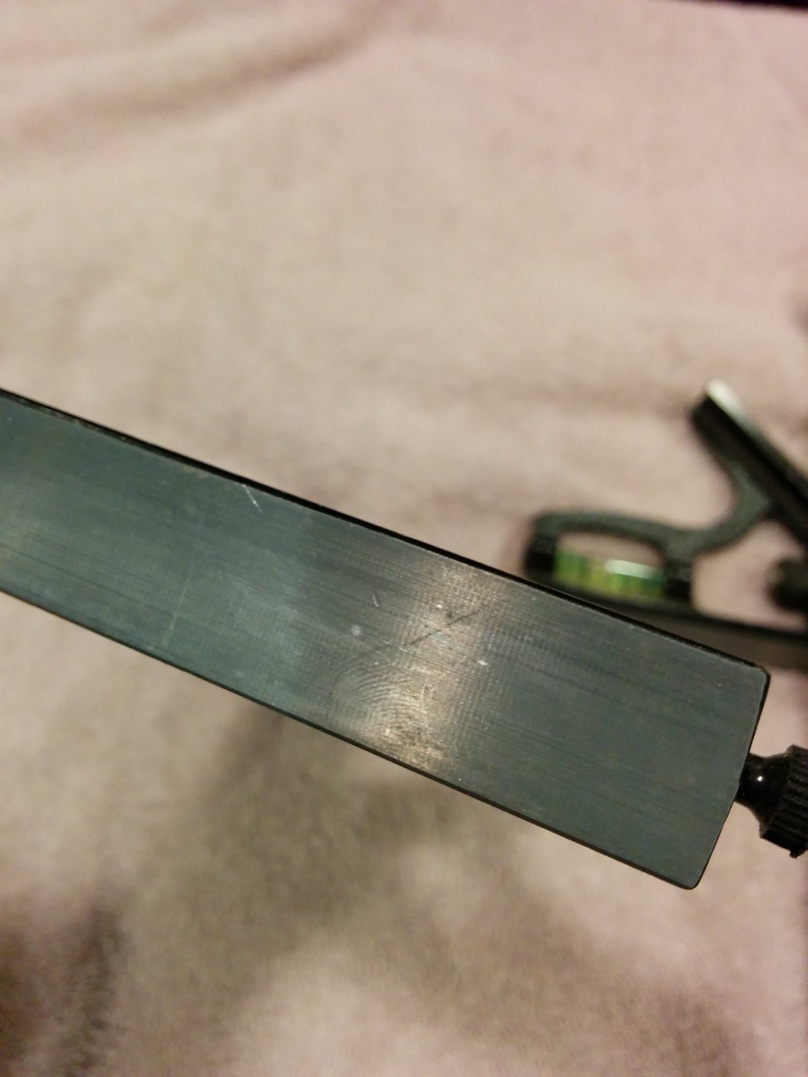
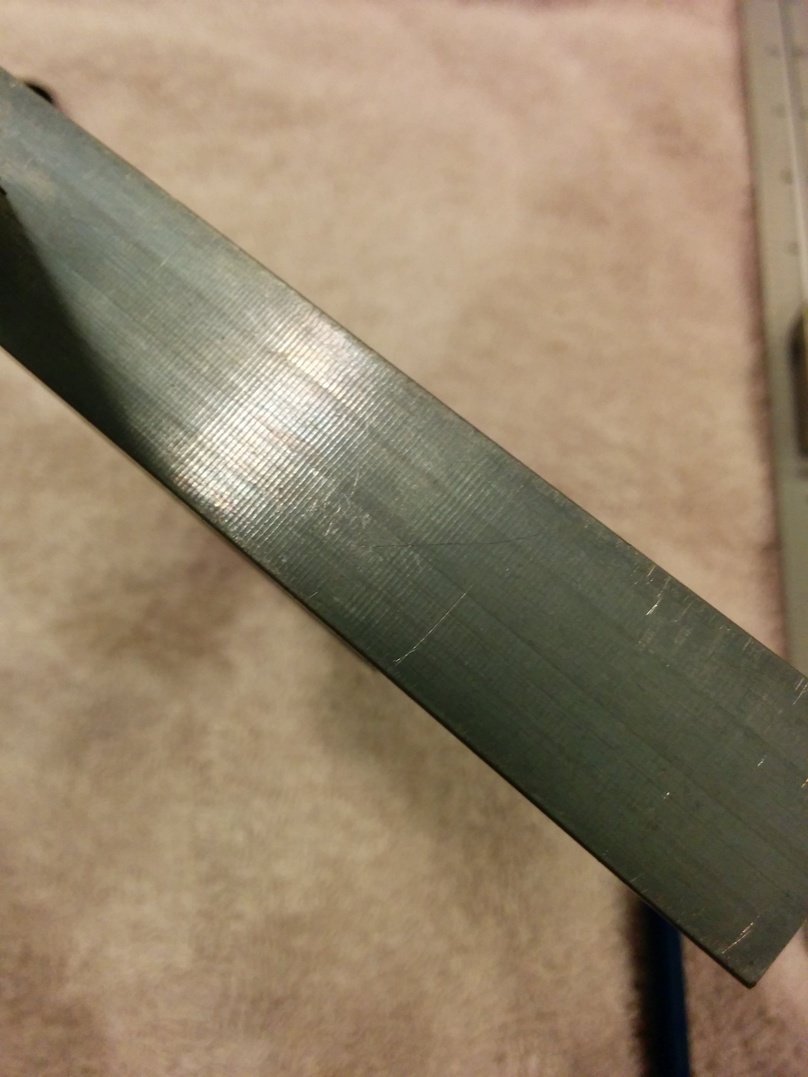
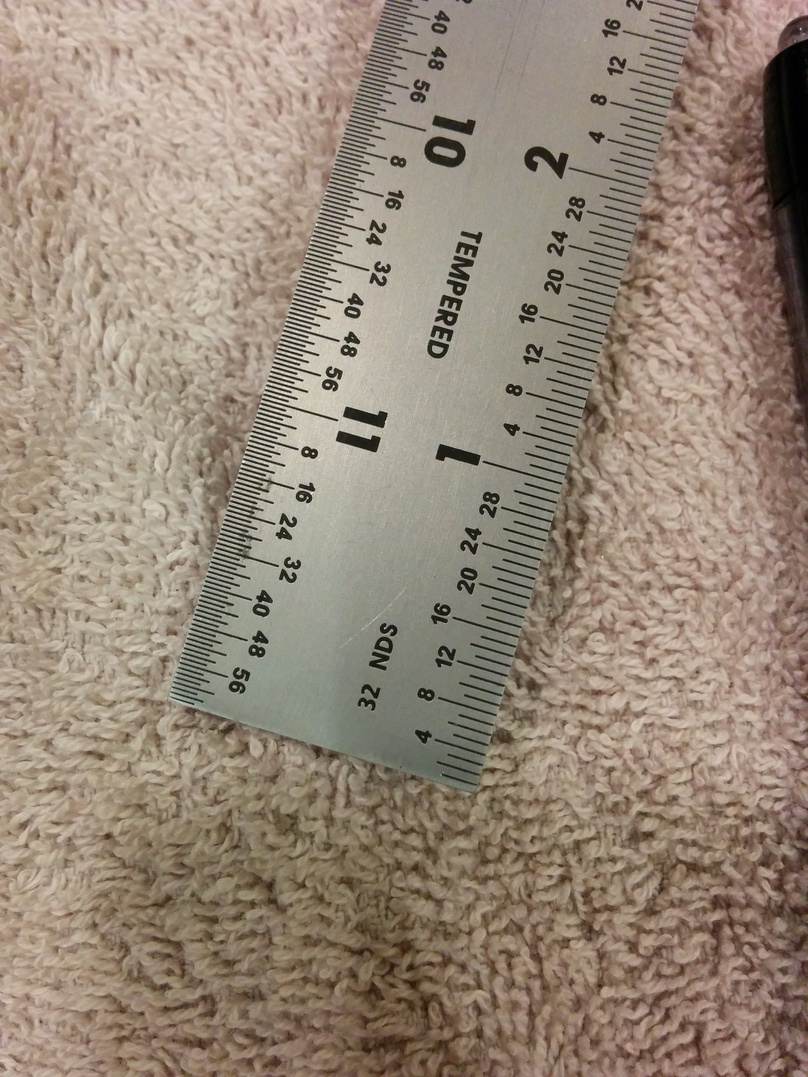
Pittsburgh: Not surprisingly, it's kind of rough. There are mill marks on the base:

IMG_20170629_212649.jpg


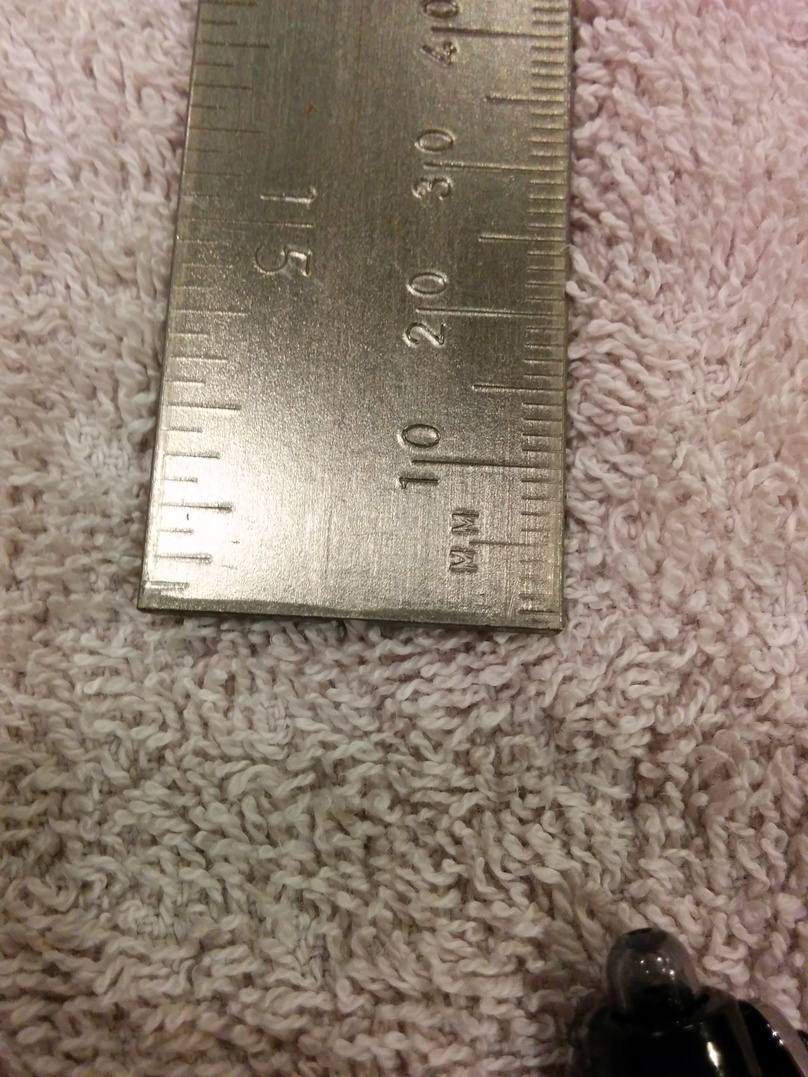
And the ruler has a slightly sloppy end and evidence of clamp damage during manufacturing, about 1/2" from the end and another about 1-1/4" in:

IMG_20170629_212714.jpg


On the plus side, the Pittsburgh has a square groove, like the PEC, and although the milling on that is sort of sloppy at the bottom, it's straight where it counts, and it slides well. Its number stampings are flush and blacked in, making it pretty easy to read. And although the end is a little sloppy, it looks like the first marking on each scale is pretty accurate.

Stanley: The milling is better than the Pittsburgh:

IMG_20170629_212747.jpg


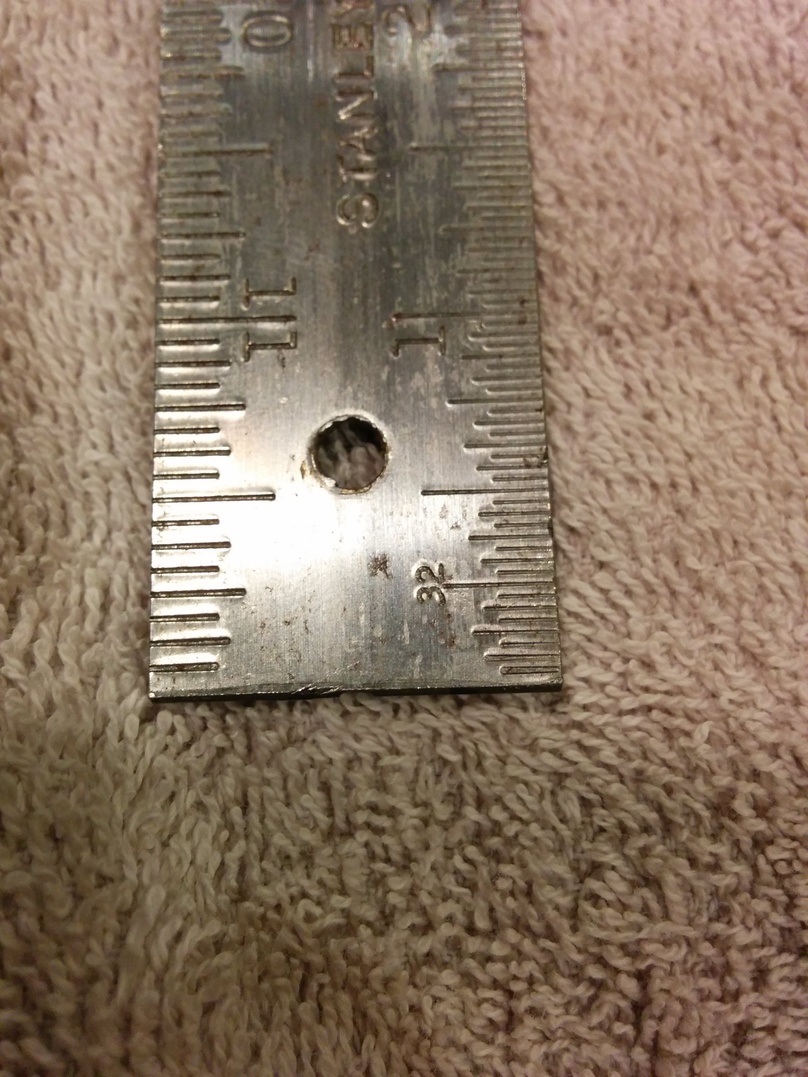
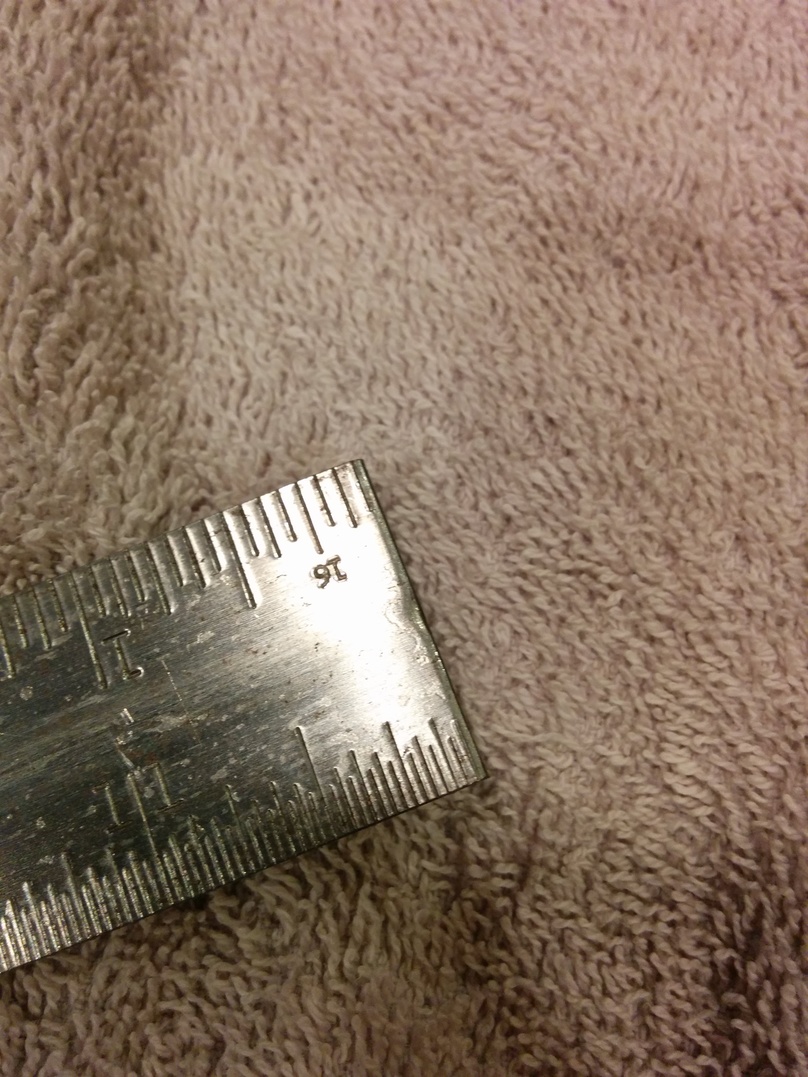
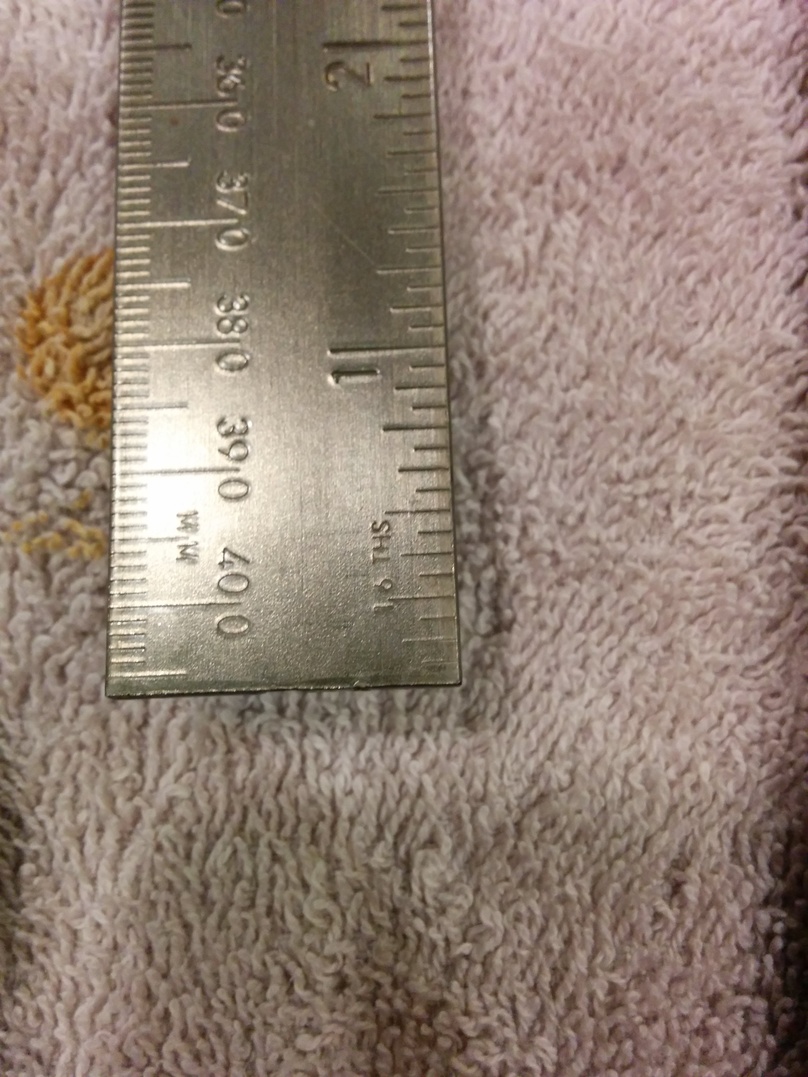
But the ends are sloppily cut and inaccurate:

IMG_20170629_212804.jpg

IMG_20170629_212820.jpg


In that second picture I'd say that's off by at least 1/32". The stamped scale markings are thick and have a lot of flare-up around them, making them difficult to read accurately. It slides easily but sloppily.

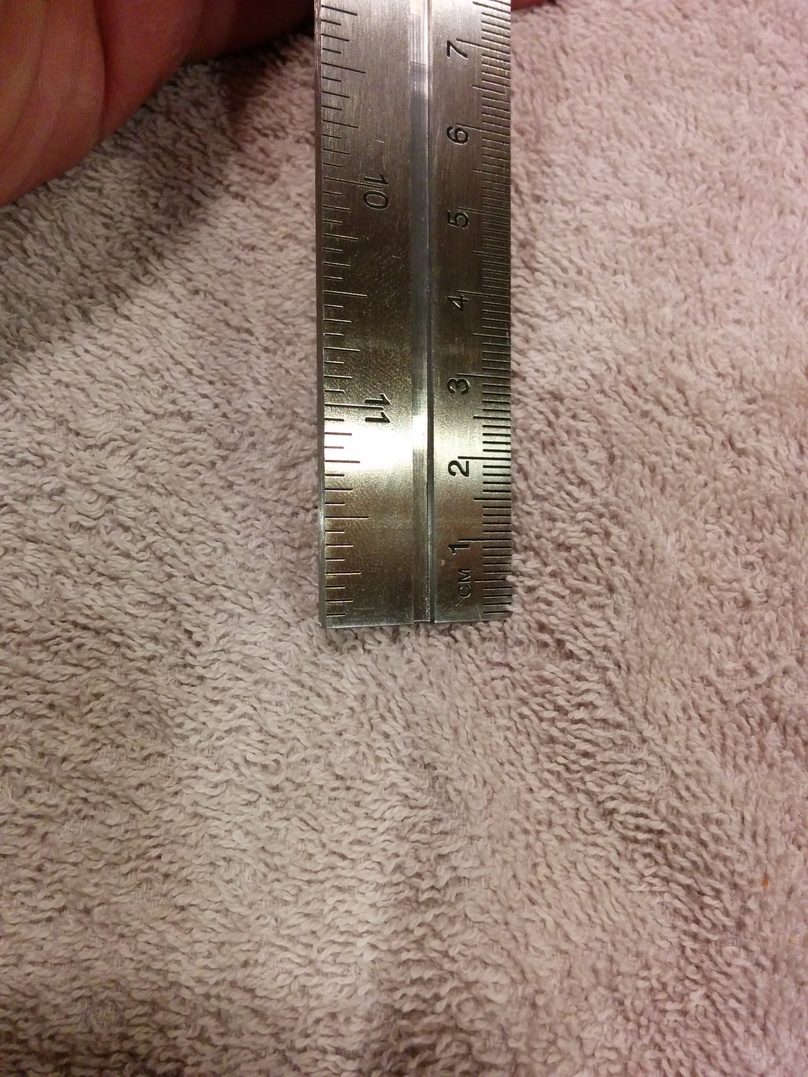
The groove in the Stanley's ruler is smaller and appears stamped rather than milled as the other three:

IMG_20170630_064424-detail.jpg


That rough area at the bottom of the groove is the STANLEY brand stamping pushing through from the reverse side. It doesn't affect function but it seems careless.

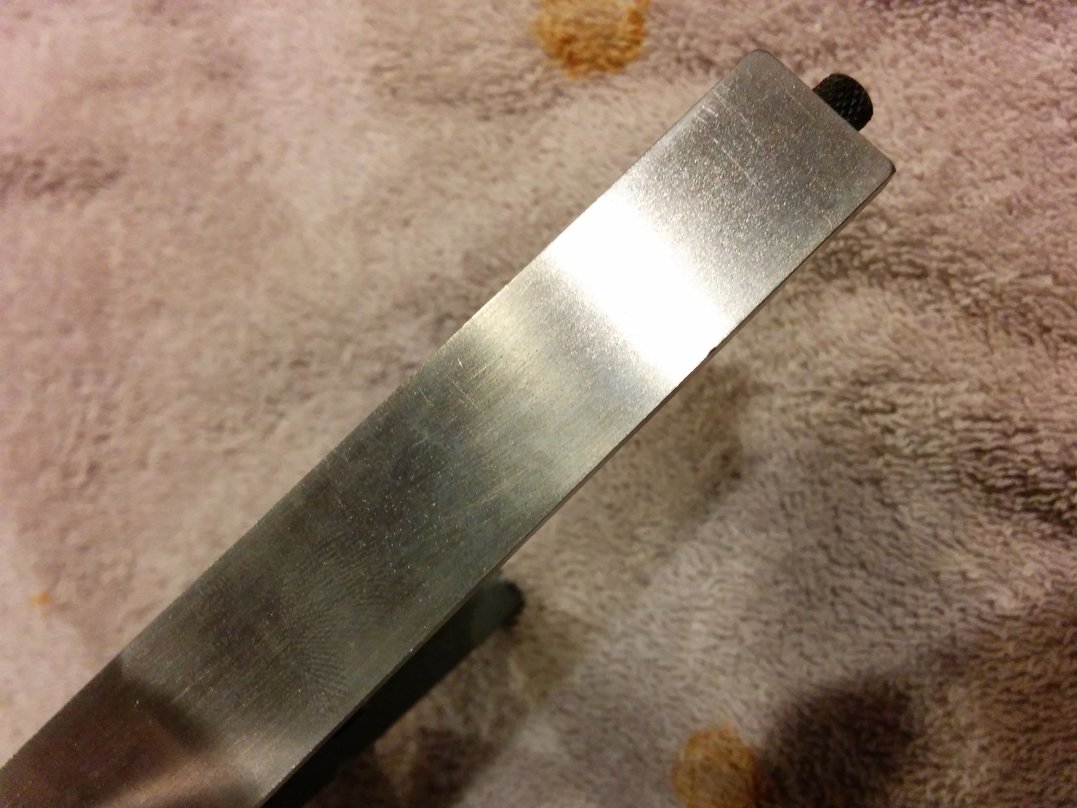
Johnson: Surprisingly the milling looks a lot like the Pittsburgh:

IMG_20170629_212834.jpg


But the ends are better and more accurate than the Stanley:

IMG_20170629_212847.jpg

IMG_20170629_212926.jpg


They look pretty good, but I think the Pittsburgh beats it. Readability has the same problem as the Stanley, but not as pronounced, because the stamped scale has finer lines that don't flare as much. It slides smoothly.

PEC: As expected, this one has the best finish, both on the head and on the rule:

IMG_20170629_214518.jpg

IMG_20170629_213005.jpg


Readability is outstanding, far better than any of the others. The ends are nice and square, no slop at all, and they look accurate to the first marking on each scale. It slides nicely and feels good, but surprisingly it takes more force on the adjustment knob to secure the head, and correspondingly more force to loosen it.

Levels:
None of the levels are really great. Of the four, the most accurate was the Pittsburgh. The Stanley leans inward, the Johnson leans outward, and the PEC leans outward just a tiny fraction. The PEC is the least visible. I suppose that means it's the most protected, but it's so small as to be mostly unusable. Fortunately I rarely ever need it.

Squareness:
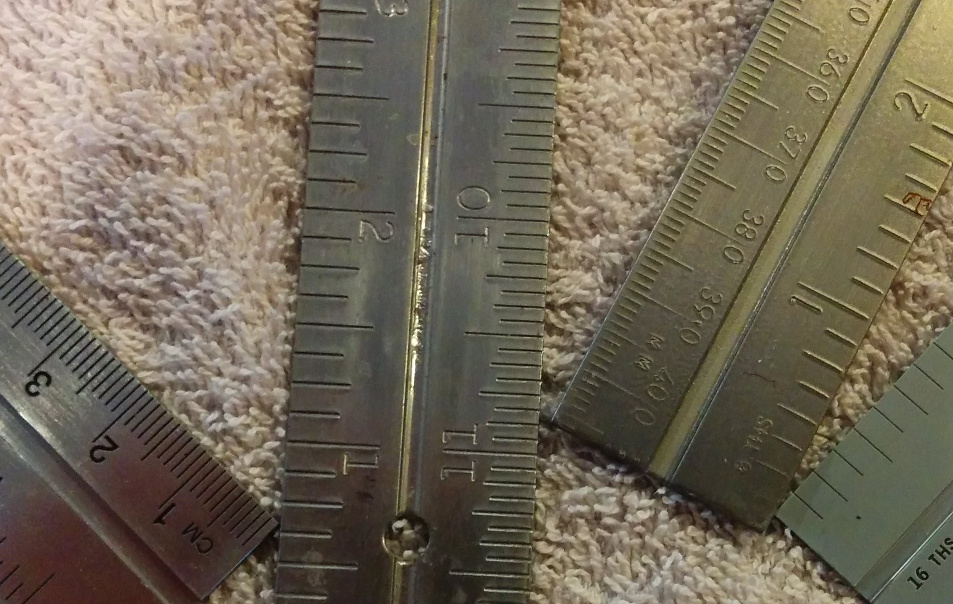
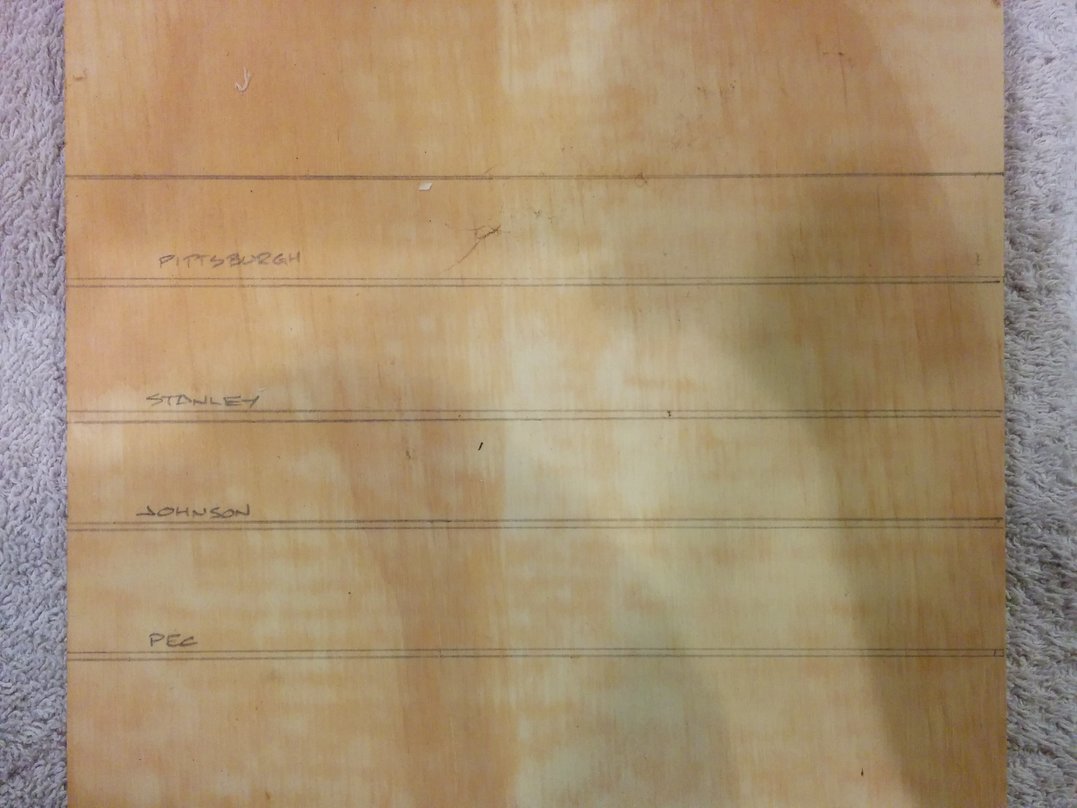
The picture tells the story:

IMG_20170629_214050.jpg


Of the four, the Stanley was the least square, followed by the Pittsburgh and Johnson (pretty similar), and then the PEC which was pretty much zeroed in.

My conclusion: Obviously the PEC is the winner. It's clearly a pro tool on a different level than the others. But of the others, I'd have a hard time choosing between the Johnson and the Pittsburgh. The Johnson feels more substantial and slides a bit more smoothly, but the Pittsburgh is more readable and has more accurately machined ruler ends.

The Stanley is going bye-bye. It doesn't win in any category. It's the unsquarest, has the sloppiest ruler, and is the hardest to read. The Pittsburgh beats it handily, and that's pretty pathetic when you consider that the Pittsburgh only cost $7.

Did I miss anything?
 

ptgarcia

Well-known member
Joined
Nov 15, 2016
Messages
1,202
Location
Alta Loma, CA
Nice right up!

For anyone looking, Harry J Epstein's also sells the blemished PEC squares. They appear to all be cast iron sets, though, didn't see any with hardened part numbers.
 

FMC1959

Well-known member
Joined
Feb 9, 2014
Messages
2,319
Location
Montreal, Canada / Upstate NY
Warning: Long post ahead.

I bought a PEC blem 12" combination square from Taylor Tool, as some of you suggested. It arrived today and it's nice. If there's a blemish, I don't see it. The brand name on the ruler has been obscured but otherwise it looks perfect to me.

I decided to do a little comparo for the edification and amusement of you, the reader.

Included in this comparison are the new PEC 12"; a Johnson 16"; the Stanley 12" I've been mostly using up until now; and, to represent the bargain bin, a Pittsburgh 12" purchased from Harbor Freight specially for this occasion.

IMG_20170629_211823.jpg

IMG_20170630_064424.jpg


Country of origin:
Pittsburgh: China (duh)
Stanley: Not marked, presumably China
Johnson: USA
PEC: USA

Price:
Pittsburgh: $7
Stanley: $10 (approx.)
Johnson: $17
PEC: $33 (remember it's a blem, though; perfect would be $75)

Weight:
Pittsburgh: 196g
Stanley: 284g
Johnson: 354g (but remember this is a longer one than the others)
PEC: 422g

It's interesting that the PEC is over twice as heavy as the lightweight Pittsburgh. But the PEC has a larger head than all the others, about half an inch longer on the base.

Finish:
Pittsburgh: Not surprisingly, it's kind of rough. There are mill marks on the base:

IMG_20170629_212649.jpg


And the ruler has a slightly sloppy end and evidence of clamp damage during manufacturing, about 1/2" from the end and another about 1-1/4" in:

IMG_20170629_212714.jpg


On the plus side, the Pittsburgh has a square groove, like the PEC, and although the milling on that is sort of sloppy at the bottom, it's straight where it counts, and it slides well. Its number stampings are flush and blacked in, making it pretty easy to read. And although the end is a little sloppy, it looks like the first marking on each scale is pretty accurate.

Stanley: The milling is better than the Pittsburgh:

IMG_20170629_212747.jpg


But the ends are sloppily cut and inaccurate:

IMG_20170629_212804.jpg

IMG_20170629_212820.jpg


In that second picture I'd say that's off by at least 1/32". The stamped scale markings are thick and have a lot of flare-up around them, making them difficult to read accurately. It slides easily but sloppily.

The groove in the Stanley's ruler is smaller and appears stamped rather than milled as the other three:

IMG_20170630_064424-detail.jpg


That rough area at the bottom of the groove is the STANLEY brand stamping pushing through from the reverse side. It doesn't affect function but it seems careless.

Johnson: Surprisingly the milling looks a lot like the Pittsburgh:

IMG_20170629_212834.jpg


But the ends are better and more accurate than the Stanley:

IMG_20170629_212847.jpg

IMG_20170629_212926.jpg


They look pretty good, but I think the Pittsburgh beats it. Readability has the same problem as the Stanley, but not as pronounced, because the stamped scale has finer lines that don't flare as much. It slides smoothly.

PEC: As expected, this one has the best finish, both on the head and on the rule:

IMG_20170629_214518.jpg

IMG_20170629_213005.jpg


Readability is outstanding, far better than any of the others. The ends are nice and square, no slop at all, and they look accurate to the first marking on each scale. It slides nicely and feels good, but surprisingly it takes more force on the adjustment knob to secure the head, and correspondingly more force to loosen it.

Levels:
None of the levels are really great. Of the four, the most accurate was the Pittsburgh. The Stanley leans inward, the Johnson leans outward, and the PEC leans outward just a tiny fraction. The PEC is the least visible. I suppose that means it's the most protected, but it's so small as to be mostly unusable. Fortunately I rarely ever need it.

Squareness:
The picture tells the story:

IMG_20170629_214050.jpg


Of the four, the Stanley was the least square, followed by the Pittsburgh and Johnson (pretty similar), and then the PEC which was pretty much zeroed in.

My conclusion: Obviously the PEC is the winner. It's clearly a pro tool on a different level than the others. But of the others, I'd have a hard time choosing between the Johnson and the Pittsburgh. The Johnson feels more substantial and slides a bit more smoothly, but the Pittsburgh is more readable and has more accurately machined ruler ends.

The Stanley is going bye-bye. It doesn't win in any category. It's the unsquarest, has the sloppiest ruler, and is the hardest to read. The Pittsburgh beats it handily, and that's pretty pathetic when you consider that the Pittsburgh only cost $7.

Did I miss anything?

I know I am reviving a year and 1/2 old thread; I thought your test was interesting....BUT, here's my issue. Combination squares, because of the sliding ruler and the tightening nut, can be accurate one time and you change the marking and it can be slightly off. To me, a top notch square needs to have 100% repeat ability.

I know this might seem ****, but your test above would need to be done....e.g....take one, like the Pittsburgh. Set the square flush or at 0 inches and make your parallel lines. Move the ruler to the 2" mark, repeat parallel lines, then 6" and make lines. Then start over and repeat at 0, 2, & 6 inches, then one more time. Once you have collected parallel lines at 3 different marks, and done this 3 times for each marking, ALWAYS changing the position for every set of lines drawn.

Never take it for granted that it was square one time, it will be all of the time. I think this is where a highly crafted, forged steel Starrett and other high end squares would show why they cost so much. And even then, if you by something expensive, check it the first time and test it for consistency. I don't trust quality control, even on high end stuff, so I do my own.

It's not that I am paranoid but a combination square has moving parts and therefore only the highest standards can assure repeated accuracy.
 

MBfreak

MEMBER EMERITUS
Joined
Dec 10, 2010
Messages
2,301
Location
Linkoping , Sweden
Maybe a bot OT but here goes.
At a classic car show here in Sweden 5 years ago there were quite a lot of Russians selling ex Soviet Armed Forces tools.
I picked up a square for around $10 and out of curiosity had a tool room check it. It was as close to perfect as they had ever seen.

Ola
 

Attachments

  • mini-rysk vinkelhake 006.jpg
    mini-rysk vinkelhake 006.jpg
    56.2 KB · Views: 51
  • rysk vinkelhake 001.jpg
    rysk vinkelhake 001.jpg
    151.6 KB · Views: 58

6PTsocket

Well-known member
Joined
Mar 12, 2014
Messages
4,593
If you don't want to spring for a Starrett, which is what I use as my primary square, I really like Products Engineering. They seem to be every bit as good quality as Starrett. Sold as PEC tools.

Look for forged and hardened heads, and satin chrome on the blades.
PEC shows up as a lot of house brands, too. My Lee Valley 4" square is PEC.

Sent from my SM-G900V using Tapatalk
 

tclark

Well-known member
Joined
Feb 23, 2016
Messages
71
Woodpecker makes some nice stuff; not sure if they make a combination square but I know they have a variety of other types
 

Milton Shaw

Well-known member
Joined
Feb 11, 2011
Messages
4,845
For most wood and metal working I use a triangle type square from HD or others. Mark the cut and then use the square as a guide for the saw to help keep it straight. I also use them with a plasma cutter or Milwaukee 8" metal cutoff skill saw. I have combination squares but usually use them just for angles or center finding. Woopdpecker's sells the most accurate triangle square I have ever seen, but they want a ransom for it.
 
To avoid these ads, REGISTER NOW!

6PTsocket

Well-known member
Joined
Mar 12, 2014
Messages
4,593
Woodpecker makes some nice stuff; not sure if they make a combination square but I know they have a variety of other types
For what Woodpecker charges for their pretty red tools, you might as well go straight to Starrett. I did not actually check this one out but I get an email every time Woodpecker comes out with one of their limited addition, expensive tools.

Sent from my SM-G900V using Tapatalk
 

exmaxima1

Well-known member
Joined
Jun 25, 2011
Messages
6,343
Location
Midwest
I have a 50's Brown & Sharpe I use at work, but to be honest I have a hard time reading it at my age. I always wanted a Mitutoyo but never got one. Last year I came across a pair of Craftsman squares that actually look pretty good. Stainless blades, easy to read, and really "square". Not sure if the current ones at Sears are the same, but if they are I recommend them.
 

Attachments

  • sq1.JPG
    sq1.JPG
    135.8 KB · Views: 37
  • sq2.JPG
    sq2.JPG
    137.3 KB · Views: 38
Last edited:

FMC1959

Well-known member
Joined
Feb 9, 2014
Messages
2,319
Location
Montreal, Canada / Upstate NY
I am looking at some squares on eBay, CL and other used seller sites. I can't always trust what the seller states and sometimes, they themselves are not aware.

I am looking for a hardened square vs cast. Sometimes it is marked, but not always. So looking at the 3 pics below, anyone who is an expert, tell me if my estimation is correct

This one looks like it has the wrinkle paint, usually on a cast. (This is the one I am the least sure about cast or hardened)
s-l1600[3].jpg

This one is the one that looks like it is hardened or forged steel.
s-l7600.jpg

This one looks (to me), has to be cast. O forged square would be very difficult to get that intricate pattern. Not that it could not be stamped or embossed, but would add considerable work and price, not necessary for a square. Typically brand new, a forged Starrett 12" would be about $20-$30 more than cast, which sounds about right for the forge work. That pattern would skyrocket the price, so I figure it is cast.
s-l1600.jpg

So what do you guys that may be very familiar either with cast versus hardened square or just metal work in general, are my assesments right, or completely wrong. Hoping to use this info to correctly identify what I am looking for.
 

exmaxima1

Well-known member
Joined
Jun 25, 2011
Messages
6,343
Location
Midwest
I am looking at some squares on eBay, CL and other used seller sites. I can't always trust what the seller states and sometimes, they themselves are not aware.

I am looking for a hardened square vs cast. Sometimes it is marked, but not always. So looking at the 3 pics below, anyone who is an expert, tell me if my estimation is correct

This one looks like it has the wrinkle paint, usually on a cast. (This is the one I am the least sure about cast or hardened)
s-l1600[3].jpg

This one is the one that looks like it is hardened or forged steel.
s-l7600.jpg

This one looks (to me), has to be cast. O forged square would be very difficult to get that intricate pattern. Not that it could not be stamped or embossed, but would add considerable work and price, not necessary for a square. Typically brand new, a forged Starrett 12" would be about $20-$30 more than cast, which sounds about right for the forge work. That pattern would skyrocket the price, so I figure it is cast.
s-l1600.jpg

So what do you guys that may be very familiar either with cast versus hardened square or just metal work in general, are my assesments right, or completely wrong. Hoping to use this info to correctly identify what I am looking for.

I'd take the first one in a heartbeat. It reads "Athol" which AFAIK is Starrett. It has the nicest and most readable scale, and absolutely will be quality. The others have worn or low-contrast scales and will be a pain to see in low light.
 

FMC1959

Well-known member
Joined
Feb 9, 2014
Messages
2,319
Location
Montreal, Canada / Upstate NY
I'd take the first one in a heartbeat. It reads "Athol" which AFAIK is Starrett. It has the nicest and most readable scale, and absolutely will be quality. The others have worn or low-contrast scales and will be a pain to see in low light.

They are all Starrett's and they all have hardened rulers. It is the square in particular which I care about. The best models have hardened or forged steel squares, the others which are also god quality but not as good as the hardened forged steel are cast, which I guess over time will develop some slop or play. I am just trying to figure out by looking at them because the sellers often don't know or don't mention what the square is.

According to the Starrett site, current models have gloss/smooth paint for the hardened and wrinkle for the cast.
http://www.starrett.com/category/pr...isplayMode=grid&itemsPerPage=12&sortBy=wp/asc

The older models may have had different characteristics, like the first pic that has the stamped décor pattern on the square. I am trying to see if someone knows about these and can figure if they are cast or hardened.
 

Tinner

Well-known member
Joined
Aug 31, 2013
Messages
1,101
Location
N.E. Wisconsin
As far as I know, Starrett is the only US manufacturer that makes or has made a forged steel square and they are all smooth finish. The ones in your photos are all cast. The forged heads are much thinner and lighter. Blow up the photos on the Starrett website and you should be able to see the difference.

There are some hardened cast iron squares, but they aren't as hard as a Starrett forged.
 

ttpete

Well-known member
Joined
Mar 8, 2011
Messages
6,737
Location
Dearborn, MI
As far as I know, Starrett is the only US manufacturer that makes or has made a forged steel square and they are all smooth finish. The ones in your photos are all cast. The forged heads are much thinner and lighter. Blow up the photos on the Starrett website and you should be able to see the difference.

There are some hardened cast iron squares, but they aren't as hard as a Starrett forged.

I have 3 square sets. There are 2 Starrett and 1 B&S. All are forged and the B&S is so marked.

I have 2 styles of Starrett protractor heads. One is single-sided and the other is double-sided.
 

FMC1959

Well-known member
Joined
Feb 9, 2014
Messages
2,319
Location
Montreal, Canada / Upstate NY
I have 3 square sets. There are 2 Starrett and 1 B&S. All are forged and the B&S is so marked.

I have 2 styles of Starrett protractor heads. One is single-sided and the other is double-sided.

Does the B&S say "hardened" on it or "forged", if it is hardened, maybe it is hardened cast TINNER was mentioning?

The protractors, double sided meaning it has markings to read on both sides?

I believe even the line centers and protractors come in cast or forged (by Starrett)
 

Tinner

Well-known member
Joined
Aug 31, 2013
Messages
1,101
Location
N.E. Wisconsin
Does the B&S say "hardened" on it or "forged", if it is hardened, maybe it is hardened cast TINNER was mentioning?

The protractors, double sided meaning it has markings to read on both sides?

I believe even the line centers and protractors come in cast or forged (by Starrett)

B&S for a long time, marked their square heads "hardened" and they were cast. They are still hardened cast, but no longer stamped. Looking around last night I saw a couple old ones that looked possibly forged, but the pics weren't very good. I bought a B&S around 1990, got the part number out of their full line catalog and they didb't show any forged, so if they made them, it must be older than that. B&S has changed and dropped a lot of tools since then.

Some protractors will swing all the way on either side of 90 degrees, some don't.

Starrett square and center heads come either cast or forged, but protractors are all cast. They do come in smooth or wrinkle finish to make sets match.
 

tclark

Well-known member
Joined
Feb 23, 2016
Messages
71
For what Woodpecker charges for their pretty red tools, you might as well go straight to Starrett. I did not actually check this one out but I get an email every time Woodpecker comes out with one of their limited addition, expensive tools.

Sent from my SM-G900V using Tapatalk

They're pricy because they're good quality tools. I've only seen a few of their things in person but they were top-notch quality.
 

exmaxima1

Well-known member
Joined
Jun 25, 2011
Messages
6,343
Location
Midwest
They're pricy because they're good quality tools. I've only seen a few of their things in person but they were top-notch quality.

They are beautiful tools. Their router lifts are a work of art.
 

Attachments

  • wood1.JPG
    wood1.JPG
    137.5 KB · Views: 21
  • wood2.JPG
    wood2.JPG
    143.4 KB · Views: 24

FMC1959

Well-known member
Joined
Feb 9, 2014
Messages
2,319
Location
Montreal, Canada / Upstate NY
B&S for a long time, marked their square heads "hardened" and they were cast. They are still hardened cast, but no longer stamped. Looking around last night I saw a couple old ones that looked possibly forged, but the pics weren't very good. I bought a B&S around 1990, got the part number out of their full line catalog and they didb't show any forged, so if they made them, it must be older than that. B&S has changed and dropped a lot of tools since then.

Some protractors will swing all the way on either side of 90 degrees, some don't.

Starrett square and center heads come either cast or forged, but protractors are all cast. They do come in smooth or wrinkle finish to make sets match.

Tinner, you are exactly the person I was hoping to hear from, you sound like you know your combination squares. All good information above.

How about Lufkin, I have seen some that say hardened; they are also cast or could they be forged?

The second one may have a starrett rule, but that heart shape around the locking nut is a dead giveaway of a Millers Falls or Goodell Pratt product.

More good info....I think some sellers might know but hope to get a sale because buyers may not know about these differences. But I think that also there are many sellers that sell so many things, they themselves do not know all the small details or have expertise on everything they sell. As a buyer, I like to know what I am buying before I hand over the money, especially if you are paying a premium but in the end getting something mediocre.

****
Sorry to the OP if I sort of highjacked his thread, but it was over a year and a half since anyone had posted :dunno:
 

Tinner

Well-known member
Joined
Aug 31, 2013
Messages
1,101
Location
N.E. Wisconsin
Tinner, you are exactly the person I was hoping to hear from, you sound like you know your combination squares. All good information above.

How about Lufkin, I have seen some that say hardened; they are also cast or could they be forged?

Glad I could help. I know this stuff because I'm old and have been a tradesman all my life. :) I buy a lot of quality squares on ebay and sell them at work.

Lufkin is really before my time, I got into the trade in 1975. Lufkin sold their precision tools line around 1969, so I saw plenty of it in my early years, but it became more scarce with the passage of time. Don't really know a lot about it, but it was good quality.

I really only deal with Starrett, Mitutoyo, B&S, PEC and their rebrands which include: Mututoyo(USA) General, SPI(USA) and a couple others I can't remember.

I don't mess with the Lufkin, Miller's Falls, Union Tool or other defunct brands.

Currently the only US made quality combination squares are Starrett, B&S and PEC. The rules will interchange, but the clamp screws do not. A worn or damaged clamp screw is more often than not the cause of a combination square being out of square. That can be a real issue with any square that's out of production. Sometimes something can be made to work, sometimes not.
 

tarbellb

Well-known member
Joined
Apr 17, 2011
Messages
5,767
Location
Oregon
I know I am reviving a year and 1/2 old thread; I thought your test was interesting....BUT, here's my issue. Combination squares, because of the sliding ruler and the tightening nut, can be accurate one time and you change the marking and it can be slightly off. To me, a top notch square needs to have 100% repeat ability.

I know this might seem ****, but your test above would need to be done....e.g....take one, like the Pittsburgh. Set the square flush or at 0 inches and make your parallel lines. Move the ruler to the 2" mark, repeat parallel lines, then 6" and make lines. Then start over and repeat at 0, 2, & 6 inches, then one more time. Once you have collected parallel lines at 3 different marks, and done this 3 times for each marking, ALWAYS changing the position for every set of lines drawn.

Never take it for granted that it was square one time, it will be all of the time. I think this is where a highly crafted, forged steel Starrett and other high end squares would show why they cost so much. And even then, if you by something expensive, check it the first time and test it for consistency. I don't trust quality control, even on high end stuff, so I do my own.

It's not that I am paranoid but a combination square has moving parts and therefore only the highest standards can assure repeated accuracy.

I dont believe this is true.

The groove is pulled by the knurled catch/nut and in return pulled against the inside machined mating surface of the square, creating the 90º action.

So unless something goes terribly wrong INSIDE the mating surfaces of the square, then the repeatability of the tool should not be affected.

If looking for more accuracy than that, used a static square. These are still considered rough measurement tools.
 

FMC1959

Well-known member
Joined
Feb 9, 2014
Messages
2,319
Location
Montreal, Canada / Upstate NY
I dont believe this is true.

The groove is pulled by the knurled catch/nut and in return pulled against the inside machined mating surface of the square, creating the 90º action.

So unless something goes terribly wrong INSIDE the mating surfaces of the square, then the repeatability of the tool should not be affected.

If looking for more accuracy than that, used a static square. These are still considered rough measurement tools.

This may be true on higher end, good to top quality combo squares. But I had a cheap Irwin or Stanley years ago and when I would move the ruler and re-tighten, the angle was not always square.

Furthermore, even the better ones, it is a machined mating surface that encounters movement. In the hands of someone who uses it multiple times daily, years down the road, it can result in minor usage of the surface and enough play to not guarantee perfect square. This being important when buying used.

And my other point to this was that even when new, there could be a defect at the outset, which should get caught by quality control, but in this day and age, I have seen mistakes slip through the cracks with brands that are considered the best (Ask Festool users about their Kapex saws).

So what you are saying should be true; I am saying is do not take it for granted that it is.

You last point is kind of where I was going with my whole discussion. A combo square can never be as micro accurate as a machined tri-square used by a machinist, engineers triangles, or even a proper speed square.
 

ttpete

Well-known member
Joined
Mar 8, 2011
Messages
6,737
Location
Dearborn, MI
B&S for a long time, marked their square heads "hardened" and they were cast. They are still hardened cast, but no longer stamped. Looking around last night I saw a couple old ones that looked possibly forged, but the pics weren't very good. I bought a B&S around 1990, got the part number out of their full line catalog and they didb't show any forged, so if they made them, it must be older than that. B&S has changed and dropped a lot of tools since then.

Some protractors will swing all the way on either side of 90 degrees, some don't.

Starrett square and center heads come either cast or forged, but protractors are all cast. They do come in smooth or wrinkle finish to make sets match.

The B&S square head is quite old and was my grandfather's from about 1920. It's marked hardened but is very much like my forged Starretts in contour and weight.

The Starrett protractor heads are of two types. The first has the blade running down one side of the head and the second has the blade running through the center of the head face.
 
To avoid these ads, REGISTER NOW!
Top Bottom