
To avoid these ads, REGISTER NOW!

Recommendations for a good low current clamp meter/probe

bob_the_builder

Well-known member
Joined
Apr 25, 2010
Messages
404
As the title says I am looking for a decent low current clamp meter or a low current amp probe.

I live in Canada so alot of the nice tools listed on AES Wave is out of my price range when you add the exchange rate and include shipping/import fees.

I currently have a Klein multimeter MM700 which I really like. I think I would like to add an amp probe to my toolbox for trouble shooting electrical issues on cars. A scope is out of my price range so I thought a current clamp might be a good start. I thing I would be using it alot for would be parasitic draw on car batteries. Just looking for some feedback. I am currently looking at:

Snap-on EETA503C:
https://store.snapon.com/Multimeter-Accessories-Adaptor-Low-Current-AC-DC-P649397.aspx

Snap-on EETA308D:
https://store.snapon.com/Probes-and-Adaptors-Precision-Probe-Low-Amps-P642210.aspx

By the way, I am not sure why one is listed as a scope accessory and the other is listed as a multimeter accessory.

Snap-on EEDM750:
https://store.snapon.com/New-Products-Low-Current-Color-Digital-Display-Clamp-Meter-P889613.aspx

ES Inc. also has a few options from the G2S catalog and they are around a little cheaper than the Snap-on units. Not sure what the quality is like on them.

I like the EEDM750 since the clamp diameter is 7/8" compared to 1/2" on the other two units so it gives you the option of clamping around larger diameter battery wires. I was just wondering if this unit would be too big and bulky to fit into tight spots.

Anyways, just looking for some feedback.
 
To avoid these ads, REGISTER NOW!

toplessHO

Well-known member
Joined
Oct 20, 2014
Messages
14,012
Location
central florida
just recommended this one on another topic
Sears Craftsman 82369
400A AC/DC
has temp probe too $53.99 on sale at Sears
 
Last edited:

FigureItOut

Well-known member
Joined
Sep 14, 2015
Messages
3,267
Location
Bentonville AR
OP
B

bob_the_builder

Well-known member
Joined
Apr 25, 2010
Messages
404
Thanks for the recommendations. What is a good resolution for finding parasitic draw?

Is 60amp max with a 10 MA resolution good enough for a parasitic draw check?

Bob
 
Last edited:

Tallpilot

Well-known member
Joined
Jan 13, 2017
Messages
2,384
Location
Orlando
AESWave is very proud of their stuff. I have a box full of it and it is very time saving and high quality but it is also almost silly expensive. I really want the CAN breakout box and the front probes but for $200 each, ouch.
 

rlitman

Well-known member
Joined
Oct 18, 2010
Messages
24,584
Location
Long Island
Not sure why you're looking at Snap On, unless it is just for comparison purposes. I am a fan of the Snap On tools that I have, but you're not going to find you get the best value for your dollar on their electronics.

The multimeter accessory has the plugs that fit into a standard multimeter's banana plug spacing. I'd skip this one.

The scope probe however is useful, if you have a scope, or plan to have one.

just recommended this one on another topic
Sears Craftsman 82369
400A AC/DC
has temp probe too $53.99 on sale at Sears

The lowest clamp range on that 40A. So it will read down to 10mA, but really cannot be trusted on that last digit. Because of that, and the clamp shape, I don't think this is what the OP is looking for.

for things without a scope i think just a cheap one is fine. if you're doing things with a scope is when i'd get a more expensive one.
this one is affordable and reviews say very accurate especially at low ranges.
https://www.amazon.ca/gp/product/B01FNMCA6Q/?tag=atomicindus04-20

It's cheap, because it is a 2000 count display. This might do the job, though the clamp is designed more like a smaller version of its high current cousins than a true milliamp clamp. That's going to be tough to get into tight spots.

I have that same set of probe wires that came with an Amprobe meter. I really like the way I can remove the cones from the tips to expose the Cat II probes, or cover them up for Cat IV use. I discovered that the wire insulation is in two layers, when the outer (red) cover split near the banana strain relief. Because of the location, I was able to put new ends on and only shorten it an inch.

If it were me, I'd be looking at:
https://www.amazon.com/dp/B001TCWL1E/?tag=atomicindus08-20

or:
https://www.amazon.com/dp/B0038RPP8O/?tag=atomicindus08-20
 

thefoobag

Well-known member
Joined
Oct 25, 2013
Messages
85
For a parasitic draw on an automotive application a good meter put inline with the circuit (or vehicles positive cable and battery) on the amperage setting is the easiest route (**note don't try to start it), also more accurate than an inductive amp meter.

For recommendations wise i have a MASTECH MS2108 for checking alternator output and other things like motor current draw. Accurate enough and pretty durable. Would still rather have a kline attachment for my meter but it also works as a basic meter if I'm away from the service truck and didn't opt for the fluke :).
 

Rickss96

Well-known member
Joined
Sep 23, 2010
Messages
455
Location
SoCal
this one is affordable and reviews say very accurate especially at low ranges.
https://www.amazon.ca/gp/product/B01FNMCA6Q/?tag=atomicindus04-20

I also purchased this UNI-T meter recently based on reviews and have been happy with it so far. Using it to troubleshoot an intermittent short on my car and wanted the jaws to clamp around cable bundles. A nice feature is true RMS but I don't really need that for anything I will do with it.

I would prefer 1mA resolution.
Agreed.

Nice meter but read the one-star reviews where someone compares this meter to the UNI-T noted above.

There is also a reasonably priced current meter on AES Wave here:
https://www.aeswave.com/Current-Probe-Low-range-with-BNC-p9500.html
This meter also has a very small tip if you need to isolate down to a single wire. Won't fit over your battery cable though. Shielded housing and BNC cable/connector to help reduce noise pickup if you are testing on a running vehicle. You need to plug this into a voltmeter or oscilloscope for readings.
 

6PTsocket

Well-known member
Joined
Mar 12, 2014
Messages
4,593
just recommended this one on another topic
Sears Craftsman 82369
400A AC/DC
has temp probe too $53.99 on sale at Sears
Sears just declared bankruptcy in Canada. I don't know if they are still open.

Sent from my SM-G900V using Tapatalk
 

6PTsocket

Well-known member
Joined
Mar 12, 2014
Messages
4,593
That looks like a winner. The whole meter is often cheaper than an accessory probe. Those accessory probes do not seem to be very popular. The DVM's are mass produced for zip and it does not take much to add a hall effect current clamp. It is also more convenient. This one has 1ma resolution. I think the acceptable current on my car is 25 to 40ma so 10 would work. If there is a problem it will probably be a lot higher, but this meter is a better choice.


Sent from my SM-G900V using Tapatalk
 
OP
B

bob_the_builder

Well-known member
Joined
Apr 25, 2010
Messages
404
I was looking at some of the specs of a standard multimeter and I was just wondering for the required resolution for a parasitic draw I was wondering a a standard meter would just be better. Break the circuit and put the meter leads just on the wires from the better.

Is this a better way than a clamp meter?
 

theoldwizard1

Well-known member
Joined
Feb 22, 2011
Messages
43,106
Location
SE MI
I was looking at some of the specs of a standard multimeter and I was just wondering for the required resolution for a parasitic draw I was wondering a a standard meter would just be better. Break the circuit and put the meter leads just on the wires from the better.

Is this a better way than a clamp meter?

YES ! Just be careful NOT TO EXCEED THE CURRENT FOR THE SELECTED RANGE !! You can damage the meter. When measuring current with the meters built in shunt, always start with the HIGHEST range.
 

DFB

Well-known member
Joined
Sep 7, 2016
Messages
5,765
Location
Southern VT/Western Mass
Cant beat some of Uni-T meters at the price point for sure

I have a few different models of Uni T DMM with several other test tools...digital tach, circuit tester, temp gun etc.

For sure the 210e clamp meter is the latest bang for your buck
 

Wamsutta

Well-known member
Joined
Jan 8, 2014
Messages
10,870
Location
Amarillo, Texas
Somebody should post a picture of a Fluke:

Fluke-376fc-675x675.jpg
 
To avoid these ads, REGISTER NOW!
OP
B

bob_the_builder

Well-known member
Joined
Apr 25, 2010
Messages
404
I was looking at some of the fluke units but I could not find a model that would do low amps. I liked the Fluke 365 but it does 200 amps with a resolution of 0.1 amps. The Klein and the others mentioned in this thread have a resolution of 10 mA in the smaller scales.
 

theoldwizard1

Well-known member
Joined
Feb 22, 2011
Messages
43,106
Location
SE MI
I was looking at some of the fluke units but I could not find a model that would do low amps. I liked the Fluke 365 but it does 200 amps with a resolution of 0.1 amps. The Klein and the others mentioned in this thread have a resolution of 10 mA in the smaller scales.

These unit are designed for industrial use, not automotive.

As I said before, if you want to measure current below 100mA accurately you need a shunt. A shunt is nothing more than a precision resistor (which is my most DMM can measure current) and you are actually measuring the voltage drop across that resistor. Just because a meter has a resolution of 10mA doesn't mean that it has that accuracy. If you are chasing a parasitic draw, repeatability is probably more important.

A fuse is really a close cousin to a precision resistor, which is why I recommend measuring the voltage drop across the fuse. You can also buy a 0.1 ohm 50W wire wound aluminum housing resistor on eBay for a couple of bucks, but it will be +/- 5%. Be careful because it will get hot !
 

Ruger_556

Well-known member
Joined
Dec 8, 2013
Messages
4,005
These unit are designed for industrial use, not automotive.

As I said before, if you want to measure current below 100mA accurately you need a shunt. A shunt is nothing more than a precision resistor (which is my most DMM can measure current) and you are actually measuring the voltage drop across that resistor. Just because a meter has a resolution of 10mA doesn't mean that it has that accuracy. If you are chasing a parasitic draw, repeatability is probably more important.

A fuse is really a close cousin to a precision resistor, which is why I recommend measuring the voltage drop across the fuse. You can also buy a 0.1 ohm 50W wire wound aluminum housing resistor on eBay for a couple of bucks, but it will be +/- 5%. Be careful because it will get hot !

No, you don't... :eyecrazy: Amp clamps are more than accurate enough to track down automotive parasitic draws. Less time reading on the internet, more time working in the shop :thumbup:

Something like a Midtronics PDF40 is very accurate below that range and plenty capable to diagnose parasitic draws. The accuracy difference between an inline meter and amp clamp is almost nothing down to 20 mA measured current

To the op, and major brand "low amp" meter should work fine, I bought my Midtronics in school and am still using it, I like the small size compared to other meters so you can get it around a wire in a harness without fighting it.
 
Last edited:

Mr_B

Well-known member
Joined
Nov 21, 2016
Messages
5,374
Location
Reading
I've used cheap clamp meters with no problem finding parasitic draw and inspecting component draw, they accurate enough generally, combine it with a basic dmm or amp gauge with homemade leads with fuse break out connector for further inline amp testing on individual circuits and you can do quick accurate diagnosis for very little equipment outlay .
 

thefoobag

Well-known member
Joined
Oct 25, 2013
Messages
85
A decent meter will be the best route, I've used the 29$ minova from autozone countless times diagnosing current draws when my fluke would be at the shop.

Keep in mind a standard automobile will always have about .10-.25 amp current draw depending on application. I usually don't see more then .15 amps once the modules shut down but that is what most manufactures will say just for keep alive memory. once you are at .5 and up again depending on size of battery and how new it is can start causing no starts after 1-4 days of sitting.

Even a cheapo meter will have the resolution to show you what you need put it on 10 amp auto setting cycle the key to wake the modules needed then wait for it to shut down. Start pulling fuses till you identify what causes it to drop to the stated 10-20ma and then get a schematic for what that fuse powers as a radio circuit may have 3 things it powers, not just the radio.

The reason I like the cheap meters in this situation is I saw a guy smoke his old fluke, must have had the wrong fuse inside but a service writer came and needed mileage or something and bumped the starter and let the smoke out.

Good luck dudeski
 

redwrench60

Well-known member
Joined
Sep 10, 2011
Messages
6,062
Location
East Tennessee
We deal with a lot of problem children cars at the shop with parasitic battery draws. Seems other shops stick batteries and alternators on them and when they still go dead they send them our way.

I personally like to start out by shutting the vehicle down, removing the key and letting it sit a while for all or most modules to power down. Then I just use a fluke 0-400A clamp meter to quickly see if there's a big draw that would kill a battery (and my multimeter's fuse) and be easy to find. If it shows really any amps at all in this resolution then it has a definite problem, (light still on, partially shorted starter, any one of the 20-30 modules still awake and pulling 1 or more amps a piece etc.) if not then I use a multimeter to do a formal parasitic draw test with a test switch at the battery so I can close the switch and let all modules go to sleep before the test (all modules wake up when you connect a battery) then connect the meter across the switch. Upon opening the switch current then flows through the meter without interrupting the sleeping modules.

So for me it's really a two tool approach. Clamp meter for fast verification that there even is a problem to chase then a traditional multimeter for better resolution and exact measurement for diagnosis.
 

charlez

Member
Joined
May 13, 2013
Messages
21
Location
Lincoln, NE
I was trying to track down a very intermittent draw on my personal car. It seemed that one of the modules would not shut down all the time. I normally used an inline meter to track current but when I would unhook the battery to install it the offending module would reset. ( redwrench's method would work here if you left the switch installed ) I went with the clamp on meter because it was much quicker to test. Also on this car the fuse block(s) break out into individual wires so it was easy to move the meter down the line and find the offending circuit.

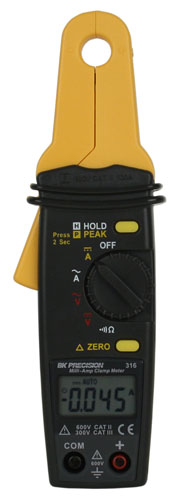
I went with the B&K Precision 316
http://www.bkprecision.com/products/multimeters/316-mini-ac-dc-clamp-meter.html

It worked great in this appliction. It has good ranges and the head is smaller than most to fit in tighter spaces.

316_front_lrg.jpg
 

gotwheels

Well-known member
Joined
Jan 2, 2011
Messages
120
redwrench60, Your battery test switch is interesting. Would you offer more description or a picture of the set-up? Thanks
 

Tallpilot

Well-known member
Joined
Jan 13, 2017
Messages
2,384
Location
Orlando
When I went through this decision process what ultimately kept me from getting a DMM with a built in amp clamp was the fact that I couldn't find one that also had an internal amp shunt. This is a problem if you need / want to measure something in the small mA or micro amp range.

As always seems to be the case there are compromises when trying to find a tool that does everything. Unfortunately to run the entire gambut of automotive electrical diagnostics you need a decent DMM(Hz, hold, diode, etc), a low amp clamp, high amp clamp and eventually a scope. I am currently using a cheap one channel scope but a two channel is on my short list of needed items.
 

redwrench60

Well-known member
Joined
Sep 10, 2011
Messages
6,062
Location
East Tennessee
redwrench60, Your battery test switch is interesting. Would you offer more description or a picture of the set-up? Thanks

Just got in from working on fence, I'm going to cool off a bit then I'll go out to the garage and take some pics. I made one for work and home. They're based on a common type battery disconnect switch you can buy at Walmart or any auto parts house. I just modify them with provisions to easily attach a meters leads and conjure up a few battery post adapters for connecting to top or sidepost batteries. They make testing pretty fool proof and allow you to start the vehicle, road test it and operate all accessories and instruments before shutting it down and removing the key for module power down (push button start vehicles require the fob be moved out of range or some modules won't sleep and some straight shift vehicles require the manual trans be in a certain gear)
 

udderlyoffroad

Well-known member
Joined
Aug 2, 2014
Messages
93
Location
Bristol, UK
To the OP, I am another satisfied UNI-T Clamp meter user. In fact, I'm carrying it now in my 'away mission' sack, though I have upgraded the supplied test leads to something better...

And yes, for parasitic current draws I use the clamp meter to narrow down where the flow is going, and the voltage drop method in the correct fuse box. I haven't used this more than a couple of times, so am sure a more experienced person will be along shortly to point out the limitation of this method.

Matt
 

theoldwizard1

Well-known member
Joined
Feb 22, 2011
Messages
43,106
Location
SE MI
No, you don't... :eyecrazy: Amp clamps are more than accurate enough to track down automotive parasitic draws. Less time reading on the internet, more time working in the shop :thumbup:
That is not what I said ! What I said was
theoldwizard1 said:
... if you want to measure current below 100mA accurately ...

You don't need to be "accurate" to track down a parasitic draw. You are not looking for a difference of a couple of mA, you are looking for a difference of like 50 mA !

I concur with

 
Last edited:

General Geoff

Well-known member
Joined
Jan 12, 2013
Messages
3,872
Location
Allentown, Pennsylvania
You don't need to be "accurate" to track down a parasitic draw. You are not looking for a difference of a couple of mA, you are looking for a difference of like 50 mA !

Best way to check for parasitic draw in a car is by checking voltage drop across fuses using fuse voltage drop charts. See also:

<iframe width="560" height="315" src="https://www.youtube.com/embed/lRcj1fQcWwU?list=FLKZrVvL7dmQORYjz0ZdWRqg" frameborder="0" allowfullscreen></iframe>

It's best to have a relatively accurate and sensitive meter to check voltage drop like this.
 
OP
B

bob_the_builder

Well-known member
Joined
Apr 25, 2010
Messages
404
Since we have been talking about meters and different ones that work for parasitic draw, I was wondering if someone could explain how to calculate the accuracy.

For example,

Clamp meters calls out:
Range: 0-5,000mA
Resolution: 1mA
Accuracy: +/- 2.8% +20 digits

Amp Probe calls out:
Range: 0-20,000mA
Resolution: 1mA
Accuracy: +/- 1.0% +5mA

When calculating the accuracy, do I use the max range of the meter (5,000mA) or do I use the the reading I see on the meter.

If I use the max reading for the accuracy
Clamp meter would be +/-5,000*0.028+20 = +/-160mA
Amp probe and +/-20,000*.01+5 = +/- 205mA

If you use the reading on the meter the accuracy would be much better on both units. I just want to make sure I am calculating the accuracy correctly so one can make a far comparison between different meters.


Bob
 

pedrodagr8

Well-known member
Joined
Aug 25, 2013
Messages
613
Since we have been talking about meters and different ones that work for parasitic draw, I was wondering if someone could explain how to calculate the accuracy.

For example,

Clamp meters calls out:
Range: 0-5,000mA
Resolution: 1mA
Accuracy: +/- 2.8% +20 digits

Amp Probe calls out:
Range: 0-20,000mA
Resolution: 1mA
Accuracy: +/- 1.0% +5mA

When calculating the accuracy, do I use the max range of the meter (5,000mA) or do I use the the reading I see on the meter.

If I use the max reading for the accuracy
Clamp meter would be +/-5,000*0.028+20 = +/-160mA
Amp probe and +/-20,000*.01+5 = +/- 205mA

If you use the reading on the meter the accuracy would be much better on both units. I just want to make sure I am calculating the accuracy correctly so one can make a far comparison between different meters.


Bob
% of reading +/- counts listed. The counts at the end are related to what used to be called % of range error. The handle non-linearities and things like that.

I also can vouch for the UT210e. It's just about the only meter you can find in that price point that not only does ac and dc but also reaches mA resolution.

Sent from my LGLS992 using Tapatalk
 
Last edited:
OP
B

bob_the_builder

Well-known member
Joined
Apr 25, 2010
Messages
404
% of reading +/- counts listed. The counts at the end are related to what used to be called % of range error. The handle non-linearities and things like that.

I also can vouch for the UT210e. It's just about the only meter you can find in that price point that not only does ac and dc but also reaches mA resolution.

Sent from my LGLS992 using Tapatalk

Are the counts in mA as well?

Looking at the accuracy of the clamp meter:
Clamp meters calls out:
Range: 0-5,000mA
Resolution: 1mA
Accuracy: +/- 2.8% +20 digits

If I had a reading of 32.6 then my accuracy would be (32.6mA*0.028)
Therefore my reading would be 32.6 +/-0.9128mA +/- 20 counts. To get the total accuracy do I add the counts does that make it 32.6 +/- 20.9128mA. That just seems like a big difference in numbers. My reading of 32.6 could be anywhere between 11.7mA and 53.5mA. That could be the difference of a car having a parasitic draw vs. not having one.

I just wanted to double check to make sure the math is correct.
 
To avoid these ads, REGISTER NOW!
Top Bottom