To avoid these ads, REGISTER NOW!

Recommended Max Working Torque by Drive Size?

The Critic

Well-known member
Joined
Aug 18, 2008
Messages
675
Location
CA

This video is from 2018 so I assume the info is current.

Skip to 3:30.

According to Snap-On, these are the maximum recommended working torque by drive size:

1/4 (under-dash): 28 ft lbs
3/8 (engine bays): 80 ft lbs
1/2 (under-vehicle): 330 ft lbs

The numbers for 1/4 and 3/8 seem low. Thoughts?
 
To avoid these ads, REGISTER NOW!

2ndGearRubber

Well-known member
Joined
Mar 24, 2014
Messages
14,185
Location
Pittsburgh
They seem low to me too. I would expect 1/4" to go to 50 and I know for an absolute fact that 3/8" can go to 100 as every 3/8" drive torque wrench in the world maxes out at 100 ft-lb.

My 3/8 techangle maxes at 125. Which is a little hairy but it gets the job done.

The list is probably "best practices" rather than "can I avoid pulling the motor mount and jam 3/8 in there?".
 

johninct

Well-known member
Joined
Dec 21, 2010
Messages
2,595
It seems about right to me. 80ftlb for some cars is their wheel torque and I do not want to torque a wheel with my 3/8" ratchet. Just because you can do something (which we all have done) doesn't mean you should do it as a regular practice.
 

Astro_Pneumatic_Tools

Well-known member
Joined
Oct 30, 2013
Messages
2,108
Location
South El Monte
Yes the 1/4" & 3/8" sound arbitrary and low.
1/4" is 75% of ANSI, 3/8" is only 53% of ANSI where as 1/2" is 88% of ANSI.

Sounds like something you'd say to try and get more of your customers to use 1/2" to reduce your warranty cost.
All the tool truck brands use a multipler of ANSI as their standard (as in over 100%), so i'd take that recommendation with a grain of eye roll
 

tamaraw

Well-known member
Joined
Jun 6, 2022
Messages
842
It's going to depend upon the quality and design of the tool but those numbers seem very low.

My 3/8" Precision Instruments torque wrench has a 20-100 lb-ft scale. I keep a 1/2" adapter on there basically 24/7 and have used it to torque lug nuts plenty (80 lb-ft). They wouldn't rate it any higher if it was going to break.

Hazet publishes rather impressive max specs for their HP ratchet mechanisms which are as follows:
12.7mm (1/2") --> 1000Nm (738 lb-ft)
9.5mm (3/8") --> 400Nm (295 lb-ft)
3.65mm (1/4") - - > 120Nm (89 lb-ft)

You can see point of failure on their 1/2" mechanism is pretty spot-on to the rated value (near 6:55 timestamp):

Obviously you wouldn't want to take it to the failure point regularly (and the rating on their 1/4" mechanism seems a little questionable imho) but you can see that good quality tools can go much higher than Snap-on's values.

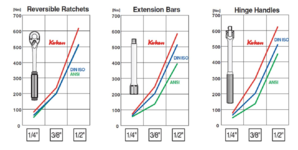
Here's another example from the Koken catalog:
1678120177986.png

Guessing numbers from the ratchet graph, that looks like maybe 80Nm (59lb-ft) for 1/4", 240Nm (177lb-ft) for 3/8", and 610 Nm (450lb-ft) for 1/2". And that's probably for their cheapest classic Proto-style ratchets (pictured), not the fancy Z-series stuff with stronger engagement.

I would say either Snap-On tools **** massively and shouldn't be used... or they are fudging the ratings and lying to you to try to sell more tools. Pick your poison. :dunno:
 
OP
T

The Critic

Well-known member
Joined
Aug 18, 2008
Messages
675
Location
CA
Yes the 1/4" & 3/8" sound arbitrary and low.
1/4" is 75% of ANSI, 3/8" is only 53% of ANSI where as 1/2" is 88% of ANSI.

Sounds like something you'd say to try and get more of your customers to use 1/2" to reduce your warranty cost.
All the tool truck brands use a multipler of ANSI as their standard (as in over 100%), so i'd take that recommendation with a grain of eye roll
Interesting - I did not know ANSI had a standard for this. Thank you for the lesson.
 

F-22

Well-known member
Joined
Jan 23, 2022
Messages
1,830
The Snap On values are good recommendations. Sure the failure torque can be higher, but why go that far? I'm not torquing lug nuts with a 3/8", nor am I tightening cylinder heads with a 1/4"...

Unless you only have a 3/8" set.
 

75' forty

Well-known member
Joined
Feb 1, 2013
Messages
431
Location
Foley, Alabama
Curious what impact sockets & drives from different materials are rated for.
My 3/8" Fuel Stubby impact is good for up to 250 ft-lbs and my IR pneumatic is 475 ft-lbs
 

2ndGearRubber

Well-known member
Joined
Mar 24, 2014
Messages
14,185
Location
Pittsburgh
Not sure about the ideal situations, but I did some thinking about this today in terms of tightening torque.

3/8, IMO you're really tapped out around 125. I've taken angle sequences up to 145ish,but you're breaking wobble extensions at that level. You're also really working the tool. The drive may take more, but you only have so much handle.

1/2, getting up to 300 starts to be a chore vs handle length.

Both of these fit as the max torque for a respective drive techangle from Snap On BTW.

1/4 drive, I abuse. 30ft/lb is probably the most I could see torquing up to. You run into the mechanics of such a small tool, assumingly in a tight space, and being able to properly setup to pull on it. Top end of a 1/4 techangle is 20ft/lb, I'd prefer 25 for versatility. Much like the other tools I would say you could probably just watch the display and use that to cheat the maximum torque spec by overloading the tool. Only so much over you can go before it would stop recording in protest of your treatment.


These are all for tightening, obviously I abuse and shock load my tools when loosening stuff.
 

Zewnten

Well-known member
Joined
Jun 11, 2017
Messages
1,803
I always figure 90% of my techangles was a good range. 3/8 110ft/lbs, 1/2 270ft/lbs, 3/4 I'll take to 900ft/lb as a torque multipler goes to 1000ft/lb even though the torque wrench stops at 600ft/lb, same system with 1" as the 3/4.

Snap On has a tool safety video out there about using the right tool for the job and some of it was good, ie not using screwdriver as a prybar, and others were a little ridiculous like getting the next drive size up for more torque but using a similar length handle.
 

Jbullfrog

ALLIANCE MEMBER
Joined
Jan 9, 2007
Messages
2,347
Location
Avoca, Iowa
What are the ratings for 3/4 and 1" drive tools? My 3/4 Matco torque wrench goes to 650ft/lbs. I have a Snap-On 15:1 torque multiplier with 1/2" input and 1" output is rated for 2200 ftlbs
 

LogiLuddite

Well-known member
Joined
Aug 27, 2022
Messages
68
Borrowing some specs from Tekton. Their 3/8 ratchet made it to almost 300 lb (at the 4:30 mark). Snap-on is probably being conservative for the smaller socket sizes

tekton-socket-torque-chart-std-mm-1x.jpg
 
To avoid these ads, REGISTER NOW!

king nero

Well-known member
Joined
Dec 27, 2010
Messages
1,469
Location
Belgium
The standards are specific to socket sizes, but I went off of drive size on a tool. Socket sizes in many cases can also exceed the drive size standard in larger sizes

Any chances you can find the ISO alternative to this ANSI standard? Or if you could give the reference to the ANSI, I'll probably be able to find it myself... Much appreciated!
 

KnurledNut

Well-known member
Joined
Jan 28, 2011
Messages
8,108
Location
n/a
Something important is being overlooked here...

The video is about sockets.

Just because the anvil of your ratchet will achieve much more than the recommended working torque, it doesnt mean your universal socket will.

Snap-on’s stated values apply to multiple tools and accessories of each drive size, with exception for reducers, crowsfeet, etc.
 

AdAstra

Well-known member
Joined
Aug 27, 2021
Messages
195
Any chances you can find the ISO alternative to this ANSI standard? Or if you could give the reference to the ANSI, I'll probably be able to find it myself... Much appreciated!
ISO 3315 has the tools, ISO 1711-1 has the sockets.
The US standard is not ANSI but rather ASME B107.100 (consolidation of the older B107.1)

Something important is being overlooked here...

The video is about sockets.

Just because the anvil of your ratchet will achieve much more than the recommended working torque, it doesnt mean your universal socket will.

Snap-on’s stated values apply to multiple tools and accessories of each drive size, with exception for reducers, crowsfeet, etc.
Yes very good point, it looks like SO are quoting about the midpoint of the socket range, but actually above the ASME proof load of the universals. So maybe it's their recommended max for universals (prob the weakest type) and therefore a safe number for using everything in that drive size.

Also remember that proof load is a one-time survival requirement on a new tool, and that fatigue and in-use damage (nicks, drops, etc.) is a thing. Repeatedly taking something to full load could break something at below 1x failure load.

For example SAE AS955 (an aerospace tool standard) also requires 2000 cyclic loads at 70% of proof. So even for that more stringent requirement they don't need to design for thousands of cycles at full proof torque.
 
Last edited:

king nero

Well-known member
Joined
Dec 27, 2010
Messages
1,469
Location
Belgium
According to Snap-On, these are the maximum recommended working torque by drive size:

1/4 (under-dash): 28 ft lbs
3/8 (engine bays): 80 ft lbs
1/2 (under-vehicle): 330 ft lbs

The numbers for 1/4 and 3/8 seem low. Thoughts?


ISO 3315 has the tools, ISO 1711-1 has the sockets.
The US standard is not ANSI but rather ASME B107.100 (consolidation of the older B107.1)

Thx for that!

It seems torque in ISO country has significantly higher values?
1/4 drive: 62 Nm or 46 ft-lbs
3/8 drive: 202 Nm or 149 ft-lbs
1/2 drive: 512 Nm or 378 ft-lbs

The Hazet values mentioned above are impressive!
 

Sweetcorn

Well-known member
Joined
Feb 14, 2018
Messages
671
Location
North Central Ohio
So how many of you tighten your wheel nuts or studs with 3/8” drive tools?
ENOUGH SAID
I did a thread a while back on here and was surprised at the amount of people who just zip them down with an impact and don't worry about torque.

In a normal cross section of society, that wouldn't surprise me. On here, there's more attention to those kind of details and I didn't expect to see many posters "admit" to not torquing to a specific number.
 

johninct

Well-known member
Joined
Dec 21, 2010
Messages
2,595
I liked the post years ago someone posted about using 3/4" drive for dash work. Said that when the bolts saw 3/4" drive stuff, they all got scared and jumped out on their own...
 

tamaraw

Well-known member
Joined
Jun 6, 2022
Messages
842
So how many of you tighten your wheel nuts or studs with 3/8” drive tools?
ENOUGH SAID
I do, no reason not to on a 4x100 Honda or other similar application. :dunno:


BarryWells

Well-known member
Joined
May 26, 2019
Messages
647
Location
In the mountains
So how many of you tighten your wheel nuts or studs with 3/8” drive tools?
ENOUGH SAID
I guess I'm a freak. I use a beam type SK 3/8 torque wrench on lug nut. No air. zzt zzt with a Dewalt 20 and snug them afterwards to 85-95.
That way they stay but don't need 2 stout rednecks on Harleys to remove them from some poor dummys ride on the roadside, in the rain. Tire Kingdumb Superthunderhurricane impact installer !! Yes sir ! Theyza goodNtite ! = 400 ft lbs...LOL
 

Garcky

Well-known member
Joined
Sep 10, 2022
Messages
3,434
Location
Twin Cities Metro Area, Minnesota
Like everything, this is subject to considerable debate. As usual, it all depends. For me, it's pretty simple, really.

I use 1/4" drive only for small fasteners. So, I don't own a 1/4" drive torque wrench. Tight is tight. You can feel it.

3/8" drive, for me, is for doing any stuff with hex heads smaller than 5/8" and 7/16" or larger. I have a 3/8" drive torque wrench, with inch pound settings. Most of the time, though, I'm still going by feel with the stuff I do with 3/8" drive.

For everything else on cars and light trucks, I switch to 1/2" drive. Torque wrench goes to 200 ft. lb.

I do have a 3/4" drive socket set, with ratchet and big-*** breaker bar. Only place I use it is on rusty old trailer hitch mounts. I don't work on equipment.
 

dnschmidt

Well-known member
Joined
Oct 3, 2014
Messages
7,270
Location
Phoenix, AZ
So how many of you tighten your wheel nuts or studs with 3/8” drive tools?
ENOUGH SAID
Why wouldn't I? My 3/8 torque wrenches go to 100 ft-lb and my Toyota only needs 75 ft-lb. This is the best option as torque wrenches work best at the top half of their scale. 75 ft-lb on a 250 ft-lb torque wrench, now that doesn't make any sense.
 

Jbullfrog

ALLIANCE MEMBER
Joined
Jan 9, 2007
Messages
2,347
Location
Avoca, Iowa
After you use an impact for a few years, you will get the feel of proper torque. I use a torque wrench on true magnesium wheels, but the aluminum rims on my Super Duty and tractors just get an impact. If you don't trust yourself with an impact, go ahead and check them.
I did a thread a while back on here and was surprised at the amount of people who just zip them down with an impact and don't worry about torque.

In a normal cross section of society, that wouldn't surprise me. On here, there's more attention to those kind of details and I didn't expect to see many posters "admit" to not torquing to a specific number.
 
To avoid these ads, REGISTER NOW!
Top Bottom