To avoid these ads, REGISTER NOW!

Reduce or Eliminate Slop in Threaded Adjustable Feet

DrReid

Well-known member
Joined
Aug 2, 2020
Messages
47
Location
Oregon
My shop-made and commercial examples of adjustable feet have the same basic design: puck (foot) welded to all-thread that screws into bottom of leg or whatever having a welded nut or similar threaded fitting so that turning the foot adjusts it up or down. Each has the same problem: the threading is so loose that it allows play and, hence, much larger ’jiggle’ in the item that it supports. One example is my very heavy workbench, and another is my cabinet table saw mounted on a rolling base with adjustable feet that lower to fix the base into position.

Is there a simple way to reduce the slop in the threaded connections? I don’t like locking down my table saw and still having it jiggle as I watch the threaded feet move back and forth in their threaded connections. If I was a machinist, I‘d just cut my own threads.

Thanks for any suggestions.
 
To avoid these ads, REGISTER NOW!

BukitCase

Well-known member
Joined
Apr 11, 2017
Messages
1,075
Location
Oregon
Also, if you're tight for space look for JAM nuts; they're thinner than standard - if you look hard enough you should be able to find THREE different thicknesses of most nuts - heavy (not only thicker, but usually 1 wrench size larger) then standard, finally jam. If your threaded feet are acme thread, you have fewer choices IME... Steve
 
OP
D

DrReid

Well-known member
Joined
Aug 2, 2020
Messages
47
Location
Oregon
Thanks, folks! I'm embarrassed that the solution didn't occur to me before posting, so I'm thankful for the gracious and helpful replies.
 

Monza Harry

Well-known member
Joined
Dec 29, 2018
Messages
1,433
Location
Windsor ON
DrReid if you welded the nuts on by welding around the outside you most likely opened the threaded hole up exacerbating the situation, only way to stop this is drill (or open up the hole to the tap drill size) and tap after welding, Not always convenient but another option to the jam nut, which is your least painful way now. Harry
 

BukitCase

Well-known member
Joined
Apr 11, 2017
Messages
1,075
Location
Oregon
When I weld nuts in place I attempt to minimise the heat problem by first locking the (to be welded) nut in place with the corresponding size bolt, tightened down HARD - then I do 3 fairly heavy tacks (mig) placed on every other flat - BUT I only do one tack at a time, cooling with compressed air after each tack. The bolt doesn't get removed til the LAST tack is cool to touch.

No actual proof of how well this works, but seems to avoid any measurable increase in slop... Steve
 
OP
D

DrReid

Well-known member
Joined
Aug 2, 2020
Messages
47
Location
Oregon
When I weld nuts in place I attempt to minimise the heat problem by first locking the (to be welded) nut in place with the corresponding size bolt, tightened down HARD - then I do 3 fairly heavy tacks (mig) placed on every other flat - BUT I only do one tack at a time, cooling with compressed air after each tack. The bolt doesn't get removed til the LAST tack is cool to touch.

No actual proof of how well this works, but seems to avoid any measurable increase in slop... Steve
I hadn't considered the effect of heat on the threaded fit, but that makes sense. On my workbench, I used long threaded couplers (wleded inside the end of each leg) instead of nuts, possibly minimizing the heat effect on hole size. I'll try the quick tack MIG method next time.

(Also Steve...also in OR!)
 
To avoid these ads, REGISTER NOW!

BukitCase

Well-known member
Joined
Apr 11, 2017
Messages
1,075
Location
Oregon
Wow, so we're twin sons of different mothers :geek: (OK, maybe only sorta )

All seriousness aside, I tend to use coupler nuts too (but I still do the "small doses" welding approach when possible - I also, if wanting smoothness of operation (like doing some sort of "tool-less" operation such as tacking a piece of round rod across the head of a bolt that'll run in a welded nut) I'll run a tap thru the welded nut to clean up any "leftovers" -

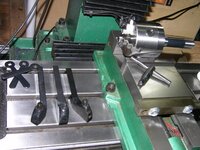
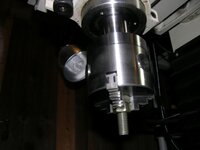
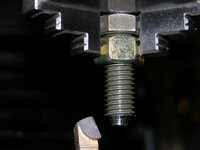
Another trick I've used (nothing to do with your "project du jour") - there are times when I want a tool OR toolless set screw to maintain a setting on 2 mating pieces somewhere - I don't have a lathe yet, so I found a little 3" 3 jaw chuck (R8 shank) on Victor machinery's site -


if I don't want the threads messed up on my custom "set bolt", I can turn an ordinary bolt into a dog point bolt this way - for toolless, just weld a piece of rod across the bolt head when done - See pics below ... Steve (the OTHER one :=)
 

Attachments

  • VertLathe-3.jpg
    VertLathe-3.jpg
    271 KB · Views: 37
  • VertLathe-4.jpg
    VertLathe-4.jpg
    101.3 KB · Views: 35
  • VertLathe-5.jpg
    VertLathe-5.jpg
    86.4 KB · Views: 35
  • VertLathe-7.jpg
    VertLathe-7.jpg
    125.3 KB · Views: 35
  • VertLathe-9.jpg
    VertLathe-9.jpg
    145 KB · Views: 37
OP
D

DrReid

Well-known member
Joined
Aug 2, 2020
Messages
47
Location
Oregon
Wow, so we're twin sons of different mothers :geek: (OK, maybe only sorta )

All seriousness aside, I tend to use coupler nuts too (but I still do the "small doses" welding approach when possible - I also, if wanting smoothness of operation (like doing some sort of "tool-less" operation such as tacking a piece of round rod across the head of a bolt that'll run in a welded nut) I'll run a tap thru the welded nut to clean up any "leftovers" -

Another trick I've used (nothing to do with your "project du jour") - there are times when I want a tool OR toolless set screw to maintain a setting on 2 mating pieces somewhere - I don't have a lathe yet, so I found a little 3" 3 jaw chuck (R8 shank) on Victor machinery's site -


if I don't want the threads messed up on my custom "set bolt", I can turn an ordinary bolt into a dog point bolt this way - for toolless, just weld a piece of rod across the bolt head when done - See pics below ... Steve (the OTHER one :=)
What a clever idea! Thanks for including that in this thread.
 

BukitCase

Well-known member
Joined
Apr 11, 2017
Messages
1,075
Location
Oregon
Wow, we're nearly neighbors - I'm about 15 miles east of Albany, with 10 acres and 'WAY too many hobbies for a non-billionaire :rolleyes:
 
Last edited:
OP
D

DrReid

Well-known member
Joined
Aug 2, 2020
Messages
47
Location
Oregon
Wow, we're nearly neighbors - I'm about 15 miles east of Albany, with 10 acres and 'WAY too many hobbies for a non-billionair :rolleyes:
Haha. My corollary: I have too many for someone who still works full time doing nothing even remotely close to fabrication . I'm a little envious of my retired and talented elders here...
 

Lwel9226

Well-known member
Joined
Jun 7, 2014
Messages
764
Location
So Oregon
I'm about 10 mi. north of Medford.... Is there going to be a swap-meet at Albany this year???

LynnW
 

ChevyEFI

Well-known member
Joined
Sep 2, 2012
Messages
8,736
Location
Phoenix, AZ
Pick a leg nut size available with the same thread pitch in a larger size.
9/16-18 and 5/8-18.
7/16-20 and 1/2-20.
5/16-24 and 3/8-24.
When you weld your 7/16-20 nut, you will be able to use a drill-tap to tap it out to nice standard 1/2 threads. If you compare the tap size for 1/2-20 fine, it is barely bigger than 7/16, and you might be able to just use the tap. Tough to tell without knowing dimensions on how much the weld is expanding the nut. But it's probably a way to save time, buy slightly smaller hardware (less $.) If you add stout springs (used valve.aprings), between the puck foot and the leg nut, you will probably have little to no vibration when your saw runs.
 
To avoid these ads, REGISTER NOW!
Top Bottom