To avoid these ads, REGISTER NOW!

Rehabbing My Garage

drelldrell

Well-known member
Joined
Jan 27, 2015
Messages
50
Hello all,
I bought a house in late 2013 with a two car garage (20x22) that is likely 30 years old, but in good structural condition. I live in Chicago, so the winters get very cold. Summers are moderately hot in July and August. My plan is to use the garage for some general woodworking/carpentry work and man cave type hanging out. There is no heating or insulation. I need advice on two things:

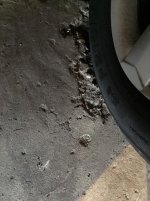
Slab - The slab is in rough shape with cracks, pitting, unevenness, and some water wicking up to surface in one small area (likely due to one of the cracks). I plan to have the slab replaced as soon as it warms up in Chicago. The contractor will cut out a 6" internal perimeter to leave the existing footings in place. No stem wall. The 3" on compacted gravel followed by a 4" slab. Should I add a vapor barrier and possibly foam board under the new slab? Also, I am thinking about digging down about 12" around the external perimeter and adding foam board for frost protection. Is this sensible to do?

Insulation - Given I would like to use the garage most of the year, I want to insulate to keep in heat when in use during winter and prevent excessive heat in summer. I likely will use a propane heater of some sort next winter. The wall has OSB already with no insulation. The hip style roof is uninsulated. Ther are soffit vents. I added foam board insulation to the inside of the garage door. Is blown in insulation a good idea for the walls? I guess I could rip out the OSB since its nailed in, add FB and a vapor barrier, and then add OSB or plywood, but that seems like more work than blown in. Is building a ceiling and blowing in insulation better that using baffles and batt insulation to insulate in the roof rafters?

Thanks for any and all advice.
 

Attachments

  • image.jpg
    image.jpg
    146.7 KB · Views: 128
To avoid these ads, REGISTER NOW!

rburke65

Well-known member
Joined
Nov 10, 2007
Messages
12,349
Location
Canfield, Ohio
If the contractor is going to cut out all but a 6" perimeter of the floor and leave the existing "footer" in place I assume you arête erring to the area of the floor under the base plate of the garage? "Footers" are usually below the frost level....2...3...4' below ground level. Yes add a vapor barrier but I see no advantage to adding the isolation under the slab alone.
 
OP
D

drelldrell

Well-known member
Joined
Jan 27, 2015
Messages
50
Thanks. I'm not not construction person by any stretch. I talked with three contractor and each said they would leave a 3 to 6" perimeter so as to not interfere with the footing structure. I see your pint that the footer goes at least two feet subgrade.
 

little d

Well-known member
Joined
Nov 13, 2009
Messages
815
Location
NW Oklahoma
Drell,
since your walls already have the osb up, you could blow in insulation but, you would have to drill some pretty good sized holes between the studs through the osb. Ya might want to price out what rigid foam board would cost, nail it to what is exsisting and then cover with what ever you want on the walls. remember, this is a shop not a house, your not in it all the time and when you are, your working... Myself, I like the temp about 60 for working.

On the ceiling, theres no reason blown in wont work, just remember to leave an area by the eves for the air to escape (they make a cardboard "chase" that you can staple to the rafters).
 
To avoid these ads, REGISTER NOW!

The FIB

Well-known member
Joined
Jan 8, 2014
Messages
266
Location
chicagoland
Welcome drelldrell,
I would definitely put a vapor barrier down, under slab insulation only if you plan on keeping it heated for extended periods. Keep in mind, footings in this area are typically put at 4 feet deep, I think 32" is the minimum depth, digging down vertically and installing foam insulation would do very little to prevent frost under your slab, although it may help with heat loss when heating the garage for extended periods.
Usually, when insulating for ground frost they run insulation on the outside horizontally, I think 4 feet out, and under the slab.
By the way, I see the roof sheathing is boards instead of plywood, that would make me think your garage is older than 30 years old.
 

lattimer17

Member
Joined
Apr 4, 2012
Messages
16
Slab-

Proper insulation of an unheated space (I'm assuming you won't be heating it 24/7) can prevent heaving of a shallow foundation.

I'm not sure about your area, but here many older garages (and based on your roof decking I believe your garage is more than 30 years old) were built on nothing more than a turned down slab with thickened edges that get no where near the frost line. While this type of system can be protected via insulation, it needs to be done prior to construction to be effective....too late for you.

Here is how I would handle the slab (assuming your soils are similar to mine in WNY). Geotextile. 6-12 inches of free draining coarse gravel (compacted...I don't care what the contractor says, compact it). Geotextile. 6-12 inches of well graded gravel (compacted). Concrete slab of appropriate thickness and reinforcement for your loading conditions.

Unless you have specific flooring requirements, I wouldn't get into vapor barrier or insulation. Improperly installed or engineered, they can do more harm than good. Also, be sure to keep the area graded away from your slab and that gutters and downspouts are directing surface water well away from your slab.

Keep in mind, this advice is generic and based on assumed site conditions. Your conditions, and therefore the best methods, could be vastly different.

Insulation -

I'd use fiberglass batt insulation for everything. Pull down OSB, insulate, reinstall. The main reason is that it would likely be cheaper, and also because its a one man job. Blowing in insulation is not a one man show.

I'd also make sure to install proper roof venting. If you are heating it regularly, you will end up with a hot roof if its not properly vented. Hot roof leads to ice dams, which lead to leaks...especially since you likely do not have snow and ice shield beneath the shingles.
 
OP
D

drelldrell

Well-known member
Joined
Jan 27, 2015
Messages
50
Thanks for the replys. Really appreciate the advice. Interesting to learn the garage is older than I thought. Looks like I need to add more compacted gravel than planned. The contractor is talking about 3", then wire mesh, and then 4" slab. Parking a midsize SUV only. No lift or anything. The soil is clay, but drains well elsewhere on my lot.

One more questions:

If I pull down the OSB and use drywall, is that fine for the Chicago area? The OSB is nailed in so I'm not sure how easy it may be to pull it off without a lot of damage.
 

The FIB

Well-known member
Joined
Jan 8, 2014
Messages
266
Location
chicagoland
Drywall is do-able, I have seen it used in detached garages.
OSB and drywall each have their pro's and con's. Drywall has a more finished look and is more fire resistant (when fire taped). OSB is more resistant to dents and scratches, wont hold moisture like drywall, and is easier to install (no taping).

You said you plan on heating with propane, I am assuming it will be some kind of a portable unit. Portable propane and kerosene heaters tend to create a lot of moisture, so if you do go with drywall use one of them high moisture, mold resistant types.

When installing the drywall make sure you have a gap at the floor so it doesn't wick the moisture off the slab. A good vapor barrier behind the drywall will also be very important.
 
OP
D

drelldrell

Well-known member
Joined
Jan 27, 2015
Messages
50
Here is an update and a bit of a rant due to some bad advice I received on a cure and seal product. After pouring the slab, I got a product called Silencure A from a local concrete supply store (Northlake, IL). Seemed like a better idea than Home Depot or Lowes; plus the concrete company recommended them. I thought I would go the extra mile as add this combination curing and penetrating sealer. Big mistake! It took that **** a WEEK to dry fully. A week!

After a couple of days – not the 12 hours as stated on the technical spec document, I called manufacturer (ChemMaster) to see what was going on with the extended drying time. I found out two things. The first is that our 60 degree weather week down to high 40s and low 50s two days later so that added to the drying time. I also found out that the product Silencure SRT, not Silencure A should be used on steel troweled floor. When used on steel trowel floors, the product would take much longer to penetrate into the pours of the concrete. So I had heating going in the garage for the entire week to help the sealer dry/evaporate.

I called the concrete supply store and let them know of the bad advice and they were like “Thanks. We were not aware.” What the hell, I almost lost it, but decided that I just need to have more patience next time and do the normal curing process and seal with more traditional products.

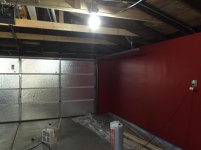
One thing I noticed is that the insulation I installed helps tremendously! The temps dropped to the low 30s one night and the garage was toasty. Vast difference from before.

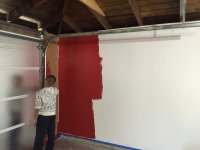
Today we finally started painting walls and the garage is starting to look great. One wall with be red to contract the cabinets and bench I will have in place in the next few days. The other two walls will be light grey as will the ceiling sometime this summer.

There are a few imperfections in the walls and I will paint the PT boards I used a baseboard in a few weeks – I want them to dry out well before painting.

Hope to have much more progress in the coming days.
 

Attachments

  • IMG_1146.jpg
    IMG_1146.jpg
    140.2 KB · Views: 31
  • IMG_1149.jpg
    IMG_1149.jpg
    144.6 KB · Views: 33
  • IMG_1153.jpg
    IMG_1153.jpg
    138.1 KB · Views: 29
Last edited:
To avoid these ads, REGISTER NOW!
Top Bottom