

You are using an out of date browser. It may not display this or other websites correctly.
You should upgrade or use an alternative browser.
You should upgrade or use an alternative browser.
Reminder : Drain your air compressor tank !
- Thread starter theoldwizard1
- Start date

dagofast
Well-known member
Or you could simply pay attention to the date code and scrap them when recommended.

1cargarage
Well-known member
Or you could simply pay attention to the date code and scrap them when recommended.
That's nonsense. I don't let a few numbers stamped on little soulless badges push me around and tell me how to live my life. No way.
Hagatronics
Well-known member
Don't those things have a pressure release valve?
Don't those things have a pressure release valve?
Most do but the tank may have ruptured below the set pressure level due to corrosion/ rust weakening the tank.
vavet
Well-known member
Or you could simply pay attention to the date code and scrap them when recommended.
What is the recommended age?
American Locomotive
Well-known member
Or you could simply pay attention to the date code and scrap them when recommended.
Oh yes, please tell me more about the reccomended "scrap age" stamped into compressor tanks.
Oh, wait.
Oh yes, please tell me more about the reccomended "scrap age" stamped into compressor tanks.
Oh, wait.
Newer compressors should at least have stickers on them stating when to remove them from service. My 2015 year model says to remove the tank from service in 2025 for example.
Jazz1
Well-known member
My 60 gallon RK compressor has production date 2009 but no mention of expiration date. Canadian made and I drain any moisture end of any day it get used..
driz
Well-known member
Mine is nestled next to the boiler in the basement where nobody is ever near unless it’s depressurized. If I was to worry about one I’d just locate it behind something like a wall.
As for keeping it drained the best thing I found is one of those Harbor freight drain valves for eight bucks. Put it in and set it up and forget about it. All you ever notice is a little rust stain on the floor[emoji847]
Sent from my iPad using Tapatalk
As for keeping it drained the best thing I found is one of those Harbor freight drain valves for eight bucks. Put it in and set it up and forget about it. All you ever notice is a little rust stain on the floor[emoji847]
Sent from my iPad using Tapatalk
seber
Well-known member
It doesn't matter how often you drain the tank. There will always be moisture in it and it will always be rusting. Fact is, ambient moisture in the tank is where the rust takes place, not so much under the water. Time to scrap is dependent on time, pressure, and thickness of the wall. I don't know for sure if this is working but every year or two on my older tank, I remove the pipe and tap the bottom with a steel rod to see if I can go through.
danski0224
Well-known member
It wouldn't rust if it was made out of PVC...
Bretny
Well-known member
My dad had a 20gal compressor in the unheated section of his shop for prob 13yrs here in humid/freezing NY. One year we decided to bring it down...i go to move it and could hardly pick one side up. It had over 10gal of water in it. Who knows the last time it was drained. It quickly got pin hole leaks in the bottom but continued to be used for about a year..then leaked to much.
welder4956
Well-known member
If you keep it drained of moisture after every use, there is no expiration date on the tank. Failures occur at the bottom of the tank where there is standing water due to oxygen pitting. The light rust on the rest of the tank due to humid air is not a concern for failure.
However, for the average Joe Homeowner who never drains the tank, 10 years might just be a good replacement schedule to keep Joe from blowing up the tank.
However, for the average Joe Homeowner who never drains the tank, 10 years might just be a good replacement schedule to keep Joe from blowing up the tank.
welder4956
Well-known member
It wouldn't rust if it was made out of PVC...
Very true...
welder4956
Well-known member
One thing that helps protect the tank on a stationary compressor is to put a brass elbow and section of brass pipe on the drain. Make the pipe as long as possible without sticking out so much that it is at risk of getting stepped on and broken off. The condensation will collect inside the brass pipe instead of the steel tank bottom. The brass pipe will not corrode and the steel tank bottom will not have standing water.
cabranch47
Well-known member
The brass pipe sounds like a great idea.
strutaeng
Well-known member
Looks like a cheap 20 gallon unit. Those aren't ASME-certified, at least not the cheap consumer air compressors sold everywhere.
I think 30 gallons and over are typically ASME-certified...
I think 30 gallons and over are typically ASME-certified...
dagofast
Well-known member
What is the recommended age?
On both of mine it is 10 years. One is a cheap-o Chinese Porter Cable 20 gallon and the other an older Campbell Hausfeld 20 gallon that is now on it's second tank.
Perhaps the larger, better quality tanks used in more expensive industrial units last longer? One thing is certain, the failed unit in the picture wasn't one of those industrial units and it also looked quite old. Hence my original reply.
I believe the industrial grade tanks as sold to businesses by industrial air suppliers are pressure tested at certain intervals, or at least they are supposed to be. For hobbyists or home users that buy the cheaper consumer grade or "disposable" type compressor, it is on us to dispose of them when the time comes as I don't think anyone will test those tanks.
Last edited:
engineer2
Well-known member
Even if you have an auto drain, you should periodically check it to make sure it's actually draining the tank.
danski0224
Well-known member
I just looked at small compressors this week, and they all had "expiration date" stickers on the tank in 3 languages.
"Small" being 2 gallons and under.
I wouldn't be surprised if the larger models available at the box stores had similar labeling.
"Small" being 2 gallons and under.
I wouldn't be surprised if the larger models available at the box stores had similar labeling.
chickenfarmer
Well-known member
You are a genius! Why didnt we think of this earlier!?It wouldn't rust if it was made out of PVC...
Sent from my SM-G930P using Tapatalk
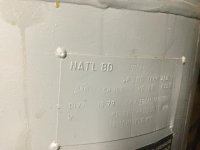

It’s weird no one from air industry chimes in here at garage journal.Well there was a guy but quit posting due to know-it-all’s. This is catastrophic serious stuff wether it be rebuilding pumps or taking a tank out of commission in a timely manner.
My 2015 80 gallon tank always had a auto drain mounted on it when I bought it last year.I should get one.
My 2015 80 gallon tank always had a auto drain mounted on it when I bought it last year.I should get one.
One thing that helps protect the tank on a stationary compressor is to put a brass elbow and section of brass pipe on the drain. Make the pipe as long as possible without sticking out so much that it is at risk of getting stepped on and broken off. The condensation will collect inside the brass pipe instead of the steel tank bottom. The brass pipe will not corrode and the steel tank bottom will not have standing water.
That's what I have on mine. Elbow, pipe, ball valve, & a plastic hose ext at the end. I forget what the date code is on my 60 gal but I've had it for like 8 yrs now & I bought it used. Not a single sign of rusty moisture coming out of it yet.
My prev 20 gal Craftsman/Deville Biss started showing shows of rust when draining only after 5 yrs. But then again I wasn't as meticulous about draining that one.
HoosierBuddy
Well-known member
It occurs to me that the big problem here is that it is difficult to inspect the tank for corrosion. If you could monitor the corrosion and the remaining tank wall thickness, you would have a good basis to make a decision to either keep or scrap the tank.
In the past few years, a couple of pieces of kit that might be useful have actually become really affordable. One would be a bore scope that you could use to see inside the tank and visually inspect it.
When I was a young engineer, the first bore scope I bought for us to use at GM was a couple of thousand dollars. You can buy one now that will plug into your smart phone for about $35. You'd need a 3/8 hole to insert the camera into the tank. I think most tanks would have that available.
The second item is an ultrasonic wall thickness gauge. I was paying almost $1000 a unit for those a few years back to check pipe wall thickness on underground pipes. For giggles I bought a couple for about $80 from China and they worked fine. Due to the size of the probe (about 1/4") you'd get some "averaging" of minimum wall thickness, but it would be easy to check the top of a tank and the bottom of a tank. If the bottom is measuring 60% of the top...you know you have big problems.
Final idea for the truely ********* would be to hydrotest the tank. If you fill it with water and then apply a tank of compressed gasses (like nitrogen for example), you can test to a pressure above the operating pressure. The advantage of using water as a test medium is, water isn't compressible, so if the tank ruptures, it (in theory) isn't going to blow up....it's just going to leak water everywhere. Probably a good "outside" job. I think that's how they retest oxygen cylinders every so many years. If anyone does this, please do not put the entire 2000 PSI from the nitrogen tank on the water. Keep it to something reasonable ...1.5 to 2.0 times the compressors cut off pressure maybe?
Just a couple of ideas. I can't imagine any of us are going to throw away a compressor tank (or the whole unit) after 10 years, if it is still working fine....but an inspection might be a good practical alternative.
Phil
In the past few years, a couple of pieces of kit that might be useful have actually become really affordable. One would be a bore scope that you could use to see inside the tank and visually inspect it.
When I was a young engineer, the first bore scope I bought for us to use at GM was a couple of thousand dollars. You can buy one now that will plug into your smart phone for about $35. You'd need a 3/8 hole to insert the camera into the tank. I think most tanks would have that available.
The second item is an ultrasonic wall thickness gauge. I was paying almost $1000 a unit for those a few years back to check pipe wall thickness on underground pipes. For giggles I bought a couple for about $80 from China and they worked fine. Due to the size of the probe (about 1/4") you'd get some "averaging" of minimum wall thickness, but it would be easy to check the top of a tank and the bottom of a tank. If the bottom is measuring 60% of the top...you know you have big problems.
Final idea for the truely ********* would be to hydrotest the tank. If you fill it with water and then apply a tank of compressed gasses (like nitrogen for example), you can test to a pressure above the operating pressure. The advantage of using water as a test medium is, water isn't compressible, so if the tank ruptures, it (in theory) isn't going to blow up....it's just going to leak water everywhere. Probably a good "outside" job. I think that's how they retest oxygen cylinders every so many years. If anyone does this, please do not put the entire 2000 PSI from the nitrogen tank on the water. Keep it to something reasonable ...1.5 to 2.0 times the compressors cut off pressure maybe?
Just a couple of ideas. I can't imagine any of us are going to throw away a compressor tank (or the whole unit) after 10 years, if it is still working fine....but an inspection might be a good practical alternative.
Phil
Last edited:
matt_i
Well-known member
Looks like a cheap 20 gallon unit. Those aren't ASME-certified, at least not the cheap consumer air compressors sold everywhere.
I think 30 gallons and over are typically ASME-certified...
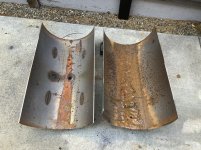
Here it is ^
An ASME tank built of pressure-vessel steel and welding techniques won't tear apart like that, even if the tank rusts a hole in it.
There are long established design principles for tanks that "leak before break" and the basic premise is to get a quality steel that's uniformly low enough in carbon so that the energy that can propagate a crack at the speed of sound in that material, is stopped (sometimes called "shunted") by the ductility of the material.
That the "new edge" pictured has evidence of tearing and what I would call "brittle fracture" says to me that this tank wasn't built to a quality standard and the crack couldn't be stopped. We also have no information about whether the overpressure relief was present or functioning to aid & abet the failure.
If you want peace of mind for your personal tank you have to hydro test it which basically means filling it full of water (oil? no way!) and then pressurizing with something like a modified grease gun. Without knowledge of specific codes I'd say it has to pass hydro at 2x the actual working pressure.
Pressure washer to test tank that’s full of water.Thats my unqualified GUESS.
I look at it like old rubber is old rubber.
My 2015 80 is MAWP 200 psi @400*F so 2X’s doesn’t sound like a good idea.Newer tanks are lighter compared to older tanks.Very noticeable.
I look at it like old rubber is old rubber.
My 2015 80 is MAWP 200 psi @400*F so 2X’s doesn’t sound like a good idea.Newer tanks are lighter compared to older tanks.Very noticeable.
platypus20
Well-known member
Standard ASME hydro test is 1-1/2 times the working pressure, not 2 times.
Wrench97
Well-known member
In my younger and dumber days I drilled and tapped the pin hole or 2 or 3 to 1/4" pipe to fix the leak...................it had a date code from 1934..............................I got rid of it about 10 years ago
OccupantRJ
Well-known member
One of the tanks where I once worked is a 1948 model, still in service. The tank is “inspected” every two years by the state boiler and pressure vessel division. They looked at the data plate, had me activate the pressure relief, then issued a certificate of compliance. See you in two years. Nothing but a state money game. If a tank has to be taken out of service, a plug has to be removed to show it as inactive. It it can then still be used as a motor mount and a new tank installed nearby and attached to the output line.
Last edited:
bsaint
Well-known member
You will get pin hole leaks before random explosions. Most of the time when tanks erupt, they've ignored the warnings.
hobby_guy
Banned
Here's my 1993 Craftsman DeVilbiss. Should I be worried - it's 27 years old (my how time flies. I remember buying it brand new. Seems like yesterday).
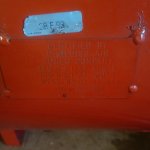



seancassey
Member
This is rusty
lakeroadster
Well-known member
I designed ASME Section VIII Div. 1 pressure vessels from 1981 until 4 years ago.
During that time period there was no ASME requirement placed on the Manufacturers to specify an expiration date on a pressure vessel. Manufacturers create a Data Report, it specifies the minimal vessel wall thickness. It is up to the end user to maintain the vessel.
The rules for inspection and care of the vessel falls under the jurisdiction of the location the vessel was installed. Sometimes based on State requirements, sometimes county, sometimes city.
The National Board of Boiler and Pressure Vessel Inspectors keeps track of the jurisdictional requirements. https://www.nationalboard.org/
During that time period there was no ASME requirement placed on the Manufacturers to specify an expiration date on a pressure vessel. Manufacturers create a Data Report, it specifies the minimal vessel wall thickness. It is up to the end user to maintain the vessel.
The rules for inspection and care of the vessel falls under the jurisdiction of the location the vessel was installed. Sometimes based on State requirements, sometimes county, sometimes city.
The National Board of Boiler and Pressure Vessel Inspectors keeps track of the jurisdictional requirements. https://www.nationalboard.org/
vavet
Well-known member
Are the end caps made from the same steel as the cylinder? Are they just stamped into that shape and then welded onto the cylinder?
I’m asking because I prefer vertical tanks. I’m guessing the end caps are more likely to rust through because of the smaller surface area compared to a horizontal tank.
I’ve had my Craftsman vertical since about 1999. No signs of imminent failure, but I suppose it could start anytime.
I’m asking because I prefer vertical tanks. I’m guessing the end caps are more likely to rust through because of the smaller surface area compared to a horizontal tank.
I’ve had my Craftsman vertical since about 1999. No signs of imminent failure, but I suppose it could start anytime.