To avoid these ads, REGISTER NOW!

remote switch (relay ?) for air compressor ...

gjbuilder

Well-known member
Joined
Aug 31, 2015
Messages
132
I plumbed in a nice air outlet on the exterior of my shop but my air compressor manual says not to leave it plugged in and powered on ... I believe a fire and safety issue if the air is bleeding and the compressor is allowed to run forever.

Fair enough.

However, if someone is at the point of use and runs the tank out, they need to stop what they are doing, walk all the way around the building, enter the shop, fire up the compressor, walk back out ...

We cannot "properly" wire up the outlet to an exterior lightswitch - all the walls are in, construction is done, etc.

But we *could* drill a little hole and run some little low voltage wires ...

Does there exist a 20a outlet that I could control with a normal looking lightswitch, via a relay ? I see a 15a here:

https://www.amazon.com/dp/B01FG86RUC/?tag=atomicindus08-20

... and I think that is probably what I want, but the outlet in question is a 20A outlet. Although I think the compressor can run on 15A ... so maybe I could use that anyway ?

I don't want anything smart ... no wireless, no zigbee, no arduino controller, etc. - just a switch and some wires.

Thanks.
 
To avoid these ads, REGISTER NOW!

Fixin'Stuff

Well-known member
Joined
Jun 14, 2016
Messages
584
Location
HotterNHellHouston
Do you have access to the lighting circuit? If so, this thread might offer a solution: https://www.garagejournal.com/forum/showthread.php?t=193219

Switches off power to the compressor when the shop lights go off, restores it when the shop lights are on. :)

EDIT: That's not the thread that I was thinking about. :( It's a more complex solution. The one I remember just uses a contactor with a 120 volt coil, wired into the lighting circuit. Lights go off, contactor opens.
 
Last edited:
OP
G

gjbuilder

Well-known member
Joined
Aug 31, 2015
Messages
132
Need to backup and start with motor specs.

What is the HP listing on the motor nameplate?

It is this compressor:

https://www.amazon.com/gp/product/B0058NRVMO/?tag=atomicindus08-20

... which is 1HP.

However, I must be confused about how this works - I was thinking that my relay needed to be sized depending on the *outlet*, which is 20 amps, and who cares what's plugged into it, right ?

Shouldn't the relay safely handle whatever is safely plugged into the outlet ?

Just to clarify:

The *goal* here is to have a normal looking lightswitch, that controls a single outlet, and the connection between the switch and the outlet are some little low voltage wires that I can drill into the side of the building and drape behind my cabinets... no high voltage work or install required ...
 
Last edited:
OP
G

gjbuilder

Well-known member
Joined
Aug 31, 2015
Messages
132
You can't install a relay with no high voltage or install required.
You have to interrupt the 120 Volt line to INSTALL the relay, and there's the matter of installing the LV transformer in the first place.

I was thinking of an actual plug-in device *between* the real outlet and the compressor plug - look at the device in my original post ... the only problem with that one is that it is rated only to 15A, whereas the plug I am going into is 20A.

So in that case, no high voltage work - just connect small wires from the plug-in device to the switch ... but I cannot find one that is for 20A ...

Am I thinking about this wrong ?
 

alfredeneuman

Well-known member
Joined
Mar 3, 2011
Messages
4,592
Location
Fullerton, CA
The relay is 15A
A "true" 1 HP motor is 16A, and the relay should be rated for HP as well as amps. Most ampere rated relays only achieve their ratings for resistive loads, not inductive loads like a motor.
Where would you need to drill a little hole?
 

wyliesdiesels

Well-known member
Joined
Aug 14, 2012
Messages
20,067
Location
Modesto, CA
It is this compressor:

https://www.amazon.com/gp/product/B0058NRVMO/?tag=atomicindus08-20

... which is 1HP.

However, I must be confused about how this works - I was thinking that my relay needed to be sized depending on the *outlet*, which is 20 amps, and who cares what's plugged into it, right ?

Shouldn't the relay safely handle whatever is safely plugged into the outlet ?


Just to clarify:

The *goal* here is to have a normal looking lightswitch, that controls a single outlet, and the connection between the switch and the outlet are some little low voltage wires that I can drill into the side of the building and drape behind my cabinets... no high voltage work or install required ...

I was thinking of an actual plug-in device *between* the real outlet and the compressor plug - look at the device in my original post ... the only problem with that one is that it is rated only to 15A, whereas the plug I am going into is 20A.

So in that case, no high voltage work - just connect small wires from the plug-in device to the switch ... but I cannot find one that is for 20A ...

Am I thinking about this wrong ?

As alfred pointed out, when one is controlling the amperage of a motor, the equipment needs to be rated for at least the same HP rating as the motor. I looked at the relay you linked to but couldnt find a HP rating....
 
OP
G

gjbuilder

Well-known member
Joined
Aug 31, 2015
Messages
132
The relay is 15A
A "true" 1 HP motor is 16A, and the relay should be rated for HP as well as amps. Most ampere rated relays only achieve their ratings for resistive loads, not inductive loads like a motor.
Where would you need to drill a little hole?

OK, then I am correct to be looking for a 20A plug-in relay-outlet thingy.

That's what I can't find.

As for the hole, the point-of-use is on the *outside* of the building but the compressor, and its outlet, is on the inside ... so that's major electrical wiring and tearing open walls if we wire up a "real" switch to the "real" outlet ... but if I can just drill a hole in the exterior wall and run some little low voltage wires into the building and drape them behind the cabinets ... that's easy ...
 

wyliesdiesels

Well-known member
Joined
Aug 14, 2012
Messages
20,067
Location
Modesto, CA
OK, then I am correct to be looking for a 20A plug-in relay-outlet thingy.

That's what I can't find.

As for the hole, the point-of-use is on the *outside* of the building but the compressor, and its outlet, is on the inside ... so that's major electrical wiring and tearing open walls if we wire up a "real" switch to the "real" outlet ... but if I can just drill a hole in the exterior wall and run some little low voltage wires into the building and drape them behind the cabinets ... that's easy ...

Im not sure where the disconnect is.

But you need a relay that is rated for AT LEAST 1HP.

The amperage rating is second to the HP rating.

And you may not find what youre looking for.
 
Last edited:
To avoid these ads, REGISTER NOW!
OP
G

gjbuilder

Well-known member
Joined
Aug 31, 2015
Messages
132
Unless the distance is an issue have you considered a wireless dust collector remote switch? Such as... http://www.grizzly.com/products/120V-Dust-Collection-Remote/T26673

Thank you.

Yes, I have seen these and this would be perfect, right ?

The problem is that this is on the exterior of a building and I am not going to mount a remote control on the exterior wall ... what I really want is something exactly like this grizzly device, but that I can attach to a weatherproof lightswitch, like this:

https://i.stack.imgur.com/MMT90.jpg

Make sense ?

I just went through all of grizzly products and there are only RF switches - none that you can wire to a plain old switch ...
 

pattenp

Well-known member
Joined
Jun 4, 2008
Messages
10,175
Location
Virginia - USA
I was thinking the compressor was inside along with the power outlet and you had plumbed the airline to the outside. I'm at a loss for the need of the weather proof switch outside when the remote will be the switch. Sorry for not following what you are trying to do.
 
OP
G

gjbuilder

Well-known member
Joined
Aug 31, 2015
Messages
132
I was thinking the compressor was inside along with the power outlet and you had plumbed the airline to the outside. I'm at a loss for the need of the weather proof switch outside when the remote will be the switch. Sorry for not following what you are trying to do.

Yes, that is correct - the compressor is inside.

The compressor is inside, but one leg of the air line goes to an exterior air nozzle so people can quickly and easily pump up bike/car tires.

BUT, if the pressure is low, it's not easy - you have to go around the building and go into the shop and walk across the shop and turn on the compressor ...

So I would like a switch, outside, at the point of use.

But I don't want to rip open the walls and run power and switch legs to an outlet and so on ...

The remote control is a great solution for *inside* the shop but for outdoor use, it makes no sense (and would get lost or wrecked, etc.).

I just want a lightswitch above the air outlet that you can flip on and power up the outlet and was hoping I could do that with a relay so that I could just drill a little hole in the exterior wall and run two little low voltage wires along the inside wall, behind my cabinets ... to the compressor outlet.

I am open minded to the idea that I am thinking about this wrong or this is a bad idea, etc. ... but it seems like a reasonable idea ...
 

Git

Well-known member
Joined
May 18, 2008
Messages
6,894
Location
S Cal
You don't need to switch the power off, turn the AIR off instead

RapidAire sells a motorized ball valve
https://www.rapidairproducts.com/page/motorized-compressor-shut-off-valve

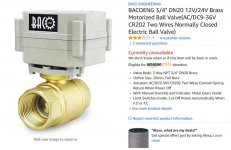
You can get the same thing on Amazon for about half the price. I use one that works on DC voltage, so a simple wall wart type transformer provides power. With power, the valve opens and you get air. When you turn it off or if the power is cut, the valve automatically closes and shuts off the air. You could easily control this with your low voltage wires, but an easier way would be wireless with a Z wave outlet and remote

Here is the valve I have from Amazon, looks like it is currently unavailable but I see they also have an eBay store
https://www.ebay.com/usr/bacoengineering

attachment.php
 

Attachments

  • SNAG-0201.jpg
    SNAG-0201.jpg
    115.6 KB · Views: 135
OP
G

gjbuilder

Well-known member
Joined
Aug 31, 2015
Messages
132
You don't need to switch the power off, turn the AIR off instead

Thank you very much - this is very interesting ...

So are we on the same page here - it's dangerous to leave the compressor "on" all the time because if something stays open, the compressor could run forever and burn itself out or start a fire, etc.

And you are saying, you can safely leave the compressor on if you put a valve right at the compressor and turn it off, thus ensuring no matter what happens to the rest of the line, the compressor stays safely off ...

Yes ?

Just some background - my original intention was to just leave the compressor plugged in and powered up - it was not until I read the owners manual where they explicitly warn against doing this that the danger occurred to me ... and that is when I started looking for a remote (but wired) power switch.
 

Git

Well-known member
Joined
May 18, 2008
Messages
6,894
Location
S Cal
I don't turn off my compressor for 'safety', I turn off the air because I have an older system and it will leak down, causing it to cycle - sometimes in the middle of the night and I don't need that happening... (But I do see the safety aspect of eliminating a source of oxygen in case of fire)

The bottom line is if you install the valve at or near the compressor, the compressor should not be cycling if the valve is closed. (I have a 3' whip connected directly to the compressor to minimize vibrations and then the ball valve)

If you want to go the low voltage wire route, the motorized ball valve is very doable and wouldn't be that expensive. I use a 24v transformer from an old modem that I had laying around. You could install a switch or even just install a timer that your transformer plugs into and have the compressor powered on during working hours and off at night. Lots of options

Also there is an advantage to just turning off the air - when you want to turn it back on, you don't have to wait for it to come up to pressure, it should be ready to go

Again those ball valves come in different sizes (1/2", 3/4", etc) different power sources (110v, 12-24v DC) different wiring and either normally open or normally closed. My valve is a simple 2 wire DC that is normally closed and when the power is cut when it is open, a spring will close the valve

Here is the 110v version on Amazon if you wanted to use it with a timer or relay. This is basically what RapidAir is selling
https://www.amazon.com/dp/B00PVQFTHW/?tag=atomicindus08-20
 
Last edited:
OP
G

gjbuilder

Well-known member
Joined
Aug 31, 2015
Messages
132
Thank you - appreciated.

I don't turn off my compressor for 'safety', I turn off the air because I have an older system and it will leak down, causing it to cycle - sometimes in the middle of the night and I don't need that happening... (But I do see the safety aspect of eliminating a source of oxygen in case of fire)

My understanding of the warning in my owners manual was that if the pipe broke or you had a severe leak while nobody was there, the compressor would just run forever and presumably burn itself out - and in the process, perhaps create enough heat, etc., to present a fire risk.
 
To avoid these ads, REGISTER NOW!
Top Bottom