
You are using an out of date browser. It may not display this or other websites correctly.
You should upgrade or use an alternative browser.
You should upgrade or use an alternative browser.
Remove Walker Turner chuck
- Thread starter Joe Flinn
- Start date
DaveAndStuff
Well-known member
It's taper fit, yes?
Decent picture would help.
Decent picture would help.
Mintgrun
Well-known member
The chuck key holes are enlarged.
What size are the holes? ( you could measure using drill bits to see which one fits )
I've got a little stash of chuck keys and am impressed by how large some of the end-pins are. It'd be interesting to compare your chuck to those pins.
Sawmill7
Well-known member
Please post pictures
Beerhippie
Well-known member
Generally that style of mount uses a right-hand thread for the screw and left-hand threads for the chuck/spindle. Use your chuck key to hold the chuck while you unscrew the screw,. then chuck a large Allen key in the chuck and give it a couple of good whacks with a deadblow or soft-face mallet--in the direction that seems wrong. It'll usually spin off after a whack or two.The Chuck is mounted on a shaft with a screw at the inside top of the chuck; it is an Allen head cap screw. Thank you to all who replied to my question.
Bbp78
Well-known member
Good morning, I don’t mean to hijack this post, I’m in the same situation trying to remove the chuck from a Walker Turner 900 drill press. Joe Flinn, I hope you got yours off and don’t mind me jumping into this thread. I see Beerhippies recommendation above, does that mean that the chuck is threaded on or am I misunderstanding and you’re using the large Allen key as a way to apply force with the dead blow? I saw they make wedges for chuck removal, but I like the Allen key idea better. My chuck seems to be missing the threaded nut above the chuck, does that matter? Do I need to replace that? Thanks for any suggestions and guidance, it’s appreciated.
Attachments


Bbp78
Well-known member

Our friends at Vintage Machinery have a treasure trove of old publications
one of the 900 series publications may be of help toyou
one of the 900 series publications may be of help toyou
FrankLee
Well-known member
Good morning, I don’t mean to hijack this post, I’m in the same situation trying to remove the chuck from a Walker Turner 900 drill press. Joe Flinn, I hope you got yours off and don’t mind me jumping into this thread. I see Beerhippies recommendation above, does that mean that the chuck is threaded on or am I misunderstanding and you’re using the large Allen key as a way to apply force with the dead blow? I saw they make wedges for chuck removal, but I like the Allen key idea better. My chuck seems to be missing the threaded nut above the chuck, does that matter? Do I need to replace that? Thanks for any suggestions and guidance, it’s appreciated.
Here’s another picture. If I get this thing off, I need to figure out how to clean it and get it working better. I’m sure there are plenty of threads on how to do that.
The chuck body should have the attachment technique and the capacity specs.
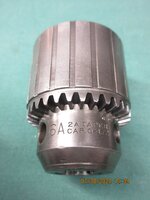
Yours looks like a Jacobs 6A chuck and likely has a 33 taper fit. You'll need wedges for removal. However, sometimes previous owners use a retaining compound which greatly complicates removal.


A large hex key is helpful when removing a chuck with the safety collar. It won't really help on your chuck.
Last edited:
FrankLee
Well-known member
One purpose of the thrust collar nut is to prevent damage to the thrust collar threads.

Bbp78
Well-known member
Thank you Neighbor and FrankLee, I appreciate it. I will look at the Vintage Machinery links. I saw the threads are boogered up, is it necessary to fix those if I get the chuck off? I will also get some wedges like you recommended FrankLee. How do I know if the chuck should be replaced or can just be cleaned and lubed? Maybe that’s a silly question, I guess if it doesn’t work well after cleaning then I will know. Can you tell I’m new to this, thanks again.
FrankLee
Well-known member
Not really, unless you want to get a collar nut.I saw the threads are boogered up, is it necessary to fix those if I get the chuck off?
There are several factors. Probably one of the most important is the condition of the bit surfaces on the jaws. They should be smooth and straight. The condition of the taper socket is another.I will also get some wedges like you recommended FrankLee. How do I know if the chuck should be replaced or can just be cleaned and lubed?
A good cleaning involves dismantling the chuck.
Not at all. Everyone is/was a newbie at everything.Maybe that’s a silly question,
I guess if it doesn’t work well after cleaning then I will know. Can you tell I’m new to this, thanks again.
Bbp78
Well-known member
Thank you FrankLee, I appreciate it. I didn’t get time yesterday to work on it. I’ll look into the wedges and will reply back once I have an update. I appreciate everyone’s help and guidance.
Bbp78
Well-known member
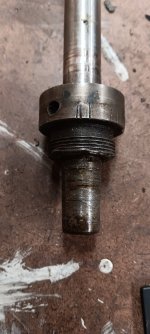
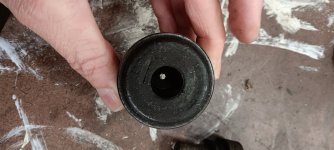
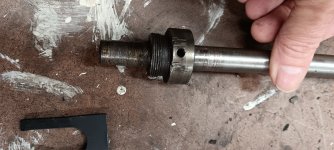
Hi all, I wanted to update you. I was able to pop the chuck off last night with wedges so that was a relief. I may have mashed the threads above a little bit. Is it possible to fix those or remove that piece? I guess it doesn’t matter in the end? It is a Jacob’s 6A with a 33 taper FrankLee, like you thought. I will look for disassembly instructions when I have some time. Thanks again for all of the help.
Attachments


FrankLee
Well-known member
Threads can be made usable with a thread file. IIRC, that collar is threaded 1-1/16, 20 tpi.Hi all, I wanted to update you. I was able to pop the chuck off last night with wedges so that was a relief. I may have mashed the threads above a little bit. Is it possible to fix those or remove that piece?
I don't think so. The only time you'd need them is with an uncommon taper attachment; router bit collet, planer attachment, etc.I guess it doesn’t matter in the end?
Jacobs Service and Repair:It is a Jacob’s 6A with a 33 taper FrankLee, like you thought. I will look for disassembly instructions when I have some time. Thanks again for all of the help.
I use a puller.
The end of your jaws have a rather large arc to them, i.e., they are worn.
Bbp78
Well-known member
Thank you FrankLee for all the information. I wasn’t familiar with a thread file, but that’s not saying much, lol. Thank you for teaching me. Do you think it makes sense to get a new chuck if it’s so worn? If so, is there a particular chuck to buy? Thanks again.
DaveAndStuff
Well-known member
I would buy a new chuck, what you buy depends on what you want to do.
FrankLee
Well-known member
It really depends on your expectations.Do you think it makes sense to get a new chuck if it’s so worn?
How badly are the jaws worn? Are just the ends worn? You won't really know until you get it apart and inspected.
The jaws below area good example. The bit contacts are straight and narrow, but the ends at the bottom are slightly damaged. I consider these to be in good usable condition.
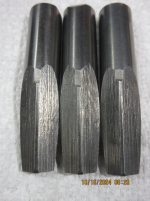
These, on the otherhand, are not. The bit contacts have a very slight taper and have much more damage toward the bottom.

These have uneven wear. The bit contacts are of different widths. The bits used in this chuck very likely spun in the chuck.
It's a good practice to tighten the chuck with the key in all three pilot holes.

Are you going to use the drill press on a daily basis?
What materials will you be drilling? Wood is more forgiving than metal.
There are many grades of quality and therefore a wide price range. Again, it depend on how much you are willing to spend.If so, is there a particular chuck to buy?
IMO, based on the condition of the spindle, I would not spend a lot.
Last edited:
Bbp78
Well-known member
Thank you both for your responses. I’m just a woodworker so won’t really be drilling metal very much. It appears Jacob’s still makes quality chucks, but they are not cheap. I have no problem paying for a new one if necessary since I’m putting all this work into it. I will try to get the chuck apart to inspect it further. FrankLee when you say the condition of the spindle, are you referring to the threads? Maybe I’ll try a thread file like you said before to see if I can make them better. When you say you use a puller for the chuck, is that a bearing puller? Thanks again.
FrankLee
Well-known member
The threads, the pipe wrench marks, the impact marks, the striations on the taper... Were you able to check runout?Thank you both for your responses. I’m just a woodworker so won’t really be drilling metal very much. It appears Jacob’s still makes quality chucks, but they are not cheap. I have no problem paying for a new one if necessary since I’m putting all this work into it. I will try to get the chuck apart to inspect it further. FrankLee when you say the condition of the spindle, are you referring to the threads? Maybe I’ll try a thread file like you said before to see if I can make them better.
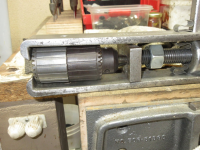
I use a Proto puller with a sleeve from a fubar chuck to dismantle and reassemble chucks.When you say you use a puller for the chuck, is that a bearing puller? Thanks again.
Craftsman Drill Press
DP#151 - Part 8 I refurbished the chuck this morning. This is a Ridgid Supreme chuck, model 6T33C. It was a little sluggish opening and closing, so it definitely needed dismantling. This chuck is very similar to a Jacobs 633C, but the procedure to dismantle is very different. It took several...
 www.garagejournal.com
These Proto pullers are very versatile. I found all my pullers at estate sales and garage sales.


JonahBrown
Well-known member
- Joined
- May 5, 2025
- Messages
- 110
I believe you want the surface below the threads to be flat.Hi all, I wanted to update you. I was able to pop the chuck off last night with wedges so that was a relief. I may have mashed the threads above a little bit. Is it possible to fix those or remove that piece? I guess it doesn’t matter in the end? It is a Jacob’s 6A with a 33 taper FrankLee, like you thought. I will look for disassembly instructions when I have some time. Thanks again for all of the help.
DaveAndStuff
Well-known member
For woodwork I would just buy something like this:

JonahBrown
Well-known member
- Joined
- May 5, 2025
- Messages
- 110
I found a NOS Jacob’s chuck at a local distributor 15 years ago when I was rebuilding my WT900 and put that on it. It had some chinese junk chuck on it and I wanted it restored to original. I actually found a NOS set of quill bearings at the time as well.
Bbp78
Well-known member
FrankLee thank you, I haven’t checked runout yet or been able to do much lately. I tried cleaning some of the parts on Sunday and got them cleaned pretty well. Can I soak everything in mineral spirits to help dissolve the old grease? I cleaned them with Simple green and now have them soaking in WD40, hopefully that’s not a mistake. That puller looks awesome, is there a redneck way to do this, lol? I’m not sure I’ll be able to track a puller like that down.The threads, the pipe wrench marks, the impact marks, the striations on the taper... Were you able to check runout?
Wow Jonah what a great find, I see a few other WT drill presses by me, but not sure I want to start collecting for parts.I found a NOS Jacob’s chuck at a local distributor 15 years ago when I was rebuilding my WT900 and put that on it. It had some chinese junk chuck on it and I wanted it restored to original. I actually found a NOS set of quill bearings at the time as well.
I use a Proto puller with a sleeve from a fubar chuck to dismantle and reassemble chucks.
Craftsman Drill Press
DP#151 - Part 8 I refurbished the chuck this morning. This is a Ridgid Supreme chuck, model 6T33C. It was a little sluggish opening and closing, so it definitely needed dismantling. This chuck is very similar to a Jacobs 633C, but the procedure to dismantle is very different. It took several...
These Proto pullers are very versatile. I found all my pullers at estate sales and garage sales.
Dave, that’s something to think about if I can’t get the Jacob’s apart. ThanksFor woodwork I would just buy something like this:
FrankLee
Well-known member
I'm not sure what you mean by everything, but I soak many parts in mineral spirits or lacquer thinner. I clean many other parts with Grez-Off without any further soaking.FrankLee thank you, I haven’t checked runout yet or been able to do much lately. I tried cleaning some of the parts on Sunday and got them cleaned pretty well. Can I soak everything in mineral spirits to help dissolve the old grease? I cleaned them with Simple green and now have them soaking in WD40, hopefully that’s not a mistake.
It is.That puller looks awesome,
Some dismantle chucks using a vise as a press. Check Jeff's Shop video. Jeff is member @11b30b4 here on GJ.is there a redneck way to do this, lol? I’m not sure I’ll be able to track a puller like that down.
Last edited:
Bbp78
Well-known member
Hi all, I’ve been busy with life and work so haven’t done much on the press lately. I got out tonight and tried to get the bearing off the quill, but couldn’t seem to get it to budge. The other side came out easily after I removed the nut and conical washer. Does anyone know if the bearing on the other side is unable to be removed? If I can, do you have any tips? Thanks again for any advice.
Attachments


DaveAndStuff
Well-known member
Are you replacing the bearing?
Can you not get behind it with a long punch/bar from the opposite end?
Can you not get behind it with a long punch/bar from the opposite end?
FrankLee
Well-known member
I insert a long wooden dowel into the quill, turn the assembly over and slam the dowel onto my anvil until the bearing pops out. It destorys the bearing, but works quite well.
Bbp78
Well-known member
Thanks Dave and Frank. I was trying to punch it out last night from the other side, but didn’t want to damage it. It’s my understanding that these bearings are no longer available as Walker Turner used odd sized bearings. I was nervous I was going to get into a situation where I ruined the press if I go too far. What are your thoughts? If I can’t get bearings, is it possible to lubricate this bearing as is? It seems impossible to do that but I have no idea. Thanks again.
FrankLee
Well-known member
Ok, that's a concern.
In your situation, I would try to find a piece of round steel/brass stock that is slightly smaller than the ID of the quill case, drop it into the quill. The steel stock would rest on the inner race and not damage the shield. Then use the dowel somewhat less aggressively... maybe clamp the quill onto the work bench and use a mallet. Additionally, heating the quill around the bearing should help too.
You would still have to lubricate the bearing. Depending on how dirty the bearing is, you could remove one shield to thoroughly clean and relube the bearing. The open side would be installed toward the inside of the quill.
In your situation, I would try to find a piece of round steel/brass stock that is slightly smaller than the ID of the quill case, drop it into the quill. The steel stock would rest on the inner race and not damage the shield. Then use the dowel somewhat less aggressively... maybe clamp the quill onto the work bench and use a mallet. Additionally, heating the quill around the bearing should help too.
You would still have to lubricate the bearing. Depending on how dirty the bearing is, you could remove one shield to thoroughly clean and relube the bearing. The open side would be installed toward the inside of the quill.
DaveAndStuff
Well-known member
If you're not going to replace the bearing, don't tear it up. You can oil it without removing it, and if they are not sloppy, it's a waste.
I doubt the bearings are all that odd. You have one out, are they the same? Do you have decent caliper you can measure it with?
With the dimensions you can likely find new bearings and check the prices and see what you want to do.
If you go with new bearings, check the fit BEFORE you bang the old one out,
Good luck!
I doubt the bearings are all that odd. You have one out, are they the same? Do you have decent caliper you can measure it with?
With the dimensions you can likely find new bearings and check the prices and see what you want to do.
If you go with new bearings, check the fit BEFORE you bang the old one out,
Good luck!
Bbp78
Well-known member
Thank you Frank and Dave. Let me check the size of the other one I was able to remove to see if it’s the same size, I think it is. I bought calipers recently so that will help. If I don’t remove it, do I try to get some Super Lube Oil inside it or how would I lubricate it, I don’t think I could get grease in it. I’m out of my element here, thanks again.
FrankLee
Well-known member
I would not recommend mixing the original grease with a synthetic oil. Use 3-in-One 20 weight, or regular 3-in-One.If I don’t remove it, do I try to get some Super Lube Oil inside it or how would I lubricate it, I don’t think I could get grease in it.
I would also heat the original bearing on a light bulb for about five minutes to loosen up the original grease. Then, spin it on a buffing wheel.
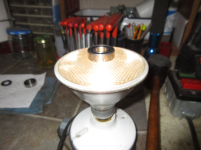
While still warm, add oil around the gap between the inner race and the shield. Hold a rag over the hose on a shop vac. Place the bearing on the rag and add more oil with the vac running. Spin the bearing again on the buffing wheel. Right or wrong, I've done this many times with good results.
Last edited:
Bbp78
Well-known member
Thank you Frank, I’m hoping to get some time tomorrow night to do some more. Thanks again for all the help.
Bbp78
Well-known member
I was able to get out in the shop tonight. The bearings are SKF I 70336 AZ. They are 35 mm OD, 15.75 mm shaft, 10.96 mm thick. I googled that and couldn’t locate much. I need to look more, the 10.75 mm shaft seems like it will be difficult to find. The bearings in the quill are pretty stiff, I wonder if I damaged something trying to pop them out the other day. They don’t look damaged though. This is a shame, what a beautiful machine to have such odd bearings. If I can’t locate new bearings, Frank I will try your method above. On the bearing I was able to get out for the other end of the quill, do you recommend something like Super Lube grease? Thanks again.
DaveAndStuff
Well-known member
Is the fit between the shaft and the bearing sloppy?I was able to get out in the shop tonight. The bearings are SKF I 70336 AZ. They are 35 mm OD, 15.75 mm shaft, 10.96 mm thick. I googled that and couldn’t locate much. I need to look more, the 10.75 mm shaft seems like it will be difficult to find. The bearings in the quill are pretty stiff, I wonder if I damaged something trying to pop them out the other day. They don’t look damaged though. This is a shame, what a beautiful machine to have such odd bearings. If I can’t locate new bearings, Frank I will try your method above. On the bearing I was able to get out for the other end of the quill, do you recommend something like Super Lube grease? Thanks again.
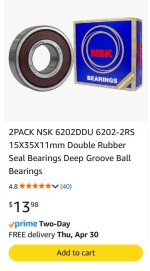
15 X 11 X 35 is common
FrankLee
Well-known member
In general,If I can’t locate new bearings, Frank I will try your method above. On the bearing I was able to get out for the other end of the quill, do you recommend something like Super Lube grease?
I use Super Lube Grease and Oil almost exclusively for machine reassembly, but only after thoroughly cleaning off all previous lubricants.
I use Mobil Polyrex EM, Motor Grease, when repacking ball bearings.
I use 3-in-One sae 20 in motors with sleeve bearings.
I would find a bearing house nearby for their opinion.
Last edited:
Bbp78
Well-known member
Thank you Frank and Dave. I called two bearing suppliers and one of them was very helpful and said it sounds like I need a 6202-10ZZ bearing, but asked me to bring everything in for them to measure it. Dave I found some 6202ZZ Timken bearings on Amazon. Not sure if they will work because the 10 is missing, but they will be here tomorrow and I can check. I’m going to try this first as the bearing supplier is an hour away. Fingers crossed, thank you both again. If they look the same, I guess I’ll put some Kano Kroil in the one that’s stuck to see if I can get it out. What’s the best practice to put the new ones on if they work since I don’t have a press. Is it just a dowel or copper or brass pipe to hammer it on gently?