To avoid these ads, REGISTER NOW!

Removing a broken wheel stud

dwasifar

Well-known member
Joined
May 28, 2017
Messages
2,097
Today I had to remove a broken wheel stud from the rear hub of a Subaru. (A tire shop, or maybe the dealer, crossthreaded the lug nut, and it jammed and torqued off when I tried to remove the nut.) I did what I've always done: knocked it out with a hammer, and pulled a new one through the hole with a lug nut.

Later on, I got curious and googled this task. Maybe two-thirds of the results recommended this same procedure. The others recommended pressing it out with a tie rod end remover or the like, on the grounds that the hammer blows will damage the wheel bearing. (One of them also recommended you throw away the lug nut you use to pull the new stud through, in the belief that it will stretch the threads. Why it would damage the nut, but not the new stud, is not explained, but I digress.)

In this particular case I think I would still have used a hammer, rather than disassemble the tiny-toons drum brake Subaru uses for a parking brake in order to get a pressing tool onto the back of the hub. And I feel like if a wheel bearing can take 100k miles of road shocks to the hub, it can probably take a couple of hammer shocks too. You don't really have to hit it all that hard. But am I wrong? Is the hammer actually not a good idea?
 
To avoid these ads, REGISTER NOW!

BillK

Well-known member
Joined
Aug 24, 2006
Messages
9,349
Location
Beautiful Southern Maryland
Depends on how easy they come out. Most of those hubs, drums, rotors etc now days seem to be so flimsy that knocking the stud out with a hammer could knock the rotor/hub out of whack. Its a judgement call. Not sure about the lug nut. As long as you dont exceed the rated torque I dont see how using it to pull the stud in would hurt anything.
 
OP
D

dwasifar

Well-known member
Joined
May 28, 2017
Messages
2,097
Depends on how easy they come out. Most of those hubs, drums, rotors etc now days seem to be so flimsy that knocking the stud out with a hammer could knock the rotor/hub out of whack. Its a judgement call. Not sure about the lug nut. As long as you dont exceed the rated torque I dont see how using it to pull the stud in would hurt anything.

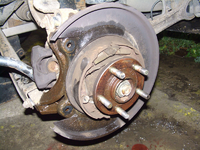
The hub actually seems reasonably robust:

1680311835926.png

This is not my actual car, just a pic I found on the internet, but that's what it looks like with the rotor off.
 

2ndGearRubber

Well-known member
Joined
Mar 24, 2014
Messages
14,185
Location
Pittsburgh
Just hit it with a hammer. The thinnest stuff I've seen is the rear hubs of some small toyota/honda products and you're not bending that before you overcome the grip of the splines on the stud.
 

plinker

Well-known member
Joined
Feb 28, 2007
Messages
4,286
Location
Northern Wi
Depends on the hub, most are pretty solid to where hammering should damage anything. Preference to using an air hammer & long punch though.

Couple things I've run into is the new stud being to large of a diameter on the shoulder to fit the hole in the hub (aftermarket hub) and also not being able to remove the stud after knocking them loose as the flange to knuckle is too close to get the stud out (FCA mini vans IIRC, rear hub).
 

The Cobbler

Super Moderator
Staff member
Joined
Oct 24, 2013
Messages
25,949
Location
Niagara Region, Ontario, Canada
I don;t think punching a wheel stud out will do anything to the hub to distort it . on the few studs I;ve replaced in my life, whem installing new ones, I try to line up the grooves already in the hub to the spline and pull the stud in with a wheel nut & a spacer(s)
 
To avoid these ads, REGISTER NOW!
OP
D

dwasifar

Well-known member
Joined
May 28, 2017
Messages
2,097
I didn't need a punch for this one because it broke at the lug nut, so there was plenty left sticking out to hit with a hammer.

1680320912105.png

As for the installation, I usually just scrounge up whatever improvised spacer will fit. In this case I used an oil filter cap wrench with a combination hex/square drive on the cap. The hole through it was big enough for the stud, and it was thick enough so I could pull the stud all the way down without bottoming out the acorn lug nut.

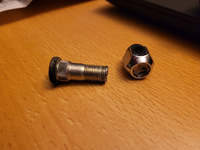
Now I will always know which stud I replaced, because the replacement has an M stamped on the end.
 

whitesco

Well-known member
Joined
Aug 1, 2022
Messages
399
Location
Pittsburgh, PA (ish)
I use the consensus method - pound the old one out and pull the new one in. I usually use a stack of washers and an old non-capped lug nut though, not the wheel and nut that will go on the finished product. Just out of an abundance of caution, may not be completely necessary. I like to see the new stud fully seated, don’t want to damage wheel, etc..
 

dnschmidt

Well-known member
Joined
Oct 3, 2014
Messages
7,285
Location
Phoenix, AZ
I use an air hammer to whack them out, after drilling a small pilot hole for a pointed chisel bit, and an impact with a stack of washers to put them in. Works for me.
 

dchawk81

Well-known member
Joined
Jul 31, 2014
Messages
14,410
I use an air hammer to whack them out, after drilling a small pilot hole for a pointed chisel bit, and an impact with a stack of washers to put them in. Works for me.
That's funny I've always been able to wack them out with a half *** swing of a 4 lb hammer. Even on the semi truck.
 

tooljunkie4

Well-known member
Joined
Apr 25, 2011
Messages
1,776
Location
Maryland
This type of installer works well when greased. Doesn't screw up a second lug nut (a stack of washers can deform the taper and mushroom the end of the lug). When lubricated, it doesn't tear up the threads on the stud or those on the tool - even if the splines on the replacement stud are a bit more aggressive and resist installation.

Wheel Stud Installer Set.jpg
 

2ndGearRubber

Well-known member
Joined
Mar 24, 2014
Messages
14,185
Location
Pittsburgh
This type of installer works well when greased. Doesn't screw up a second lug nut (a stack of washers can deform the taper and mushroom the end of the lug). When lubricated, it doesn't tear up the threads on the stud or those on the tool - even if the splines on the replacement stud are a bit more aggressive and resist installation.

Wheel Stud Installer Set.jpg

That's my.preference.

I have some of the bearing style, which work okay. They don't respond well to acorn lug nuts like nissans or subaru where the flats of the lug can dig into the tool while installing. Yes you can just buy extra lugs of a different design. You also need a larger version for some trucks.

I bought the above tool and haven't looked back.
 
To avoid these ads, REGISTER NOW!
Top Bottom