To avoid these ads, REGISTER NOW!

removing loft and supporting trusses

MrPink

Well-known member
Joined
Feb 16, 2021
Messages
1,178
Location
Bridgeport,MI
Ok so in my 20x20 shop. there is a loft, however its sketchy, the floor is supported only by 2x4's which are at the top of the wall. I am wondering if i can remove the deck, and raise or add truss supports further up thus increasing the working height in the shop too. In theory i want to remove the loft and give my ceiling height a raise to possibly add a hoist, currently has a working height of 9ft i believe,
 
To avoid these ads, REGISTER NOW!

Superbowl

Active member
Joined
Feb 19, 2026
Messages
40
Location
DC area
You can do anything is you apply the right amount of money.

Your questions/descriptions are unclear. If you have trusses you can not cut the bottom cord. You could tear the roof off, build up the walls, and reuse the trusses. If you just want to make the loft floor stronger, you can sister another 2x4 to the bottom truss cords.

If you have a cut roof (no trusses) then you have to figure out if your ridge is a BEAM (usually a double 2x8, 2x10, 2x12 )with posts (at least 4x4) on either end that run down to the foundation or just a ridge BOARD that is just supported by the rafters and not supported on the ends. Ridge BOARDS need ceiling joists to keep the walls from pushing out so like the bottom cord of a trusses, those joists can not be removed or cut. With a ridge BEAM, the posts at either end the rafters do not push out the walls allowing for cathedral ceilings.
 
OP
M

MrPink

Well-known member
Joined
Feb 16, 2021
Messages
1,178
Location
Bridgeport,MI
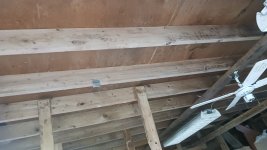
Ok so crappy pics but here is looking up and then up in the loft, but I want to eliminate the loft, and have enough room for a lift.

20260331_182804.jpg
20260331_182829.jpg

20260331_182853.jpg

20260331_182910.jpg


I was wrong they are 2x6 not 2x4. For the floor support.
 

KenC

Well-known member
Joined
Dec 20, 2009
Messages
2,577
It appears you have a steep roof, maybe 12/12. 2x6 rafters and ceiling joists.

My questionable conclusion is that raising the joists is doable. Remove the decking and working one at a time remove and shorten the joists. Shorten to fit the space that is 1/3 of the distance from peak to current location. Attach them to the rafters at that location using your choice of nailing on the side of the rafter, or ply gussets on the flush rafter and joist.
 

strutaeng

Well-known member
Joined
Dec 12, 2011
Messages
2,261
Location
Dallas, TX
That looks like a traditional rafters+rafter ties (which are your ceiling joists). It's more like an attic.

So you basically want to raise the "ceiling," but the attic (loft that you are calling) is in the way? How much?

You can probably do it, yes, but it will involve some work to reinforce stuff and/or add additional framing stuff...

My joke is that with time and money, you can do anything.
 
OP
M

MrPink

Well-known member
Joined
Feb 16, 2021
Messages
1,178
Location
Bridgeport,MI
That looks like a traditional rafters+rafter ties (which are your ceiling joists). It's more like an attic.

So you basically want to raise the "ceiling," but the attic (loft that you are calling) is in the way? How much?

You can probably do it, yes, but it will involve some work to reinforce stuff and/or add additional framing stuff...

My joke is that with time and money, you can do anything.
I would like to go from 9ft to 12ft it's a large 1 car shop(20x20) so my hoist will be dead in the center of it.
 

Skooterj

Well-known member
Joined
Mar 11, 2021
Messages
749
Location
Indiana
Your "loft" is keeping the walls from bowing outward and your roof falling. The bottom cord in a rafter style construction is called a rafter tie. There are ways to raise them, but not much. I believe they still need to be in the bottom third of the height from the roof peak to the walls the roof sits on. Fasteners need to be upgraded as well, since the stress on the beam to keep the walls from bowing increases as well. Can you remove it altogether, not easily.
 
OP
M

MrPink

Well-known member
Joined
Feb 16, 2021
Messages
1,178
Location
Bridgeport,MI
Your "loft" is keeping the walls from bowing outward and your roof falling. The bottom cord in a rafter style construction is called a rafter tie. There are ways to raise them, but not much. I believe they still need to be in the bottom third of the height from the roof peak to the walls the roof sits on. Fasteners need to be upgraded as well, since the stress on the beam to keep the walls from bowing increases as well. Can you remove it altogether, not easily.
this makes sense. So let me ask this instead, can I sister boards to the existing rafter ties then to strengthen the floor support? I am unsure if its just me or not but the loft floor didn't seem stable.
 

BillK

Well-known member
Joined
Aug 24, 2006
Messages
9,311
Location
Beautiful Southern Maryland
The "upper level" might not have been designed to have a floor and somebody might have added it. If you have 2x6's spanning 20ft then I would say it is definitely not designed for a floor.

How about a picture looking in from the main door showing the whole shop. Its really hard to tell what you have from the pictures so far. Is the floor over the entire 20x20 area ?
 
OP
M

MrPink

Well-known member
Joined
Feb 16, 2021
Messages
1,178
Location
Bridgeport,MI
The "upper level" might not have been designed to have a floor and somebody might have added it. If you have 2x6's spanning 20ft then I would say it is definitely not designed for a floor.

How about a picture looking in from the main door showing the whole shop. Its really hard to tell what you have from the pictures so far. Is the floor over the entire 20x20 area ?
it is except for the 3x3 opening where the stairs go up
 

Firebrick43

Well-known member
Joined
May 12, 2015
Messages
14,003
Location
West central Indiana
this makes sense. So let me ask this instead, can I sister boards to the existing rafter ties then to strengthen the floor support? I am unsure if its just me or not but the loft floor didn't seem stable.
It wont do much if you make them the same size. You can add deeper joist and sister in but that will make the head room even smaller.

The reason your floor feels unstable is because it shouldn't have any weight on it at that span. A 2x6, as a ceiling joist, with no load on it other than ceiling weight only has an allowable span of 14' on 16" centers. It should be 2x8 on 16" centers just for the ceiling weight and no storage minimum.

Looking up the floor joist span tables says that 20' span is only doable with Douglas fir 2x12 on 12" centers. 14" deep LVL I joist can also do it on 16" centers.
 

cgrutt

Well-known member
Joined
Mar 4, 2016
Messages
8,200
No help with the headroom but is it possible to run a beam underneath ceiling rafters with a couple (at least) posts running to ground to help support floor?
 
OP
M

MrPink

Well-known member
Joined
Feb 16, 2021
Messages
1,178
Location
Bridgeport,MI
No help with the headroom but is it possible to run a beam underneath ceiling rafters with a couple (at least) posts running to ground to help support floor?
That would eliminate the usability of the workspace that i currently have.
 

CraigStu

Well-known member
Joined
May 22, 2014
Messages
4,017
Location
Blacksburg, Va
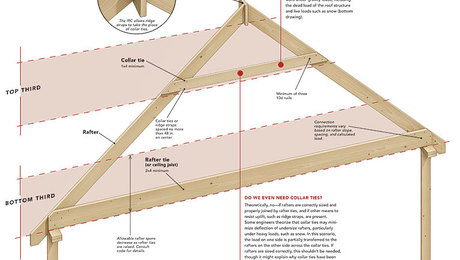
As Skooterj says, "Your "loft" is keeping the walls from bowing outward and your roof falling...". So the rafter ties are needed. But; 1- which way do they run? Are they parallel to a car in the garage? 2- How far apart are they? I ask because you might be able to add new rafter ties 2-3ft higher and then remove 2 or 3 of them and get just enough room for the roof of a lifted car to fit in between. Here is an article on rafter and collar ties.
I could see removing just enough of the plywood for the car opening and leave the rest in place.
 
OP
M

MrPink

Well-known member
Joined
Feb 16, 2021
Messages
1,178
Location
Bridgeport,MI
As Skooterj says, "Your "loft" is keeping the walls from bowing outward and your roof falling...". So the rafter ties are needed. But; 1- which way do they run? Are they parallel to a car in the garage? 2- How far apart are they? I ask because you might be able to add new rafter ties 2-3ft higher and then remove 2 or 3 of them and get just enough room for the roof of a lifted car to fit in between. Here is an article on rafter and collar ties.
I could see removing just enough of the plywood for the car opening and leave the rest in place.
they run perpendicular.
 
To avoid these ads, REGISTER NOW!

cgrutt

Well-known member
Joined
Mar 4, 2016
Messages
8,200
i dont plan on using it for storage, i really want to remove it as a whole
Yeah I was responding to your comment that the floor doesn't feel right (paraphrasing). You can probably pull it out provided, as others stated, you add rafters ties in bottom third of roof structure. It looks like the roof rafters are 2x6 which may be fine but are likely on minimum requirements. The "rafter ties" there now are really more like ceiling joists as (I'm assuming) they are likely sitting on your top plates and keeping roof and walls from spreading under load. I say more like ceiling joists as I suspect they are undersized to support a floor load in attic given span. Plywood may have been added later for storage. Problem is once you raise them they are no longer physically connected to the top plates (which may be fine) so need to make sure the roof rafters are adequately sized to support load. You would definitely need to add rafter ties higher (absent other modifications such as a ridge beam with appropriate posts) and possibly modifications to the top plates. I'm just concerned about the 2x6s seems light. Probably best to have an engineer look at it.
 

Jackfre

Well-known member
Joined
Dec 26, 2010
Messages
4,406
Location
N CA
Well, you are in Michigan and you do, as you can attest this winter, get snow and it is heavy. Don’t worry about yourself. Worry about the car. Call an engineer
 

Firebrick43

Well-known member
Joined
May 12, 2015
Messages
14,003
Location
West central Indiana
Yeah I was responding to your comment that the floor doesn't feel right (paraphrasing). You can probably pull it out provided, as others stated, you add rafters ties in bottom third of roof structure. It looks like the roof rafters are 2x6 which may be fine but are likely on minimum requirements. The "rafter ties" there now are really more like ceiling joists as (I'm assuming) they are likely sitting on your top plates and keeping roof and walls from spreading under load. I say more like ceiling joists as I suspect they are undersized to support a floor load in attic given span. Plywood may have been added later for storage. Problem is once you raise them they are no longer physically connected to the top plates (which may be fine) so need to make sure the roof rafters are adequately sized to support load. You would definitely need to add rafter ties higher (absent other modifications such as a ridge beam with appropriate posts) and possibly modifications to the top plates. I'm just concerned about the 2x6s seems light. Probably best to have an engineer look at it.
You are correct in your assessment of what is there but there really is no reason to have an engineer look at it if they are only used as ceiling joist and the plywood floor is removed.

The building code allows for standard construction without engineering if it follows the included tables.

Therefore 2x8 ceiling joist/rafter ties of the appropriate species/grade [IRC802.5.1(2)]would be perfectly acceptable if they are attached in the bottom third of the rafters and attached according to code IRC802.5.2 and the rafters are correctly size[IRC R802.4.1(4)]
 
OP
M

MrPink

Well-known member
Joined
Feb 16, 2021
Messages
1,178
Location
Bridgeport,MI
You are correct in your assessment of what is there but there really is no reason to have an engineer look at it if they are only used as ceiling joist and the plywood floor is removed.

The building code allows for standard construction without engineering if it follows the included tables.

Therefore 2x8 ceiling joist/rafter ties of the appropriate species/grade [IRC802.5.1(2)]would be perfectly acceptable if they are attached in the bottom third of the rafters and attached according to code IRC802.5.2 and the rafters are correctly size[IRC R802.4.1(4)]
I will say that new code yes requires that, but when this was built(1950) i am sure this passed lol.
 

Firebrick43

Well-known member
Joined
May 12, 2015
Messages
14,003
Location
West central Indiana
I will say that new code yes requires that, but when this was built(1950) i am sure this passed lol.
That is irrelevant to the conversation.

You want to make a change.

If you change anything you have to bring that part up to current code.

I do have to say that is the cleanest and lightest 75 year old wood I have seen
 
OP
M

MrPink

Well-known member
Joined
Feb 16, 2021
Messages
1,178
Location
Bridgeport,MI
The more i sit and think about it I think I am just going to make the loft inaccessible (remove the stairs) for the time being, I don't need my 2 young kids getting hurt because it fails to support their weight if they go up there.

I appreciate the input on the idea that i had
 

cgrutt

Well-known member
Joined
Mar 4, 2016
Messages
8,200
You are correct in your assessment of what is there but there really is no reason to have an engineer look at it if they are only used as ceiling joist and the plywood floor is removed.

The building code allows for standard construction without engineering if it follows the included tables.

Therefore 2x8 ceiling joist/rafter ties of the appropriate species/grade [IRC802.5.1(2)]would be perfectly acceptable if they are attached in the bottom third of the rafters and attached according to code IRC802.5.2 and the rafters are correctly size[IRC R802.4.1(4)]
Thanks. So for sake of argument we can use same span table for both roof rafters and ceiling joists at same load? Didn't realize that. So one table shows 16'11 span for 2x6 on 16" centers. This is limited load and for SPF wood. So in that case 2x6 should be good for both existing roof rafters and new ceiling rafters if OP goes up 1/3 height. I'm assuming 10' roof rafter span and approx 13.5' ceiling joist (rafter tie) span with 12:12 (estimated based on pic) roof pitch. He can reuse the existing ceiling joists and just cut to required length. Is this correct?
 

cgrutt

Well-known member
Joined
Mar 4, 2016
Messages
8,200
The more i sit and think about it I think I am just going to make the loft inaccessible (remove the stairs) for the time being, I don't need my 2 young kids getting hurt because it fails to support their weight if they go up there.

I appreciate the input on the idea that i had
Your kids and do whatever you feel is best but I don't think two kids are the kind of load we're talking about. Pretty sure loft will support them just don't use it to store all of your stuff.
 

Firebrick43

Well-known member
Joined
May 12, 2015
Messages
14,003
Location
West central Indiana
Thanks. So for sake of argument we can use same span table for both roof rafters and ceiling joists at same load?
Not exactly. Depends where you are. I should have looked it the required snow loads for the OP location. And that does mean that his rafters are probably undersized. I am pretty sure he would be on the line for the 30/35 lbs snow load in bridgeport. That would mean that rafter table R802.5.1(5) should be used not (4). My bad. ASSuming 12:12 roof (I don't like assumption) then the actual rafter span is 14.4' Table R802.5.1(5) has 2x6 rafters a max span of 9-13' depending on species or grade, so the current rafters would be too small in that case and need to have 2x8 rafters sistered in

Screenshot_2-4-2026_13542_up.codes.jpeg
Didn't realize that. So one table shows 16'11 span for 2x6 on 16" centers. This is limited load and for SPF wood. So in that case 2x6 should be good for both existing roof rafters and new ceiling rafters if OP goes up 1/3 height. I'm assuming 10' roof rafter span and approx 13.5' ceiling joist (rafter tie) span with 12:12 (estimated based on pic) roof pitch. He can reuse the existing ceiling joists and just cut to required length. Is this correct?
If your guess that the pitch was actually 12:12 and the ceiling rafter span would then be 13.34' raised 1/3 of rafter height if my math is correct, then yes he could reuse the 2x6 ceiling joist, (no storage still) assuming that the quality/grade is correct.
 
Last edited:

cgrutt

Well-known member
Joined
Mar 4, 2016
Messages
8,200
Not exactly. Depends where you are. I should have looked it the required snow loads for the OP location. And that does mean that his rafters are probably undersized. I am pretty sure he would be on the line for the 30/35 lbs snow load in bridgeport. That would mean that rafter table R802.5.1(5) should be used not (4). My bad. ASSuming 12:12 roof (I don't like assumption) then the actual rafter span is 14.4' Table R802.5.1(5) has 2x6 rafters a max span of 9-13' depending on species or grade, so the current rafters would be too small in that case and need to have 2x8 rafters sistered in

Screenshot_2-4-2026_13542_up.codes.jpeg

If your guess that the pitch was actually 12:12 and the ceiling rafter span would then be 13.34' raised 1/3 of rafter height if my math is correct, then yes he could reuse the 2x6 ceiling joist, (no storage still) assuming that the quality/grade is correct.
Sorry for the sidetrack but confused about your comments regarding the roof rafters isn't the span 10' irrespective of pitch (i.e. one-half the building width)? If I'm following you correctly the 14'4" would be rafter length, no? But don't you use horizontal span in the tables?

Note image below shows this as "half-span".

images (38).jpeg
 
Last edited:

Firebrick43

Well-known member
Joined
May 12, 2015
Messages
14,003
Location
West central Indiana
Sorry for the sidetrack but confused about your comments regarding the roof rafters isn't the span 10' irrespective of pitch (i.e. one-half the building width)? If I'm following you correctly the 14'4" would be rafter length, no? But don't you use horizontal span in the tables?

Note image below shows this as "half-span".

images (38).jpeg
Did you use the 0.67 adjustment factor at the bottom of the table for having the ceiling joist 1/3 up? I am using decimals not '/" yes that is the rafter length. Span with adjustment factor would actually be 14.9'. Still require a 2x8
 

cgrutt

Well-known member
Joined
Mar 4, 2016
Messages
8,200
Did you use the 0.67 adjustment factor at the bottom of the table for having the ceiling joist 1/3 up? I am using decimals not '/" yes that is the rafter length. Span with adjustment factor would actually be 14.9'. Still require a 2x8
I'm saying that I think the roof rafter span is 10' (+/-) and the existing 2x6s are probably fine. I think we're talking about different things. I thought you were saying the roof rafter (not ceiling joist/rafter tie) span was 14'4" and 2x6s should not have been used. Anyway sorry for the sidetracked.

I was referring to your comment

then the actual rafter span is 14.4' Table R802.5.1(5) has 2x6 rafters a max span of 9-13' depending on species or grade, so the current rafters would be too small
 
Last edited:

Firebrick43

Well-known member
Joined
May 12, 2015
Messages
14,003
Location
West central Indiana
I'm saying that I think the roof rafter span is 10' (+/-) and the existing 2x6s are probably fine.
You are not applying the .67 correction factor at the bottom of the table in if you move the ceiling joist up 1/3 the height, its not fine if you do. If you apply it the theoretical span to use in the table is 14.9' or 14'11"

Screenshot 2026-04-02 145737.png
 

cgrutt

Well-known member
Joined
Mar 4, 2016
Messages
8,200
You are not applying the .67 correction factor in if you move the ceiling joist up 1/3 the height, its not fine if you do
Nevermind. We're talking apples and oranges. I'm talking about the existing roof rafters not about moving the ceiling joists/rafter ties up. All I'm saying is that the "span" used for the tables is the horizontal projection of the rafter not its length. I think the appropriate span (for the roof rafters) is approximately 10' (one-half the building width) and that the 2x6s used are probably fine.

ETA so adjustment factor is used to adjust roof rafter span because the ceiling joist is not on the top plate? OK I get it now.

But now I'm confused by the math. "Multiplying the span by the factor" of 0.67 doesn't that result in a shorter span length? I get 10' DIVIDED by 0.67 equals 14.9' but table says to multiply not divide? Sorry for being so thick with this just trying to understand what it means. Thanks
 
Last edited:

Firebrick43

Well-known member
Joined
May 12, 2015
Messages
14,003
Location
West central Indiana
Nevermind. We're talking apples and oranges. I'm talking about the existing roof rafters not about moving the ceiling joists/rafter ties up. All I'm saying is that the "span" used for the tables is the horizontal projection of the rafter not its length. I think the appropriate span (for the roof rafters) is approximately 10' (one-half the building width) and that the 2x6s used are probably fine.
Yes the current rafters are sized correctly, but the ceiling joist are not. If you cut/move the ceiling joist reducing their span, and hang them on the rafters, then the rafters are too small. Either way, something needs enlarged to make moving things up right if anything is altered
 

cgrutt

Well-known member
Joined
Mar 4, 2016
Messages
8,200
Yes the current rafters are sized correctly, but the ceiling joist are not. If you cut/move the ceiling joist reducing their span, and hang them on the rafters, then the rafters are too small. Either way, something needs enlarged to make moving things up right if anything is altered
Lightbulb went off thanks and sorry for being thick. I still don't understand the math but that's fine. I edited my last comment.
 

Firebrick43

Well-known member
Joined
May 12, 2015
Messages
14,003
Location
West central Indiana
As far as the math. If you want to multiply all the values tables by .67 it reduces the all the spans listed. That is fine if you want to do it that way.

Instead of multiplying every span on the table one can inversely divide the know span of the building and compare the results it to the original table without having to figure every cell in the table. The results are the same.
 

cgrutt

Well-known member
Joined
Mar 4, 2016
Messages
8,200
As far as the math. If you want to multiply all the values tables by .67 it reduces the all the spans listed. That is fine if you want to do it that way.

Instead of multiplying every span on the table one can inversely divide the know span of the building and compare the results it to the original table without having to figure every cell in the table. The results are the same.
Thanks I get it now. Much appreciated learn something new every day! I was thinking about the actual roof rafter span not the allowable max span shown on the table. So at the end of the day what they are saying is if you move the point of connection from the top plate up into the attic, the spans allowed in table are shortened by whatever adjustment factor is needed depending on how high you raise the support. Makes sense now thanks for putting up with me.
 
To avoid these ads, REGISTER NOW!
Top Bottom