To avoid these ads, REGISTER NOW!

Repairing / Reinforcing Roof

RyanEricW

Well-known member
Joined
Jan 14, 2012
Messages
85
Repairing / Reinforcing Sagged Roof

Hello guys, I'll try to keep this post minimal

My mother purchased a home and I guess the inspector missed some damage in the garage. I guess the guy who owned it before put like thousands of lbs worth of stuff over the "bottom chords", and it sagged the roof quite a bit.

Now I'm tasked with taking on this repair. I ordered some 28' length boards to put on each side of the existing bottom chords then tie together with some SPAX. Then I was thinking of removing the existing bracing and jacking up the roof to install some new webbing to support the roof in what should be it's original position

What are your thoughts?

My biggest concern is getting the lower chords over the wall plates, the existing rafters are about 16" OC
 
Last edited:
To avoid these ads, REGISTER NOW!

doublearon98

Well-known member
Joined
Oct 7, 2017
Messages
676
Location
Hamton, Arkansas
A 2x6x14 lapped would be easier to work with in my opinion. Lap the joint at least 18" with a 2x4 coming down from the peak to the joint would be plenty strong. 3" framing nails toenailed to the plate and then nailed to the rafters would be sufficient as marctrees stated.

Jack up the ridge and make a tempory post until you finish framing in. The ridge appears to be a 2x6 while it should have been a 2x8.
 
Last edited:

GMCGarage

Well-known member
Joined
Jan 31, 2017
Messages
1,264
Re: Repairing / Reinforcing Sagged Roof

Hello guys, I'll try to keep this post minimal

My mother purchased a home and I guess the inspector missed some damage in the garage. I guess the guy who owned it before put like thousands of lbs worth of stuff over the "bottom chords", and it sagged the roof quite a bit.

Now I'm tasked with taking on this repair. I ordered some 28' length boards to put on each side of the existing bottom chords then tie together with some SPAX. Then I was thinking of removing the existing bracing and jacking up the roof to install some new webbing to support the roof in what should be it's original position

What are your thoughts?

My biggest concern is getting the lower chords over the wall plates, the existing rafters are about 16" OC


Google Album with Hi-Res Pictures
https://photos.app.goo.gl/N7pCoEHooyFnd7p29

First check your walls, make sure they are plumb. Then if you want to raise the ridge back level, do that, and then install your cross members. Dont add webbing, since all you will do is pull down on the rafters and push the walls out, and let the ridge sag again.
 
OP
R

RyanEricW

Well-known member
Joined
Jan 14, 2012
Messages
85
A 2x6x14 lapped would be easier to work with in my opinion. Lap the joint at least 18" with a 2x4 coming down from the peak to the joint would be plenty strong. 3" framing nails toenailed to the plate and then nailed to the rafters would be sufficient as marctrees stated.

Jack up the ridge and make a tempory post until you finish framing in. The ridge appears to be a 2x6 while it should have been a 2x8.

You mean take the existing 2x6x28' and cut them approx. in half, **** lap them in the center at least 18" on each side and join together?

I was afraid putting that roof load on the joint would sag with time being cut and rejoined in the middle

You think that would be strong enough huh?
 

doublearon98

Well-known member
Joined
Oct 7, 2017
Messages
676
Location
Hamton, Arkansas
You mean take the existing 2x6x28' and cut them approx. in half, **** lap them in the center at least 18" on each side and join together?

I was afraid putting that roof load on the joint would sag with time being cut and rejoined in the middle

You think that would be strong enough huh?
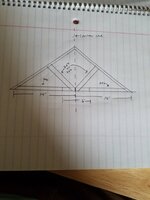
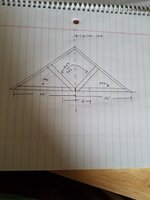
I was saying if you were putting in new joist it would be easier to put one side in then the other. Nail together at the joint. I may have said that weird idk. What is the distance wall to wall?

Will you be putting any weight on the joist?

Maybe this drawing will help explain.74e47eff9d36acd29728040201948d04.jpg

Sent from my SM-G930V using Tapatalk
 

Attachments

  • 74e47eff9d36acd29728040201948d04.jpg
    74e47eff9d36acd29728040201948d04.jpg
    42.9 KB · Views: 0

dfiler2

Well-known member
Joined
Dec 15, 2014
Messages
2,858
Location
NW Minnesota
Agree with Marc.^^ Some pictures would really help. If the roof is sagged because of the bottom cord then straightening the bottom cord will push the roof back into place.
 

doublearon98

Well-known member
Joined
Oct 7, 2017
Messages
676
Location
Hamton, Arkansas
So I spoke with my dad (been a contractor for over 30 years) and his fix is not much different from mine.

If the span is 28' (originally thought it was 26') which is what it sounds like, you need to take two 14' 2x6's butted together then lap with a 6' 2x6. Then truss it up by putting a 2x4 from the rafter to the end of each 14' joist

Of course before any of that I would check to make sure the walls are plumb and straighten the ridge.
c42829304e18f1be9d8adcce095cff27.jpg
 

Attachments

  • c42829304e18f1be9d8adcce095cff27.jpg
    c42829304e18f1be9d8adcce095cff27.jpg
    52.7 KB · Views: 0
Last edited:

doublearon98

Well-known member
Joined
Oct 7, 2017
Messages
676
Location
Hamton, Arkansas
IF... IF... you have already paid the $$$ premium price for the 28's... WHY would you put a splice in the center... the last place you would want one ???????

The existing bottom chords continue to carry the load to the Top Plate.

That has NOT changed, nor degraded in ANY way.

You do NOT have to bear your new 28's, unless convenient, more than 1" onto the plate.

Think about it... you will be sistering new 28's crown up, gently jacking old chord up... using a string as a gauge as you do it... and peppering it w 3" nails.

The new board carries the load, is INTIMATELY "one piece" w THE OLD ONE, which then transfers the load to the top plate then, AS IT DOES NOW before you add anything.

Cutting your new 28's in the center would be total foolishness.

ONLY reason one would have a joint in the center... is if he wanted off of shelf 14's TODAY.

And then, only OK with a 8' sister scab over joint, ... maybe 6' OK.

Marc

Marc
I think there is a misunderstanding.

Yes if he has already paid the super high premium for 28' use them without cutting. Should be ok without webbing.

If he hasn't, do it the way I explained in my last post.

Fyi cut in the center with a lap would be no different than a 20' and 8' with a lap. But the center is better when adding webbing.

No need to be so defensive either.

Sent from my SM-G930V using Tapatalk
 

doublearon98

Well-known member
Joined
Oct 7, 2017
Messages
676
Location
Hamton, Arkansas
Sorry if I was rammy... I guess my main points were...Full bearing on the top plates is totally unnecessary in this case, AND, cutting at center for the reason of increasing bearing footprint is a definate detriment overall, not improvement.

Marc

Completely agree if you already have a solid 28' board. The purpose of the joists are to "pull" the walls in as the weight of the roof pushes them out, in theory creating equilibrium. In any case, if the attic is to be used as storage, webbing would be needed to support the added weight on the joist.
 

doublearon98

Well-known member
Joined
Oct 7, 2017
Messages
676
Location
Hamton, Arkansas
OP used the term "bottom chords" so that tells me it's already trusses with webbing.

I am going on the theory OP used correct terminology when asking a structural question.... photos would have been good to confirm.

Marc
Photos in the link at post of OP's first post. They are not trusses but rafters, at least from the pictures in that link they are rafters.

Sent from my SM-G930V using Tapatalk
 

finn

Well-known member
Joined
Mar 27, 2005
Messages
16,297
Location
The UP, God's country
Edit - I thought SPAX where more like GRK RSS screws, but I see now they are not very spendy.

Still, the framing nailer is wayyy faster, AND.... AFAIK - Nails are preffered for most carpentry work due to being not as brittle.. having a bit of flex capability.

For example, when building a typical outdoor deck... NAILS, not screws are recommended, possibly mandated by Codes for all framing... then the screws, for decking, maybe some railing work.

Certainly, if you find it easier, you can pin to hold in place your sisters or whatever w a little impact driver and screws, but then fill in w the framing gun.


Marc

The nails vs engineered structural screw controversy was discussed here about a month or six weeks ago.

Engineered construction screws won handily when the specifications were compared and the opinions bowed to data.
 

Marctrees

Well-known member
Joined
Mar 5, 2015
Messages
6,265
Location
TX/LA border - Toledo Bend
NOW I see them... hiding at the bottom, I guess I visually missed it as if part of a "Sig"

Edit - It seems OP has now highlighted link, Thank you.

I usually read posts pretty carefully, my mistake.

Edit - I deleted my posts due to my mis understanding of the problem... I have no fix for the sagging ridge.

Thank you, carry on, Marc
 
Last edited:
OP
R

RyanEricW

Well-known member
Joined
Jan 14, 2012
Messages
85
So I spoke with my dad (been a contractor for over 30 years) and his fix is not much different from mine.

If the span is 28' (originally thought it was 26') which is what it sounds like, you need to take two 14' 2x6's butted together then lap with a 6' 2x6. Then truss it up by putting a 2x4 from the rafter to the end of each 14' joist

Of course before any of that I would check to make sure the walls are plumb and straighten the ridge.
c42829304e18f1be9d8adcce095cff27.jpg

Thank you for the picture and your time. I'll probably do this method but I'll be adjoining 2 sets of these tied together just to be safe....

Probably overkill, and know I may have wasted some $$ on the 28' but, hey that's life sometimes

Appreciate the help
 

Attachments

  • c42829304e18f1be9d8adcce095cff27.jpg
    c42829304e18f1be9d8adcce095cff27.jpg
    52 KB · Views: 0

doublearon98

Well-known member
Joined
Oct 7, 2017
Messages
676
Location
Hamton, Arkansas
Thank you for the picture and your time. I'll probably do this method but I'll be adjoining 2 sets of these tied together just to be safe....

Probably overkill, and know I may have wasted some $$ on the 28' but, hey that's life sometimes

Appreciate the help
Not necessarily a waste of $$ but with that said I can only imagine how much a 28' board is. Get your ridge straight and walls plumb first. Wedge the 28' in place and add bracing

Sent from my SM-G930V using Tapatalk
 
Last edited:
To avoid these ads, REGISTER NOW!

biggziff

Well-known member
Joined
Apr 9, 2015
Messages
623
Location
Upstate NY
That's a big miss, but it happens.

The inspector should have E&O insurance or belong to something like Internachi which can provide a complete buy-back if he missed *anything*. Costs the inspector $5 an inspection to provide this level of insurance.
 

MrSurly

Well-known member
Joined
Jan 15, 2014
Messages
1,671
Location
East Texas
As others have said (and it can’t be overstated) the purpose of the bottom chord (yes it’s a “truss” even if built on site, not delivered) is to prevent the spreading of the walls and the roof system; NOT by holding up a two-by standing under the ridge, but by being a tensioned member preventing the bottom of the triangle from “flattening out”. In other words, the basic open triangle shape is as strong *without* the vertical two-by under the ridge if all the connections are solid and the lumber is good condition.
The ridge is not sagging because the bottom chord is bending down, it’s because the chord is not sufficiently connected at the outer ends of the truss or at a lap joint. I think a lot of people don’t recognize this aspect and consequently they figure that a couple of 16d toenails are good enough at the truss-plate area.
(People tend to thing of loads as always being vertical)

It is very common to find similar roof systems that have NO vertical members, usually just a pair of braces at about a 45* angle from the bottom chord to mid-rafter.
To this point, the 28’ boards are advantageous IF you can get them into place.
Jacking the ridge and pulling the walls back into spec will likely need to be done simultaneously to avoid breaking things.
Please don’t just jack up the ridge without addressing the wall position. These things go hand in hand. Also, lumber that has been bent slowly over twenty years can be darned reluctant to straighten out in an afternoon.


Sent from my iPhone using Tapatalk
 
Last edited:

The Cobbler

Super Moderator
Staff member
Joined
Oct 24, 2013
Messages
25,928
Location
Niagara Region, Ontario, Canada
My take, he has common rafters & collar ties . the collar ties have sagged perhaps because the ridge beam is undersized? the collar ties are taking load which isn't really their job sort of, they are meant to keep the walls from spreading as already noted
I would either call back the inspector to see what he will offer as a remedy. or forget him and jack it back into position and beef up the collar ties, even add some between the existing and block the ridge beam to them .
 

TRWham

Well-known member
Joined
Aug 11, 2017
Messages
1,961
Location
East Cobb County, Georgia
In those photos I see evidence of progressive efforts to fight the inevitable failure of undersized roof framing. That looks like a pretty low pitch where a 2x6 rafter would simply not work (lower pitch requires bigger rafters for a given span), yet those appear to be 2x6 rafters.

I think the rafter ties (they are not joists) are original, but the collar ties and all that other stuff (several Simpson products and even a jack post) have been added over the years to shore up the roof as it sagged. I'm guessing that most of the band-aids were applied without correcting any of the deflection that had occurred up to that particular phase of remediation so the existing sag was baked in to the pie step by step.

You can see in one photo where the rafter tie connections have clearly failed at the wall. That may be caused by the vertical load applied by the attempts to post the ridge down and/or the weight of the stuff stored on them, or because the wall is bowed, or both, but I cannot see from the photo how much the wall is bowed. I can see where some rafters are pulling away from the ridge board, so it has bowed at least some.

The purpose of collar ties (I think added here after original construction once the roof started to sag) is to prevent the rafters from pulling out of the ridge board in the event of uplift caused by wind, and they provide very little stiffening of the rafters. Rafter ties (present in this case) provide tension to resist the compression in the roof and prevent spread at the bottom of the rafters but they were overloaded and the connections failed.

That ridge board should have been a ridge beam in a pitch this low. A ridge board in a higher pitched roof takes less vertical load than the rafters do and really only serves to provide a place to nail. In a lower pitch, the rafters act more like joists, and the ridge really carries load so it needs a beam stiff enough and posted down to something solid enough to carry that load.

I can see a few paths forward, but there is a lot of work ahead with each. Do not simply focus on the rafter ties- that roof needs more work than that. Your rafters and ridge are too flexible and need help. It would not be crazy to consider taking this roof off and reframing it from scratch, possibly using pre-fab trusses.
 
OP
R

RyanEricW

Well-known member
Joined
Jan 14, 2012
Messages
85
I jacked up the ridge tonight about 2-3". Instantly I can notice a difference. I was hoping the rafters would pull the walls straight, but didnt happen. Instead it seems they are separating more.

I have some hangers to tie these in, but I'm still concerned about the walls. The one wall is about 2-3" outward, the opposite wall maybe 1-2".

Any tips for straightening the walls? Both need to be pulled in

Heres more images
https://photos.app.goo.gl/LTFFvVqFdvB4CHYy6
 

doublearon98

Well-known member
Joined
Oct 7, 2017
Messages
676
Location
Hamton, Arkansas
I'd use a come-a-long or some cable, eye bolts and a turnbuckle to pull the walls back together. Start at the center, and add more as needed between the center and the ends until you get the walls pulled back in. Might have to remove some of the rafter ties and re-install them after you pull in the walls. Personally, I'd use the cables and turnbuckles, and leave them in place when I was done. You may need to also do a diagonal pull from the top of the wall that's bowed out to the opposite sill plate to get the walls pulled in evenly. If you just pull between the walls, you may pull one inwards before the opposite one gets quite straight. As you get one section plumb on both sides, install the rafter ties back in, and your 28' repair pieces. Attach them securely at the walls to hold the walls in place. Then, move on up the wall, continuing to pull them in and get them fixed in place with the rafter ties.

As mentioned before, you will probably have to beef up the rafters also, and maybe add some collar ties and/or diagonal members to make this more of a truss to do an effective long term repair. Jacking up the ridge, and pulling in the walls plumb again is just a start, not the final solution.
Couldn't have said it better! Pulling the walls in a little at a time while also pumping each jack a little

Sent from my SM-G930V using Tapatalk
 
Last edited:

TRWham

Well-known member
Joined
Aug 11, 2017
Messages
1,961
Location
East Cobb County, Georgia
As you do this, you may find some of the connections that have pulled out are fighting you. I would keep a sawzall with a demo blade handy to cut any nails that are in your way. Then repair that connection with the appropriate connector. You can slowly rework this framing into trusses built in place as you go, but you need to be sure everything is straight first. Screws will probably work better than nails for pulling things back into place.
 
OP
R

RyanEricW

Well-known member
Joined
Jan 14, 2012
Messages
85
Tried 2 turn buckles with a wrench and cable rated for 1000lbs, that didnt work at all

Went and tried 2 x 4 ton come alongs instead with chain, and the largest screw eye hooks I could find sunk all the way into the bottom top wall plate. Working them both a little at a time....The one started to split the bottom section of the top wall plate and had to release it before any real damage was done.

The wall I'm trying to pull in, its fine in the back and kicked out in the front. So thats where I attached my eye hooks on each side. I removed half of the rafter ties, at least all the ones in the problem area before doing this.

Going to have someone come by tomorrow morning to take a look at it.

Only things I could think of doing is maybe adding 2 more come alongs with chain and wrapping the chains around the top wall plates. That means Id have to cut a decent hole in the siding and into the garage.

Or drill through the 2x4 all the way and install some eye bolts with fender washers on the outside to support the load while jacking in.

Frustrated today, feel like I accomplished nothing

Couple images of how its setup and damage


https://photos.app.goo.gl/fWXwLLKWzmC9syhD8
 

doublearon98

Well-known member
Joined
Oct 7, 2017
Messages
676
Location
Hamton, Arkansas
Tried 2 turn buckles with a wrench and cable rated for 1000lbs, that didnt work at all

Went and tried 2 x 4 ton come alongs instead with chain, and the largest screw eye hooks I could find sunk all the way into the bottom top wall plate. Working them both a little at a time....The one started to split the bottom section of the top wall plate and had to release it before any real damage was done.

The wall I'm trying to pull in, its fine in the back and kicked out in the front. So thats where I attached my eye hooks on each side. I removed half of the rafter ties, at least all the ones in the problem area before doing this.

Going to have someone come by tomorrow morning to take a look at it.

Only things I could think of doing is maybe adding 2 more come alongs with chain and wrapping the chains around the top wall plates. That means Id have to cut a decent hole in the siding and into the garage.

Or drill through the 2x4 all the way and install some eye bolts with fender washers on the outside to support the load while jacking in.

Frustrated today, feel like I accomplished nothing

Couple images of how its setup and damage


https://photos.app.goo.gl/fWXwLLKWzmC9syhD8
I would definitely drill a hole through and bolt it. On the bottom plate (being the plate on the floor) I would take a 2x4 and put it between two studs on top of the bottom plate, then nail through the studs into the piece of 2x4 you added. Put your eye bolt through the 2x4 and as far into the bottom plate as you can. Drill as small a hole as possible for the wood screw eye bolt.

Sent from my SM-G930V using Tapatalk
 

dfiler2

Well-known member
Joined
Dec 15, 2014
Messages
2,858
Location
NW Minnesota
I've done a couple of buildings an we would drill through the wall on each side just below the top plate. Used a 4x4 on the outside, used some chain on each side and three 4" ratchet straps on the inside. Once in place remove cross ties and slowly pull together. The last one I did we would tighten all three and then wait for a while before we tightened again.
 

TractorJeff

Well-known member
Joined
Dec 8, 2013
Messages
3,309
Location
Elkhorn, WI
Many years ago, We straightened a couple of Barn walls as "dfiler2" described. One Barn wall took almost a month constant pulling get back in place!
 
OP
R

RyanEricW

Well-known member
Joined
Jan 14, 2012
Messages
85
Newer pictures at bottom of link

https://photos.app.goo.gl/LTFFvVqFdvB4CHYy6

Worked on it Monday, got some help from a local guy I met at Menards. We installed the turn buckles at the corners to help draw those in as we jacked up on the roof repeatedly. We raised it probably another 2-3"

It's getting close to where it looks normal again, we will continue working on it this weekend again after it's all had time to settle and pull itself in more during the week.

Had ended up mig welding some of the hooks I installed in the walls because they were pulling apart

You can now see the gap between the front brick and soffit. The metal at the peak was bending too. Also pulled the wall back over the brick at the corners so the walls are definitely straightening out.
 

Jim greengo

Well-known member
Joined
Sep 3, 2018
Messages
7,415
Location
Behind my house
I'd use a come-a-long or some cable, eye bolts and a turnbuckle to pull the walls back together. Start at the center, and add more as needed between the center and the ends until you get the walls pulled back in. Might have to remove some of the rafter ties and re-install them after you pull in the walls. Personally, I'd use the cables and turnbuckles, and leave them in place when I was done. You may need to also do a diagonal pull from the top of the wall that's bowed out to the opposite sill plate to get the walls pulled in evenly. If you just pull between the walls, you may pull one inwards before the opposite one gets quite straight. As you get one section plumb on both sides, install the rafter ties back in, and your 28' repair pieces. Attach them securely at the walls to hold the walls in place. Then, move on up the wall, continuing to pull them in and get them fixed in place with the rafter ties.

As mentioned before, you will probably have to beef up the rafters also, and maybe add some collar ties and/or diagonal members to make this more of a truss to do an effective long term repair. Jacking up the ridge, and pulling in the walls plumb again is just a start, not the final solution.
:beer::beer::beer::beer:
 
To avoid these ads, REGISTER NOW!
Top Bottom