To avoid these ads, REGISTER NOW!

Replace 3 phase motor with single phase?

sgbotsford

Member
Joined
Dec 30, 2023
Messages
7
I have an ancient cabinet sliding table table saw that I picked up at auction. Came with a 3ph motor. Handles a 12" blade. Has a unifence (not capitalized, not made by delta) that would do me a serious injury if I dropped it on my foot. Rails for 3 feet between fence and blade.

I don't have 3ph here, and yes, I could use a VHD, but I've seen a bunch of ways to fry VHDs.

So I'm looking at just swapping out the 3ph for a single ph motor.

The motor is 5 HP.

Cheap new 5 HP motors from Princess Auto are $600
Used Baldor 5 HP motors on our local classifieds are about the same. I'm inclined to go with the latter.

What gotchas are involved in swapping motors?

* The saw has both a mag relay start switch and a foot level kill switch. Like to put in a paddle switch for my knee too.
* There is a box between the switch and the motor. Starter?
* I need to remove the top to get at the motor. Top is cast iron, and the rim thickness is 2" more or less. (This saw is about 600 lbs. I used my front end loader to lift it off the truck. Tips on moving this kind of slab of iron and keeping all my fingers.
* I need to match frame to be able to mount it.
* Ditto shaft size and length. If size is wrong, can buy a new drive pulley.
* I know I need to match RPM.
* Direction can be changed with rewiring the little wiring cabinet.
* If speed different from the usual 3450, can compensate with a new drive pulley. BUT if the motor is 1725, is there room for twice as much pulley?
 
To avoid these ads, REGISTER NOW!

micromind

Well-known member
Joined
Sep 24, 2023
Messages
3,058
Location
Fernley, Nevada, about 30 miles east of Reno.
When using a VFD with a table saw, one thing you'll notice right away is it'll bog down much easier. No motor will have the same breakdown (bog down) torque with a VFD as it will with true sine wave power.

Frame size is important as it involves mounting holes, shaft size and diameter and distance from the end of the shaft to the front mounting bolts. For example, a 56 frame motor can be replaced by any other 56 frame.

Things to look out for with frame sizes......any letter before the numbers doesn't mean anything, it is a manufacturers letter and does not affect the mounting holes or the shaft. Letters after the numbers matter a lot. For example, a 56 frame has a 5/8" shaft that's 3 1/2: high. A 56HZ frame has a 7/8" shaft that's 3 1/2" high.

56 and 56H are the same shaft dimensions but the mounting holes are different. It'll fit a 56 mount but also has 2 more holes a bit further back than the 56.

The 3 digit numbers are similar. A 143 has the same dimensions as a 145 but the 145 has 2 more mounting holes a bit farther back. 143 is different than 143U and different than 143T. The next size up is 182/184. Every dimension is different than a 143/145.

Another thing is what is called the C dimension. This is how long the motor is. It's not on the nameplate and there's no standard, you need to actually measure it if the new one might be too long.

Yet another thing is open vs. enclosed. ODP (Open Dripproof) is just that. Open frame with windings exposed. Water falling at a 15 degree angle or less is ok (horizontal mounting only) and not dust proof at all. TEFC (Totally Enclosed Fan Cooled) or TENV (Totally Enclosed Non Ventilated) can be installed out in the rain and dust doesn't bother them. These motors are typically longer than the ODP models.

As far as quality goes, I would go for a used nationally recognized brand (Leeson, Baldor, WEG, US Electrical Motors and several others I can't recall at the moment) rather than a cheap off-brand new one.

The box between the incoming power and the motor is indeed a starter. It has 2 types of circuits, power and control.

The foot switch, the start-stop (or on-off) switch are in the control circuit. They remain the same with single or 3 phase but if it has a control transformer, you'll need to make sure the primary is connected for the correct voltage.

The power circuit will have the overloads. Depending on the type, you'll need to change the 'heaters' or turn the dial up to match the new motors full-load amps. If you don't change this to match the new motor, then your 5HP motor becomes about a 3HP or so. Also, if it's the dial type, you'll need to do a bit of re-wiring, All 3 of the terminals need to see the same current or it'll trip out on phase loss.

Further, the contactor part of the starter needs to be rated for 5HP single phase. It might be or maybe not.

The rotation direction of a single phase motor is changed in the motor terminal box, not at the starter.

Sorry for the long post but there's a lot involved with replacing a 3 phase motor with a single phase one.
 
Last edited:

rsanter

Well-known member
Joined
Dec 22, 2007
Messages
18,522
Location
visalia ca
I prefer 3 ph and the VFD.
You also have the option to buy or build a rotary phase converter.

Issues with the motor. Well if it’s a proprietary mount you either cannot do it or you are making a mount to bolt the flat base to.
If it’s a basic flat base or end mount motor then it’s fairly easy. Be sure to to verify shaft size of your motor and the one you are buying
 

LopezBart

Well-known member
Joined
Oct 13, 2023
Messages
2,540
Location
Lopez Island, WA
When using a VFD with a table saw, one thing you'll notice right away is it'll bog down much easier. No motor will have the same breakdown (bog down) torque with a VFD as it will with true sine wave power.
This is true if you're emulating three phases w/ a phase converter... but a VFD supplies proper three phase power, and it won't reduce the torque of the motor unless the VFD or circuit driving it is too small for the load. From https://thinkvert.com/variable-frequency-drive-affects-on-torque-horsepower/:

1704001777296.png
 

Beerhippie

Well-known member
Joined
Oct 13, 2023
Messages
9,819
Location
Far NE Oregon
I don't know where the idea that 3-phase motors will "bog down" when driven with VFDs comes from. I drive motors up to 11 hp off of VFDs and they have no problem with torque--as long as the VFD is set up right! The big advantage of 3-phase w/VFD is power control without loss of torque compared to the old rheostats or variable transformers, which did lose torque when slowed down.

A VFD to drive a 3-phase, 5 hp motor from single-phase line will cost less than a good single-phase motor and you'll never regret it. The only times I've "fried" VFDs were from BIG power surges during power outages--the local power company seems to have fixed this problem after paying for a few $10ks of VFDs to replace ours. For shop use, that should be no problem--just throw the breaker when done using it (this is also a good idea as some modern VFDs will have a low but constant draw when not in use).
 

aquinob

Well-known member
Joined
Oct 7, 2014
Messages
238
Location
Portsmouth, VA
Not sure what brand of saw we're talking about, but most of the older machines had very high quality motors that an offshore motor doesn't come close too. A properly sized VFD will not bog down a motor, but the ones for higher HP motors will not come cheap. You'll need an appropriately sized 220v circuit to power it. If you do decide to go with a VFD, the VFD has to be direct wired on the 3 phase side to the motor, you don't want the existing starter in-between.
 

KenC

Well-known member
Joined
Dec 20, 2009
Messages
2,589
Location
oklahoma
I have an ancient cabinet sliding table table saw that I picked up at auction. Came with a 3ph motor. Handles a 12" blade. Has a unifence (not capitalized, not made by delta) that would do me a serious injury if I dropped it on my foot. Rails for 3 feet between fence and blade.

I don't have 3ph here, and yes, I could use a VHD, but I've seen a bunch of ways to fry VHDs.

So I'm looking at just swapping out the 3ph for a single ph motor.

The motor is 5 HP.

Cheap new 5 HP motors from Princess Auto are $600
Used Baldor 5 HP motors on our local classifieds are about the same. I'm inclined to go with the latter.

What gotchas are involved in swapping motors?

* The saw has both a mag relay start switch and a foot level kill switch. Like to put in a paddle switch for my knee too.
* There is a box between the switch and the motor. Starter?
* I need to remove the top to get at the motor. Top is cast iron, and the rim thickness is 2" more or less. (This saw is about 600 lbs. I used my front end loader to lift it off the truck. Tips on moving this kind of slab of iron and keeping all my fingers.
* I need to match frame to be able to mount it.
* Ditto shaft size and length. If size is wrong, can buy a new drive pulley.
* I know I need to match RPM.
* Direction can be changed with rewiring the little wiring cabinet.
* If speed different from the usual 3450, can compensate with a new drive pulley. BUT if the motor is 1725, is there room for twice as much pulley?
Wait 'til the table is off before buying a motor. A lot of older industrial woodworking tools used proprietary motors, non-standard mounts.
 

micromind

Well-known member
Joined
Sep 24, 2023
Messages
3,058
Location
Fernley, Nevada, about 30 miles east of Reno.
Here's what I meant by bog down........

I've installed and programmed well over 200 VFDs in the last 20 years, all the way from its-bitsy up to 2000 HP.

The vast majority of them are constant loads, like centrifugal pumps.....the load is known and is within the capacity of the VFD. No problems with these.

With a VFD, the output power is not a sine wave, it is a pulse width modulated sine wave. Instead of a constantly rising and falling wave, it it a bunch of pulses that looks like a sine wave but actually isn't. A basic normal motor cannot produce the same torque on PMW power as it can on an actual sine wave.

Further, unless the VFD is grossly oversize, it cannot produce all the current that the motor demands under overload conditions.

When feeding stock into a table saw, for example, the load on the motor is human controlled, not constant. If you feed the stock faster and faster, eventually you'll reach a point when the motor will bog down.....suddenly lose speed. This is called breakdown torque. Breakdown torque will be higher using sine wave power (utility) than when using a VFD.
 

u3b3rg33k

Well-known member
Joined
Dec 18, 2017
Messages
4,048
Here's what I meant by bog down........

I've installed and programmed well over 200 VFDs in the last 20 years, all the way from its-bitsy up to 2000 HP.

The vast majority of them are constant loads, like centrifugal pumps.....the load is known and is within the capacity of the VFD. No problems with these.

With a VFD, the output power is not a sine wave, it is a pulse width modulated sine wave. Instead of a constantly rising and falling wave, it it a bunch of pulses that looks like a sine wave but actually isn't. A basic normal motor cannot produce the same torque on PMW power as it can on an actual sine wave.

Further, unless the VFD is grossly oversize, it cannot produce all the current that the motor demands under overload conditions.

When feeding stock into a table saw, for example, the load on the motor is human controlled, not constant. If you feed the stock faster and faster, eventually you'll reach a point when the motor will bog down.....suddenly lose speed. This is called breakdown torque. Breakdown torque will be higher using sine wave power (utility) than when using a VFD.
if you're comparing a VFD driven motor to what a CB 'protected' motor will do before the breaker trips, well... yikes.

most smaller VFDs i've seen will do 150% rated output for an operationally meaningful amount of time. at some point of overload you WANT the drive to trip out, or something will break.

breakdown on a decent small 3ø motor is often 3x rated. if that's regularly a problem you've either got an idiot for an operator or a grossly undersized motor for the application.

one way you can address the operator issue is to give them a visual indicator for load/overload. either set an analog output to run a gauge so they can visualize load easily, or trip a relay/light when they hit 80-100% load (dealer's choice).

I've actually found VFD+ 3ø motors to be a great combination for highly intermittent loads. the right programming on a VFD will limit current when the motor slows down instead of tripping overload protection, and modern drives often model motor thermals so you don't have to rely on tripping phase thermostats.

for example, running a 1.5HP inertial wood splitter.

factory motor pretty much needs a 20A circuit to start, and may trip out either the panel breaker or on-motor overload under stall conditions.

same application, 3ø and VFD, you can ride down to a stall at 150% rated current and re-accelerate to operating speed without ever exceeding the feeder rating or going way off the charts on the motor.

similar things are true for a chipper application, but with the added benefit of VFDs tripping on a jam. that's possible with "traditional" motor protection, but a standard thermal won't do it, you also need a mag relay to interrupt the pilot signal.
 
To avoid these ads, REGISTER NOW!

LopezBart

Well-known member
Joined
Oct 13, 2023
Messages
2,540
Location
Lopez Island, WA
I've often wondered why residential submersible well pumps aren't three phase with VFDs instead of single phase motors and motor starters. With a programmed slow start this would greatly reduce generator requirements, instead of starting at full load as they do today.
 

micromind

Well-known member
Joined
Sep 24, 2023
Messages
3,058
Location
Fernley, Nevada, about 30 miles east of Reno.
I've often wondered why residential submersible well pumps aren't three phase with VFDs instead of single phase motors and motor starters. With a programmed slow start this would greatly reduce generator requirements, instead of starting at full load as they do today.

I've worked with a few of those, they are advertised to work without a pressure tank.

The 3 that I worked on did rather poorly and I was not able to get into the VFD program so I couldn't adjust the PID (Process Integral Derivative) to fine tune them. So I added a small pressure tank, 1 worked pretty good after that, the other 2 I ended up replacing them with a VFD that I could program and they worked ok.

One drawback to using a small gen with a VFD is often the VFD will not accept the distorted waveform that a small gen produces.
 

LopezBart

Well-known member
Joined
Oct 13, 2023
Messages
2,540
Location
Lopez Island, WA
One drawback to using a small gen with a VFD is often the VFD will not accept the distorted waveform that a small gen produces.
Interesting... there must be some fault-detection going on in the VFD. Most of the VFDs I've seen rectify the incoming AC waveform into DC to keep a set of capacitors charged; that DC then gets 'chopped' into the 3phase needed to drive the load.
 

micromind

Well-known member
Joined
Sep 24, 2023
Messages
3,058
Location
Fernley, Nevada, about 30 miles east of Reno.
Interesting... there must be some fault-detection going on in the VFD. Most of the VFDs I've seen rectify the incoming AC waveform into DC to keep a set of capacitors charged; that DC then gets 'chopped' into the 3phase needed to drive the load.

They do but if there's too much ripple on the DC circuit, it'll go into low voltage fault.

The 3Ø input ones will fault out on loss of phase.

Not all VFDs won't handle distorted waveforms but I know of at least 2 that had trouble.
 

u3b3rg33k

Well-known member
Joined
Dec 18, 2017
Messages
4,048
I've often wondered why residential submersible well pumps aren't three phase with VFDs instead of single phase motors and motor starters. With a programmed slow start this would greatly reduce generator requirements, instead of starting at full load as they do today.
well technically, all centrifugal pumps start at no load, due to the nature of centrifugal pumps/fans. the issue is the inrush of the motor itself starting DOL, not the pumping. there ARE variable speed well pumps in the residential market - I assume they're BLDC or have good filters because well pumps often have long leads.

a capacitor and a relay are cheaper than active electronics, so cost is the main reason.
I've worked with a few of those, they are advertised to work without a pressure tank.

The 3 that I worked on did rather poorly and I was not able to get into the VFD program so I couldn't adjust the PID (Process Integral Derivative) to fine tune them. So I added a small pressure tank, 1 worked pretty good after that, the other 2 I ended up replacing them with a VFD that I could program and they worked ok.

One drawback to using a small gen with a VFD is often the VFD will not accept the distorted waveform that a small gen produces.
I've never seen a system that didn't have a bladder/tank of some kind. maybe a drinking water/heating system sized tank, but SOMETHING for a tank.

even this has a tank

as for running a small VFD on a generator, the LFP power banks and inverter generators out there now put out nice clean power. if you NEED to run a VFD off a generator, those seem to work great, and since power banks and inverter generators generally have lower surge ratings, the soft start of a VFD is a definite plus.
Interesting... there must be some fault-detection going on in the VFD. Most of the VFDs I've seen rectify the incoming AC waveform into DC to keep a set of capacitors charged; that DC then gets 'chopped' into the 3phase needed to drive the load.
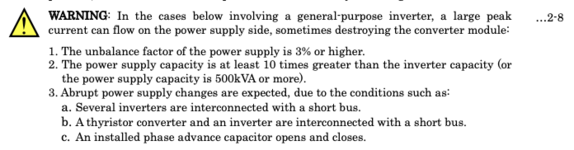
the spec tolerances for input power on VFDs are usually <3% phase balance. a small generator can have a hard time doing that on load changes.

Screen Shot 2024-02-03 at 17.45.41.png

They do but if there's too much ripple on the DC circuit, it'll go into low voltage fault.

The 3Ø input ones will fault out on loss of phase.

Not all VFDs won't handle distorted waveforms but I know of at least 2 that had trouble.
there are ways to program the VFD to be "more tolerant" of noise, there are also VFDs built for extended operating conditions (at additional cost, of course). and then there's input/output side filtering but that's a whole other conversation.
 

Provincial

Well-known member
Joined
Sep 21, 2011
Messages
6,871
Location
Near Salem, OR
If someone tries to sell you a Grundfos SCALA pump, don't walk away - RUN!!!!!!!!

A well driller sold my sister-in-law one for her shallow well. It was easy to install, and worked fine for a while, but in eight years we had to replace three pumps. Grundfos wouldn't answer their phone. I later learned that these have a horrible reputation. I did a post-mortem on one, and discovered that the ball bearings on the shaft are undersized, not sealed, not lubricated, and shaft/rotor is not designed to be removable. The bearings wear, the shaft seal leaks, water gets into the bearings and the wear proceeds at a rapid pace until it jams up or the rotor hits the field windings. In other words, it is a disposable pump that is priced as a premium model.
 

Beerhippie

Well-known member
Joined
Oct 13, 2023
Messages
9,819
Location
Far NE Oregon
If someone tries to sell you a Grundfos SCALA pump, don't walk away - RUN!!!!!!!!

A well driller sold my sister-in-law one for her shallow well. It was easy to install, and worked fine for a while, but in eight years we had to replace three pumps. Grundfos wouldn't answer their phone. I later learned that these have a horrible reputation. I did a post-mortem on one, and discovered that the ball bearings on the shaft are undersized, not sealed, not lubricated, and shaft/rotor is not designed to be removable. The bearings wear, the shaft seal leaks, water gets into the bearings and the wear proceeds at a rapid pace until it jams up or the rotor hits the field windings. In other words, it is a disposable pump that is priced as a premium model.
We used to have several Grundfoss pumps here at the brewery. These were stainless steel, food/beverage grade, so more expensive yet. They're not only problematic, but they're the most difficult and expensive to repair of any pumps I've worked on--and that would be a lot of pumps from several brands.
 

u3b3rg33k

Well-known member
Joined
Dec 18, 2017
Messages
4,048
my point was only that it has an expansion tank in it, not to endorse it.

The only grundfos pumps I have experience with are wet rotor hvac/boiler pumps, and those seem to be pretty reliable.
 

dutchgray

Well-known member
Joined
Sep 28, 2014
Messages
6,467
Location
Dorset. England.
my point was only that it has an expansion tank in it, not to endorse it.

The only grundfos pumps I have experience with are wet rotor hvac/boiler pumps, and those seem to be pretty reliable.
Grundfos were always the best of the cast iron heating pumps available in the UK, don't think they are anymore though.
 
To avoid these ads, REGISTER NOW!
Top Bottom