To avoid these ads, REGISTER NOW!

Replace a switch with a receptacle?

CARS

Well-known member
Joined
Jan 19, 2011
Messages
535
Location
New Ulm, MN
Hello. I'm helping my friend put a receptacle in a box that currently has a switch on the outside of her house. Hopefully I can put this into words.
The switch on the outside is tied together with a switch on the inside by the back door and it controls a motion light.
There are 3 wires to the outside switch. Red, Black, and White. (the box is grounded but there was no green wire to the switch :headscrat )
When I put a meter on the wires, I get 120V between the Red and White with the switch in one position, and 120V between the Black and White when it's in the other position.
Is there any way I can use this configuration to get an outlet to work (switched or not)?
It's a remodeled 1890's brick home and as you can imagine it would be almost impossible to run a new circuit to this box.
 
To avoid these ads, REGISTER NOW!

BigGarage

Well-known member
Joined
Jun 5, 2019
Messages
2,344
Location
Just south of Detroit, MI.
Hello. I'm helping my friend put a receptacle in a box that currently has a switch on the outside of her house. Hopefully I can put this into words.
The switch on the outside is tied together with a switch on the inside by the back door and it controls a motion light.
There are 3 wires to the outside switch. Red, Black, and White. (the box is grounded but there was no green wire to the switch :headscrat )
When I put a meter on the wires, I get 120V between the Red and White with the switch in one position, and 120V between the Black and White when it's in the other position.
Is there any way I can use this configuration to get an outlet to work (switched or not)?
It's a remodeled 1890's brick home and as you can imagine it would be almost impossible to run a new circuit to this box.

It sounds to me like the 2 switches are 3-way switches. If you put an outlet on the outside I think it may end up being controlled by the inside switch.

The experts will be along shortly.:)

Dennis
 

jeffmattero76

Well-known member
Joined
Mar 26, 2018
Messages
115
You have two three way switches. In the box you want to tap into to run an outlet, you need to find out if there is an "always hot" black wire.

To explain... in one of the switch boxes there will be a cable that contains a black and a white wire. That wire carries the incoming power, and that black will always be hot regardless of the switch position. That black will be hooked to the COMMON screw (usually black painted) on the 3 way switch. There should also be a cable with red, black, and white wires. The red and black of that 3wire cable are connected to the TRAVELER screws of the 3way switch. The remaining white wires are connected together. That 3wire cable brings power to the other 3way switch.

In any case, if that is what you have in the switch box you are tapping into, you would remove the incoming hot black wire from the COMMON screw, and you would get a 6 inch piece of black wire (pigtail). You would connect the incoming black, one end of the pigtail, and the black of the new cable feeding the outlet with a wirenut. Connect the other end date of the pigtail to the COMMON screw. Connect the new white wire to the existing two white wires.

If you don't have an always hot in that switchbox, you can still do it, but the outlet will be controlled by the switches.

Sent from my SM-G530T using Tapatalk
 

mm08822

Well-known member
Joined
Jan 13, 2012
Messages
5,875
Location
NJ
Need more info to provide an accurate answer.

Need you to look into both 3way switch boxes and detail the cables entering each box along with where each wire is connected.
You may have 120v in the interior switch box and if so, you could power a recept on the exterior if you eliminate the ext 3way for it. Also the interior 3way would have to change to a single pole toggle.

If there is only a switch leg brought down into the 3way box from the light then you can't do the recept from this source.
 

mm08822

Well-known member
Joined
Jan 13, 2012
Messages
5,875
Location
NJ
You have two three way switches. In the box you want to tap into to run an outlet, you need to find out if there is an "always hot" black wire.

To explain... in one of the switch boxes there will be a cable that contains a black and a white wire. That wire carries the incoming power, and that black will always be hot regardless of the switch position. That black will be hooked to the COMMON screw (usually black painted) on the 3 way switch. There should also be a cable with red, black, and white wires. The red and black of that 3wire cable are connected to the TRAVELER screws of the 3way switch. The remaining white wires are connected together. That 3wire cable brings power to the other 3way switch.

In any case, if that is what you have in the switch box you are tapping into, you would remove the incoming hot black wire from the COMMON screw, and you would get a 6 inch piece of black wire (pigtail). You would connect the incoming black, one end of the pigtail, and the black of the new cable feeding the outlet with a wirenut. Connect the other end date of the pigtail to the COMMON screw. Connect the new white wire to the existing two white wires.

If you don't have an always hot in that switchbox, you can still do it, but the outlet will be controlled by the switches.

Sent from my SM-G530T using Tapatalk

Answer depends upon cabling between source, switches and light. I read the OP as the exterior S3 box only has a 3c cable connecting to it.
 

tonyciambrone

Well-known member
Joined
Nov 4, 2015
Messages
1,152
Location
Northern Illinois
Is the box grounded by a bare copper conductor or are you saying its grounded based on getting 120v between black or red and the box?

I almost never see NM cable because of my region. is it common for it to be run into masonry?
 

jeffmattero76

Well-known member
Joined
Mar 26, 2018
Messages
115
Answer depends upon cabling between source, switches and light. I read the OP as the exterior S3 box only has a 3c cable connecting to it.
I wasn't sure from the OP original post. Regardless, if he pigtails the wire that is connected to the common screw, and connects the new white to the existing neutrals, the outlet will work. It may or may not be controlled by the 3ways, depending on which 3way he is tapping into.

Sent from my SM-G530T using Tapatalk
 

mm08822

Well-known member
Joined
Jan 13, 2012
Messages
5,875
Location
NJ
I wasn't sure from the OP original post. Regardless, if he pigtails the wire that is connected to the common screw, and connects the new white to the existing neutrals, the outlet will work. It may or may not be controlled by the 3ways, depending on which 3way he is tapping into.

Sent from my SM-G530T using Tapatalk

That's my point - there may not be a neutral present in the box.
 

jeffmattero76

Well-known member
Joined
Mar 26, 2018
Messages
115
That's my point - there may not be a neutral present in the box.
Perhaps I am missing something... didn't he say that his meter read 120v between the black and white, and 120v between the red and white? Assuming that is true, isn't the white wire proven to be a neutral?

Sent from my SM-G530T using Tapatalk
 

mm08822

Well-known member
Joined
Jan 13, 2012
Messages
5,875
Location
NJ
Perhaps I am missing something... didn't he say that his meter read 120v between the black and white, and 120v between the red and white? Assuming that is true, isn't the white wire proven to be a neutral?

Sent from my SM-G530T using Tapatalk

I'm seeing it as the white is on the S3 common (or point), so he is reading the open ckt voltage between the traveler that is keeping the light off and the load.

Arrangement of the existing boxes/cabling is needed.
 

jeffmattero76

Well-known member
Joined
Mar 26, 2018
Messages
115
I'm seeing it as the white is on the S3 common (or point), so he is reading the open ckt voltage between the traveler that is keeping the light off and the load.


Arrangement of the existing boxes/cabling is needed.
I agree that I would also like to have more clarification.

However, he says that he gets 120v between the black and white with the switch in one position, and 120v between the red and white with the switch on the other position. As I see it, that proves that the white is a neutral, rather than a traveller. Am I somehow mistaken?

Sent from my SM-G530T using Tapatalk
 

mm08822

Well-known member
Joined
Jan 13, 2012
Messages
5,875
Location
NJ
I agree that I would also like to have more clarification.

However, he says that he gets 120v between the black and white with the switch in one position, and 120v between the red and white with the switch on the other position. As I see it, that proves that the white is a neutral, rather than a traveller. Am I somehow mistaken?

Sent from my SM-G530T using Tapatalk

Not saying white is a traveler. It is on the common of the S3. The white is a hot wire.

I know of no S3 wiring config where a S3 alone in a box connected by only a 3 conductor cable can support S3 wiring and a contain a neutral.
 

jeffmattero76

Well-known member
Joined
Mar 26, 2018
Messages
115
He didn't sat that the 3 wire was the only wire.

Regardless, if the white wire is NOT a neutral, his meter would not be showing 120v between black and white and 120v between red and white. If there 's a way that his meter would show that please explain.

Sent from my SM-G530T using Tapatalk
 

vavet

Well-known member
Joined
Mar 6, 2012
Messages
5,321
Location
Ashland, VA
C'mon GJ, you're slipping. We need pics of this friend before we can help. Also, if she has any hot girlfriends, we need pics of them, too.
 

bergheger3

Active member
Joined
Oct 9, 2018
Messages
27
Location
Missouri
Agree it sounds like a 3-way switch. switches don't have neutrals landed on them unless they are occupancy sensors switches or smart switches. That being said sometime they would run the hot into 1 switch box and tie the neutrals together and push them back into the box.

You will need to look at both switches. pictures would be nice.
 

teamextreme

Well-known member
Joined
Aug 10, 2013
Messages
867
Location
Lakewood, CO
He didn't clarify where the white wire is. If it's landed on a switch terminal is most certainly is NOT a neutral, and yes, you can measure 120v through the light bulb (load) even if it's not a neutral, as MM stated. If the white wire is in a wire nut, then it's likely a neutral. I'm guessing there's no neutral in the box. There are ways to skin this cat but require ditching the 3W setup. Pretty much pointless to continue debating, however, until we get some further info...
 
To avoid these ads, REGISTER NOW!

TRWham

Well-known member
Joined
Aug 11, 2017
Messages
1,958
Location
East Cobb County, Georgia
He didn't sat that the 3 wire was the only wire.

Regardless, if the white wire is NOT a neutral, his meter would not be showing 120v between black and white and 120v between red and white. If there 's a way that his meter would show that please explain.

Sent from my SM-G530T using Tapatalk

Because the black and red are connected through a load (presumably the light) to a neutral. All 120V circuits eventually get back home via a neutral somewhere.
 
Last edited:

jeffmattero76

Well-known member
Joined
Mar 26, 2018
Messages
115
Because the black and red are connected through a load (presumably the light) to a neutral. All 120V circuits eventually get back home via a neutral somewhere.
Please educate me. Are you saying that a white wire (that is being used as a hot in a 3 way configuration), will show 120 volts between it and the black wire, and 120 volts between it and the red wire???

Sent from my SM-G530T using Tapatalk
 

TRWham

Well-known member
Joined
Aug 11, 2017
Messages
1,958
Location
East Cobb County, Georgia
Please educate me. Are you saying that a white wire (that is being used as a hot in a 3 way configuration), will show 120 volts between it and the black wire, and 120 volts between it and the red wire???

Sent from my SM-G530T using Tapatalk

Yes, when the switch position is changed, as he said it was, but there are numerous potential 3 way switch configurations, and I don't know how this one is wired.

ETA: I will add I am not sure the white is the incoming hot rather than a traveler.
 
Last edited:

jeffmattero76

Well-known member
Joined
Mar 26, 2018
Messages
115
I have never seen that, but I also don't think I ever tried. I am going to test that on my bench with a mock up. Thanks for the education.

Sent from my SM-G530T using Tapatalk
 

exranger06

Well-known member
Joined
Aug 9, 2015
Messages
1,686
Location
CT
Most likely yes. Assuming the white is constant hot and connected to the common screw on the switch, and the load is turned off, it'll definitely show 120V between the white and one of the other wires (let's say it's the black wire that shows 120V). The red wire will show 0V because it's essentially connected directly to the white wire, thus no voltage difference. When you flip the switch (assuming you don't touch the other switch) and the load turns on, you now have no voltage difference between the white and the black wire since they're connected together. The red wire is just sitting there, not connected to anything on either end. So if you measure voltage between the white and the red, you'll probably get a voltage of 120V. I say "probably" as I'm not positive. On one hand, I was thinking you might not get a voltage difference at all, since the red wire isn't grounded, it's just connected to nothing. What's the voltage difference between a hot leg and "nothing?" :headscrat On the other hand, if you were to touch the red wire with your hand, you wouldn't get shocked since it's not hot and basically disconnected on both ends; just like touching a grounded conductor. So that means there IS a voltage difference between it and the white wire. I guess I have to whip out my multimeter and test this for myself. But assuming the voltmeter reads 120V between the white (constant hot) and whichever traveler is not being used when the load is switched on, then YES, it will always read 120V between white and red in one position, and white and black in the other position.
 

jeffmattero76

Well-known member
Joined
Mar 26, 2018
Messages
115
Thanks for that detailed explanation. Obviously, I am not an electrician, but I do lots of electrical work at my rental properties. I will do anything from the meter in. I just will not connect to the POCO. I have been educating myself on electrical work by reading, watching and asking questions.

I always thought that in order for the meter to read 120 volts, it had to connect a hot with either a neutral or a ground. I still don't understand how connecting the hot black to the white on the common will show 120 volts. As I see (saw) it, with the 3 way in position to send power to the hot black wire, the switch was essentially connecting the white and black such that they became "one wire". Therefore, I don't see how the meter would read 120 volts.

Again, I will have to try this out with a mockup. Thanks again.


Sent from my SM-G530T using Tapatalk
 

TRWham

Well-known member
Joined
Aug 11, 2017
Messages
1,958
Location
East Cobb County, Georgia
Thanks for that detailed explanation. Obviously, I am not an electrician, but I do lots of electrical work at my rental properties. I will do anything from the meter in. I just will not connect to the POCO. I have been educating myself on electrical work by reading, watching and asking questions.

I always thought that in order for the meter to read 120 volts, it had to connect a hot with either a neutral or a ground. I still don't understand how connecting the hot black to the white on the common will show 120 volts. As I see (saw) it, with the 3 way in position to send power to the hot black wire, the switch was essentially connecting the white and black such that they became "one wire". Therefore, I don't see how the meter would read 120 volts.

Again, I will have to try this out with a mockup. Thanks again.


Sent from my SM-G530T using Tapatalk

Yeah, I got to pondering this further, and it's hard to see how they can both connect through the load without changing something other than the one switch. I will ponder it yet further and possibly revise and extend my remarks later.
 

exranger06

Well-known member
Joined
Aug 9, 2015
Messages
1,686
Location
CT
If the switch is connecting the (constant hot) white and the black traveler together, there will be no voltage difference and the voltmeter will read 0V between those wires. If the load is switched off, you will read 120V between the white and the red wires. This is because (assuming the load is switched OFF) the OTHER switch is connecting the switched hot (which goes from the load, to the common screw on the OTHER switch) to the red traveler. So, at the first switch, the red wire is basically connected directly to the load. So if you measure the voltage between the white and the red, you're measuring the voltage difference between the hot and the load. Now what is the potential of the load? Whenever you have just one wire connected to a load, the potential of that wire applies to the whole load. For example, if you have a light fixture that is switched on, and you cut the neutral wire, the light will turn off as it can't complete the circuit. But if you grab the neutral wire that's still attached to the fixture, you will get shocked. Why? Because you now have only one wire still hooked up to the fixture, and it's the hot wire! So the neutral is also now at 120V: the potential of that hot wire still hooked up applies to the whole fixture, and all wires connected to it.

So, you have a neutral that is always connected to the load on one side, and a switched hot connected to the other side. The switched hot is only "hot" when the load is turned on. If it's turned off, the switched hot is basically disconnected at the other end. Once again, in this situation, we have only one wire still connected to the fixture: the neutral. So the switched hot wire is at the same potential as the neutral when the load is turned off. Therefore, if you measure voltage from the constant hot to the switched hot when the load is turned off, it's basically the same thing as measuring voltage from hot to neutral. That is why you get 120V from the white to the red wire at the first switch.
 
Last edited:

TRWham

Well-known member
Joined
Aug 11, 2017
Messages
1,958
Location
East Cobb County, Georgia
I think the OP already said no pilot light.


Sent from my SM-G530T using Tapatalk

If so, I did not see that, but an illuminated (lighted) switch is not the same as a pilot light. A pilot light is usually on when the load is on and requires a neutral. A lighted switch is on when the load is off via a high impedance circuit back through the load when the switch is off. You can read a voltage, and the current is enough to light the switch, but not enough to light the load.
 

mm08822

Well-known member
Joined
Jan 13, 2012
Messages
5,875
Location
NJ
I've been waiting for the OP to comeback with requested info so we don't continue down the wrong rabbit hole. I guess he is checking other boxes and no time for this.

Since this thread is carrying on w/o the op and confusing some along the way, the attached ckt is what I expected the OP to have.

The only way he could get 120v at each traveller is if he switched the inside S3. That detail was omitted in his original post.

Based on 4 possible switch positions, the measured voltages possible at the S3 are included in the attachment.

S3_Voltages.JPG
 
Last edited:

jeffmattero76

Well-known member
Joined
Mar 26, 2018
Messages
115
Not sure if it is due to my old phone, but the link you posted shows as broken, and does not work.

Sent from my SM-G530T using Tapatalk
 
OP
C

CARS

Well-known member
Joined
Jan 19, 2011
Messages
535
Location
New Ulm, MN
I’m sorry it has taken so long to get back to this project. I LOVE the discussion it has created. While I wasn’t able to open more up until today, I did read the discussions and soaked in as many of the ideas/theories as possible.

So I had this morning off. Let’s dig in!
I’m on work’s POS IPad so I don’t know how to attach the pictures as I go.

The first pic is what I saw when I opened the inside light switch (I never re-installed the outside switch, so her motion light didn’t work the last week)

Second pic is the wires all tucked in. Note the connection of 3 red wires in the lower left.

Opened things up more and discovered one hot white that went into the switch and one hot red that was in that cluster of red wires. (The switch to the right is the entryway lights. Just ignore)

Using my cheap analog meter I did a continuity test, labeled the wires with masking tape (because I don’t have any short-term memory left), and came up with a plan.
In the fourth pic you can see what I did.
I eliminated the red wire going to the exterior box, replaced the 3way switch with a single pole switch, connected the other 2 red wires from lord knows where back together, and wired the switch up in a conventional method.

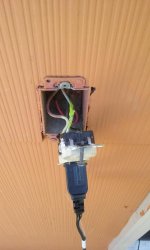
On the exterior side I hooked the hot and neutral up to an outlet for testing.
(YES I KNOW GFCI needs to be installed and her daughters green paint isn’t code for marking the ground wire, but until I get to Menards tonight after work, it will do.)

Damn if it doesn’t work! :beer:

The switch does control the outlet but that is something she was willing to live with.
Maybe someone can explain a different way to wire the outlet to make it hot, but I think I’ve done all I can with the wires available to me.

Thanks again for everyone’s help. It really expanded my limited electrical knowledge.
 

Attachments

  • AA712880-1261-4939-8885-4C155946F53D.jpg
    AA712880-1261-4939-8885-4C155946F53D.jpg
    53.9 KB · Views: 19
  • EBFCBD49-0322-4CC3-BE35-223EE4A781F0.jpg
    EBFCBD49-0322-4CC3-BE35-223EE4A781F0.jpg
    39.3 KB · Views: 20
  • 38FEA3CA-27FA-4F97-9FBD-6B8E56E40A3F.jpg
    38FEA3CA-27FA-4F97-9FBD-6B8E56E40A3F.jpg
    52.2 KB · Views: 18
  • 08D1D0D3-5D2F-4B75-8FC0-50D93A20FC68.jpg
    08D1D0D3-5D2F-4B75-8FC0-50D93A20FC68.jpg
    59.9 KB · Views: 18
  • 6AE30B79-A257-4A4C-849F-7432E84FA31F.jpg
    6AE30B79-A257-4A4C-849F-7432E84FA31F.jpg
    51 KB · Views: 17
To avoid these ads, REGISTER NOW!
Top Bottom