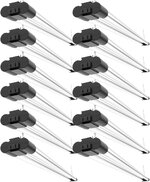
If it were me, there's no question, LED all the way. The only thing is, do you have electronic ballasts? If so, you can use a drop-in LED bulb, but if not, you'll either want to replace the ballasts or do a ballast delete.
True, but it's not a fair rating since the beam patterns are so different. The fluorescent beam is spread over 360 degrees while the LED is over 180. In a shop light with a white "reflector", you're not getting most of that upper half of the light, so the 3000 lumen fluorescent puts less light on the workbench than the 2100 lumen drop-in LED. In a fixture with an aluminized parabolic reflector, the fluorescent still wins, but that's a different beast. Also, as you said - when new. Fluorescent light output drops rapidly (CRI even faster). LED maintains close to full brightness for much longer.be aware that most LED tubes are much lower output than those tubes were when new -- they're rated at ~3000 lumens/ tube, and typically actually exceeded that, depending on the ballast. Most LED replacements are 1500 to 1900. that might not matter in your application, but it does for some.
At the same time fluorescent has light coming out in all directions and does have reflected light coming down where LED tubes are more unidirectional. Altho newer ones are a lot better then the older ones are.True, but it's not a fair rating since the beam patterns are so different. The fluorescent beam is spread over 360 degrees while the LED is over 180. In a shop light with a white "reflector", you're not getting most of that upper half of the light, so the 3000 lumen fluorescent puts less light on the workbench than the 2100 lumen drop-in LED. In a fixture with an aluminized parabolic reflector, the fluorescent still wins, but that's a different beast. Also, as you said - when new. Fluorescent light output drops rapidly (CRI even faster). LED maintains close to full brightness for much longer.
And that's at room temperature. I have fixtures that supposedly start a T8 lamp at -20F (and some at 0F), but below 40F, the fluorescent tubes were all so dim you could have told me they were solar path lights. LED doesn't care about the cold.
What he said is correct^^^True, but it's not a fair rating since the beam patterns are so different. The fluorescent beam is spread over 360 degrees while the LED is over 180. In a shop light with a white "reflector", you're not getting most of that upper half of the light, so the 3000 lumen fluorescent puts less light on the workbench than the 2100 lumen drop-in LED. In a fixture with an aluminized parabolic reflector, the fluorescent still wins, but that's a different beast. Also, as you said - when new. Fluorescent light output drops rapidly (CRI even faster). LED maintains close to full brightness for much longer.
And that's at room temperature. I have fixtures that supposedly start a T8 lamp at -20F (and some at 0F), but below 40F, the fluorescent tubes were all so dim you could have told me they were solar path lights. LED doesn't care about the cold.
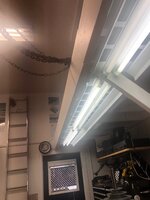
good plan, in my opinion.My plan is to replace them with the ballast bypass type.
The actual tech in program start electronic ballasts is pretty cool. So were the results -- 20K hour tube life even on frequent starts, very high ballast factors possible, instant starting down to 0F or lower, and high efficiency. Can do better with LED these days, but for 20 years ago, it was impressive.I'd relamp them with fluorescent. I tend to stick with old tech. Electronic T8 was never really never that interesting though.
I replaced the tubes in the lights in my garage with direct wire led replacements, from a good supplier. Manufacturer claimed they were equivalent to what I was replacing. Measured output of the LEDs directly below was about 85% the foot candles, falling off to more like 75% at the edge of coverage. these were good commercial fixtures with good reflectors, good GE ballasts, but rather aged tubes. Many people might have considered it the same, I didn't. I would have lived with it, but the color rendering was ****, so I put the tubes and ballasts back. I got some nice commercial led panels for a good price, so the fluorescents are gone. need to get around to running wire so I can dim them.What he said is correct^^^
Typical F32T8 lamp emits 2850 lumens. It's run by a ballast that drives it at 88%. (2850 x .88 = 2508). Typical strip fixture is 75% efficient, meaning only 75% of the light gets out of the fixture. (2508 x .75 = 1881). Lumen depreciation at 40% of life is between 10% and 15%. (1881 x .9 = 1693). So, regardless of what the data sheet of a new F32T8 says it's lumens are, you only get about 1700 lumens delivered.
Coincidentally, you'll notice that new LED tubes put out about 1700 to 2000 lumens, with no ballast loss and a beam angle that delivers all the lumens to target. The lumen output was set to those levels deliberately to match the output of a fluorescent lamp. So, yes, a 1700 lumen LED lamp delivers as much light as a 2850 lumen fluorescent lamp.
CD
We had 3 and 4 fluorescent 40 watt tube fixtures with several of these in the rooms and offices in our church. I replaced them with 2each 18watt led tubes ballast bi pass at less than $5 per tube. Led tubes were made by Parmida available at Amazon. They come in either frosted or clear with a 5 year warranty. Easy diy instructions for wiring.I suspect the ballasts are shot. What about the LED where you bypass the ballast?
What brand?I replaced all of mine with LED no ballast . LED bulb life is not what expected to see . Not pleased
A major reason I prefer retrofitting existing fixtures to ballast bypass LED is that it's quite difficult to replace a discontinued fixture & then you end up with a hodge podge of fixtures. With fluorescent a lot of fixtures were manufactured for many years it was easy to match, now they are off shored & of dubious quality & product supply lifespan, if a retrofitted fluorescent fails, replace the LED tubes & your done.What brand?
I have not had a single failure yet of my hyperkons installed 8 years ago. Unfortunately my kids sometimes leave them burning 25/7
On the other hand i put some of these up in my pole barn and have had a 20 percent failure rate after 5 years. And they are not as easy to replace as swaping out a tube on a converted t8 fixture.
the short version; buy ballast by pass bulbs, re wire the fixture according to type of bulb you bought, may need to swap out the tombstones if yours are shunted . trash the ballastsHow do I retrofit my ballast type fixtures?
Tell me the part # of the ballast.How do I retrofit my ballast type fixtures? I have several old style T8 fixtures and the ballast and or tubes are failing.
the ballast and or tubes are failing.
what does the ballast have to do with it? I think he wants to be rid of them.part # of the ballast.
If it's instant start, the fixure will most likely have shunted sockets. If it's rapid start or programmed rapid start, then the fixture will most likely have non-shunted sockets.what does the ballast have to do with it? I think he wants to be rid of them.
Thanks. That's an instant start ballast. Cut the wires close to the ballast, leaving long leads from the sockets. Take the two leads from the sockets on one end and connect them to the white wire feeding the fixture. Take the two leads from the sockets on the other end and connect them to the black wire feeding the fixture. Done. Easy peasy.I would like to get rid of the ballast, the present ballast are American Ballast Model No. AB2-32-IP-120-1. These also seem to be no longer available.