To avoid these ads, REGISTER NOW!

Replacing a PVC T Inline ??

danieldd

Well-known member
Joined
Dec 10, 2010
Messages
1,005
Location
Southern Tennesseee
I've got a 3/4" PVC T that is leaking on a condensate line. I've never had to replace something inline before, so I don't know how to go about making that type of connection. Usually I would use a coupler, but since the T is inline with the existing PVC pipe, I don't have a clue how to do this. I know someone here is smarter than I am and can give a suggestion as to make this work.

I took a picture on my phone, but I'm too ignorant to figure out how to get it to show up here (sorry)...
 
To avoid these ads, REGISTER NOW!

matt_i

Well-known member
Joined
Mar 14, 2008
Messages
10,728
Location
SE Michigan
You can use the pVC cement as a "caulk" if you know where its leaking (small crack or bad wetting originally) if its just a condensate line. Obviously clean is good and you can also use the purple primer.
 

sixty4

Well-known member
Joined
Dec 1, 2007
Messages
1,424
Location
CT
I would cut out the Tee put a new one on and use a slip coupling with a small piece of 3/4" pvc. You will have to work fast with such a small size though.
 

Innovate1

Well-known member
Joined
Jul 28, 2014
Messages
4,289
Location
Illinois near St. Louis, Missouri
You can use the pVC cement as a "caulk" if you know where its leaking (small crack or bad wetting originally) if its just a condensate line. Obviously clean is good and you can also use the purple primer.

I would give this a try since there is no pressure on a condensate line. Need to let it dry out. then paint some thin cement on the leaking area and let it wick into the leak. If you can pull a slight vacuum on the line that is even better but I wouldn't use an electric vacuum. The vapors of the cement are flammable. A water powered venturi would be ideal. But you may not even need the vacuum.
 

Kaizen

Well-known member
Joined
Jan 9, 2015
Messages
6,948
Location
New England
This kind of repair is easy if the pipes can move laterally. If they can’t then you have to use repair couplings on a few of them. Make sure you get repair and not regular. Cut back away from the T. Do one side (coupling,stub of pipe into T), then if the other pipes can slide repeat the process. If they slide a few inches then use regular couplings. So get a piece of pipe as well. Just cut the parts and lay them out on the table and go through the motions.


Sent from my iPhone using Tapatalk
 

SGKent

Banned
Joined
Feb 12, 2010
Messages
1,959
Location
Citrus Heights CA
I would try to force glue into the joint while a vacuum cleaner is sucking on one end. If that fails you will need to cut all three parts, typically about a foot from each joint of the tee. Then marry a new piece of PVC with a coupler into a tee. Then another. To be able to marry them you will need to be able to lift them to move the end back then slide it into the new tee. ONE THING you might look at is if the PVC was never glued, it may come apart so you can glue it. Main thing working with a PVC line is do you have flexibility to lift the line to get clearance to get it back in. If not then it gets harder.

Another solution since it is not under pressure, is just tape the joint well with electricians tape.
 
OP
D

danieldd

Well-known member
Joined
Dec 10, 2010
Messages
1,005
Location
Southern Tennesseee
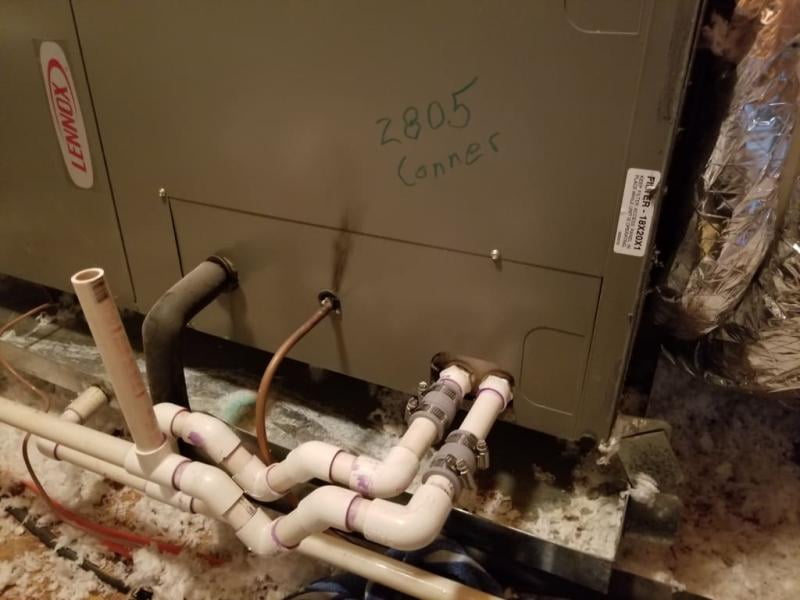
Nothing better than a picture:
The T is tied into the condensate line from the HVAC, which is to the left, out of the picture. As the condensate line travels from left to right, it is intersected by a T from the water heater overflow pan. That T is leaking, so I have to cut it out.

So, it looks like I need to cut the T out maybe 3-4 inches to the left and 12 inches to the right, then glue a coupling on the left side of the condensate line, glue in a new T, reattach the overflow line from the water heater. Then add a small length of PVC pipe to the right side of the T and use a compression coupling to tie the two pipes together.

Sounds like a lot of work. Looking for alternate suggestions.
 

Attachments

  • IMG_7109.jpg
    IMG_7109.jpg
    141.2 KB · Views: 105
Last edited:
To avoid these ads, REGISTER NOW!

pbon

Well-known member
Joined
May 14, 2017
Messages
3,498
If it is the lower pipe, it looks like it might have enough flex if you unclamped it to replace the tee without a compression coupler. It may also be possible to be able to drop it into place if you redo a longer section. I don’t know what is to the left or right.

But since it is just a drain pipe, a simple rubber sleeve can replace the compression coupler you think you need. You just have to find a piece of hose that fits. You can buy plumbing pvc rubber coupler for a variety of sizes at HD or Lowe’s but I am not sure I have seen one that small. Basically slide the rubber hose down past the end of the pipe, move the other pipe into place and pull the rubber hose back over the joint and clamp it. Again, I would do this at only one end of the new tee section you make to insert in place of the leaking one. Glue the other end with a pvc coupler. PVC is really cheap; the glue set might cost more than the pipe parts.

Add an extra clamp on the next stud to add support so this is less likely to happen again.
 
OP
D

danieldd

Well-known member
Joined
Dec 10, 2010
Messages
1,005
Location
Southern Tennesseee
If it is the lower pipe, it looks like it might have enough flex if you unclamped it to replace the tee without a compression coupler. It may also be possible to be able to drop it into place if you redo a longer section. I don’t know what is to the left or right.

But since it is just a drain pipe, a simple rubber sleeve can replace the compression coupler you think you need. You just have to find a piece of hose that fits. You can buy plumbing pvc rubber coupler for a variety of sizes at HD or Lowe’s but I am not sure I have seen one that small. Basically slide the rubber hose down past the end of the pipe, move the other pipe into place and pull the rubber hose back over the joint and clamp it. Again, I would do this at only one end of the new tee section you make to insert in place of the leaking one. Glue the other end with a pvc coupler. PVC is really cheap; the glue set might cost more than the pipe parts.

Add an extra clamp on the next stud to add support so this is less likely to happen again.

Thanks for the input!
 

fourjeepin

Well-known member
Joined
Feb 12, 2011
Messages
3,658
Location
Atlanta, GA
Did you check if that joint is glued? I don’t see any primer at the tee and it seems unlikely that a condensate line would develop enough pressure to leak unless it wasn’t glued.
 

welder4956

Well-known member
Joined
Apr 8, 2010
Messages
3,071
Location
Birmingham, AL USA
Did you check if that joint is glued? I don’t see any primer at the tee and it seems unlikely that a condensate line would develop enough pressure to leak unless it wasn’t glued.

It definitely happens. I had a new roof put on last year and found a stain on one of the bedroom ceilings the first time it rained afterwards. Had the roofers come back out and seal the plumbing vent penetration and it still leaked when it rained. So I crawled up in the attic to look and the leak was coming from a pvc elbow on the plumbing vent that was never glued. The house is 35 years old and it did not leak until the roofers bumped the plumbing vent loose and the pipe came out of the elbow.
 

Milton Shaw

Well-known member
Joined
Feb 11, 2011
Messages
4,838
I have used 3/4 automotive heater hose to splice PVC pipe. Works great and gives you a place to take it apart to clean 10 years from now. Just a couple of hose clamps and you are ready to use. Do replace the T fitting and glue stubs in and then splice with hose.. Do keep the hose pieces short enough so they cannot kink between the clamps.
 

sweetk30

Well-known member
Joined
Jan 2, 2011
Messages
2,306
Location
finger lakes area upstate ,ny
also those condensate lines get gummed up bad with slime and need a good clean out or replace every now and then .

my pump on my hvac furnace was acting slow and i pulled it apart and WOW was it nasty inside . scrubbed it clean and she now pumps water much faster . also tossed in a slug of purple power to help kill of whats in the line and its a lot cleaner now ( clear plastic ) and a lot less sludge .
 

Dumber than lumber

Well-known member
Joined
Dec 19, 2015
Messages
1,898
i am always thinking "do it right or do it over".
On those pvc Tees I know what a pain they are to replace because of the way you have 3 pipes that need to align.
There are a couple of things I have in my bag of tricks for situations like this.
One thing you might try is 45* pvc angles; the other is the flex pipe (comes in black) that glues with some types of pvc glues.
 

Lynden

Well-known member
Joined
May 23, 2015
Messages
672
Location
Southern California
Fernco makes a flexible coupling for 3/4" pvc pipe. They are often used on condensate lines to make cleaning easier.

https://www.supply.com/fernco-3-4-in-cast-iron-and-plastic-flexible-coupling-1056-075/p2459271

k2-_349dc4bd-096a-4c61-9bc3-a6c04729555c.v1.jpg


vbtlxa7svdi2tqbbu4bx.jpg
 
Last edited:

Busted Knucles

Well-known member
Joined
Apr 15, 2016
Messages
437
cut it out and use flanges and couplings with short pieces of pipe to make up the lengths you cut out
 

pbon

Well-known member
Joined
May 14, 2017
Messages
3,498
The fernco type coupling is what I have used, but a piece of any rubber hose that fits should work if you happen to have a bunch of random hose from car projects.
 
To avoid these ads, REGISTER NOW!
Top Bottom