To avoid these ads, REGISTER NOW!

Replacing load bearing wall

branimal

Well-known member
Joined
May 31, 2016
Messages
1,938
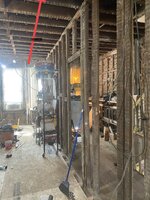
I need to move a load bearing wall in my renovation project. The plan is to build a new 2x4 wall (red line in the pic) and then cut out the old wall.

Plan is a double plate 2x4x16 on top. And a single plate on the bottom.

Should I place my studs in line with the ceiling joists or the floor joists. They are off ~1 1/2" and not all of the joists are 16oc.

(The floor is way off level - bowed in some spots). I've been shimming up the deck with the help a laser. And putting 3/4" plywood on top. )
 

Attachments

  • IMG_5359.jpg
    IMG_5359.jpg
    474.3 KB · Views: 255
To avoid these ads, REGISTER NOW!

mike93lx

ALLIANCE MEMBER
Joined
Dec 9, 2013
Messages
37,401
Location
Richmond, VA
Are you moving the wall or is the red line temporary? What's below that? The wall needs to bear on support, so moving a load bearing wall is not always simple

A double plate helps if the ceiling framing doesn't align with the studs. I would keep the studs at 16OC.
 

MoonRise

Well-known member
Joined
Nov 5, 2010
Messages
4,028
Location
NJ
Not enough info in the pic or words to say yay or nay.

Which thus means NAY.

You have to have a continuous load path from the top to the bottom for a load bearing structure. The floor joists from above have to sit on a beam or wall plate, which then has to transfer the load from above down to the structure below (beam or load bearing wall below) and then eventually down to the foundation or footings.

And a "structural change" NEEDS to have Permit approval beforehand. Which means there have to be structural drawings submitted beforehand from the engineer or architect to the permit approval folks.

Moving a load bearing wall is NOT something you just decide to do on your own.

Is it feasible to move your load bearing wall from where it is to where you want it to go? Maybe, or maybe not. It all depends on how the existing structure is able to transfer the loads from above to below and how much time and money you can afford. (with enough time and money, you could put a BIG beam in there and beefed up support posts to support the BIG beam and then big support pillars all the way down to the beefed up support footings. Then you wouldn't even need a support wall there. :lol: )
 

APEowner

Well-known member
Joined
Oct 2, 2009
Messages
4,164
Location
Sunny, New Mexico
As others have indicated there's not enough information given to really make a call on that.

There's nothing in the picture that indicates that wall is load bearing.

You need to consider what loads are being transferred from above. If there's a wall or roof structure that's loading that wall directly then you can't just move it over.

Likewise there needs to be sufficient support below the new wall to take on whatever loads are being transferred.

Not related to your question but something else to consider if you do move the wall over is clearance to the window. Make sure you leave enough room between the window and the framing for whatever sheathing you're using plus the window frame and ideally some whitespace to make the window look like it belongs there.
 

Zeke

Well-known member
Joined
Aug 13, 2009
Messages
17,176
Location
Long Beach CA, the sewer by the sea.
Well, it's some kind of load bearing wall because it's perpendicular to the joists. However, the joists are continuous so it's not a main load bearing wall. (I know that is not a proper framing term.)

Me, I'd just do it but with some considerations. Since you are putting sleepers on the old floor, I'd want to know more about them. If there is a cripple wall below the existing wall and you're breaking the sleepers at that point, that's a weakness. You might want to investigate what's under there and maybe put a beam on piers under the new wall. If using a single bottom plate, I'd try to place the new studs over the sleepers or use a double bottom plate for the same reason you use a doble top plate.

For sure build the new wall one stud at a time cutting them all a tad long and preloading the new wall. If you just stand a wall up and remove the old one, I can guarantee you that the joists will settle downward. When preloading a wall, I don't start at one end, nor do I start at the center and move outward one stud space at a time. I skip studs and fill in reading the amount of pressure it takes to knock a stud in.

Always have a long level or laser to gauge what's happening as you go. I've leveled a few houses over the years, so there are tricks that make it better vs. worse.

It doesn't appear that you staggered the floor sheathing. Did you?
 

mike93lx

ALLIANCE MEMBER
Joined
Dec 9, 2013
Messages
37,401
Location
Richmond, VA
Well, it's some kind of load bearing wall because it's perpendicular to the joists. However, the joists are continuous so it's not a main load bearing wall
That doesn't mean it's load bearing. Just means it could be.

Could just be a partition. Non load bearing walls perpendicular to joists are not uncommon.
 
Last edited:

firebirdparts

Well-known member
Joined
Jun 8, 2016
Messages
10,584
Location
Kingsport, TN
The joists are continuous, so you're in pretty good shape above. Convince yourself there's not an enormous load directly above it, and by that I mean the END of a bunch of floor joists or any part of the roof standing directly on a wall that's standing directly above that. It's unlikely, but I've seen it.

If you're happy with that, then at least above it will be fine.
 

Bretny

Well-known member
Joined
Jul 31, 2017
Messages
3,918
Location
Dutchess county NY
Are you sure it is load bearing? Judging by the door header size it may not be.
This is what I'm thinking too. It may help with the load, depending on what's under it. Judging by how old that lumber looks a few inches of bowing in floor/ceiling joists is expected over 100yrs.
 

Jlbc212

Well-known member
Joined
Dec 7, 2013
Messages
1,530
Location
Northeast MA
Assuming it is a load bearing wall and the location for the new wall is appropriate for carrying the loads it will be supporting and the new wall has adequate support beneath, I wouldn’t remove the old wall until I had the new wall built in place.
 

yeldogt

Well-known member
Joined
Jan 2, 2012
Messages
18,184
looks like a hall way --- did you take a set of steps out .... what is above ?

In those old buildings the walls supported the steps all the way down to the basement -- each level had the same thing. The floor load was between the wall you want to move and the far wall. It really depends on what is above. Top floor my guess no issues .... first with 4 above my guess no
 

quickfarms

Well-known member
Joined
Feb 14, 2021
Messages
1,027
Location
Southern California
Not enough information

The wall may or may not be load bearing

When dealing with these old buildings you need to look at the framing all the way from the foundation to the roof to figure out the load paths

If you are asking the question here you need to talk to your structural engineer
 

Sumboodie

Well-known member
Joined
Mar 20, 2021
Messages
10,660
Location
AK
Not enough info in the pic or words to say yay or nay.

Which thus means NAY.

You have to have a continuous load path from the top to the bottom for a load bearing structure. The floor joists from above have to sit on a beam or wall plate, which then has to transfer the load from above down to the structure below (beam or load bearing wall below) and then eventually down to the foundation or footings.

And a "structural change" NEEDS to have Permit approval beforehand. Which means there have to be structural drawings submitted beforehand from the engineer or architect to the permit approval folks.

Moving a load bearing wall is NOT something you just decide to do on your own.

Is it feasible to move your load bearing wall from where it is to where you want it to go? Maybe, or maybe not. It all depends on how the existing structure is able to transfer the loads from above to below and how much time and money you can afford. (with enough time and money, you could put a BIG beam in there and beefed up support posts to support the BIG beam and then big support pillars all the way down to the beefed up support footings. Then you wouldn't even need a support wall there. :lol: )
How do you know he needs a permit, he live in your area?
 
To avoid these ads, REGISTER NOW!

The Cobbler

Super Moderator
Staff member
Joined
Oct 24, 2013
Messages
25,823
Location
Niagara Region, Ontario, Canada
I skimmed thru the posts , did not read them in their entirety .
what I would do is place the studs over the floor joists . even if they are not all @ 16" 0/C . the double top plate would easily support the joists without a problem. the only thing with random spacing of studs is maybe a bit more drywall wastage , but it's sometimes a price you have to pay when doung renos .
 

rayra

Well-known member
Joined
Dec 1, 2014
Messages
4,724
Location
Escaped from Los Angeles
"what I would do is place the studs over the floor joists"

lol why. double bottom plate would spread the load just fine, if that was any concern.

OP what is under to old wall / floor joists and what if anything will be under the new. If that is any sort of bearing wall, there'll be another underneath conveying the load down to the earth.
 

The Cobbler

Super Moderator
Staff member
Joined
Oct 24, 2013
Messages
25,823
Location
Niagara Region, Ontario, Canada
"what I would do is place the studs over the floor joists"

lol why. double bottom plate would spread the load just fine, if that was any concern.

OP what is under to old wall / floor joists and what if anything will be under the new. If that is any sort of bearing wall, there'll be another underneath conveying the load down to the earth.
I said if it was me, that's what I would do . no where did I say it's the only way to do it.
and
there doesn't have to be a wall directly beneath that wall to make it a bearing wall...
 
OP
B

branimal

Well-known member
Joined
May 31, 2016
Messages
1,938
Thanks for all the responses.

Here are answers to the questions asked:

  1. The building is attached on both sides to two similarly sized buildings. It's 3 stories with a flat roof and a below ground basement. The building is 19.75' x 57.5'.
  2. The joists are full span 20'. Joists are rough sawn 3" x 8" actual.
  3. The sleepers are continuous; They are screwed through the pine floor into the joists.
  4. When I demo'd the 3rd floor, there were no structural walls. The ceiling height sloped from 14'-12'. The room partition walls were secured with cripples wherever necessary. I rebuilt the 3rd floor with no structural walls.
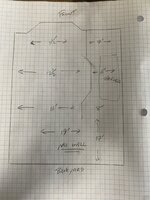
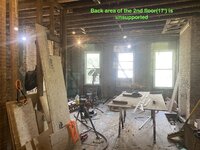
  5. I drew a rough diagram of the 2nd floor (floor in question) illustrating where the wall perpendicular to the joists lands with respect to the building. The diagram is not to scale and the measurements were quickly taken with laser. The is no "perpendicular wall" in the back of the building. So theoretically the back 17' is unsupported.
  6. The 1st floor's "perpendicular walls" are roughly in the same locations as the 2nds. There is some variation.
  7. The basements "perpendicular walls" are also roughly where the 2nd floors walls are. There are 3 metal posts in the basement. They are not exactly in line with one another. I can't tell if these metal posts are supporting a beam. It's been sheetrocked over. I can knock the rock off and take a closer look.
  8. The new floor sheeting is staggered.
  9. @yeldogt rough location of the stairwell is in the diagram
Some pics:
 

Attachments

  • IMG_5382.JPG
    IMG_5382.JPG
    324.3 KB · Views: 115
  • IMG_5371.JPG
    IMG_5371.JPG
    518 KB · Views: 83
  • IMG_5373.JPG
    IMG_5373.JPG
    532.3 KB · Views: 79
  • IMG_5374.JPG
    IMG_5374.JPG
    413.8 KB · Views: 77
  • IMG_5375.JPG
    IMG_5375.JPG
    445.5 KB · Views: 74
  • IMG_5379.JPG
    IMG_5379.JPG
    251.1 KB · Views: 99
OP
B

branimal

Well-known member
Joined
May 31, 2016
Messages
1,938
Yes the metal posts are under the wall I want to move. One of the posts is off about 10”. But the other 2 metal posts are under the wall I want to move.
 

NUTTSGT

Super Moderator
Staff member
Joined
Sep 14, 2009
Messages
50,864
Location
Northern Central Ohio
Another question for you about your project. Are you raising the entire floor level with sleepers and Advantech OSB ?

If you are, what are you doing at the top/bottom of the stairs ?
 

billconner

Well-known member
Joined
Jul 20, 2021
Messages
6,930
Location
Thousand Islands NYS
Yes the metal posts are under the wall I want to move. One of the posts is off about 10”. But the other 2 metal posts are under the wall I want to move.
An engineer might tell you it will work - the second floor load bearing wall holding third floor being eccentric. Stout construction. It would seem worst case is sistering second floor joists from wall to new 2nd floor wall line, picking up third floor load on the cantilever, or sistering joists from far party wall to existing first floor wall.
 

BillK

Well-known member
Joined
Aug 24, 2006
Messages
9,299
Location
Beautiful Southern Maryland
Yes the metal posts are under the wall I want to move. One of the posts is off about 10”. But the other 2 metal posts are under the wall I want to move.

If that is the case then I dont think I would want to move it personally. I guess I shouldnt ask but will this work be inspected ? If so you need to find the answers first.
 

Jlbc212

Well-known member
Joined
Dec 7, 2013
Messages
1,530
Location
Northeast MA
Twenty feet is a long span for 3” x 8” native lumber joists. It should have a bearing wall approximately near the center of the span (give or take 3 feet) to decrease the span length of the joists. Walls and supporting beams do not have to be directly under each other, but should be fairly close.
A floor on sleepers above another floor creates an ideal habitat for mice and other vermin.
 
OP
B

branimal

Well-known member
Joined
May 31, 2016
Messages
1,938
Twenty feet is a long span for 3” x 8” native lumber joists. It should have a bearing wall approximately near the center of the span (give or take 3 feet) to decrease the span length of the joists. Walls and supporting beams do not have to be directly under each other, but should be fairly close.
A floor on sleepers above another floor creates an ideal habitat for mice and other vermin.
The new walls are all within a 2-3' of the support beam in the basement. I attached a diagram of the new layout below. The new wall "jogs" around the old wall in both directions.

Mice and sleepers - fun little maze for them. I couldn't think of another way to get this floor level. It's sure is a lot of tedious work. But with some experience is going a lot faster than the last time I did it.

If that is the case then I dont think I would want to move it personally. I guess I shouldnt ask but will this work be inspected ? If so you need to find the answers first.
No there won't be an inspection.

For the small added cost, you could place extra studs on both the ceiling joists and on the floor joists….sleep easy.
I'm going to double plate both.


@NUTTSGT Good question on the impact of sleepers & advantech at the stairs. Going from the 2nd to 3rd floor there's a ~3'x3' landing I can rebuild to match the rise on the staircase. At the top of the stairs going from the 1st to the 2nd, it's off level 5/16" -3/4" left to right. Add in the advantech and we're talking about a 1 1/16" - 1 1/2" change in rise. The steps rise 7 1/2". I might have to gently slope the new deck around the staircase.


Attachments

  • 2nd floor layout v2 shorten bedrooms.jpg
    2nd floor layout v2 shorten bedrooms.jpg
    103.7 KB · Views: 54
Last edited:

Zeke

Well-known member
Joined
Aug 13, 2009
Messages
17,176
Location
Long Beach CA, the sewer by the sea.
@NUTTSGT Good question on the impact of sleepers & advantech at the stairs. Going from the 2nd to 3rd floor there's a ~3'x3' landing I can rebuild to match the rise on the staircase. At the top of the stairs going from the 1st to the 2nd, it's off level 5/16" -3/4" left to right. Add in the advantech and we're talking about a 1 1/16" - 1 1/2" change in rise. The steps rise 7 1/2". I might have to gently slope the new deck around the staircase.
This starting to sound pretty mickeymouse.
 

mike93lx

ALLIANCE MEMBER
Joined
Dec 9, 2013
Messages
37,401
Location
Richmond, VA
The new walls are all within a 2-3' of the support beam in the basement. I attached a diagram of the new layout below. The new wall "jogs" around the old wall in both directions.

Mice and sleepers - fun little maze for them. I couldn't think of another way to get this floor level. It's sure is a lot of tedious work. But with some experience is going a lot faster than the last time I did it.


No there won't be an inspection.


I'm going to double plate both.


@NUTTSGT Good question on the impact of sleepers & advantech at the stairs. Going from the 2nd to 3rd floor there's a ~3'x3' landing I can rebuild to match the rise on the staircase. At the top of the stairs going from the 1st to the 2nd, it's off level 5/16" -3/4" left to right. Add in the advantech and we're talking about a 1 1/16" - 1 1/2" change in rise. The steps rise 7 1/2". I might have to gently slope the new deck around the staircase.
Changing the height of one step is dangerous. Rise needs to be consistent or it is a trip hazard
 

MoonRise

Well-known member
Joined
Nov 5, 2010
Messages
4,028
Location
NJ
3 floors, in NYC?

Yeah, it is -supposed- to have a permit and an approved construction plan and ALL of the inspections.

You are not just painting some walls and sanding a hardwood floor and replacing some light bulbs.

You are reframing and restructuring the building.


Structural design requirements


Fire protection requirements


Fire and smoke protection


Types of construction


Wood framing details and requirements


And as mike93lx mentioned, steps HAVE to be very-very consistent in rise (height) and run (tread width/depth), both from step-to-step and over the ENTIRE set of stairs. No more than 3/8" variation in the rise (or the tread depth) from the largest to the smallest rise over the entire set of stairs.

And 3 floors? Is this a single family home or is this a multi-unit/family building? If multi-unit/family (aka apartments or rental units), the rules are usually slightly stricter on some of the construction details and requirements. Electrical, structural, plumbing, fire code requirements (sprinklers, smoke detectors, fire blocking in wall and floor bays, etc) are all usually slightly stricter once a building is no longer an R3 class single-family.
 
To avoid these ads, REGISTER NOW!
Top Bottom