To avoid these ads, REGISTER NOW!

Replacing SO bit socket's bit and roll pin with a C6 bit and set screw

Jaywalk3r

Well-known member
Joined
Mar 9, 2025
Messages
50
Location
PNW, USA
I recently purchased two used Snap-on 1/4 inch drive, 1/4 inch hex bit sockets, model number TMA8 with a 1985 date code.

When I placed my order, I was under the mistaken impression that the bits were secured with a set screw. Upon receipt, I found that the bits were secured with a roll pin instead. I was able to remove the bits from both bit sockets without issue.

My intention is to replace the 1/4 inch OEM bit with a PB Swiss C6 security hex bit. Unfortunately, that the socket uses a roll pin instead of a set screw might pose a problem. As I see it, I have five options:
  1. Drill the PB Swiss bit for the roll pin.
  2. Tap one of the roll pin holes in the socket to accept a set screw (M3x0.5, about 3mm in length).
  3. Use some sort of epoxy, e.g., JB Weld, to secure the C6 bit in the socket, presumably creating a permanent bond.
  4. Use thread locking compound to secure the C6 bit in the socket, creating a semi-permanent bond.
  5. Abandon the project.
Am I missing any alternatives?

Option 1 seems impractical, and I'd like to avoid option 5.

Option 2 is most appealing. The roll pin holes appear to be approximately 2.5 millimeters in diameter, making an M3 set screw appropriate. However, the holes (one for each socket) will need to be tapped. I'm concerned about the hardness of the socket making thread tapping difficult, if not impossible. I don't want to destroy the sockets or damage the tap, which will likely be a borrowed tool.

Is option 2 possible? If so, are there any special precautions I should take? Or should I be looking at options 3 or 4 instead?
 
To avoid these ads, REGISTER NOW!
OP
J

Jaywalk3r

Well-known member
Joined
Mar 9, 2025
Messages
50
Location
PNW, USA
I already have the bits and sockets. I also already have a set of Ko-Ken hex bit sockets, but I need (only) one particular size in security hex. Each of my bit kits is already suitably supplemented with a C6 security hex bit and a redundant L-key; I'm just trying to maximize the utility of my excess C6 security bits. The Frankenstein's monster I want to assemble will be redundant no matter the toolbox into which it goes.

I have other sockets in which I can semi-permanently install the bits more easily, but I'd like to see if I can make it work with one (or both) of the SO sockets.

I already have plenty of top-shelf hex tools, far more than I need. I do not want to buy any more unless the new form factor simplifies a task I need to perform.
 

seber

Well-known member
Joined
May 31, 2016
Messages
4,202
Location
Deep East Tx.
I think one and three are your only real options. I'd try epoxy first and see if it holds up under use. In theory it is possible to tap hardened steel but I would expect to break multiple taps in the process.
 

johninct

Well-known member
Joined
Dec 21, 2010
Messages
2,597
Can you somehow ****** up the end of your PB bit a little and then tap it in?
 

mike93lx

ALLIANCE MEMBER
Joined
Dec 9, 2013
Messages
37,723
Location
Richmond, VA
Why not just temper it back in your heat treat over, drill and ream on your mill and then reharden it?

I mean, you do have both, right?
 

KnurledNut

Well-known member
Joined
Jan 28, 2011
Messages
8,166
Location
n/a
I drilled and tapped a bit extension for a set screw in a custom extra long (15”) bit holding screwdriver. I used a cobalt drill and a brand new japanese tap of which the make escapes my memory. My industrial supplier had them in stock.
 
Last edited:
OP
J

Jaywalk3r

Well-known member
Joined
Mar 9, 2025
Messages
50
Location
PNW, USA
Can you somehow ****** up the end of your PB bit a little and then tap it in?
That’s an interesting idea. I’ll try that before I resort to using epoxy. The bit is hardened tool steel, though, so I might not have much success.
 
To avoid these ads, REGISTER NOW!
OP
J

Jaywalk3r

Well-known member
Joined
Mar 9, 2025
Messages
50
Location
PNW, USA
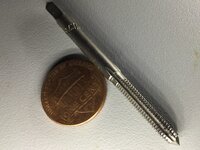
I drilled and tapped a bit extension for a set screw in a custom extra long (15”) bit holding screwdriver. I used a cobalt drill and a brand new japanese tap of which the make escapes my memory. My industrial supplier had them in stock.

View attachment 2315016
Thanks! That’s definitely proof of concept for the set screw approach. Fortunately, I should be able to use an existing hole, which should hopefully simplify the process.

Do you remember if the tap survived the project in usable condition?
 

Stubby1743

Well-known member
Joined
Jul 16, 2023
Messages
732
Location
UK
DSCF0316R.jpg

I drilled and tapped a 1/2" drive 10mm socket to make a 10mm bit holder. It was not difficult to to do the drilling and tapping. Sockets are not "hard" as that would make them brittle.
 

KnurledNut

Well-known member
Joined
Jan 28, 2011
Messages
8,166
Location
n/a
Thanks! That’s definitely proof of concept for the set screw approach. Fortunately, I should be able to use an existing hole, which should hopefully simplify the process.

Do you remember if the tap survived the project in usable condition?

Survived just fine, but I don’t know how well one would do in Snap-on’s tough alloy steel. M4x0.7.

54460910165_4ce1ed6043_b.jpg
 

Steve_P

Well-known member
Joined
Sep 15, 2010
Messages
5,185
A bit is going to be >50 RC and probably >55RC. You're not going to drill it unless you have something very special. And since you're asking, you probably don't, or you'd be done with the project. You might be able to drill and tap the socket for a set screw.

But why? I know this is GJ, but just buy some proper bit sockets.
 
OP
J

Jaywalk3r

Well-known member
Joined
Mar 9, 2025
Messages
50
Location
PNW, USA
I know this is GJ, but just buy some proper bit sockets.
What would be the point? Like I said, the project serves to make use of spare bits and sockets. I can make use of a security hex bit socket, Extra bits and 1/4 x 1/4 sockets? Not so much. Buying a bit socket new solves no problem and adds no utility value. Not everyone wants to buy tools for the sake of buying tools*.

On the other hand, creating a bit socket from spare parts? I end up with a new (and redundant) bit socket and fewer spares to keep track of. It’s a win-win. I want to make sure I’m anticipating any plausible issues, hence this thread. Fortunately, other posters have already proven the concept is viable.

*Edit: I have been known to buy tools for the sake of getting free shipping, which is actually why I have the extra bits to begin with.
 
Last edited:

308guru

Well-known member
Joined
Jun 17, 2017
Messages
463
Have a go at drilling a hole in the bits. Report back here with the results. :p
 
OP
J

Jaywalk3r

Well-known member
Joined
Mar 9, 2025
Messages
50
Location
PNW, USA
Have a go at drilling a hole in the bits. Report back here with the results. :p
No need.

I eliminated options 1 and 5 before I made the post. Option 1 requires a machine shop, since I lack the equipment, making it cost prohibitive. Option 5 requires someone who gives up much more easily than I do. Those options were included only for the sake of completeness lest someone complain that I was ignoring options.
 

larry_g

Well-known member
Joined
Apr 28, 2007
Messages
16,889
Location
oregon
Get a bit of shim to put in the socket just thick enough so that you have to drive the bit into the socket. Now the bit is wedged into the socket and could be pulled out if necessary.

lg
 

rancherbill

Well-known member
Joined
Oct 18, 2007
Messages
5,335
Location
Foothills County, Alberta, Canada
The few of mine that I changed were friction fit. I drove the old one out with a punch. There was something on the bit. FLASH it hit me, they had used Loctite or something. I grabbed my Loctite, reassembled and waited ?30? minutes (it said on the tube) and I have not had any problem
 
To avoid these ads, REGISTER NOW!
Top Bottom