SaintPanzer
Active member
- Joined
- Jul 28, 2014
- Messages
- 31
I'm going to re-post this here, because it had 60 views in the general tools forum, but no responses. Perhaps the right person who understands old tools will see it here.
Specifically, how does it build pressure?
OK, full disclosure. This is not a grease problem, but I need to modify a gun, and I don't want to break it.
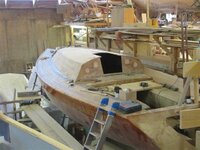
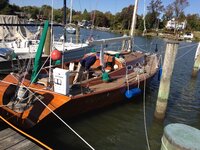
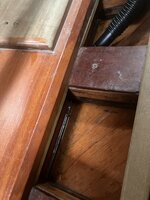
In this specific problem, I have a sailboat that has a small leak between the ballast keel and the keel/keelson. I've spoken with my boat builder, and he has solved this problem in the past with a modified Alemite gun filled with 3M 5200.
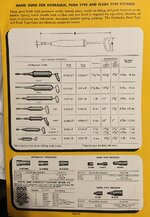
His gun is modified as below. His recommendation is to drill a small hole where the keelson meets the keel, thread the gun into the hole, and then "pump like crazy". The 5200 will fill any small areas under pressure, and prevent further water ingress.

I have two Alemites I'd like to modify. More correctly, I will modify one of the two. The first is an Alemite 6057, which is similar, but has a grease/zerk type fitting that appears to be sweated/brazed to a ****** on the gun. I do not know what (if any) springs are in the fitting, and don't want to cut the fitting off if it's integral to building pressure.
The second is an Alemite 6056. It's a little larger, and has a "pipe" with a "normal looking" grease fitting on the pipe. When I unscrewed the fitting from the gun, there was some sort of spring arrangement "inside" the gun. I didn't get a good look at this, because it was caked with a bunch of 50 or so years old grease, so I need to do some cleaning there.
That leaves the "normal looking" (i.e. looks the same as any other grease gun fitting I've ever seen) that I could simply cut off, and then thread the end (assuming the fitting is not already threaded in).
I have scraped the internet to find instruction manuals for the 6057 and 6056, and both are "so old" the information is NLA. That's why I'm hoping someone here might know how these things work.
Finally, there is the "more expensive" plan than the total $40 I've spent on these two guns: A brand new Alemite 600 is about $100... and has no fitting... you need to screw one of several fittings into the gun. Again, is that final fitting (where it plugs into the zerk) required for pressure building? Or is that simply a good way to hold on to the gun as the grease is forced out?
Specifically, how does it build pressure?
OK, full disclosure. This is not a grease problem, but I need to modify a gun, and I don't want to break it.
In this specific problem, I have a sailboat that has a small leak between the ballast keel and the keel/keelson. I've spoken with my boat builder, and he has solved this problem in the past with a modified Alemite gun filled with 3M 5200.
His gun is modified as below. His recommendation is to drill a small hole where the keelson meets the keel, thread the gun into the hole, and then "pump like crazy". The 5200 will fill any small areas under pressure, and prevent further water ingress.
I have two Alemites I'd like to modify. More correctly, I will modify one of the two. The first is an Alemite 6057, which is similar, but has a grease/zerk type fitting that appears to be sweated/brazed to a ****** on the gun. I do not know what (if any) springs are in the fitting, and don't want to cut the fitting off if it's integral to building pressure.
The second is an Alemite 6056. It's a little larger, and has a "pipe" with a "normal looking" grease fitting on the pipe. When I unscrewed the fitting from the gun, there was some sort of spring arrangement "inside" the gun. I didn't get a good look at this, because it was caked with a bunch of 50 or so years old grease, so I need to do some cleaning there.
That leaves the "normal looking" (i.e. looks the same as any other grease gun fitting I've ever seen) that I could simply cut off, and then thread the end (assuming the fitting is not already threaded in).
I have scraped the internet to find instruction manuals for the 6057 and 6056, and both are "so old" the information is NLA. That's why I'm hoping someone here might know how these things work.
Finally, there is the "more expensive" plan than the total $40 I've spent on these two guns: A brand new Alemite 600 is about $100... and has no fitting... you need to screw one of several fittings into the gun. Again, is that final fitting (where it plugs into the zerk) required for pressure building? Or is that simply a good way to hold on to the gun as the grease is forced out?