To avoid these ads, REGISTER NOW!

Required to Isolate Slab From Footings

luke000

Active member
Joined
Apr 17, 2019
Messages
32
Location
Macomb, Michiagn
I just received my building permit for my 28X34 garage from the city, on there under "stipulations" they had one that said "Slab must be isolated from footings. Here in Michigan we are required 42 x 12 inch trench footings for all structures over 600 square feet. I was planning on, and lined up a concrete guy to do this in a monolithic pour. Now that my permit states that the slab must be isolated from the footings. I talked with the building inspector yesterday and he said it is to help with the movement of the ground and keeping the slab from bowing in the center. He also said I should have a 5% slope for drainage on the slab. He said I should pour the footings in a form and then float in the slab with a cold joint.
I was not aware that this was a requirement (nor was the concrete contractor) and am sure it is going to cost me a lot more money than I am already paying (about $14K with a 6 inch slab). I can see the benefits, but it seems excessive.
Has anyone heard of a similar requirement? Should I ask to see the code?
 
To avoid these ads, REGISTER NOW!

Aerospace Eng

Well-known member
Joined
Jun 2, 2019
Messages
93
Location
Zelienople, PA
For my aircraft hangars the footings were required to be completely independent of the slabs, and are insulated from them with about 1/2" of foam.

I'm not sure whether it would have been required in a monolithic pour.

With respect to the slope......many jurisdictions require a slope to the door or a floor drain to an oil water separator. It's for fire reasons. I'm sure he meant 0.5%, not 5%. In my tee hangars, the front part of the hangar is sloped 1.5" over 21 feet. I was able to work around this requirement in some 50x41 box hangars I built by agreeing to put a spill kit in every hangar bay.
 

ard

Well-known member
Joined
Feb 16, 2015
Messages
4,391
Location
Sierra Foothills... California
Time to deal with this was with the plan check/approval. Inspector just inspects to the plan.

Was the foundation engineered, with stamped plans? I'm guessing not, plan check just defaulted to isolated slab as they are most comfortable with that. Without engineering, soils report, testing, their policy may be 'no monolithic'.

BTW, that would be my STRONG preference too.

I'd lean on the concrete guy, at 14k he has some room. If he wants to charge more, mention you need to get some more bids....

My 2 cents
 

ConCretin

Well-known member
Joined
Jan 20, 2011
Messages
3,378
Location
Central Maine
If you are digging a 42" trench around the perimeter, you really aren't placing a monolithic slab even if you place it all at once. A mono-slab is generally a floating slab with a thickened edge, which acts like a footing to support the structure but it all moves together. Your 42" 'grade beams' are presumably designed to bear below the frost line.

I assume the code is intended to allow the slab and grade beams to move independently because the grade beams are frost protected but the slab isn't. There are several ways you could place the grade beams and the slab the same day and still isolate them from one another. Just keep the possibility of differential movement in mind so everything can move the way it wants to.
 

blkhonda1991

Well-known member
Joined
May 20, 2008
Messages
608
Location
Connecticut
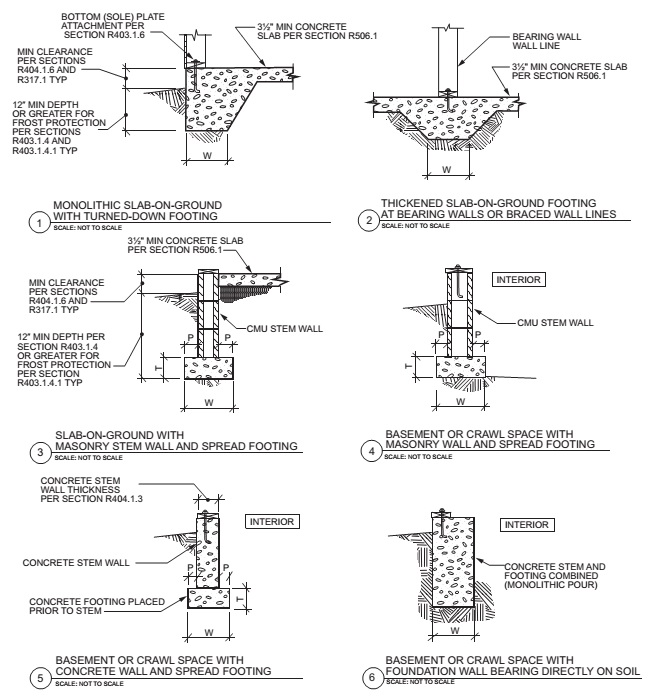
Never heard of a monolitic pour incorporating a 42" wall at the perimeter...you typically either do a floating monolitic slab with thickened edges or you do a frost wall with footing and a floating slab. See image from the IRC with the various foundation types. If you are required to do frost walls at 42" down the typical construction is a roughly 20x12" footing, 8"-10" stem wall and then a floating slab.
Fig0021.jpg
 

matt_i

Well-known member
Joined
Mar 14, 2008
Messages
10,728
Location
SE Michigan
Trench foundation is very common at least in MI, my neighbor and 2 coworkers did this for their shop build here in SE Michigan. If you run some rough numbers with a single story (no 2nd story loads) it all looks good with respect to soil bearing as in less than 2000 psf with an 8" wide trench. One person even cut it with a ditch-witch (!).

The footing is earth-formed and extends 42" below grade, width of the excavator bucket. Have to act quickly as in wet weather like we are having this year it can get away fast and the trenches collapse into a huge mess of wet earth that has to be hand shoveled clear.

My coworkers poured monolithically, as in form a 6" at the grade level and fill it all up.

My neighbor poured his trenches full right to the grade level and rough-screeded that. Then he built a row of block right on top of the foundation, and framed up from that. The slab filled in the center. Seemed to work OK but I don't know how much work he put into leveling the course of block.
 
Last edited:
To avoid these ads, REGISTER NOW!

wssix99

Well-known member
Joined
Mar 2, 2011
Messages
5,161
Location
Chicago, IL
Should I ask to see the code?

You should take the time to inform yourself as to what the code says because:

He also said I should have a 5% slope for drainage on the slab.

^ this is excessive and sounds arbitrary. Slope to the floor is a good thing and is, indeed a requirement in many codes. I've usually come across limits of 1/8" or 1/4" per foot suggested but don't recall seeing anything prescriptive and 5% would be over 1/2" per foot. Sometimes the slope is also required for attached structures but may not be a requirement for detached.

The slope helps heavier-than-air gasses (ie: gasoline vapors) passively escape from the enclosed space, so it's a safety feature like gas curbs under man doors going into residential areas. It also helps with snow melt run-off, so that may be a consideration for you, also.


I was planning on, and lined up a concrete guy to do this in a monolithic pour. Now that my permit states that the slab must be isolated from the footings.

This is a pickle. As Doug points out, you can isolate the two by pouring all of them in a single day, but it takes a little more time. (Not nearly as much time and expense as going away and then coming back on another day!) This will cause your contractor to incur more cost. So, if you are open to the discussion and a cost escalation here, you should be able to get a quality result. (If you try to hold a price you received for a quickie pour, with the two not isolated, then your contractor may be pressured to cut some corners.)
 

blkhonda1991

Well-known member
Joined
May 20, 2008
Messages
608
Location
Connecticut
Trench foundation is very common at least in MI, my neighbor and 2 coworkers did this for their shop build here in SE Michigan. If you run some rough numbers with a single story (no 2nd story loads) it all looks good with respect to soil bearing as in less than 2000 psf with an 8" wide trench. One person even cut it with a ditch-witch (!).

The footing is earth-formed and extends 42" below grade, width of the excavator bucket. Have to act quickly as in wet weather like we are having this year it can get away fast and the trenches collapse into a huge mess of wet earth that has to be hand shoveled clear.

My coworkers poured monolithically, as in form a 6" at the grade level and fill it all up.

My neighbor poured his trenches full right to the grade level and rough-screeded that. Then he built a row of block right on top of the foundation, and framed up from that. The slab filled in the center. Seemed to work OK but I don't know how much work he put into leveling the course of block.

Trench foundation as shown in condition 6 of the image i posted? have you seen it done the way the original poster is suggesting?
 

pcmeiners

Well-known member
Joined
Aug 13, 2009
Messages
7,908
Location
In the only town in Pennsylvania, Bloomsburg.
Considering the correct compaction is rarely done I can see the reason for a floating slab. On Staten Island they permitted basement slabs to be connected to foundation footing , end result the slabs sink in the center. Duplex **** house next to me is down a very noticeable foot in the center of the basement ( over width of 12 ft). Floating slab would be the only way I would go in a heavy frost area such as Michigan.
 

matt_i

Well-known member
Joined
Mar 14, 2008
Messages
10,728
Location
SE Michigan
Trench foundation as shown in condition 6 of the image i posted? have you seen it done the way the original poster is suggesting?

Yes, you have it, but these people I know didn't form the inside, they either formed outside-only, then poured walls and floor together as a monolith or poured it flat with the ground and added 1 row of block, the floor was a separate pour.

I don't see why the trench couldn't be done like #6, with the inside form as well right at grade, a 2x8 or 2x10, whatever is desired, with block-outs for the garage and man-doors. Have to let it set in those lower areas for a bit to get enough strength so it can support the 'crete above it, and not have a hydrostatic blowout. Usually some planning between trucks can help aid this too.
 

BB16

Active member
Joined
Jun 13, 2019
Messages
36
Location
Michigan
I’m just down the road from you and I’m fighting the opposite battle. My engineered plans for my building say a monolithic pour. My cement guy was trying to get the county to let him pour the footings, then float the slab over it, tying them together with rebar angled at 90* from the footing into the slab. It was a no go from the county. They say we have to do a monolithic pour.
 

wssix99

Well-known member
Joined
Mar 2, 2011
Messages
5,161
Location
Chicago, IL
My cement guy was trying to get the county to let him pour the footings, then float the slab over it, tying them together with rebar angled at 90* from the footing into the slab. It was a no go from the county. They say we have to do a monolithic pour.

Yea, from a design perspective, that would be bad. The monolithic pour is all-in-one. Pouring two pieces separately and then tying them together would essentially be like having a floating slab tied to the foundation wall, which doesn't work either. (The floor would likely rip itself apart as it shrinks under curing.)

I'm sure, with the right engineering, the tie-in's can be mechanically designed so this would work and the county would sign off on it, but the cost of that engineering (your concrete guy can't guess this) will likely cost you way more than the cost of whatever inconvenience there is to do a conventional monolithic pour. (I assume your concrete guy wants to use removable forms and back fill the foundations vs. carefully trench the foundation?)
 
To avoid these ads, REGISTER NOW!
Top Bottom