To avoid these ads, REGISTER NOW!

Restoring leather-ring handles?

Brad54

Well-known member
Joined
Jun 13, 2006
Messages
4,646
Anybody have any tips on restoring vintage leather-ring handles?
They were common on hammers, but also on hunting knives, which I'm restoring now.

I've got an old Marbles knife that was junk when my dad found it in the Canadian woods in the early '50s, and it didn't improve with age sitting in his drawer for the next 60 years.

I've restored the blade and the pummel, and the leather rings are okay, but I'd like to clean the scuffs out of them. A couple of the rings aren't lined up anymore either--they pulled apart over time, and then sat smashed in different drawers and boxes, so they've become misaligned and not all of the edges are square.

I've taken them all apart and re-seated them with a dab of white glue between each to keep them together, but there's still some misalignment issues.

I'm also putting a brass tang/guard on it, and want to blend the shape of it to the rings.

I THINK, but am not sure, that when new, they were shaped on a belt sander.

Never having done this, I'm thinking I could clamp the blade in the vise and use different grits of Emory cloth to blend all the contours again... but I don't know.

My thinking then goes to using shoe polish to finish the handle. But again, I don't know.
The rings are dark brown, and they're brown the whole way through, so I don't think they were polished out just the outter edge when new.

They might have been polished/stained as a whole raw strip before the rings were stamped out.

Again, I don't know.

Thoughts?

-Brad
 
To avoid these ads, REGISTER NOW!

jimreed2160

Well-known member
Joined
Aug 7, 2016
Messages
3,589
Location
Tallahassee FL
I have made several leather ring chisel handles. I use a sharp chisel to line everything up. On a vintage leather tool, I would get them close and trim lightly with a really sharp knife or a vegetable peeler. Then I would finish with a few good treatments of saddle soap.
 

safariknut

Well-known member
Joined
Mar 28, 2015
Messages
388
Location
Michigan
I would make sure that the leather discs are compressed fairly tight before starting any shaping.I made a tool to tighten the pommel nut by taking an old flat screwdriver and filing a notch in the center of the tip so it just fits over the tang threads.
To shape it I would cover the blade edge with a couple layers of duct tape and use a 1x30 belt sander to rough shape them.When they are close to shaped,use an old 1x30 belt by hand with the knife clamped in a vise using it like a shoe shine rag.When you have the shape you want apply some Rennaisance Wax to the leather and polish.
I would not use any form of leather conditioner on it as it tends to soften and eventually rot the leather.
Just out of curiosity what model Marbles is it? I have several old Marbles knives in my collection.Easiest way to tell is the length and shape of the blade(measured from the point to the guard).
 
OP
B

Brad54

Well-known member
Joined
Jun 13, 2006
Messages
4,646
I would make sure that the leather discs are compressed fairly tight before starting any shaping.I made a tool to tighten the pommel nut by taking an old flat screwdriver and filing a notch in the center of the tip so it just fits over the tang threads.
To shape it I would cover the blade edge with a couple layers of duct tape and use a 1x30 belt sander to rough shape them.When they are close to shaped,use an old 1x30 belt by hand with the knife clamped in a vise using it like a shoe shine rag.When you have the shape you want apply some Rennaisance Wax to the leather and polish.
I would not use any form of leather conditioner on it as it tends to soften and eventually rot the leather.
Just out of curiosity what model Marbles is it? I have several old Marbles knives in my collection.Easiest way to tell is the length and shape of the blade(measured from the point to the guard).

THAT'S What I was lookin' for!

I've already made a really nice tool for the pommel nut, just as you described.
The aluminum pommel was pitted pretty bad, so I've already ground those out (that sounds a lot worse than it was. You can't tell once I got finished with it... several Trizac belts, then polish and buff).

The blade was heavily oxidized, and the "thumb" serrations on the spine were worn smooth. I took a small file and re-cut the serrations, sanded and polished the blade, then put an edge on it.

The rings are still in pretty good shape, I just want to clean them up a bit--there's some scuffs and burrs, and they don't all perfectly line up.

The original brass guard was bent over, and it caused the red plastic ring to take a permanent set/disform, so I've had to get rid of that one. That made the tang a little too long, so I cut it down the appropriate length and re-threaded it.

I also don't like the very small guard--I want something that will unquestionably keep my hand from sliding into the blade while I'm working with it. So since the brass was beat up anyway (even after straightening, filing and polishing), I'm going to get a new piece of brass and make a larger guard. It'll still look "right," but it'll be more practical.

I also dropped the very tip of the point, just a little. It was damaged, so I took a little bit out of the spine side.

It's turning into a nice project, and it will be used for deer. I don't currently have a nice deer skinner/harvester, so this one will fill the bill nicely.

I'll have a local guy make a sheath for it, as the original is long gone.

It's like this one, but really, it was trashed. There was little to no value in it as-found. I've gotten to the point in my life where I really like vintage things, but they HAVE to be usable, because I have no more interest in display pieces. Everyone always says you ruin the value of knives and guns if you restore them, but if they're junk to begin with, what's the harm?

I'm making a couple small changes to make it more practical for me, and I'll let my kid deal with the harm in resale value when he sells it at the Estate Sale. Until then, its perfect for deer (and a nice compliment to the '65 Winchester .30-30 I use to bring them down).


http://www.ebay.com/itm/Antique-Mar...540581?hash=item1ec99d2f65:g:m5oAAOSw6YtZRtaR

Thanks for the tips!!!
-Brad
 

safariknut

Well-known member
Joined
Mar 28, 2015
Messages
388
Location
Michigan
Sounds like you have it pretty well covered and I will look forward to seeing the completed knife. Sounds like you might have a Marbles Woodcraft pattern that was one of their most popular knives.
The one I have also suffered from deteriorating leather discs(I removed two)and was the reason I made the tool for the pommel nut and shortened the tang.Still has a comfortable grip and the steel in the knife holds a tremendous edge.
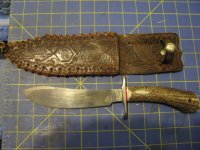
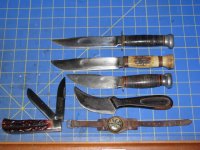
Here are a couple pics of my Marbles knives.The fish knife(the small curved blade one)I bought at a yard sale for 75 cents(!)and was offered $300 for it.
The folding knife in the group picture is a recent "Pacific Rim" inport and actually pretty well constructed.The last two pictures are of modern made Marbles knives from around 2000 that were made in Gladstone Michigan.
 

Attachments

  • MarblesCollection2016.jpg
    MarblesCollection2016.jpg
    77.3 KB · Views: 55
  • Marbles1.jpg
    Marbles1.jpg
    63.6 KB · Views: 53
  • MarblesStagHunter 001.jpg
    MarblesStagHunter 001.jpg
    138.8 KB · Views: 49

jakemac

Well-known member
Joined
May 21, 2013
Messages
9,035
Location
New England
In the realm of Working Knives ....

This was my grandfather's "everything" knife. The only marking is "EGW Knife". It always sat on his workbench, and was used and abused for just about anything. My entire life it was missing the handle and pommel. It just had two guard pieces and a ring to keep them from falling off the tang.

Until about 15yrs ago when I stole it from him to rehandle and gave it back at X-mas.

I started with a WHOLE LOTTA leather disks that I punched out of a hide. Then more punching for the slot for the tang.

Filled the tang with the disks and compressed them on the knife with my vise. After 24-48 hours in the vise, I added more. Repeat until full. After the back guard and ring were back in place, I left it for a week for the leather to settle.

To shape the handle, I roughed out the shape with a razor blade, then went to the 1" belt sander. Finishing was done with a light coat of boiled linseed oil, to soak in and mostly dry. Followed by burnishing with a smooth wooden disk clamped into the chuck of my hand drill.

Not a pretty handle, but a functional handle for a well used (as evidenced by how much it's been worn by sharpening) working knife.

When I gave it back, my grandfather didn't recognize it. He got it used and I don't think he ever saw a handle on it before. I had to tell him it was his old knife. Oddly enough, I never saw him use it again after he got it back. It just sat on the bench where he could see it.
 

Attachments

  • image.jpg
    image.jpg
    15.6 KB · Views: 68
Last edited:
OP
B

Brad54

Well-known member
Joined
Jun 13, 2006
Messages
4,646
In the realm of Working Knives ....

This was my grandfather's "everything" knife. The only marking is "EWG Knives". It always sat on his workbench, and was used and abused for just about anything. My entire life it was missing the handle and pommel. It just had two guard pieces and a ring to keep them from falling off the tang.

Until about 15yrs ago when I stole it from him to rehandle and gave it back at X-mas.

I started with a WHOLE LOTTA leather disks that I punched out of a hide. Then more punching for the slot for the tang.

Filled the tang with the disks and compressed them on the knife with my vise. After 24-48 hours in the vise, I added more. Repeat until full. After the back guard and ring were back in place, I left it for a week for the leather to settle.

To shape the handle, I roughed out the shape with a razor blade, then went to the 1" belt sander. Finishing was done with a light coat of boiled linseed oil, to soak in and mostly dry. Followed by burnishing with a smooth wooden disk clamped into the chuck of my hand drill.

Not a pretty handle, but a functional handle for a well used (as evidenced by how much it's been worn by sharpening) working knife.

When I gave it back, my grandfather didn't recognize it. He got it used and I don't think he ever saw a handle on it before. I had to tell him it was his old knife. Oddly enough, I never saw him use it again after he got it back. It just sat on the bench where he could see it.

That's awesome!
 
OP
B

Brad54

Well-known member
Joined
Jun 13, 2006
Messages
4,646
Sounds like you have it pretty well covered and I will look forward to seeing the completed knife. Sounds like you might have a Marbles Woodcraft pattern that was one of their most popular knives.
The one I have also suffered from deteriorating leather discs(I removed two)and was the reason I made the tool for the pommel nut and shortened the tang.Still has a comfortable grip and the steel in the knife holds a tremendous edge.
Here are a couple pics of my Marbles knives.The fish knife(the small curved blade one)I bought at a yard sale for 75 cents(!)and was offered $300 for it.
The folding knife in the group picture is a recent "Pacific Rim" inport and actually pretty well constructed.The last two pictures are of modern made Marbles knives from around 2000 that were made in Gladstone Michigan.

Mine is the same as the 3rd knife down, under the bone handle knife.
It's perfect for fleshing out a deer, so I'm looking forward to using it.
I have another Marbles hunting knife that I picked up years ago at an antique store for $8. I think it's a 6-inch blade. Just a basic hunting knife. "Jack of all trades, master of none" type of knife.

I've used it for deer several times, but I've used better knives, so it usually just sits in the drawer.

-Brad
 

safariknut

Well-known member
Joined
Mar 28, 2015
Messages
388
Location
Michigan
In the realm of Working Knives ....

This was my grandfather's "everything" knife. The only marking is "EWG Knives".
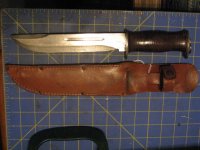
I think the mark may be EGW which stands for E.G. Waterman;a maker of knives for the military(but not military issue)during WWII.The giveaway is the ring used to hold the pommel and handle to the knife. They came in two different sizes.Yours looks to be the smaller of the two and less common than the larger version. Here is a pic of the larger version that I own.
Nice job on the handle BTW!
 

Attachments

  • InvGreenGunCase 035.jpg
    InvGreenGunCase 035.jpg
    57.6 KB · Views: 42
To avoid these ads, REGISTER NOW!

jakemac

Well-known member
Joined
May 21, 2013
Messages
9,035
Location
New England
Ahhhhh, so that is what the handle is supposed to look like. I was winging it when I did it.
You are correct about the maker. My brain desrever the letters. I've edited the post.
My grandfather's has a bottle opener in the blade and no evidence of a fuller (blood groove).
5" blade, 9-1/2" overall
The sheath is likely from another knife.
 
Last edited:

safariknut

Well-known member
Joined
Mar 28, 2015
Messages
388
Location
Michigan
Some of the larger models also had the cap lifter feature. The smaller blades did not have a fuller IIRC. I see you are from New England;I grew up in a small town about 10 miles north of Boston.Couldn't pay me enough money to live there now;the traffic is horrendous!
 

jakemac

Well-known member
Joined
May 21, 2013
Messages
9,035
Location
New England
I'm outside 128. The traffic is usually better. I used to have to drive the full circle during rush hour(s) to get to one job and over the Tobin to get to the others. Glad those days are over.
 

safariknut

Well-known member
Joined
Mar 28, 2015
Messages
388
Location
Michigan
I'm outside 128. The traffic is usually better. I used to have to drive the full circle during rush hour(s) to get to one job and over the Tobin to get to the others. Glad those days are over.
My youngest son lives in Lowell and works in Tewksbury(the next town)and it still takes him about 45 minutes to drive to work! He was working in Somerville and it took him nearly two hours to drive in every day(about 35 miles!).
 

code4pay

Well-known member
Joined
Jun 5, 2014
Messages
237
Location
Jervis Bay Australia
This is an estwing hammer I fixed for dad the other day. From belt material, punch out the elongated holes in the middle and trimmed the outside down with a draw knife. 16f110917e24844774cfb91964143165.jpg
 

Attachments

  • 16f110917e24844774cfb91964143165.jpg
    16f110917e24844774cfb91964143165.jpg
    93.1 KB · Views: 1

jimreed2160

Well-known member
Joined
Aug 7, 2016
Messages
3,589
Location
Tallahassee FL
...
I would not use any form of leather conditioner on it as it tends to soften and eventually rot the leather...

Your statement covers a wide range of products. It seemed to contradict my recommendation for using saddle soap. I have used this product successfully on all types of leather for over sixty years and have never seen any rot. It is a simple compound that contains mild soap, lanolin, and beeswax. Some form of saddlesoap has probably been used as a leather conditioner for hundreds of years. I doubt very much that any of these natural products have caused any leather rot. I think many others, like myself, have found it to be a very effective and useful product.
 

safariknut

Well-known member
Joined
Mar 28, 2015
Messages
388
Location
Michigan
Your statement covers a wide range of products. It seemed to contradict my recommendation for using saddle soap. I have used this product successfully on all types of leather for over sixty years and have never seen any rot. It is a simple compound that contains mild soap, lanolin, and beeswax. Some form of saddlesoap has probably been used as a leather conditioner for hundreds of years. I doubt very much that any of these natural products have caused any leather rot. I think many others, like myself, have found it to be a very effective and useful product.
Perhaps I should have clarified my statement a bit. It has been my experience that when trying to treat older leather with a preservative or cleaner in order to protect it that the material wicks into the leather and makes it very pliable. It also makes it very susceptible to tearing and other damage.
If the leather is in good shape to begin with it isn't a problem.Leather that has been polished on the outside usually reacts well to conditioner.Leather not so treated is usually not so sturdy.
I remember seeing a friend of mine treat the leather upholstery in his Cadillac with mineral oil and it kept it nice and pliable but it would also damage rather readily.
I currently am trying to figure out to preserve an old manicure kit that I acquired recently. The leather is very thin and the polished surface is pretty much worn away in many places. I repaired an area around the latch that was ripped using a product called Shoo Goo which is made for repairing shoes.Worked pretty good but is still fragile.
 

jimreed2160

Well-known member
Joined
Aug 7, 2016
Messages
3,589
Location
Tallahassee FL
There are many different types of leather and many surface treatments. Most auto leather is painted and that adds yet another wrinkle. I have heard of baseball players *seasoning* their mitts with olive oil. My guess is that the olive oil does make the leather soft but also results in long term damage. Ditto with the mineral oil treatment. Leather does not last forever. Stories are that the leather in King Tuts tomb had turned to a black goo.

But back to saddle soap. It is probably one of the mildest treatments around and less likely to cause permanent damage to most leathers. I think it would be great for tool handles but would probably not be so hot for auto seats.
 
To avoid these ads, REGISTER NOW!
Top Bottom