To avoid these ads, REGISTER NOW!

Retaining wall help needed

bhalv

Well-known member
Joined
Oct 27, 2011
Messages
346
Location
Boise Idaho
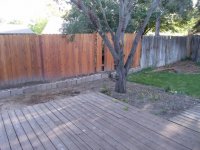
So I need some help from someone who has experience with retaining walls. Looking at making one that is 2 cinder blocks high, with a cap stone, and about 45 ft long. The dirt behind the wall varies between 6" and 1' high, so not a ton of pressure involved. What I need to know, is how large of a footer should I be making? Should it be a compacted bed or concrete, and if so, how much of either material? The plan is to use the cinder blocks pictured, they are just there as a temporary right now. open to all comments. GEDC0105.jpgGEDC0106.jpgGEDC0107.jpg
 
To avoid these ads, REGISTER NOW!

theoldwizard1

Well-known member
Joined
Feb 22, 2011
Messages
43,076
Location
SE MI
Cinder block will not work well. Even when mortared in, the pressure from the soil behind it will push it.

They make various kinds of garden wall block. They all have a lip of some mechanism to interlock with the block below.

Dig down about 10-12". Lay a bed of finely crushed stone (depending on where you live, this is called stone dust or slag or something else). Start at you lowest point and the first layer of block should be about level with the ground. Obviously it the ground rises, the first level will be below grade. Add/remove crushed stone as required to keep that first course level.

If you are only going 1' high you will not need any adhesive. The cap stones will stay in place in no one sits or walks on them. (Little kids like to walk on them !)
 

wssix99

Well-known member
Joined
Mar 2, 2011
Messages
5,155
Location
Chicago, IL
The significant pressure behind the wall is due to water. If you imagine a dry pile of dirt in your yard without a wall, it's just fine, but when you add water it starts moving. The hydraulic pressure behind your retaining wall is what will cause it to fail.

Having proper drainage behind the wall and at the base is the secret to it being durable. You'll also want pathways for the water to escape, through a drain tile or weep holes in the bottom, etc. You may also separate the gravel from the dirt with a textile so the dirt doesn't clog the pores in the gravel, etc. and reduce the efficiency of your drainage.
 

Fcvapor05

Well-known member
Joined
May 4, 2014
Messages
1,079
The significant pressure behind the wall is due to water. If you imagine a dry pile of dirt in your yard without a wall, it's just fine, but when you add water it starts moving. The hydraulic pressure behind your retaining wall is what will cause it to fail.

Having proper drainage behind the wall and at the base is the secret to it being durable. You'll also want pathways for the water to escape, through a drain tile or weep holes in the bottom, etc. You may also separate the gravel from the dirt with a textile so the dirt doesn't clog the pores in the gravel, etc. and reduce the efficiency of your drainage.

Is the point of the gravel bed to provide drainage then? I.e. you wouldn't want to use concrete because it would provide a barrier?
 

sands35

Well-known member
Joined
May 29, 2012
Messages
936
Location
St. Joseph, MI
Part of the reason crushed rock is used is for drainage. The other part is that it is simpler to get a level base with crushed rock.

There are a lot of cross section drawings on Google for "retaining wall cross section". Since yours is only ~1-2' high, you don't need to go so elaborate, but you should have some sort of water management behind the wall. It would probably work out OK if you put in some ~1" river rock on the backside of the wall to provide some drainage with the wall on a compacted crushed rock base.
 

volleyball

Well-known member
Joined
Aug 29, 2011
Messages
4,127
Location
NY, not NYC
The proper retaining wall block is the best way to go. But I see you have lots of blocks already. So I see about using them. If you "need" to use them and cannot repurpose into maybe a block wall garden shed, then I'd dig a 1' wide trench 8" below your lowest point. 4" of 3/4" gravel compacted. Lay 1st course all the way towards the low side. fill voids with excavated dirt and compacting. Stack the 2nd row block on top in a running bond. Fill voids with dirt compacting. Repeat if necessary. drive rebar into every cavity with bar against block facing the hill. Cap with solid material adhesived down.
perforated drain pipe with fabric cover over gravel base behind block. then backfill.
This will be easy to repair if wall pushes out. Using concrete instead of dirt for block filling will make it stronger but harder to repair. Driving longer, larger sized rebar will also add strength.
 

JimVonBaden

Well-known member
Joined
Dec 2, 2011
Messages
15,716
Location
Northern Virginia
I did a similar, but taller wall. Cinder blocks made my first course, all under the ground level sitting on 12" of crushed stone. Then use standard retaining wall block. It won't move and will look a lot better than cinder block, plus hold better. Your wall is low, but it still can move!

The cost of dedicated block is not as high as you might think, especially using cinder block as the base.

frontyard2.jpg

Original cinder block was 3 high, with concrete filling and the first block half buried. It was moving significantly, and too low.


wall01.jpg


paverproject212.jpg

paverproject216.jpg

51CC6561-4F83-4B50-9AA4-1196AEA9832B.jpg

FrontYard5.jpg

18775325-737E-494E-A839-10DCE90081BD.jpg
 

volleyball

Well-known member
Joined
Aug 29, 2011
Messages
4,127
Location
NY, not NYC
That is the difference behind being a lot taller as well as supporting an active load.
Once a wall gets to 2' or taller. leaning it into the hill gives it so much more strength. You can do it wit a shorter wall but the extra work may not have much pay off
 
To avoid these ads, REGISTER NOW!

MadMechMaster

Well-known member
Joined
Sep 5, 2008
Messages
779
Location
Frankfort, IL
What does the neighbor have on the other side? Is that your fence or theirs? I think that a retaining wall could be worked in to make a nice flower bed.

It is hard to see without being there, but what I would be looking at is tapering your yard out to smooth the lawn. You may need to create a swale or some other drainage depending on where the house is.

The back corner looks odd too.
 
OP
B

bhalv

Well-known member
Joined
Oct 27, 2011
Messages
346
Location
Boise Idaho
What does the neighbor have on the other side? Is that your fence or theirs? I think that a retaining wall could be worked in to make a nice flower bed.

It is hard to see without being there, but what I would be looking at is tapering your yard out to smooth the lawn. You may need to create a swale or some other drainage depending on where the house is.

The back corner looks odd too.

The fence is technically on his side of the property line, and I am wanting to bring the wall out a foot of 2 to make a nice planter along the length of the fence. The wall is going in due to the removal of my old crappy fence which was actually holding his yard back, as he site 6" to 1' higher than mine. Im also not terribly worried about drainage as we get next to no rain out here in the high desert.
 
OP
B

bhalv

Well-known member
Joined
Oct 27, 2011
Messages
346
Location
Boise Idaho
I should also mention that the dirt i am trying to hold back was retained by my old fence for 20 some odd years with no apparent damage or heaving. We also don't get much rain for 11 months out of the year here in the high desert.
 

volleyball

Well-known member
Joined
Aug 29, 2011
Messages
4,127
Location
NY, not NYC
Put the block where the fence was and retaining wall block at the depth of the bed. Fill with dirt, mulch and plants.
 

theoldwizard1

Well-known member
Joined
Feb 22, 2011
Messages
43,076
Location
SE MI
I did a similar, but taller wall. Cinder blocks made my first course, all under the ground level sitting on 12" of crushed stone. Then use standard retaining wall block. It won't move and will look a lot better than cinder block, plus hold better. Your wall is low, but it still can move!

A good base is the secret to all walls ! With a base that deep, it may be cheaper to put down 2 - 4" lifts of compacted courser (3/4") gravel and then the final layer of crushed stone, compacted of course.

I assume you filled the concrete blocks below grade with crushed stone, correct ?
 

wssix99

Well-known member
Joined
Mar 2, 2011
Messages
5,155
Location
Chicago, IL
Is the point of the gravel bed to provide drainage then? I.e. you wouldn't want to use concrete because it would provide a barrier?

Partially, plus all the other reasons given above. The drainage under the wall isn't so important. It's the drainage behind the wall that is critical. You can see on this set of Versa-Lok instructions, they call for properly putting drainage gravel up against the back of the wall. (This is the critical part that most people skip, which will eventually lead to movement.) If you have a long run, putting a drain tile at the bottom will provide even more insurance that you won't have water (and it's associated pressure) building up against the back of the wall.
 

57c

Member
Joined
Nov 2, 2013
Messages
20
When I did my retaining wall I researched and found a lot of information on line. for a 1' high wall, you can't get in too much trouble. I would definately use retaining wall block, they are heavier, lock together, and designed to leave enough space to weep. Generally they say 2a crushed stone at base, bury your first course of block, backfill with 2b or 3/4 crushed stone.

I would recommend a heavy block if it's near where it will be stepped over, sat on etc, so that when the kids play on it the blocks are too heavy for them to knock out of place.

I put in a retaining wall that is about 100' long by 4-6' high, doing all of the stuff I said plus geogrid every 3 feet of height. I backfilled with 50 ton of stone, and put in perforated drain pipe behind it. it's fine after 10 years, must have worked.
 
To avoid these ads, REGISTER NOW!
Top Bottom