To avoid these ads, REGISTER NOW!

Retaining wall

bluedog225

Well-known member
Joined
Jan 31, 2012
Messages
3,238
Location
Texas
I’d appreciate your thoughts on a retaining wall question.

There’s a retaining wall on the uphill side of my property. It’s 3 to 4 feet on my side of the property line.

The existing concrete retaining wall tilts. Maybe 20 degrees out of plumb. They have recently almost finished a large new house 4 to 5 feet from the property line. Very large. Arguably, the overburden from the construction next door and the heavy equipment operating on top of the retaining wall made it worse. But that’s difficult to establish with precision.

Potential purchasers are concerned because the retaining wall leans and it is quite close to their foundation. And I’ll add that our soils are awful clay. And I have it on good authority from one of the original residents in the 1954 neighborhood that this very large house is built on a creek bed.

Twice, I caught the builder trying to erect concrete forms to place a concrete vertical façade and horizontal façade on the existing retaining wall. Fortunately, I work from home and was able to stop them. I eventually issued a criminal trespass. The concrete forms and rebar still sit at the property line.

I let them know we would need an engineered solution.

They have retained an engineer and proposed several methods of dealing with the issue.

I’m inclined to insist upon a new wall with the proper heel slab/toe slab. That is, excavate and put in a proper retaining wall. The solutions involving driving peers and pulling the existing retaining wall seem like ****** half measures to me. And risky in terms of damaging the existing retaining wall that has been in place since before 1991. Seems like there’s too much that can go wrong. And the end result might look like hell.

I don’t want to be an ******* here. What do you guys think?

IMG_4276.jpegIMG_4275.jpeg
 
To avoid these ads, REGISTER NOW!

Shiftless

Well-known member
Joined
Mar 9, 2014
Messages
14,446
Location
East Bay SFO
This is the right way to fix the problem. Don’t neglect the proper rebar too. (Not shown in this pic) But obviously the most expensive. Good luck getting the builder to pay for this solution.


2BD1F04F-D9A3-4C72-9AE9-3D40ABB9EB3F.jpeg
 

mikedodge

Well-known member
Joined
Jun 27, 2017
Messages
2,747
A picture of the wall would help. How big is it? What's it made of?
Using anchors on the existing wall seems like a short term solution but might be a good idea for the new one if it was designed for that from the start. Chances are you're not going to get one with the slab unless you're going to pay the difference for it and if the current one has been there since 91 and has done its job until construction affected it a replacement similar to the original should be all that's needed. Residential type ones don't last forever and do need attention every few decades.
 

Dan in Pasadena

Well-known member
Joined
Feb 18, 2009
Messages
13,103
Location
Pasadena, CA
I’m retired after 26 years as Sr. Project Quality Manager of Design and Construction for LA Metro on heavy civil engineering projects.

The correct approach is to consult with a registered Civil Engineer. You don’t say what this existing retaining wall is constructed from but IF it was cast in place reinforced concrete you may be able to stabilize it with “tie backs” but you will not pull it up true vertical. It would likely fail if trying that OR the tie back anchors would pull free.

I’d suggest the correct way is to demolish it and replace it. Best of luck
 
Last edited:

theoldwizard1

Well-known member
Joined
Feb 22, 2011
Messages
43,073
Location
SE MI
Retaining walls fail for one or more of these reason
  • Inadequate/improper footing
  • Inadequate drainage on the up hill side
  • Lack of tie backs
A simple cast concrete wall, even with a significant heel and toe slab, will still fail if it does not have adequate drainage. Back fill on the uphill side should be gravel (mixed 3/4" - 2"), separated from the soil by heavy landscape cloth (to prevent silt from getting into the gravel).

Tie backs are not always required.

Consult a soils engineer if you want it to last more than 10 years !
 

Shiftless

Well-known member
Joined
Mar 9, 2014
Messages
14,446
Location
East Bay SFO
They have recently almost finished a large new house 4 to 5 feet from the property line. Very large.

Most places have minimum required side setbacks of greater than 5 feet. Is there a chance the builder has violated the setback requirements? If so, you can take advantage of that and use it as a VERY valuable bargaining chip when negotiating payment for the retaining wall replacement.

It might be worth it to you to hire a reputable surveyor to determine the EXACT property line.
 
Last edited:

mm08822

Well-known member
Joined
Jan 13, 2012
Messages
5,839
Location
NJ
If the wall is on your property, then it is yours, to leave as is, repair or replace.

I understand why the builder wants it eliminated/hidden.

Did the builder create any damage to it or is it just a marginal design that time has won the battle using gravity as the strong arm?

I agree with a Civil Eng needing to be part of the design for a long-term solution. Maybe you need your own CE to review the Builder's CE's design.

Once your CE greenlights the design, then maybe that is where you give permission (via contract) to allow him to demolish and rebuild your wall....all on his dime. Your CE has to approve the construction progress throughout.
 
OP
B

bluedog225

Well-known member
Joined
Jan 31, 2012
Messages
3,238
Location
Texas
IMG_6901.jpeg

IMG_6908.jpeg

I think this gives a good overview. The thing has been going on since around 2021. A constant flow of debris and trash thrown on my property.

They requested, and I let them, dig a hole on the low side of the wall. It extends 16 inches below great. No heel or lip on it.

Pardon the mess. The landscaper promised to landscape my portion of the property on top of the retaining wall. The place where they ran their skid steer and dumped all the clay and concrete debris. That was a couple of years ago. I’ve left it as is thinking they might get around giving me a call. I even drove some steel post at the property line. They removed them and stole them.

I’ve been told the original owner went bankrupt. More crews than I can keep track of over the years doing this and that to try and finish it. I’m more concerted effort lately as I think they have an under contract.

A variety of promises made by various subcontractors regarding various issues. Not have been kept.

I do believe it violates the 5 foot set back from the property line. I had the chief inspector for the city of Austin out, and I pulled a string between the survey pins. It was 4.5’. 5’ required. He refused to look at the tape measure or taken independent measurement. He said strings are notoriously inaccurate. And that was the end of that.

I’m a little salty about the whole deal. Three of the four houses around me have been under construction for about eight years. One at a time. It’s been rough.

I’m not inclined to play nice until they address some of the issues I’ve got. Landscaping promises, placement of downspouts promises, removal of debris and overburden.

I’ve been here for over 30 years. Since they tried to sneak in a cap on the existing retaining wall, I’m even less inclined to be cooperative.

I guess I’m going to tell him that a new retaining wall properly designed, with actual engineering plans, and a stamp, would be my requirement if they are going to have access to my property to move forward. Without access to my property there’s no way they can get equipment in there at the 4 1/2 feet between the property line in the house.

Funny story, they put in the cancer concrete in the brand new swimming pool. There was no room to get a bobcat back in there so they had to remove the entire pool by hand with wheelbarrows.

Just thinking out loud, I guess I need insurance documents with me named as an additional insured, engineered plans, site plan, the proposed exact location of the wall, some kind of contractual language regarding straight, plumb, good and workmanlike manner, and landscaping post construction.
 

mm08822

Well-known member
Joined
Jan 13, 2012
Messages
5,839
Location
NJ
Most places have minimum required side setbacks of greater than 5 feet. Is there a chance the builder has violated the setback requirements? If so, you can take advantage of that and use it as a VERY valuable bargaining chip when negotiating payment for the retaining wall replacement.

It might be worth it to you to hire a reputable surveyor to determine the EXACT property line.
5' does seem pretty tight!
 

mm08822

Well-known member
Joined
Jan 13, 2012
Messages
5,839
Location
NJ
In order to build the wall properly, all trees and vegetation will need to be removed.

You need to be dealing with the builder, not the subs. Your contract would be with the builder.
The town would be issuing a CO to the builder and a smart buyer would have that as a contingency of purchase.

Zoning department could also help you and impact the CO getting issued.
 

Shiftless

Well-known member
Joined
Mar 9, 2014
Messages
14,446
Location
East Bay SFO
There’s a retaining wall on the uphill side of my property. It’s 3 to 4 feet on my side of the property line.
Wow!
If you think or know that your wall is 3-4 feet on YOUR side of the property line, it looks to me like that house is closer than 5 feet from the property line.
Better get that checked out.

edit: I see that you have determined it is 4.5 feet.
”strings are inaccurate” ha ha
get a laser…. It’s still gonna be 4.5 feet

If found to be in violation of the minimum set back, what are the consequences? Make ‘em tear down the whole wall? Contractor would do almost anything to avoid doing that. Sell them 6 inches of your lot for let’s say 50 grand? How about 100 grand? More?
 
Last edited:
OP
B

bluedog225

Well-known member
Joined
Jan 31, 2012
Messages
3,238
Location
Texas
In order to build the wall properly, all trees and vegetation will need to be removed.

You need to be dealing with the builder, not the subs. Your contract would be with the builder.
The town would be issuing a CO to the builder and a smart buyer would have that as a contingency of purchase.

Zoning department could also help you and impact the CO getting issued.

Agreed.
 
OP
B

bluedog225

Well-known member
Joined
Jan 31, 2012
Messages
3,238
Location
Texas
Wow!
If you think or know that your wall is 3-4 feet on YOUR side of the property line, it looks to me like that house is closer than 5 feet from the property line.
Better get that checked out.

Yeah. But when I pulled the string, the chief inspector refused to look. Dead end.
 

mm08822

Well-known member
Joined
Jan 13, 2012
Messages
5,839
Location
NJ
A guy shouldn’t have to hire an attorney to force a city inspector to look at a string. Or a laser beam, or a document from a licensed land surveyor showing what the situation is.
Agreed, but it may be the only way to have a "credible" complaint filed vs. someone's perceived rant.

Back charge the builder for these costs.
 
To avoid these ads, REGISTER NOW!

mikedodge

Well-known member
Joined
Jun 27, 2017
Messages
2,747
The way it was worded I thought you were on the high side and wondering what they they were doing up there. It looks like if they were driving heavy equipment around up there like you said near the wall that probably did contribute to the problem. Did they put any drainage in along there? Run off could be a problem now if that property isn't as vacant as it was before. How old is the house? That wood fence looks like it's been there a while.

They could have gotten a variance to build the house that close, it's been happening around here with people splitting lots and trying to get the biggest houses possible on them and the city is letting it happen.
 

blue-5

Well-known member
Joined
Mar 26, 2017
Messages
112
What does the survey say? Maybe time to have a surveyor drive pins???
Its not very expensive to have your corners pinned
 

tarmy

Well-known member
Joined
May 28, 2014
Messages
4,645
Location
Nor Cal
Welp, having dealt with very similar issues over the last 3.5 decades…

Need a Civil, soils and maybe a structural engineer. Maybe a surveyor too.

The neighbors had to have a soils report for that structure…civil too. Those two professionals either ignored that wall and the failure it may induce or they designed based upon on the dynamic load that the new house has, You need to see If they relied on the existence of the wall (not likely) Or designed to mitigate the wall in any form. The removal of the wall…will likely have some effect on that same load and the foundation as well If it was not designed properly (engineers have insurance). Seems like the first step is to get the house soils report and see if the geotechnical report/section identified that wall (it should have) and the risk associated with the potential failure of it on their clients new home. The house may have had a foundation design that did NOT rely on that wall nor its’ integrity.

Those reports should be on file at the permitting agency. That will inform you if the wall is your issue…theirs…or both. Been in many court rooms where **** like this makes attorneys and me money…and neighbors hating each other over things that should be worked out.

Good luck OP…
 

Rusted Nut

Well-known member
Joined
Dec 11, 2022
Messages
1,800
Location
PNW
I’ve built a lot of soil nail shoring/retaining walls. I very much doubt you could pull that old wall back into place. And if you tried, you would have to excavate out behind it, and probably undermine the foundation of your new neighbors in the process; that catastrophe would be on you. Best thing to do is build a new wall on your property, and sell the neighbors an easement. You need a soils engineer, and a lawyer on this one. Has the neighbor house closed yet? If not get a lawyer now, before it closes; you’ll have a lot more leverage than after it closes.
 

tehach

Well-known member
Joined
Mar 7, 2010
Messages
211
Tie backs are not going to pull that wall back to plumb without excavating. It's likely the concrete is broken.
 

Innovate1

Well-known member
Joined
Jul 28, 2014
Messages
4,262
Location
Illinois near St. Louis, Missouri
Just going to say sorry you are in this situation. Was in a dispute with a neighbor that could have been settled without lawyers if the other party had been reasonable. They ended up dragging us into a court battle that lasted a couple years and cost us about $30k in legal fees and they basically ended up not getting what they tried to force on us. The lawyers were the only real winners.

A survey to determine where the property line is shouldn't be too expensive. They may even be able to document the location of the new building on their drawing so you don't have to ask anyone to look at a string. Going to court to force them to fix the wall may be possible but it may also be a long fight that costs more in legal fees than just paying for it yourself. And you may end up paying the legal fees and losing. Sounds like you are already in an adversarial position with the neighbors so it's not looking good from here.
 

Lassen Forge

Well-known member
Joined
Apr 26, 2014
Messages
14,998
Location
The romantic hills of central Umbria, Italy,
I’m retired after 26 years as Sr. Project Quality Manager of Design and Construction for LA Metro on heavy civil engineering projects.

The correct approach is to consult with a registered Civil Engineer. You don’t saywhat this existing retaining wall is constructed from but IF it was cast in place reinforced concrete you may be able to stabilize it with “tie backs” but you will not pull it up true vertical. It would likely fail if trying that OR the tie back anchors would pull free.

I’d suggest the correct way to demolish it and replace it. Best of luck
Dan is spot on. Something caused the movement in the wall, and unless you know what actually caused it and at which level of force from what directions, you're ******* into the wind. When the hill continues to move, takes out the new wall, the structures above it, etc...

Naaaah, you really need to cover your ***. Thats why people hire Geo Engineers... so you're not replicating and magnifying a disaster. Cheap insurance compared to what it could be if SHTF.
 

Junkman

Well-known member
Joined
Dec 18, 2006
Messages
6,597
Location
Northeastern CT
Could be the biggest ******** they ever ran into and simply remove the retaining wall and let nature take it course.....
I like your way of thinking, but removing the wall might leave him with a civil lawsuit. If he does nothing and the wall falls in, the soil behind it will erode, and the owner of the property will have a bigger problem to solve. Unless this wall affects the owner, I say let it be. It might last another 20 years, or it might just come apart in 2 years.
I remember we folks had a house where the backyard backed up to another home's backyard, uphill from our backyard. Never a problem since the soil absorbed all the rainfall, and we had a dry basement. The neighbor above the hill paved the driveway, reducing the soil's ability to absorb rainfall. This resulted in our basement flooding every time it rained. My folks tried a few different remedies, and I suggested the one that worked best. They built a very thick wall on our property and installed drainage rock on the uphill side of the wall, with drainage pipes running along the side of our home to within 5 feet of the street. The water would flow out to the street, and there were no more problems. The only ill effect the wall had was in the winter, when the ground was frozen: the water would build up on the neighbor's side and create a large ice-skating area. Most of that was on our property, but if it was a particularly wet winter, they got a bunch of ice also backing up into their garage. That was more than 60 years ago, and I have no idea how the wall has fared or how the neighbors deal with it today. The wall was less expensive than any court battle that the paved driveway would have caused.
 
OP
B

bluedog225

Well-known member
Joined
Jan 31, 2012
Messages
3,238
Location
Texas
I think more info would help. I appreciate y’alls perspective and experience.

To: (construction guy)

Regarding your request to replace the retaining wall located on my property, I need to review the engineering basis for the concerns you have raised.

Please provide copies of the following, if they exist:
• Geotechnical (soils) engineering report
• Civil engineering (site and grading) report
• Any geotechnical forensic report
• All current and prior surveys (boundary and topographic)

These materials should indicate whether the design and construction of the new residence—built at or near the setback and over an what I believe to be a historic dry creek bed with challenging soil conditions—accounted for the existing retaining wall and any surcharge or stability effects associated with it, or whether the wall was not considered in the engineering analysis.

Review of these documents is necessary to assess risk, evaluate how to proceed, and ensure that any proposed work is technically justified and avoids unnecessary expense.

I share the goal of finding a practical, long-term solution that minimizes disruption and risk for both properties. And to avoid undertaking corrective work without a clear engineering basis.

Sincerely,
,me
 

strength_and_power

Well-known member
Joined
Apr 26, 2015
Messages
1,392
I think more info would help. I appreciate y’alls perspective and experience.

To: (construction guy)

Regarding your request to replace the retaining wall located on my property, I need to review the engineering basis for the concerns you have raised.

Please provide copies of the following, if they exist:
• Geotechnical (soils) engineering report
• Civil engineering (site and grading) report
• Any geotechnical forensic report
• All current and prior surveys (boundary and topographic)

These materials should indicate whether the design and construction of the new residence—built at or near the setback and over an what I believe to be a historic dry creek bed with challenging soil conditions—accounted for the existing retaining wall and any surcharge or stability effects associated with it, or whether the wall was not considered in the engineering analysis.

Review of these documents is necessary to assess risk, evaluate how to proceed, and ensure that any proposed work is technically justified and avoids unnecessary expense.

I share the goal of finding a practical, long-term solution that minimizes disruption and risk for both properties. And to avoid undertaking corrective work without a clear engineering basis.

Sincerely,
,me
Sounds great. Probably would sound even better on a lawyer’s letterhead.
 
OP
B

bluedog225

Well-known member
Joined
Jan 31, 2012
Messages
3,238
Location
Texas
I’m easing into this. I think at the end of the day the right answer is: if they want a new retaining wall, they need to build a new retaining wall. And I may be willing to allow access to my property for that purpose.

This guy trying to sneak onto my property and begin construction after I told his crew to stay off, didn’t get us off on the right foot.

I think he’s still angling for a “this is a joint problem you need to pay half” solution. And he has formally recommended the drilled anchor solution. Having thought about it, I believe that solution is fundamentally unsound without more information.

I don’t know if he’s communicating any of this information to the owner or potential purchasers. I think that duty to discloses is on him. Though I will probably need to communicate with them directly if we get much farther down this road.

I’m being careful to stick to my beliefs, and my opinion.
 

Rusted Nut

Well-known member
Joined
Dec 11, 2022
Messages
1,800
Location
PNW
Good letter! Also add “you want copy of building permit “ for new wall. Other option is to do nothing and wait for your retaining wall to collapse; and then watch neighbors house settle, or collapse as well.
 

tarmy

Well-known member
Joined
May 28, 2014
Messages
4,645
Location
Nor Cal
You also need to get a written agreement covering the entire wall, liability, costs, any easements needed for the structure and maintenance of that structure, drainage and discharge of the sub drain they should install behind it, temp construction easements, grading, access and all the other things that are going to be part of it.
 

andyvh1959

Well-known member
Joined
Feb 15, 2020
Messages
2,589
Location
Green Bay WI
When I first read this I assumed it was a block retaining wall not installed properly in a frost zone (like up north here). But that being a poured wall is another issue. Block wall or poured in place wall, site prep, base level, drainage (like said earlier) and proper backfill all produce a more reliable long term stable wall. That wall looks like nothing was done behind it other than whatever backfill material was available, in other words it wasn't done right. Only way to save that wall is to fully excavate behind it, get it plumb if possible, then anchors, proper backfill and top fill. By the time that's all done it probably would cost less to demo the current wall and build a new one. If that is done would a build in place block retaining wall be a better choice?
 

Dan in Pasadena

Well-known member
Joined
Feb 18, 2009
Messages
13,103
Location
Pasadena, CA
To the OP: IF you demolish and reconstruct this wall remember that here were forces that CAUSED it to begin to overturn. That is what the Professional Engineer will design for. I'd strongly suggest you don't try the DIY "stack" types block (concrete masonry units - CMU's) UNLESS a P.E. calculates how to best restrain those forces.

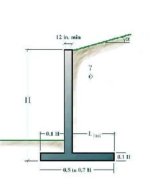
Oversimplifying here but other than the stacked CMU type there are basically two types of retaining walls for lighter use. (There are actually quite a few types on a very large civil engineering project) This section below shows the type I would recommend where the load or earth being retained bears directly on the retaining wall footing below, Forget the dimensions showing. A P.E. will calculate what you actually need.
You can (and many do) build the type where the footing is not under the load but they have to be much wider to accomplish the same thing and aren't as good though in certain situations the site will only allow that approach.

Image 12-13-25 at 11.10 AM.jpeg
 

gahrajmahal

Well-known member
Joined
Dec 12, 2008
Messages
2,515
Location
Cincinnati, Ohio
I have over 300 feet of stone retaining walls and no neighbor problems ( they actually changed their drains after touring our yard). Many years ago now the Mrs and I wanted to have our walls tucked pointed but when only one of seven requests for a quote showed up, we were bowled over. With a straight face they came in at $42,000!

With time on our hands and only in my mid fifties, we decided to learn how to do it ourselves. I turned to YouTube university which was still new then. The person who taught me how to repair stone retaining walls was Mike Haduck. If nothing else you will learn what a good retaining wall looks like. As a stone mason, he is unemployed in the winter, Mike took to making videos how to repair those walls. He also travels quite a bit and as part of his travels made videos of stone and retaining walls in other countries giving his Pennsylvania Dutch opinion about those walls.

My walls came out quite nice once I followed his advice with subtle variations on his recommendations. Here is the link to his channel.


Dig Doug

Well-known member
Joined
Apr 16, 2018
Messages
1,078
I would set up a camera to record any movement back there from the contractors

I wouldn’t touch a thing, doing something means there is an issue. The wall has been there for a long time, Do you have any pics of it prior to the construction next door?

I would make them deal with it to your satisfaction.
If you need hire a surveyor for your property pins they can unofficially tell you if the building has the appropriate set back

The Wall was there when they started construction and they should of dug their footings deeper to be completely independent of what happens next door on your side.

Ive seen people dig pools and walls prior to building the house so they have access to the back yard


Sounds like things are just messed up on that side of the property line due to the extremely long build history
 
To avoid these ads, REGISTER NOW!
Top Bottom