To avoid these ads, REGISTER NOW!

Retaining wall

finn

Well-known member
Joined
Mar 27, 2005
Messages
16,183
Location
The UP, God's country
Unless I’m missing something, I see things a little differently than most, as per usual.

I think you said the wall is on your side of the property line, is pre existing, having been there for over twenty years, and has no stem.

The house next door has been under construction for multiple years.

My opinion is that the wall was shoddily constructed in the first place and would have failed eventually, whether the new house was constructed or not. In fact, assuming the new house has some sort of footings or a basement, they probably extend below most if not all of the wall, so the lateral forces from the mass of the new house aren’t making much of a load increasing the tipping forces..

My folk’s house had a tipping wall on the uphill side of their property. It was put up by the neighbor when he backfilled and landscaped. The difference was that in their case, the neighbor put up the wall right on the property line and backfilled. It took many years but in that case the neighbor ”owned” the wall, having put it up with no tie back or hold back provisions.

In your case, you own the wall, it’s entirely on your property, presumably constructed by a previous owner, but it was still probably constructed improperly, and has failed over time because of the faulty design.

I don’t think the new house has much to do with the wall failure. Them violating the setback is an issue, though, which might warrant legal action for other reasons, although it’s likely that too much time has elapsed to get a judgement now, given the time that has elapsed.
 
To avoid these ads, REGISTER NOW!
OP
B

bluedog225

Well-known member
Joined
Jan 31, 2012
Messages
3,241
Location
Texas
To the OP: IF you demolish and reconstruct this wall remember that here were forces that CAUSED it to begin to overturn. That is what the Professional Engineer will design for. I'd strongly suggest you don't try the DIY "stack" types block (concrete masonry units - CMU's) UNLESS a P.E. calculates how to best restrain those forces.

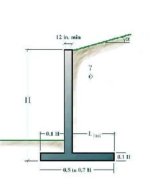
Oversimplifying here but other than the stacked CMU type there are basically two types of retaining walls for lighter use. (There are actually quite a few types on a very large civil engineering project) This section below shows the type I would recommend where the load or earth being retained bears directly on the retaining wall footing below, Forget the dimensions showing. A P.E. will calculate what you actually need.
You can (and many do) build the type where the footing is not under the load but they have to be much wider to accomplish the same thing and aren't as good though in certain situations the site will only allow that approach.

Image 12-13-25 at 11.10 AM.jpeg

Agreed. I think this is the only reason reasonable solution. I had a front seat view of the construction. I don’t recall any effort to compact the soil. In fact, I believe that part of the house is built on loose construction debris from the previous demolition on top of undisturbed, deep, deep, green clay. We can’t know for sure without some kind of soil test. But they say they can’t find any testing or engineering, etc. due to the bankruptcy and whatever else happened after that.

I don’t think it’s credible for their engineer to think driving wedges into the existing soil and trying to pull the wall upright without knowing what the soil is will be effective.

They indicated they were going to build a wall anyway. I reiterated my willingness to work with them since they only have about 4 1/2 feet between the house and the property line. I think them undertaking this project without tearing down the fencing as nd getting access to my property going to be challenging.

After describing to the builder the various aspects of performing this job properly, I told him it was best if I spoke with the owners directly or their attorneys.

I’m hoping we can resolve this amicably. I’d like a professional job and I’m willing to cooperate in the project to a reasonable extent. Depends on the details. It may involve allowing access to my property.

No point in throwing good money after bad.
 
Last edited:

C-S-H

Well-known member
Joined
Jan 18, 2024
Messages
144
I would immediately want to know the type of foundation under the new house.
 
OP
B

bluedog225

Well-known member
Joined
Jan 31, 2012
Messages
3,241
Location
Texas
I would immediately want to know the type of foundation under the new house.
I asked. They say they don’t know. They claimed to have no access to architectural or engineering plans. Or soil test. It’s slab on grade. Other than that, I only know what I saw. And I know the general soil in the neighborhood to be deep clay. Or limestone. Or some of both as I believed to be the case here.
 

mikedodge

Well-known member
Joined
Jun 27, 2017
Messages
2,751
I asked. They say they don’t know. They claimed to have no access to architectural or engineering plans. Or soil test. It’s slab on grade. Other than that, I only know what I saw. And I know the general soil in the neighborhood to be deep clay. Or limestone. Or some of both as I believed to be the case here.

Hopefully they were smart enough to build it with proper supports below slab and that house won't get too intimate with yours some day!
 

jkeyser14

Well-known member
Joined
Dec 19, 2008
Messages
1,816
Location
(rural) Maryland
Yeah. But when I pulled the string, the chief inspector refused to look. Dead end.
You need to hire a surveyor.

There's a lot potentially going on here. The wall is on your property which means it is your responsibility. However, you have no responsibility to repair it in order to benefit the neighbor if you can show they were negligent in engineering the house to meet the site conditions. Additionally, if they built too close to the property line and violated code then you have a claim against the neighbor (or bank/owner), the county, and the builder. They could have to tear the whole house down or apply for a variance which you could fight and drag out to a settlement.
 
Last edited:

theoldwizard1

Well-known member
Joined
Feb 22, 2011
Messages
43,076
Location
SE MI
You need to hire a surveyor.

There's a lot potentially going on here. The wall is on your property which means it is your responsibility. However, you have no responsibility to repair it in order to benefit the neighbor ...
Both statements are correct.

Any lawyer could easily prove that construction on the adjacent property caused the damage !
 

Joe Reed

Well-known member
Joined
Aug 31, 2005
Messages
914
Location
Cordova TN
If the house is truly built less than 5' from the property line, what are the options? Tear it down? I'm sure pursuing that would be a lot of time and likely even more money.....
 

jkeyser14

Well-known member
Joined
Dec 19, 2008
Messages
1,816
Location
(rural) Maryland
If the house is truly built less than 5' from the property line, what are the options? Tear it down? I'm sure pursuing that would be a lot of time and likely even more money.....
Yes. That has happened many times before. Around here banks lending for home builds require professional surveys to show the house location is correct relative to the property/building boundary. They need this twice, once after foundation pour, and once after the build is done. Those surveys prevent the builder from drawing further funds until they are done.
 

allinon72

Well-known member
Joined
Jul 5, 2010
Messages
3,305
Location
Indianapolis
This very clear structural issue affecting both properties should have been discussed and planned for on both sides before construction even started. An example of exactly how not to approach potential conflict, and potentially, occupancy at the new home. In construction, ignoring the land mine only makes it bigger the further you bury your head in the sand.

Also - very interesting neighborhood dynamic going on there....
 

finn

Well-known member
Joined
Mar 27, 2005
Messages
16,183
Location
The UP, God's country
Both statements are correct.

Any lawyer could easily prove that construction on the adjacent property caused the damage !
Not if the wall was of substandard, non permitted construction. It would take a lot more than circumstantial evidence that the house wasn’t there and now it is to convince any competent judge.

Walls built on clay move all the time.
 

mikedodge

Well-known member
Joined
Jun 27, 2017
Messages
2,751
Not if the wall was of substandard, non permitted construction. It would take a lot more than circumstantial evidence that the house wasn’t there and now it is to convince any competent judge.

Walls built on clay move all the time.

This too :

The existing concrete retaining wall tilts.
Maybe 20 degrees out of plumb. They have recently almost finished a large new house 4 to 5 feet from the property line. Very large. Arguably, the overburden from the construction next door and the heavy equipment operating on top of the retaining wall made it worse.

If the wall was already having issues it's only a matter of time before it had gotten worse or had to be addressed even without the construction. The construction certainly didn't help it. But if they were driving heavy equipment right up to the wall that's another thing too because they aren't designed for that much extra pressure.
 
Last edited:
OP
B

bluedog225

Well-known member
Joined
Jan 31, 2012
Messages
3,241
Location
Texas
I was out at my place this weekend. Came home to this. It didn’t come from the backyard. The forms are in the way. It doesn’t look like it came from the front yard. It looks like they hauled it in and dumped it there. And it’s **** as far as being useful for anything. I mystified.

IMG_6944.jpeg
 

zendriver

Well-known member
Joined
Dec 10, 2014
Messages
29,693
Location
Indiana
Looks like it might not have been built all that well in the first place, if it didn’t have anchors and not surprising, it’s bulging where there are trees growing.

It doesn’t look like it will fall over tomorrow and at least it’s not 8 feet high, but it’s totally understandable. Potential buyer would be concerned.

Fight to get them to pay for it it’s not really that big of retaining wall
 
OP
B

bluedog225

Well-known member
Joined
Jan 31, 2012
Messages
3,241
Location
Texas
The quality of the place is suspect in my mind. Here’s a construction photo. Note the insulator keeping my main service line off the aluminum scaffold. And the detail with which the nails follow the interior stud line.

IMG_4279.jpegIMG_4278.jpeg
 

andyvh1959

Well-known member
Joined
Feb 15, 2020
Messages
2,590
Location
Green Bay WI
Here in Green Bay WI Sept of 23 I built a 50' long curving retaining wall alongside my driveway using retaining wall blocks, from four to five blocks high. THe base row of block are mostly buried in the grade. Sandy soil here, so I dug a trench twice the width of the block and about 8" to 12" deep from the planned grade, at least 6" further into the grade behind the planned wall. Filled in about 6" of compacted gravel to set a level base and started the wall. As I added each level I backfilled it with gravel. At the top row I allowed for 4" of topsoil for plantings. Made it through three Wisconsin winters, numerous heavy summer rains, and nothing has moved, the wall is still right where I set it.

Your wall doesn't look too tall so maybe a built block retaining wall would be a good application, easy to build, "flexible" to a point to allow for settling. With the proper base and backfilling a block built wall can be very durable, especially in a climate like TX.
 
To avoid these ads, REGISTER NOW!
OP
B

bluedog225

Well-known member
Joined
Jan 31, 2012
Messages
3,241
Location
Texas
Uhhh...did that power line end up being re-routed?

Yes. Eventually. The builder offered me something like $15x if I’d let them put in an underground service. I said yes. Though Then they declared bankruptcy. The builder disappeared. And the city hung a mid span drop. It’s working fine.
 

wssix99

Well-known member
Joined
Mar 2, 2011
Messages
5,155
Location
Chicago, IL
Your retaining wall is bad (it was never good when it was new...) and needs to be replaced. No need for an engineer, replacements for smaller walls like this now come in pre-engineered solutions.

Your neighbor's house has nothing to do with this, so you can forget about that being an ongoing concern. The neighbor's house sits on a foundation that is below the retaining wall. All pressure from that house goes through its foundation and acts at a level below the retaining wall. If there is any effect because of the house, its water. (More on that later.)
- Driving construction equipment within a foot or two of the wall or setting supports on your wall could certainly affect it. So, you were right in stopping that. If you have evidence that type of activity affected the wall, then the contractor should be insured for that sort of liability.
- I would keep things nice with your neighbor because you will likely need their cooperation to dig behind the retaining wall (on their property...) to get this right. Fixing this isn't just the cost of the retaining wall, but backfill, landscaping, etc.

The wall is leaking due to hydrostatic pressure. The clay in your soil makes this situation worse. https://winstormprojects.com/retaining-wall-failure-hydrostatic-pressure/ ^ You can google retaining wall and hydrostatic pressure and find lots of information.

In an older style, gravity wall like yours, drainage is needed. (Anchors and tiebacks won't help.) Unfortunately, back in the day, many contractors skimped on this detail for gravity retaining walls. In these situations, the lean isn't a matter of "if" but "when." I don't see any drains in your wall and expect that there is no drainage.

Hydrostatic pressure is a problem everywhere, even for brick wall facades. (Masons almost always get this right.) At the bottom of these brick facades, you will see fabric wicks to provide drainage for any water that might accumulate behind the wall. (This is easier to find/see on newer walls and your retaining wall should have a similar system if it was constructed properly.)

1765941042215.png
 

Pluribus

Well-known member
Joined
Dec 16, 2012
Messages
2,143
Location
Skagit County, WA
Based on your original post, it sounds like you were not the one who built the wall, and it's been there for a long time. Generally, there is a legal requirement for adjacent/lateral support. https://en.wikipedia.org/wiki/Lateral_and_subjacent_support

Basically, if you are the lower lot owner, you are not allowed to remove material that supports the upper & adjacent lot. At this point, nobody likely knows who did what in the past, so I'd say what's happening currently probably trumps the past. Probably. No idea if there's any sort of statute of limitations regarding a civil property situation like this.

If it looks like you or a prior owner removed material to add flat area near the property line, expect an argument that it's your responsibility. If it looks like the adjacent lot was filled to level it, and the owner of your property built a wall to hold it back, you're in better shape. My gut feel is that any argument from them that it's your responsibility at this point in time would be weak.
 
OP
B

bluedog225

Well-known member
Joined
Jan 31, 2012
Messages
3,241
Location
Texas
Yeah. They built a house with an obvious wall downhill. And they “can’t find” the engineering plans. And the original builder is bankrupt and gone.

I’m not thinking they are coming after me. But who knows.

I remain willing to work with them. But no word from the owners.
 

Hooked

Well-known member
Joined
Sep 24, 2010
Messages
423
Location
League City, Texas
Out of curiosity, does the resident from the original 1954 development know when, and why, the retaining wall was built? Someone obviously hauled in a lot of dirt on the neighboring property to require the wall.
 
OP
B

bluedog225

Well-known member
Joined
Jan 31, 2012
Messages
3,241
Location
Texas
He been dead for many years (I’ve been here 35 years). I think the upper lot was cut and fill.
 

wssix99

Well-known member
Joined
Mar 2, 2011
Messages
5,155
Location
Chicago, IL
I remain willing to work with them. But no word from the owners.

What do you want from these people? A new retaining wall?

There are some trees along your retaining wall. If the wall (and soil around it) tilted during construction, those trees would be off vertical. From the pictures you have posted, the trees (and hence your retaining wall) look undistrubed.

Everyone hates construction next door. The good part is that its almost over, no one will build another house there for a long time and there is a chance some hotness may move in.
 

fteufert

Well-known member
Joined
Oct 24, 2013
Messages
382
Location
Near Scranton, PA
I asked. They say they don’t know. They claimed to have no access to architectural or engineering plans. Or soil test. It’s slab on grade. Other than that, I only know what I saw. And I know the general soil in the neighborhood to be deep clay. Or limestone. Or some of both as I believed to be the case here.
wouldn't the city have those documents? Where I live everything is kept on file
 

duneslider

Well-known member
Joined
Jan 20, 2013
Messages
2,245
Location
Riverton, Utah
I know this whole situation ***** but from what I can see your retaining wall was not built properly and was destined to fail at some point and was in the process of failing already since you noted it was leaning. Anything short of tearing it out and replacing it with a properly built retaining wall would just be a bandaid.

Did construction next to the wall contribute to the failure, possibly yes. It may have sped up the rate at which it was failing. I don't know if you have much ground to stand on when it comes to getting the new owners to do anything about an already failing retaining wall on your property.

If you have a legitimate property line complaint you need to start by putting your string up and taking pictures of the established property markers and filing a complaint with the city. If there are NOT official property markers your only course of action is getting a survey performed that will show the real property points and where the buildings are in relation to those. I suspect the survey will cost a couple grand, so is the property line issue a big enough deal to warrant a couple grand?

At the end of the day, having construction going on next to your long established house can be a very annoying process. Lots of noise, garbage, dust, etc. I tried to be really nice to my neighbors during our construction process, I would let them know before the big pour days, had a street BBQ to let them know we knew it was inconvenient, tried to pick up any garbage that blew off our lot, etc.
 

wssix99

Well-known member
Joined
Mar 2, 2011
Messages
5,155
Location
Chicago, IL
It’s slab on grade. Other than that, I only know what I saw. And I know the general soil in the neighborhood to be deep clay. Or limestone. Or some of both as I believed to be the case here.
Some additional re-assurance for you. Even with a slab on grade, the stresses from the house (transferred through the foundation) will go downward through a zone that likely does not (looking at the pictures) include your regaining wall. If the distance from the foundation to your wall is greater than 1/2 the depth from the bottom of that slab to the level of your foundation wall foundation, then you should be fine - even with clay. A method for that estimation is here: https://vulcanhammer.net/2024/04/29/the-21-method-for-estimating-stresses-under-foundations/#:~:text=The 2:1 method is a simplification used,in clay * Simple and reasonably accurate
 

elmer

Well-known member
Joined
Apr 7, 2016
Messages
246
Location
Detroit
Built this wall over 20 yrs ago. Not sure how proper it was built. Just leveled it off and started stacking these massive blocks.
It did settle a bit.
 

Attachments

  • unnamed.jpg
    unnamed.jpg
    569.4 KB · Views: 81
  • Screenshot 2025-12-19 at 1.42.19 PM.png
    Screenshot 2025-12-19 at 1.42.19 PM.png
    3.3 MB · Views: 79
OP
B

bluedog225

Well-known member
Joined
Jan 31, 2012
Messages
3,241
Location
Texas
What do you want from these people? A new retaining wall?

There are some trees along your retaining wall. If the wall (and soil around it) tilted during construction, those trees would be off vertical. From the pictures you have posted, the trees (and hence your retaining wall) look undistrubed.

Everyone hates construction next door. The good part is that its almost over, no one will build another house there for a long time and there is a chance some hotness may move in.

Mostly, I want them not to try and sneak on my property and build a retaining wall without my consent. Other than that, it would be great if they left me alone and quit dump trash on my property.

I’m happy to get along with the new neighbors once they buy it and move in.
 
OP
B

bluedog225

Well-known member
Joined
Jan 31, 2012
Messages
3,241
Location
Texas
wouldn't the city have those documents? Where I live everything is kept on file

I would think so too. So there’s something weird happened here, or the city of Austin doesn’t require that, or they’re just lying to me.
 
Last edited:
OP
B

bluedog225

Well-known member
Joined
Jan 31, 2012
Messages
3,241
Location
Texas
I know this whole situation ***** but from what I can see your retaining wall was not built properly and was destined to fail at some point and was in the process of failing already since you noted it was leaning. Anything short of tearing it out and replacing it with a properly built retaining wall would just be a bandaid.

Did construction next to the wall contribute to the failure, possibly yes. It may have sped up the rate at which it was failing. I don't know if you have much ground to stand on when it comes to getting the new owners to do anything about an already failing retaining wall on your property.

If you have a legitimate property line complaint you need to start by putting your string up and taking pictures of the established property markers and filing a complaint with the city. If there are NOT official property markers your only course of action is getting a survey performed that will show the real property points and where the buildings are in relation to those. I suspect the survey will cost a couple grand, so is the property line issue a big enough deal to warrant a couple grand?

At the end of the day, having construction going on next to your long established house can be a very annoying process. Lots of noise, garbage, dust, etc. I tried to be really nice to my neighbors during our construction process, I would let them know before the big pour days, had a street BBQ to let them know we knew it was inconvenient, tried to pick up any garbage that blew off our lot, etc.

I appreciate the response. Candidly, neither you nor I have a good idea of what kind of footing is under that wall. Do we?
 

duneslider

Well-known member
Joined
Jan 20, 2013
Messages
2,245
Location
Riverton, Utah
I appreciate the response. Candidly, neither you nor I have a good idea of what kind of footing is under that wall. Do we?
I may have miss-read up above but I thought it was said someone had dug down and there was not a footing. If there is a footing, I would be shocked. That's a pretty short retaining wall and generally a wall under 3-4 feet doesn't require engineering or a footing.

I do firmly agree that they shouldn't be throwing trash on your property and they also shouldn't go onto your property to build, or fix, the retaining wall without your permission.
 
OP
B

bluedog225

Well-known member
Joined
Jan 31, 2012
Messages
3,241
Location
Texas
I may have miss-read up above but I thought it was said someone had dug down and there was not a footing. If there is a footing, I would be shocked. That's a pretty short retaining wall and generally a wall under 3-4 feet doesn't require engineering or a footing.

I do firmly agree that they shouldn't be throwing trash on your property and they also shouldn't go onto your property to build, or fix, the retaining wall without your permission.
You’re right. I’ve forgotten about that. They did dig a single hole near the end and found no footing on the front. Sorry.
 
OP
B

bluedog225

Well-known member
Joined
Jan 31, 2012
Messages
3,241
Location
Texas
Update. They were working on my side of the property line again today. One of my neighbors let me know that the owners were present so I went next-door and knocked. They are nice people and I think we’ll get along. Turns out they closed the deal a couple of days ago.

Though it was my intention to simply have a friendly hello and welcome to the neighborhood, he wanted to talk about the returning wall.

I offered up the option of cooperatively removing everything that’s there and putting it in a proper retaining wall on the property line. He got back with me later in the day and said they were going to proceed with the project and put the entire retaining wall on their side of the property line.

Candidly, I don’t see how that’s going to work with 4 to 5 feet of space between the house and the property line. I thanked him for the information and let him know if plans changed, I’d be happy to chat.

So I guess we’re going to have two retaining walls. Later, I’ll have mine evaluated and probably removed.

It’s a shame he and I didn’t have a chance to get to know each other better before he decided on the solution.
 

PCustoms

Well-known member
Joined
Jul 23, 2011
Messages
22,251
Location
VT
Update. They were working on my side of the property line again today. One of my neighbors let me know that the owners were present so I went next-door and knocked. They are nice people and I think we’ll get along. Turns out they closed the deal a couple of days ago.

Though it was my intention to simply have a friendly hello and welcome to the neighborhood, he wanted to talk about the returning wall.

I offered up the option of cooperatively removing everything that’s there and putting it in a proper retaining wall on the property line. He got back with me later in the day and said they were going to proceed with the project and put the entire retaining wall on their side of the property line.

Candidly, I don’t see how that’s going to work with 4 to 5 feet of space between the house and the property line. I thanked him for the information and let him know if plans changed, I’d be happy to chat.

So I guess we’re going to have two retaining walls. Later, I’ll have mine evaluated and probably removed.

It’s a shame he and I didn’t have a chance to get to know each other better before he decided on the solution.

How sure are you of your property line?

All of this smells like you're operating under some assumptions...
 

rsanter

Well-known member
Joined
Dec 22, 2007
Messages
18,487
Location
visalia ca
Was the retaining wall leaning before they started construction?
has it started to lean more since construction?

to me I suspect those trees to be a big cause.

the only way anyone will get that wall back to verticle will be to:
remove those trees, then excavate behind the wall.
install earth anchors, pull the wall to straight, then backfill.

i do know earth anchors are work very well. If I let them go this route I would require an engineer sign off as well as a performance guarantee.
if they break the wall pulling it verticle, they replace it.
if the wall leans again in its reasonable lifetime, they replace it
 

finn

Well-known member
Joined
Mar 27, 2005
Messages
16,183
Location
The UP, God's country
Was the retaining wall leaning before they started construction?
has it started to lean more since construction?

to me I suspect those trees to be a big cause.

the only way anyone will get that wall back to verticle will be to:
remove those trees, then excavate behind the wall.
install earth anchors, pull the wall to straight, then backfill.

i do know earth anchors are work very well. If I let them go this route I would require an engineer sign off as well as a performance guarantee.
if they break the wall pulling it verticle, they replace it.
if the wall leans again in its reasonable lifetime, they replace it
Glad I don’t live next to you.
 
To avoid these ads, REGISTER NOW!
Top Bottom