To avoid these ads, REGISTER NOW!

Reutilizing A 30 AMP 115V RV Circuit

Pilgrim21784

Member
Joined
Apr 27, 2010
Messages
15
Hey Folks,
I've got a 30 AMP 110/115/120V circuit (no clue what the actual voltage is) on the outside of my garage. I had it installed for my now sold RV. The circuit is covered by my backup generator. Note: I've often used a 30/15 pigtail for a leaf blower/hedge cutter/electric lawn mower etc. for years with it with no problems.

I want to utilize the amps/circuit for two additional outlets, one inside the garage and one external at the back of the garage for a garden fountain.

I had an electrician doing some other work and discussed installing the two additional outlets with him. My thinking (dumber than spit here but not prone to believing everything one guy tells me) was that I could simply have him install two additional 30 AMP outlets.

The exterior fountain setup would be with a junction box at the exterior wall and a 30/15 pigtail) and I would be good to go using a 30/15 pigtail inside the garage for regular tools, with the option of the 30 AMP internal garage circuit available for electric heating.

He said - ABSOLUTELY NOT TO DO IT THAT WAY. I should have him convert the entire circuit to 20AMPs, including the existing exterior 30AMP outlet. His opinion was that using pigtails was dangerous and that since the 30AMP circuit breaker was so much higher than my general expected use of the circuit, (mostly 15AMPs or less for regular power tools, not counting using the 30 AMPS for some wintertime electric heating) that my idea of having the two additional outlets at 30AMPs was a very bad solution.

I don't pretend to be knowledgeable about electrical issues, thats why I use pros - BUT - I'm seriously confused why this electrician is adamantly against my using pigtails for a 30/15 amp usage for my general power tools while keeping the circuit at 30 amps so I can, if desired, use it for episodic garage heating.

Would appreciate anybody's knowledgeable comments on the situation before I dump this local electrician and go back to Baltimore Gas & Electric (they did my backup generator install and some other work, they are more expensive but I suspect worth the cost).
Many thanks for any input!
Tom
 
To avoid these ads, REGISTER NOW!

sberry

Banned
Joined
Jun 18, 2005
Messages
35,747
Location
Brethren, Michigan
You are an amateur using a home brewed adapter on the circuit backwards, the electrician tells you this but because you do not understand you go looking for a way around it.
Would appreciate anybody's knowledgeable comments on the situation before I dump this local electrician
I don't pretend to be knowledgeable about electrical issues,
Yes you do. He points out you don't know squat and you look for a reason to fire him.
 

zmaxmotorsports

Well-known member
Joined
Jan 11, 2013
Messages
11,948
Location
South of omaha
You are an amateur using a home brewed adapter on the circuit backwards, the electrician tells you this but because you do not understand you go looking for a way around it. Yes you do. He points out you don't know squat and you look for a reason to fire him.

;);););)
 

Hawk

Well-known member
Joined
Oct 21, 2009
Messages
1,019
Location
Kannapolis, NC
You have one electrician telling you the truth so you want to go to a more expensive solution that should tell you the same. No logic there, but it is your choice.
 
OP
P

Pilgrim21784

Member
Joined
Apr 27, 2010
Messages
15
"You are an amateur using "a home brewed adapter on the circuit backwards", the electrician tells you this but because you do not understand you go looking for a way around it."

Yes, I am an amateur and NO, I'm simply here asking for clarification, is that not what the Journal is for???

Re: bolded above - hmnn - "home brewed" - no pal, you buy them from electrical suppliers. Guess you've never owned a larger boat or an RV. Pigtails have been commercially available and used for a very,very long time and are UL certified & code legal. There are literally millions of them in use everyday. Semi-permanent residents of RV parks are using them 24/7 for extended time periods as are long term docked boats.

I've no clue what your "backwards" comment refers to.

Unfortunately no one has addressed the primary question, i.e., why would using a pigtail in my proposed situation be a bad idea? Pull into any more modern RV park and they will have 50amp power (the older parks have 30amp) for the bigger units (same situation at marinas). If you have a 30amp RV (many, many units do) you will use a 50/30 amp pigtail to connect for power. SO - my question remains unanswered.

PS - another reason for switching electricians is that the local guy has no experience/knowledge with backup generators. When I ask him about installing a load switching breaker - he didn't know what I was talking about.

For general edification: If your generator capability/panel is fully utilized (as mine is) and you'd like the ability to have backup coverage for another power demand - you can utilize a special breaker (pricey, around $700) which will switch between a primary and secondary demand as long as the primary demand is not in use.

Case in point - you have your AC on the backup panel but a newly installed electric water heater is not on the panel. (The electric HW heater was installed (for free by my boiler supplier) as my boiler's HW coil has been repeatedly a problem and is the subject of class action lawsuits.) In an outage - you've got no HW if the boiler coil is kaput (the boiler is on the backup panel). In the summer - not a biggie, in the winter, you might regret it.

BUT - you can install the speciality breaker which will switch from covering the unused AC power in a wintertime period and cover the HW heater. My local electrician had never heard of it - he's just not familiar with backup generator setups. Combined with the pigtail confusion - its probably best I switch electricians. I simply was looking for clarification on why the pigtail was an issue. It is apparent that asking the Journal community was indeed a bad idea.
 
Last edited:

sberry

Banned
Joined
Jun 18, 2005
Messages
35,747
Location
Brethren, Michigan
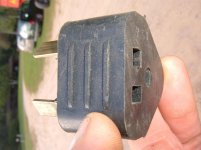
I got to give some credit for finding the adapter though. I spotted one of these gems. You can see some kind of hand stamps listing 125V and 15A on the recept side. Doesn't even say made in China, certainly no company name. It had to be a flea item.
I tried to get it in a single pic.
 

Attachments

  • adapt 30.jpg
    adapt 30.jpg
    138.3 KB · Views: 42

sberry

Banned
Joined
Jun 18, 2005
Messages
35,747
Location
Brethren, Michigan
You are right, it was rude as is fishing for a reason on the internet to look like a smart azz to fire a local who probably had a hard time splainin why a brainstorm like this was a bad idea.
Now, there are adapters and there is a legit 15 to 30 and in some cases it may work to go from 50 to 30 and most of these are designed in nature of a power strip with additional overcurrent protection so no general use 120V circuit is protected at more than 15 or 20A.
Actually your idea would be quazi legal with the addition of a power strip with a breaker.
Re: bolded above - hmnn - "home brewed" - no pal, you buy them from electrical suppliers. Guess you've never owned a boat or an RV. Pigtails have been commercially available and used for a very,very long time and are UL certified & code legal. There are literally millions of them in use everyday. Semi-permanent residents of RV parks are using them 24/7 for extended time periods.
As a matter of fact I have owned a couple, worked on a couple and read the code. I also know there is no bigger bunch of jackleggers than the RV crowd, full of good ideas, a lot of them similar in nature to carny food wagons.
They are smart but a conversation usually revolves around " I just don't understand" . It should be simple enough to look around the rest of the house, you see any other recepts like this? See them in other houses and buildings?
As for 30A 120v RV, this is followed with additional protection, usually a 15 and a 20A breaker, it does not get wired direct to outlets or other equipment but goes thru an additional panel.
 
Last edited:
OP
P

Pilgrim21784

Member
Joined
Apr 27, 2010
Messages
15
sberry":..As for 30A 120v RV, this is followed with additional protection, usually a 15 and a 20A breaker, it does not get wired direct to outlets or other equipment but goes thru an additional panel."

Suggest you contact BGE and tell them they don't know what they are doing. The 30amp circuit goes directly from the panel to the outlet, no junction box, nada. Perhaps you know better than they do. :)
 

alwaysFlOoReD

Well-known member
Joined
Sep 24, 2013
Messages
2,408
Location
Airdrie, Alberta, Canada
I'm not an electrician. I believe the reason to not use a 30 amp circuit regularly for less amps is the lower amp tool could short out (causing fire) and not trip the breaker. Please excuse the terminology if incorrect.

Sent from my XT1032 using Tapatalk
 
OP
P

Pilgrim21784

Member
Joined
Apr 27, 2010
Messages
15
I'm not an electrician. I believe the reason to not use a 30 amp circuit regularly for less amps is the lower amp tool could short out (causing fire) and not trip the breaker. Please excuse the terminology if incorrect.
Yeah, somehow that seems to be an issue, although I haven't gotten a simple explanation about it yet, it is confusing. My local electrician said something about that situation regarding installing two additional 30amp outlets and using 30/15 UL certified (Not home brewed as one poster labeled) pigtails. he recommended that I convert the 30amp line to 20 amps (at the outlet) and go from there.

He absolutely couldn't explain how that compares/plays out when you're using say a 3 amp or less power screwdriver (for example) on a 20 amp line. He also did not say using a 30/15 or 30/20 pigtail was code prohibited.

Its the same ******** situation - a lot of common household power tools use way less that a 15 or 20 amp circuit's capability.

Myself and everybody else routinely using smaller power tools that draw way below a 15 or 20amp circuit's capability. (And yes, I aware that you don't want to exceed 80% of the rated amp draw on a circuit, as well as the start-up surge at 2 or 3 times the running draw. I'm well aware of those criteria so skip any comments on those issues.)

My main workbench outlet is 20amps GFI. Using a commercial grade multiple outlet strip (I don't buy cheap gear), I've been using it for a bench light, CD player/radio & clock AND as my main plug for 15amp or less power tools.

It was installed by Baltimore Gas & Electric on their advice for my workbench. Obviously, excepting the very minor draw for the clock/CD radio/bench light - I don't use more than one 15amp or less power tool on the circuit at the same time - never had a problem and I'm pretty sure BGE is super code legal.

SO - the question remains: An existing 30amp 110/115/120V circuit is currently unused. I would prefer to simply extend the existing circuit to two additional 30amp outlets in the garage and use a 30/15 or 30/20 pigtail when I want to plug a tool in; or alternately utilize the 30amps to power electrical heating.

So far I've gotten flak from some members which, in some cases, do not know what they are talking about whatsoever. All of my electrical work has been/will be done by the best pros available.

Some took umbrage at my firing the local electrician - NO - I'm just not going to use him again because he has no experience for the concurrent work I need done in installing a switchable breaker on my backup generator as well as resolving the utilization of the 30amp circuit for additional outlets. Whether it requires changing to 20amps or whatever - so be it. I really don't want to have to schedule two different electrical service providers to get my jobs done. It is that simple, folks.
 

sberry

Banned
Joined
Jun 18, 2005
Messages
35,747
Location
Brethren, Michigan
sberry":..As for 30A 120v RV, this is followed with additional protection, usually a 15 and a 20A breaker, it does not get wired direct to outlets or other equipment but goes thru an additional panel."

Suggest you contact BGE and tell them they don't know what they are doing. The 30amp circuit goes directly from the panel to the outlet, no junction box, nada. Perhaps you know better than they do. :)
Yes it does, but there is another breaker in the trailer protecting this circuit. I can see from here the problem between you and the electrician.
My thinking (dumber than spit here but not prone to believing everything one guy tells me) was that I could simply have him install two additional 30 AMP outlets
Some took umbrage at my firing the local electrician - NO - I'm just not going to use him again because he has no experience for the concurrent work I need done in installing a switchable breaker on my backup generator as well as resolving the utilization of the 30amp circuit for additional outlets. Whether it requires changing to 20amps or whatever - so be it.
Its obvious from this whole post who has the experience.
 
Last edited:

sberry

Banned
Joined
Jun 18, 2005
Messages
35,747
Location
Brethren, Michigan
I'm not an electrician. I believe the reason to not use a 30 amp circuit regularly for less amps is the lower amp tool could short out (causing fire) and not trip the breaker. Please excuse the terminology if incorrect.

Sent from my XT1032 using Tapatalk

This is somewhat correct. There is a limit to the wire size that can be plugged in to a circuit, UL listing proves out that the device is designed for internal short circuit protection, the cord is heavy enough for a fault or there may be additional thermal beyond similar to Christmas tree lights witch have additional fuse to protect small wire.
The 30 on the general is a no no due to the fact that its a general and has several outlets which have the potential to be overloaded by plugging multiple devices in.
Any 1 UL listed with a 15 cord and end on it wont, the demand that a 15A appliance can apply will not thermally overload the circuit or the breaker.
In theory there are some cases where some devices could be used on a larger circuit but they would need to be specific and dedicated, way too much for the general user to consider at every use so they regulate it thru a plug and recept system to prevent this very issue, someone figuring how to override the fail safes built in to this when wired properly with the proper protection.
I for one wouldn't mind seeing a UL listed 30 to 15 adapter.
 
Last edited:

404

Well-known member
Joined
Aug 23, 2014
Messages
3,463
Location
Mass
SO - the question remains: An existing 30amp 110/115/120V circuit is currently unused. I would prefer to simply extend the existing circuit to two additional 30amp outlets in the garage and use a 30/15 or 30/20 pigtail when I want to plug a tool in; or alternately utilize the 30amps to power electrical heating.

Yes, not sure why there is so much grump about your question.:headscrat


If it were me I would go ahead and add the 2 additional outlets. Does some code say this will grow hair on my palms? Dunno.

I would unplug the adapters and any tools when I was not present.

I have made an adapter pigtail box that goes from a twist lock 240 volt 3 wire plus ground, and breaks out into 120 v and 240 v outlets in the box.

I don't leave it plugged in all the time.

The breaker is sized to protect the wire, not the device plugged in.
 

sberry

Banned
Joined
Jun 18, 2005
Messages
35,747
Location
Brethren, Michigan
The breaker is sized to protect the wire, not the device plugged in.
Partly true. The device has to be able to cope with a fault. Things that come with a 15 plug are not meant for 30A, that is fairly simple. The cords on it isn't, the internals may not be.
Specialized equipment may even have internal changes to it that has nothing to do with the load but simply short protection. An example is my hi pressure washer. The burner ****** uses half the current on 240 as one does on 120 but has a 14 wire vs a 16 on a 120 model, they simply changed the lead size on this little motor that draws an amp or 2 so the machine didn't need additional protection if it was plugged in to a circuit rated for it.
 

sberry

Banned
Joined
Jun 18, 2005
Messages
35,747
Location
Brethren, Michigan
A Lincoln 225 allows for 12 wire on a 50A breaker with no additional protection, in this case the load limit is the protection and the breaker doesn't provide any thermal. 240 200 class wire feeds have a 12 cord to meet short and are allowed on 50A but they have additio0nal thermal right following the switch for internal components which in turn limits the potential to overheat the incoming wire.
These are very generalizations and most of it is rather over my head or I don't really care about the details and should have been more clear that the 30A in question was not used directly in a trailer but required additional breakers within the trailer itself. Some of the mini are 20A in only. a pop up I was in the other day does not have any further breakers but simply a 15 end on the number 12 cord,,,, this insures the wire can have multiple outlets on and cannot overload the incoming when on a 20A circuit.
It could be used for a heating circuit providing it was listed for 30A, this would be a hard wired install though.
 
To avoid these ads, REGISTER NOW!

sberry

Banned
Joined
Jun 18, 2005
Messages
35,747
Location
Brethren, Michigan
3rd... there are a couple guys on this forum that are masters and pretty much cruise this and other diy types as the code police for the internet and if there was even a hint that this might be a good idea they would be here to bust my balls in a minute. They do it for a ground rod that doesn't mean squat.
 
OP
P

Pilgrim21784

Member
Joined
Apr 27, 2010
Messages
15
Okay, got the answer - its simple as spit and has nothing to do with pigtails, amp or breaker differentials, whatever. I called BGE and asked them - the immediate answer was because the residential code only allows 15 or 20 amp internal circuits; there is an exception for RV ports and generator inputs; otherwise its a no go.

The whole business about the circuit amperage/circuit breaker being too high to safely use for typical 15amp or less tools - is not an issue. It is simply the residential code spec.

Why my local electrician didn't simply state that upfront instead of the discussion about the amperage being too high and dangerous to use with a pigtail (which its not) is beyond me. Issue resolved.
 
Last edited:

zmaxmotorsports

Well-known member
Joined
Jan 11, 2013
Messages
11,948
Location
South of omaha
I'm not an electrician. I believe the reason to not use a 30 amp circuit regularly for less amps is the lower amp tool could short out (causing fire) and not trip the breaker. Please excuse the terminology if incorrect.
Yeah, somehow that seems to be an issue, although I haven't gotten a simple explanation about it yet, it is confusing. My local electrician said something about that situation regarding installing two additional 30amp outlets and using 30/15 UL certified (Not home brewed as one poster labeled) pigtails. he recommended that I convert the 30amp line to 20 amps (at the outlet) and go from there.

He absolutely couldn't explain how that compares/plays out when you're using say a 3 amp or less power screwdriver (for example) on a 20 amp line. He also did not say using a 30/15 or 30/20 pigtail was code prohibited.

Its the same ******** situation - a lot of common household power tools use way less that a 15 or 20 amp circuit's capability.

Myself and everybody else routinely using smaller power tools that draw way below a 15 or 20amp circuit's capability. (And yes, I aware that you don't want to exceed 80% of the rated amp draw on a circuit, as well as the start-up surge at 2 or 3 times the running draw. I'm well aware of those criteria so skip any comments on those issues.)

My main workbench outlet is 20amps GFI. Using a commercial grade multiple outlet strip (I don't buy cheap gear), I've been using it for a bench light, CD player/radio & clock AND as my main plug for 15amp or less power tools.

It was installed by Baltimore Gas & Electric on their advice for my workbench. Obviously, excepting the very minor draw for the clock/CD radio/bench light - I don't use more than one 15amp or less power tool on the circuit at the same time - never had a problem and I'm pretty sure BGE is super code legal.

SO - the question remains: An existing 30amp 110/115/120V circuit is currently unused. I would prefer to simply extend the existing circuit to two additional 30amp outlets in the garage and use a 30/15 or 30/20 pigtail when I want to plug a tool in; or alternately utilize the 30amps to power electrical heating.

So far I've gotten flak from some members which, in some cases, do not know what they are talking about whatsoever. All of my electrical work has been/will be done by the best pros available.

Some took umbrage at my firing the local electrician - NO - I'm just not going to use him again because he has no experience for the concurrent work I need done in installing a switchable breaker on my backup generator as well as resolving the utilization of the 30amp circuit for additional outlets. Whether it requires changing to 20amps or whatever - so be it. I really don't want to have to schedule two different electrical service providers to get my jobs done. It is that simple, folks.

Well the part about the power screw driver is simple to explain: 5a single pole breakers are like hens teeth around here,hard to find and really expensive.:dunno::lol_hitti
If you take a look at a newer ac condenser sometime they have a minimum and maximum breaker size on them for a reason.
 

zmaxmotorsports

Well-known member
Joined
Jan 11, 2013
Messages
11,948
Location
South of omaha
Okay, got the answer - its simple as spit and has nothing to do with pigtails, amp or breaker differentials, whatever. I called BGE and asked them - the immediate answer was because the residential code only allows 15 or 20 amp internal circuits; there is an exception for RV ports and generator inputs; otherwise its a no go.

The whole business about the circuit amperage/circuit breaker being too high to safely use for typical 15amp or less tools - is not an issue. It is simply the residential code spec.

Why my local electrician didn't simply state that upfront instead of the discussion about the amperage being too high and dangerous to use with a pigtail (which its not) is beyond me. Issue resolved.

And why do you think its a residential code?;)
 

sberry

Banned
Joined
Jun 18, 2005
Messages
35,747
Location
Brethren, Michigan
My natural inclination is to want to be a smart azz but as simple as I can come up with is,,,,,,,,,,,,, the code and the design of the equipment is to try and prevent THIS VERY thing. Trying to prevent things from being plugged in to circuits with too large of breakers.
 

MTW

Well-known member
Joined
Aug 6, 2013
Messages
294
Location
SE Michigan
All of the catfights aside, and the reason that the codes are the way their written is for your and other occupants safety.

Lets say you use the 30 A circuit with your adapters. Then run a 100' #14 or 16Ga chord out in the yard to do some powertool work. If that chord gets whacked or the appliance gets an internal short. You need to be able to get enough fault current to flow on the return circuit quickly to enable the breaker to trip quickly to remove the hazard by the breaker or fuse tripping.

When you have smaller gauge conductors on a larger rated circuit, the impedance and resistance get larger to restrict the flow of fault current. This can and will delay the circuit breaker from operating to clear the fault. Delay time means more arcing and burning. If the impedance is high enough or the connections are poor the protective device may not ever trip.

Your #14 or 16 AWG chord may end up becoming the fuse and burn open before the breaker trips. Normal use breakers are made to withstand motor startup surges of 6 to 10X their rating for short periods before they trip. That means at 30A x 10 = 300A of fault current would need to flow before the device would trip. Are your chords and appliances capable of conducting this kind of current to trip the protective device? Some are some aren't. I doubt that any of them are tested and UL rated for use on a 30A circuit for this reason.

I'm not saying you cant do it, it just increases your hazard risk when something goes bad, greater chance of arcing and fire, for a longer period of time. A 20A short thru a high impedance wont even think of tripping a 30A protective device, but sure will provide lots of heat and arcing in the process. Something your insurance carrier might not like if it ever was discovered, especially after a fire or incident.

In the case of RV's, as others had mentioned earlier, you normally have some downstream protection of the feeder circuit. Lower rated mobile protection for the branch circuits to protect them at their rating, reduces the hazard.

At home you don't currently have that downstream additional protection. You could however add it to get similar protection. If added after the 30A outlet for your heater, it would provide you the equivalent protection for the reduced capacity outlets and connected load. Similar to a subpanel concept. For one circuit you could use a device called a fusetron box cover unit. It can provide supplemental protection for smaller loads with a UL listed and rated fuse, but only has an indoor rating. I doubt that most inspectors would pass this for what your trying to use it for, but it would provide for better downstream protection for your portable equipment and chords, when fused properly.

www.cooperindustries.com/content/dam/public/bussmann/Edison/Resources/Catalogs/Bus_Edison_Box_Cover_Units.pdf

Remember that any outdoor outlets are required to be GFCI protected and that can get expensive for 30A circuits.

Does that explain the reasons good enough?

MTW Ω
 

sberry

Banned
Joined
Jun 18, 2005
Messages
35,747
Location
Brethren, Michigan
Part of this is why I am not a fanboy of many machine mods, adding light circuits to compressors etc. I am really quite amazed when one looks in to the amount of safety features one can build in using a plug and recept. But the most fundamental is probably current limiting. The 20A general circuit is really a quite a complicated piece of design work.
I can see why some other countries use a different system with limits built in to the plug. Wonder which is more foolproof?
 
Last edited:

gc427

Well-known member
Joined
Aug 7, 2009
Messages
263
Location
Glendale, AZ
I also know there is no bigger bunch of jackleggers than the RV crowd, full of good ideas, a lot of them similar in nature to carny food wagons.
They are smart but a conversation usually revolves around " I just don't understand".

Pure awesomeness! :scared:
 

sberry

Banned
Joined
Jun 18, 2005
Messages
35,747
Location
Brethren, Michigan
Its really a similar conversation to this, here it was worded differently,,, such as, no one can explain to me etc. Its usually followed with another one with an added,,, But I don't understand,,, which seems to be the license to do it any way they feel like it terminating in the brainfart we see here.
Even the follow up phone calls trying to find out if we can be proved wrong are a classic and not a first.
 

theoldwizard1

Well-known member
Joined
Feb 22, 2011
Messages
43,246
Location
SE MI
I have one of those in my camper from over 25 years ago.

attachment.php
 
Last edited:
To avoid these ads, REGISTER NOW!
Top Bottom