To avoid these ads, REGISTER NOW!

Rewiring sub panel for EV charger upgrade

Killer95Stang

Well-known member
Joined
Jan 1, 2008
Messages
341
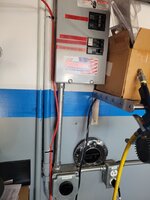
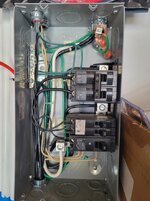
About 9 years ago, I had an electrician friend of mine install a sub panel in my garage. This was a part of a panel upgrade to 200amp service and rewire of the house during remodeling. At the time, I only needed 240v 40amp service in the garage to use with my Hobart 190 mig welder. My electrician used 3/4" armor flex conduit for the 50 foot run in the attic from the panel to the garage wall, used an "LB" (not sure on the verbage) at ceiling height and down to the sub panel. This was filled with 8ga THHN wire, which was dedicated for a 6-50P outlet under the sub panel.

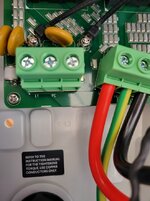
Fast forward to a few weeks ago, where we took delivery of our Rivian electric SUV. So far I have been getting by with a portable 32 amp charger, plugged into my welder outlet, but I would like to upgrade to perminent 48amp wall mounted charger. The chargers buss connectors seem to max out at 6 gauge and the wiring sizing chart says I need to 6 gauge wiring to support the 48amp capability. When I called my electrician, he said the 3/4" conduit would be too small to run 6 gauge and he would need to up size it to 1 inch. Not a big issue, but he did say he would have to break up the stucco above the flush mounted panel to gain access for the new conduit. I'm okay with that, but because he is so busy and the pain of breaking up the wall to run conduit, he has been putting me off for months. This has led me to research more options or even hire another eletrician to rewire the sub panel.

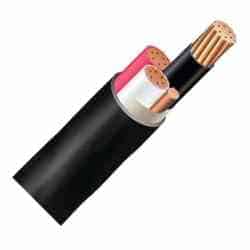
So here is my question. When I look up wire fill for 3/4" armor flex conduit, it says I can run (4) 6ga THHN wires through it. Is that really possible? Do I have to run a neutral, since my EV charger doesn't require one? If I don't that would bring the wire count down to (3) wires. Last, would 6gauge romex be even harder to work with?
 

Attachments

  • Resized_Resized_20220213_103619_450811730724692.jpeg
    Resized_Resized_20220213_103619_450811730724692.jpeg
    123.4 KB · Views: 62
  • Resized_Resized_20220213_104332_450694895643174.jpeg
    Resized_Resized_20220213_104332_450694895643174.jpeg
    118.1 KB · Views: 59
  • Resized_Resized_20230406_091037.jpeg
    Resized_Resized_20230406_091037.jpeg
    108 KB · Views: 58
  • Resized_Resized_20230406_091046.jpeg
    Resized_Resized_20230406_091046.jpeg
    100.2 KB · Views: 58
  • Resized_Resized_20230406_093244.jpeg
    Resized_Resized_20230406_093244.jpeg
    114.8 KB · Views: 61
To avoid these ads, REGISTER NOW!

gtae07

Well-known member
Joined
Mar 6, 2015
Messages
2,985
Location
Fayetteville, GA
It's my understanding you can't use 6 gauge romex for 48A continuous (60A breaker) because you have to go by the lower temperature rating. 6 gauge THHN/THWN is ok, or 4 gauge romex which is what I used to install my Tesla wall charger. It was a ***** to work with even for the 3ft of wire I needed (it's right next to the breaker panel), but I didn't need to put in conduit. If I hadn't wanted to save the 14-50 in the garage for a welder or a visitor charger, I'd have just put it there and gone with 40A.

For another perspective, do you really need 48A for charging, or could you leave the 8 gauge THHN in place with a 50A breaker and just charge at 40A?

I don't see why you'd need a neutral, but pulling the THHN would be a lot easier than trying to pull heavy romex (if you even could).
 

justsam

Well-known member
Joined
Aug 20, 2010
Messages
1,268
Location
Penngrove, California
It's my understanding you can't use 6 gauge romex for 48A continuous (60A breaker) because you have to go by the lower temperature rating. 6 gauge THHN/THWN is ok, or 4 gauge romex which is what I used to install my Tesla wall charger. It was a ***** to work with even for the 3ft of wire I needed (it's right next to the breaker panel), but I didn't need to put in conduit. If I hadn't wanted to save the 14-50 in the garage for a welder or a visitor charger, I'd have just put it there and gone with 40A.

For another perspective, do you really need 48A for charging, or could you leave the 8 gauge THHN in place with a 50A breaker and just charge at 40A?

I don't see why you'd need a neutral, but pulling the THHN would be a lot easier than trying to pull heavy romex (if you even could).
I believe the OP is referring to the fact that the sub panel is currently fed with 8ga, and as a sub panel would require a neutral. I 'll let the pros discuss the notion of using 6ga and if that can be done in the existing conduit. Also as mentioned what is the real time difference charging at the 32 vs 48 Amp rate. If overnight, does it really matter a couple hours longer?
 
OP
K

Killer95Stang

Well-known member
Joined
Jan 1, 2008
Messages
341
I believe the OP is referring to the fact that the sub panel is currently fed with 8ga, and as a sub panel would require a neutral. I 'll let the pros discuss the notion of using 6ga and if that can be done in the existing conduit. Also as mentioned what is the real time difference charging at the 32 vs 48 Amp rate. If overnight, does it really matter a couple hours longer?

This particular EV has a huge 135kw battery. Currently I'm able to charge at 7kw or 14-16mph added. If I upgrade and go to 48amp charging, I get up to 25 mph added. Lowest power rates for me are $0.23, which I can only get between 9pm and 8am. Wife usually leaves at 6am for work, so that 2 hours less of charging. 9hours x 25mph means I can only add 225miles theoretically per night if I upgrade or 140-150 miles if I don't.

Reality, we probably never need to charge that much, but it would be nice to be able to.
 

Stuff

Well-known member
Joined
Aug 31, 2013
Messages
572
If you leave out the neutral how will you power the garage lights and other 120v outlets?

3/4" should legally fit three #6 and a #10 ground. (#10 is all that is needed for a 60 amp feeder) Maybe your electrician likes larger sized conduit as it provides an easier pull.

With a sub-panel you likely will need bigger than 6 gauge wires as a load calc would show more than 65 amps, especially with your welder. If you are re-doing the conduit then consider upgrading to a 100 amp feed with 3 gauge copper.
 

justsam

Well-known member
Joined
Aug 20, 2010
Messages
1,268
Location
Penngrove, California
I don't suspect you will be welding and charging Rivian at the same time so if you can get an honest 60Amp circuit you should be OK. Sounds like this is a straight run so I would not expect the wire pull to be that tough. As you mentioned you will seldom be bringing the vehicle from Zero SOC, (State of Charge) to 100% SOC. More like from 10 to 80%. Curious what EVSE are you using, and for the Rivian what is the Wh/mile?
 
OP
K

Killer95Stang

Well-known member
Joined
Jan 1, 2008
Messages
341
You are correct that I will not be burning the midnight oil with my welder and charging at the same time. I probably only used it a few times a year, until recently when I started a mini-tub project on my Falcon.

I'm using the Rivian branded 48amp charger, that is made by Lite-on. I think the Rivian gets about 496wh / mile in the R1S trim with the wheels/ tires I selected.
 
OP
K

Killer95Stang

Well-known member
Joined
Jan 1, 2008
Messages
341
Is your Rivian going to be coal, gas, or hydro powered?
I could care less.. it makes 835hp and 920 ft lbs of torque. 0-60 in 3.0 seconds and rips the 1/4 in 11.5 @ 114mph (speed governed). I never said I was giving up my stroked falcon sprint, mustang or F150. Wife needed a new 7 seater SUV, and this was faster and cheaper than a Tahoe.
 

nadogail

Well-known member
Joined
Jan 23, 2009
Messages
32,048
Location
Coronado, CA
I interpreted the question as inquiring about how your electricity to charge the Rivian is generated. What puts the electrons in motion to flow into your Rivian batteries.
Are you using Solar or Wind to get those electrons moving? Or is your energy provider burning Coal or Natural Gas to make the Steam to spin the Turbines? Maybe Diesel or Nuclear fission.

Very few Zero Emission vehicles are truly not creating motion without creating some emissions.
 

RivennHewn

Well-known member
Joined
Jun 4, 2011
Messages
10,385
Location
PNW
I could care less.. it makes 835hp and 920 ft lbs of torque. 0-60 in 3.0 seconds and rips the 1/4 in 11.5 @ 114mph (speed governed). I never said I was giving up my stroked falcon sprint, mustang or F150. Wife needed a new 7 seater SUV, and this was faster and cheaper than a Tahoe.
Love it!

But, I do think every EV owner should be educated on where the electricity comes from.

Part of being an informed consumer.
 
OP
K

Killer95Stang

Well-known member
Joined
Jan 1, 2008
Messages
341
I interpreted the question as inquiring about how your electricity to charge the Rivian is generated. What puts the electrons in motion to flow into your Rivian batteries.
Are you using Solar or Wind to get those electrons moving? Or is your energy provider burning Coal or Natural Gas to make the Steam to spin the Turbines? Maybe Diesel or Nuclear fission.

Very few Zero Emission vehicles are truly not creating motion without creating some emissions.
I do generate most of our power from Solar that I saved up for and purchased outright, but currently, batteries do not make financial sense for me. I am a dad, and have a background in Engineering, so I can't help from being that guy that walks behind everyone turning off lights, making sure TV's aren't left on, and transfering things over to more efficient and costing saving processes. I work too much for my own good, so I don't always know how things around me impact the enviroment directly. Thanks for the question though, because learned that we get more than half our energy in So Cal from coal burning and natural gas generators. I'm not naive to believe that simply owning an electric car and sticking my nose up in the air is going make much of an impact on our enviroment, but at least it is a start.

And you are right, I misinterpreted your question. I'm a car guy, from the first I time a turned a wrench with my grandfather growing up. But, I was intrigued when I first saw the Rivian at the autoshow in 2018 and believe in the company and ideas behind what goes into producing Rivian vehicles. I blindly put a deposit on a car in early 2021 and took delivery a few weeks ago. What an amazing time in vehicle history to live in.
 
OP
K

Killer95Stang

Well-known member
Joined
Jan 1, 2008
Messages
341
Funny thing, I asked about my sub panel today and out of the blue my electrician buddy called. He should be here later this week to get a better assessment of what needs to be done.

I'll keep this updated.
 

AntonLargiader

Well-known member
Joined
Nov 20, 2016
Messages
1,372
Location
Charlottesville, VA
But, I do think every EV owner should be educated on where the electricity comes from.
Why just EV owners, and not anyone else who makes a decision about an electrical appliance?

All sorts of power sources feed the grid, and this afternoon's mix might not be the same as tomorrow morning's. Am I supposed to make some sort of decision based on the possibility that a certain type of power plant may be online at some given moment?
 

FredWanaker

Well-known member
Joined
Mar 27, 2021
Messages
1,470
Location
NorCal
Just upgrade to the 6ga and 1" conduit, then add the cost to your house basis. Hopefully the car and power are not financed, and were paid cash for. That is the only way to buy something that expensive. I've watched a few of my neighbors over the last few years trade their homes in on fancy cars. With AI coming in business, a lot of careers are going to be affected, meaning people won't have a lifetime of work to pay their homes off. Your guy is already familiar with your home and has a relationship with you. He has plenty of work right now and would not have suggested the conduit upgrade if he could have done it quicker otherwise. You've already been bitten in the *** once by the subpanel - paying for the wire, labor and conduit, don't let it happen again. In fact were it me I would put in conduit and cable big enough to support two cars, and your welder etc.,
 

Innovate1

Well-known member
Joined
Jul 28, 2014
Messages
4,296
Location
Illinois near St. Louis, Missouri
#6 THHN can be done in 3/4 conduit but if you have some bends it can take some force to get it done. I had a run with two bends and it was difficult. If you are redoing conduit you could do big enough for #2 aluminum and get 90A. That's what many here have done. If you want to make the pull easier go up at least 1 size from the minimum allowed.

Just noticed you said "armor flex conduit". I was considering PVC.
 

dcg9381

Well-known member
Joined
Jun 20, 2018
Messages
11,917
Location
Austin, TX
Is your Rivian going to be coal, gas, or hydro powered?
Depends on time of day, but looks like in 2023, in my state, it's a mix of a number of fuels. With wind power being the largest provider. If we're going to generalize, "runs on wind". With a sub 12-second quarter, perhaps "runs like the wind" is more accurate.

Look, don't think about it as an "EV" think about it as a "flex fuel" vehicle that can run on more than 2 fuels.

1685464603840.png


I typically install 50A EV outlets (14-50R) on 6 gauge copper and 1" conduit. You can do it in 3/4" but 1" is a lot easier.
 
To avoid these ads, REGISTER NOW!

RivennHewn

Well-known member
Joined
Jun 4, 2011
Messages
10,385
Location
PNW
Depends on time of day, but looks like in 2023, in my state, it's a mix of a number of fuels. With wind power being the largest provider. If we're going to generalize, "runs on wind". With a sub 12-second quarter, perhaps "runs like the wind" is more accurate.

Look, don't think about it as an "EV" think about it as a "flex fuel" vehicle that can run on more than 2 fuels.

1685464603840.png


I typically install 50A EV outlets (14-50R) on 6 gauge copper and 1" conduit. You can do it in 3/4" but 1" is a lot easier.
I like it!
 

dcg9381

Well-known member
Joined
Jun 20, 2018
Messages
11,917
Location
Austin, TX
If the EVSE doesn't need neutral, you don't have to run it.
The 14-50R is pretty standard. You can use a 6-50R, but you may have a harder time finding level 2 chargers that fit that outlet type. Apparently most L2 chargers don't need a neutral.
 

FredWanaker

Well-known member
Joined
Mar 27, 2021
Messages
1,470
Location
NorCal
I think he needs the neutral because the pull in question is about wiring between the main panel and subpanel. The pull(s) from the sub-panel to the EV is another discussion to be had. He already has a subpanel but the amp rating is too low. He is trying to avoid replacing the conduit to go up to a larger wire size. He electrician friend has advised him against it, and wants to go up to a larger conduit. My take is that he should go to the larger conduit and pull enough wires large enough to charge two cars so he doesn't have to do this again.
 

cherokee

Well-known member
Joined
Mar 2, 2010
Messages
980
Location
Kansas City MO
Why just EV owners, and not anyone else who makes a decision about an electrical appliance?

All sorts of power sources feed the grid, and this afternoon's mix might not be the same as tomorrow morning's. Am I supposed to make some sort of decision based on the possibility that a certain type of power plant may be online at some given moment?

As this drifted this way I will put my two bits into it.

I am very slowly putting in a solar/wind setup for my shop. Slowly because this stuff is expensive. Currently I have 700w of solar and a 800w wind turbine, that is still not hooked up in any way.

My original thought would be I can run the lights and such off the "solar", really everything but the 220 stuff. It will run the table saw, grinder, all that stuff, but those things are not on for a long time. I think it will do the lights just fine.

Now I am thinking how cool would it be to charge a car from it. Now I am not a customer for an EV at all, when you are one hour one way from town I don't think it is going to really work out best for me. But a little electric SXS, or one of those little pickup trucks to use around the property.....yea I could use that just fine.

I just think it would be cool. If I lived in town I would look into having a solar put in to charge the car, no idea what it would take, but it would be cool.

Why.....because I hate children ;)

You see EV owners must hate children, the tax from gas goes into road repair, if everyone goes EV then there will be no tax money going to keep up the roads, kids ride in school busses on the road, so it only goes to follow.........;)

And just incase that last part is lost on everyone, that is a joke of sorts using logic used by so many people these days.
 

Jim greengo

Well-known member
Joined
Sep 3, 2018
Messages
7,415
Location
Behind my house
It's my understanding you can't use 6 gauge romex for 48A continuous (60A breaker) because you have to go by the lower temperature rating. 6 gauge THHN/THWN is ok, or 4 gauge romex which is what I used to install my Tesla wall charger. It was a ***** to work with even for the 3ft of wire I needed (it's right next to the breaker panel), but I didn't need to put in conduit. If I hadn't wanted to save the 14-50 in the garage for a welder or a visitor charger, I'd have just put it there and gone with 40A.

For another perspective, do you really need 48A for charging, or could you leave the 8 gauge THHN in place with a 50A breaker and just charge at 40A?

I don't see why you'd need a neutral, but pulling the THHN would be a lot easier than trying to pull heavy romex (if you even could).
I've never seen #4 in Romex before.
 

dcg9381

Well-known member
Joined
Jun 20, 2018
Messages
11,917
Location
Austin, TX
As an EV owner - I've found that many EVs (or at least level 2 chargers) can often be configured within 12A @ 120V limits. Most of the time, I'm lazy and just charge the EV off 120V. I have a co-worker with a Tesla as an only car. He charges off 120V also - that's his only option at home. Do the math - and it certainly comes down to how you drive your EV, but major amps may not be required for all use cases.

Now I am thinking how cool would it be to charge a car from it. Now I am not a customer for an EV at all, when you are one hour one way from town I don't think it is going to really work out best for me. But a little electric SXS, or one of those little pickup trucks to use around the property.....yea I could use that just fine.

I just think it would be cool. If I lived in town I would look into having a solar put in to charge the car, no idea what it would take, but it would be cool.
I'm being tasked with building a "solar" charge platform for a PHEV this summer. The owner wants to be able to charge his car 100% off grid. This is not as simple as you'd think and honestly it's really about he wants to claim that his PHEV does not impact the grid at all. It will definitely not save him any money long term and I'm doing the labor free. The high level design constraint is that you cannot charge an EV "just direct" from panels. Or even panels powering inverters attached to inverters. Clouds will shut down the inverter, which will reset the level 2 charger. PV is "unstable" due to clouds. So you have to install batteries to "buffer". PV + substantial batterys + inverter = expensive.


You see EV owners must hate children, the tax from gas goes into road repair, if everyone goes EV then there will be no tax money going to keep up the roads, kids ride in school busses on the road, so it only goes to follow.........;)
The road funding issue is legit. Texas just passed a law billing EV owners $400 over normal registration costs. Subsequent years will be $200. Problem solved. Apparently.
 

cherokee

Well-known member
Joined
Mar 2, 2010
Messages
980
Location
Kansas City MO
As an EV owner - I've found that many EVs (or at least level 2 chargers) can often be configured within 12A @ 120V limits. Most of the time, I'm lazy and just charge the EV off 120V. I have a co-worker with a Tesla as an only car. He charges off 120V also - that's his only option at home. Do the math - and it certainly comes down to how you drive your EV, but major amps may not be required for all use cases.


I'm being tasked with building a "solar" charge platform for a PHEV this summer. The owner wants to be able to charge his car 100% off grid. This is not as simple as you'd think and honestly it's really about he wants to claim that his PHEV does not impact the grid at all. It will definitely not save him any money long term and I'm doing the labor free. The high level design constraint is that you cannot charge an EV "just direct" from panels. Or even panels powering inverters attached to inverters. Clouds will shut down the inverter, which will reset the level 2 charger. PV is "unstable" due to clouds. So you have to install batteries to "buffer". PV + substantial batterys + inverter = expensive.


The road funding issue is legit. Texas just passed a law billing EV owners $400 over normal registration costs. Subsequent years will be $200. Problem solved. Apparently.
Yes I am sorry, I should have talked about the batteries. Those are a must. Currently I have 400ah of battery power, just 4x 100ah batteries. That would never charge anything like a car, but I think I could afford to do an electric SxS or mini truck.

I have learned a great deal doing this project, and it is quite fun.

As to your friend, I assume he is your friend as you are doing the labor for free, tell him he can't claim that his PHEV does not impact the grid at all. The building of it, the building of the components, we will not go into the working conditions of the people, kids as well, work in.

I am not for or against electric vehicles, there is a place for them. People should know just what goes into making them. We all know about the "oil and gas" issues, if people got educated on the entire supply chain on EV's that would not go over real well and take some of the draw away from them, this is why you don't see anything on that.
 

mike93lx

ALLIANCE MEMBER
Joined
Dec 9, 2013
Messages
37,899
Location
Richmond, VA
As to your friend, I assume he is your friend as you are doing the labor for free, tell him he can't claim that his PHEV does not impact the grid at all. The building of it, the building of the components, we will not go into the working conditions of the people, kids as well, work in.

I am not for or against electric vehicles, there is a place for them. People should know just what goes into making them. We all know about the "oil and gas" issues, if people got educated on the entire supply chain on EV's that would not go over real well and take some of the draw away from them, this is why you don't see anything on that.
Can't resist getting a little jab in, eh? Chuck the grenade over the fence and hide
 

dcg9381

Well-known member
Joined
Jun 20, 2018
Messages
11,917
Location
Austin, TX
As to your friend, I assume he is your friend as you are doing the labor for free, tell him he can't claim that his PHEV does not impact the grid at all. The building of it, the building of the components, we will not go into the working conditions of the people, kids as well, work in.
Family. But same deal.

I should clarify if unclear - no one is claiming a PHEV is does not impact the environment. And I think I'll steer clear of the debate here on that as everyone is dug in and those threads get shut down.

What we are trying to do is have a PHEV that does not run off the grid (meaning the electrical grid) at all. "We're gonna smoke the grid" is a common claim (that I've read here more than once). That issue, we're going to address... It's just another "off grid" deal that instead of powering a residence, we're going to power a car. I haven't done it before, so we'll see how far I can get. Economically, it's a dumb idea.
 

cherokee

Well-known member
Joined
Mar 2, 2010
Messages
980
Location
Kansas City MO
Family. But same deal.

I should clarify if unclear - no one is claiming a PHEV is does not impact the environment. And I think I'll steer clear of the debate here on that as everyone is dug in and those threads get shut down.

What we are trying to do is have a PHEV that does not run off the grid (meaning the electrical grid) at all. "We're gonna smoke the grid" is a common claim (that I've read here more than once). That issue, we're going to address... It's just another "off grid" deal that instead of powering a residence, we're going to power a car. I haven't done it before, so we'll see how far I can get. Economically, it's a dumb idea.
Sorry when I read your words:

"The owner wants to be able to charge his car 100% off grid. This is not as simple as you'd think and honestly it's really about he wants to claim that his PHEV does not impact the grid at all. "

That means something. The no impact at all means just that. It is impossible. And flows into what my post was about. People don't know or choose to ignore (IMHO worse) what the entire life cycle of an EV is. If they are aware would the draw to them be the same, you also know that answer.

The real shame is some just can't stand to have that pointed out....right Mike?
 

cherokee

Well-known member
Joined
Mar 2, 2010
Messages
980
Location
Kansas City MO
Nail on the head, yet again
Shame you see the truth as a "grenade over the fence" and as it is easy to see I am not hiding from anyone, if you want to continue here or in PM I am here.

I will likely be off all weekend, so it could be monday before I get back to you....summer weekend and that is no time to be in front of a computer.
 

gtae07

Well-known member
Joined
Mar 6, 2015
Messages
2,985
Location
Fayetteville, GA
I've never seen #4 in Romex before.

The road funding issue is legit. Texas just passed a law billing EV owners $400 over normal registration costs. Subsequent years will be $200. Problem solved. Apparently.
A fee on registration to compensate for not getting road/gas tax is one thing. But it should be in line with the average annual taxes paid by similar ICE vehicles. $400 initial/$200 recurring sounds a little high...
 

dcg9381

Well-known member
Joined
Jun 20, 2018
Messages
11,917
Location
Austin, TX
A fee on registration to compensate for not getting road/gas tax is one thing. But it should be in line with the average annual taxes paid by similar ICE vehicles. $400 initial/$200 recurring sounds a little high...
I agree. A little math - 15k miles, F-150 (above avg consumption) - about 750 gallons... Tax is $0.20 per gallon here. That's $150.
But it is what it is now that the legislation has passed. Kinda offsets the federal rebate a bit long term.
 

dcg9381

Well-known member
Joined
Jun 20, 2018
Messages
11,917
Location
Austin, TX
<No impact to the grid>
That means something. The no impact at all means just that. It is impossible. And flows into what my post was about. People don't know or choose to ignore (IMHO worse) what the entire life cycle of an EV is. If they are aware would the draw to them be the same, you also know that answer.
Explain to me how a vehicle fueled entirely (at least on the plug in side) by privately owned PV solar, not connected to the grid (at all), has any impact on the local power system (grid)? You're right, I don't get it.

I am not at all discussing lifecycle or environmental impact of EVs. And I agree with you 100% that there is environmental impact. That's not what I am talking about. It's about building a stand alone power system to fuel a vehicle that has no impact (at all) on the local utility. Again, I'm NOT bringing those issues up (big picture), but I am not denying that they exist. IE - I'm talking about framing a wall, not building a house.. :)
 
Last edited:

mike93lx

ALLIANCE MEMBER
Joined
Dec 9, 2013
Messages
37,899
Location
Richmond, VA
I agree. A little math - 15k miles, F-150 (above avg consumption) - about 750 gallons... Tax is $0.20 per gallon here. That's $150.
But it is what it is now that the legislation has passed. Kinda offsets the federal rebate a bit long term.
There is also the federal tax of 18 cents. No idea what proportion of that goes back to TX, but some does
 

Model A Fan

Well-known member
Joined
Dec 1, 2011
Messages
1,223
Location
NW Washington
Have you considered updating your sub-panel to something newer/easier to use and that has more breakers available? That panel looks goofy and is very limiting in your garage. Personally, I'd want a bigger and better layout from my breaker panel.

I'm always intrigued by the installs of these EV charging stations. I'll eventually install one for myself too, even if I don't have an EV in the near future. I'm assuming you'd need to have a minimum 50A to supply power to the charger. What amperage would you need to have to have an EV charger and use lighting and other equipment on the same panel? Thinking miter saw, lighting, small air compressor, other power equipment, maybe a 20A table saw...

As for someone's statement about buying with cash outright...if you can finance for less than inflation, it makes sense really. I financed my truck at 0.9% and the money would have spent on it if I paid cash has gone down in value, but I still have the consistent payment at/using the devalued currency.
 

mike93lx

ALLIANCE MEMBER
Joined
Dec 9, 2013
Messages
37,899
Location
Richmond, VA
Have you considered updating your sub-panel to something newer/easier to use and that has more breakers available? That panel looks goofy and is very limiting in your garage. Personally, I'd want a bigger and better layout from my breaker panel.

I'm always intrigued by the installs of these EV charging stations. I'll eventually install one for myself too, even if I don't have an EV in the near future. I'm assuming you'd need to have a minimum 50A to supply power to the charger. What amperage would you need to have to have an EV charger and use lighting and other equipment on the same panel? Thinking miter saw, lighting, small air compressor, other power equipment, maybe a 20A table saw...

As for someone's statement about buying with cash outright...if you can finance for less than inflation, it makes sense really. I financed my truck at 0.9% and the money would have spent on it if I paid cash has gone down in value, but I still have the consistent payment at/using the devalued currency.
Very few people need 50a charging.

20-30a 240v gets it done for the vast majority.

My father has a Hyundai kona and does 100-120miles a day. He uses a 30a setup off a dryer circuit (24a charging) and doesnt have to plug in every day
 

gtae07

Well-known member
Joined
Mar 6, 2015
Messages
2,985
Location
Fayetteville, GA
'm assuming you'd need to have a minimum 50A to supply power to the charger.
You don't NEED 50 amps; they can work with less. You can just charge faster with higher amperage. But for daily use it's generally not going to matter; you'll plug in when you get home and charge overnight to whatever point you need. I just put in the full 60A (well, really 48A) capability just because I could and it was easy with the panel only two studs away.

You can get an idea of charging times here: https://evadept.com/calc/charge-time-calculator-for-EV
 
To avoid these ads, REGISTER NOW!
Top Bottom