Hello, new here. I have a 1983 reznor furnace that keeps blowing the pilot out. I ordered a new pilot assembly with igniter and flame sensor. The gas pressure checks out at 10 inches of water column on the pilot circuit. When I take the pilot off the pipe and run it there is a large flame. When I try to adjust the pilot height, nothing happens. I blew air through the pilot adjust port and it came out the pilot port so it is open. Why doesn't my pilot flame adjust and get bigger? Lines are clear and a new pilot. Furnace runs as it should with pilot assembly outside the furnace with heat on the flame rod and I just use a lighter to light the main gas circuit for testing. Thanks for any help.

You are using an out of date browser. It may not display this or other websites correctly.
You should upgrade or use an alternative browser.
You should upgrade or use an alternative browser.
Reznor furnace problem
- Thread starter toolman4
- Start date


fitter30
Well-known member
Furnace doesn't have a combustion fan not made for that isn't a horizontal flue furnace. Look for cracks in the heat exchanger. Between the sections right where the flat metal meets the sections both front and back top and bottom. With a inspection mirror above the pilot flame. Lp or nat gas? Pilot have a gas orfice in assembly? Should of shipped with one. Size of orifices Nat gas .014-.026 @7" lp .010 - . 016 @ 11"
Last edited:
Thanks, don't see any cracks in the exchanger blowing at the flame. It is propane. New pilot was sent with the pilot assembly and checks out to the correct size. It has an essex gas valve. Removed the pilot cover screw and removed the plastic adjustment screw inside as it wasn't doing anything and wanted to see how the flame was affected. The inside screw was just a plastic screw head with a longer plastic sleeve attached probably to block a port to control the pilot flame. Replaced the cover with its washer and put thread sealer on it and now it will hold the flame and run normal. Makes no sense. I tested the pilot cover with soap for leaks and I am good so far. Does anybody know how that pilot port under the screw controls the flame? Can't find a diagram anywhere and think essex is no longer around.
Attachments

BillK
Well-known member
Sorry, just realized you found the problem 
Last edited:
My furnace quit working again. All my pressures are correct and everything thing is new with the pilot circuit. My pilot flame just isn't large enough. When it's cold starting the flame sensor doesn't heat up fast enough and times out at 30 seconds. If the flame sensor is still warm it fires immediately. Thinking about bending the flame sensor closer to the pilot or finding a larger pilot tip. Don't know what else to do.
American Locomotive
Well-known member
That is an ionization flame sensor. It detects a small voltage that gets created by flames. They don't need heat to function, and should work just about instantly. They generally need to be inside the flame to work, so make sure the fire is touching it. Make sure any electrical connections going to it are clean as well.
The pilot flame has to be touching the flame rod to operate. The control measures current through the flame. The flame needs to be covering approximately 1/2 - 2/3 of the rod above the pilot flame. Usually somewhere around 6 milliamps is the current draw.
So the flame is barely getting to the rod. Here is a pic outside the furnace in its position. Too far from the flame rod, but the pilot should be bigger. I have 9 inches wc in the pilot circuit. It's regulated to 10. Nothing wrong with bending the flame rod closer to the flame? At cold start up it seems it takes it a little bit to even light the gas coming out of the pilot. Maybe the fuel valve is opening slow, when it's cold in the morning and first starts.
Attachments
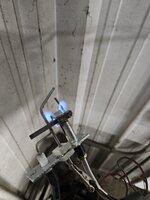
Is the pilot orifice the correct size? The pic make it look like the flame is too small, if the pressure is 10", the only item that can restrict is the pilot orifice. You shouldn't have to bend the flame rod to achieve a good flame signal, your problem is somewhere else.
No drafts...that flame in the picture is outside the furnace with no draft affecting it ... and its still small. The flame sensor assembly is all one like in the previous pic, so there is no moving anything without bending. The pilot is the correct size and for propane. Double checked all that. There were two orfice sizes for that type of heater. My model calls for the larger one which is a 4902. I couldn't track down the mm size of that pilot hole to see if I could find an even larger pilot. I wouldnt think manufacturing that tip hole size changed in 40 years, but who knows. So if anyone knows of a larger tip let me know otherwise I am just going to try bending the flame rod closer. This morning it was warmer and I hooked the gauge up to see how quick the pilot circuit read pressure and it was pretty quick and lighted like normal.
Attachments

So just updating on this, had heating guy look at the pilot and he thought the flame was too small too. He had a very fine hair file to clean the two or three little holes in the pilot and that is all it took. I had blown it out with air, but there was **** on there from manufacturing. Poor design instead of having one main hole. I had also tested the micro amps of the flame rod and it is definitely not in spec...supposed to be 2 to 10 micro amps and its only 1.4 when running. Putting a torch on it doesn't raise it to ten either. So if a little draft hit the previous pilot flame it would fall below one micro amp and trigger the main gas selonoid off and restart the start sequence. It's running for now so I'm happy. Thanks for all the suggestions.