To avoid these ads, REGISTER NOW!

Ride-on laser guided screed and rebars

shamrock12

Well-known member
Joined
Dec 26, 2007
Messages
959
Location
South Dakota
Just recently had 4” concrete approach slab poured in front of my shop. The concrete contractor used a ride-on laser guided screed which I have never seen before and thought it was interesting and cool; however, I wondered what happen to the chaired rebars when they drive over them? Rebars are 1/2” spaced 2 feet on center supported by 1” chairs. Base was built out of 4” layer of crushed concrete compacted prior to the pour. Machine is 1150 pounds plus 250 pounds operator which would come out to approximately 350 pound per wheel. Do rebars get deformed? What happen if the machine drives over a chair already embedded in concrete?

This is the machine they used:

 
Last edited:
To avoid these ads, REGISTER NOW!

PopcornSutton

Well-known member
Joined
Jun 10, 2024
Messages
784
Location
Northern Tip of VA
First, once the concrete is down and under the rebar (glad they used chairs) the weight of work won't bother them, within reason.

The laser guidance on the machine would only be good for a flat level slab. Your approach would have a slop and I doubt it was used.
 
Last edited:

jack stand

Well-known member
Joined
Feb 29, 2012
Messages
3,331
Location
Lakes Region Maine
I'd bet that almost half of the machines weight is the screed that during use is no longer suspended by the machine.
Laser guided slope control has been around forever and you probably have a very nice shop approach!
Now a picture would be great. 👍
 

ConCretin

Well-known member
Joined
Jan 20, 2011
Messages
3,378
Location
Central Maine
Properly supported steel reinforcing will bounce back after the machine passes over it. Any minor deformations aren't generally an issue.
 
To avoid these ads, REGISTER NOW!

mike93lx

ALLIANCE MEMBER
Joined
Dec 9, 2013
Messages
37,493
Location
Richmond, VA
I know, but do you think someone would program it for a short driveway approach?

Heavy equipment can be outfitted with GPS and an operator can move/fill as needed per the contours.
If they thought it justified bringing out the equipment, I would assume they used it as designed
 

ConCretin

Well-known member
Joined
Jan 20, 2011
Messages
3,378
Location
Central Maine
The OP never said it was a short driveway approach. I suspect that if the contractor went to the trouble of hauling his laser screed out, it was a sizable placement. Hand screeding sloped concrete isn't the easiest thing in the world when the screed doesn't reach the formwork. It was probably easier to punch in a few grades than it was to set physical reference points or calculate elevations for wet screeding. Plus he was able to do it with less labor and produce a higher quality product.

Kudos to him for investing in this kind of equipment.
 
OP
S

shamrock12

Well-known member
Joined
Dec 26, 2007
Messages
959
Location
South Dakota
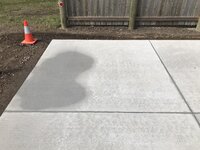
The new slab actually is an extension to the existing 14’ wide approach that was 24’ deep and is now 73’ deep. So they did 686 square footage extension. I thought they were going to use handheld power screed so I was surprised when they rolled out this laser guided machine. I believe they only shot a few points and then it was all set. I did notice the screed dip about a quarter inch lower along the centerline (longitudinal) in a slight V-pattern (barely noticeable) which I am not sure why it happened but they did run into trouble with the laser about halfway into the pour. Turned out the laser was bouncing off my shop window glass confusing the machine so we placed a piece of cardboard between the laser and the shop (laser was setup on the existing slab) so not sure if it had anything to do that.

It did produce a beautiful straight line grade at 2% from the existing slab to the end of approach; however, with a minor issue on one corner of approach end. Apparently some concrete got built up a bit too high against the formwork in the corner causing a shallow puddle to form when it rains. I took my 6 foot level and found approximately half an inch of difference in elevation. Most likely a quarter inch too high in the far corner and a quarter inch too low next to it toward the centerline which is where the shallow puddle developed. It concerns me a bit that spalling might occur in the future after some freezing thaw cycles. Obviously grinding the high spot would help fix some but then doing so would ruin the beautiful broomed finish. I could see this happening on a level slab pour but would have never expected that on a sloped pad with 2% grade so I was surprised to see that. What are your thoughts? Should I leave it alone and accept it as is? See photos below. They were taken after it has dried off some.
 

Attachments

  • IMG_4912.jpeg
    IMG_4912.jpeg
    821.2 KB · Views: 48
  • IMG_4920.jpeg
    IMG_4920.jpeg
    1.3 MB · Views: 48
  • IMG_4921.jpeg
    IMG_4921.jpeg
    996.9 KB · Views: 48
Last edited:
To avoid these ads, REGISTER NOW!
Top Bottom