To avoid these ads, REGISTER NOW!

Romex and conduit

Astross89

Well-known member
Joined
Apr 7, 2018
Messages
153
Brevard County, FL

I have read online about mixed reviews about putting Romex inside conduit.

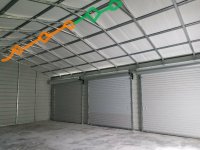
What my situation is. I have Romex in the walls behind osb board. I need to wire my outlets for my hanging lights. This is an exposed steel building roof. Can I run my 12/2 Romex in conduit where exits the OSB board. The run is roughly 30 ft of roof line. And if so what size conduit. 3/4? And metal or Pvc conduit. Thank you.
 
To avoid these ads, REGISTER NOW!

tyme2par4

Well-known member
Joined
May 16, 2016
Messages
571
Location
NH
You can run NM-B (Romex) in conduit, you just have to account for the size properly. Since it is oval, and not round like a bundle of wires would be.
You can't use it underground or in wet locations though.
 

teamextreme

Well-known member
Joined
Aug 10, 2013
Messages
867
Location
Lakewood, CO
The purpose of sleeving Romex is to provide protection from physical damage. I can't tell from your description, but is sounds like you're proposing sleeving the conduit when it leaves the OSB at the roofline. "Where exposed to physical damage" is open to huge amounts of interpretation based on the local AHJ, but not many places would consider a ceiling exposed to physical damage. I would probably still do it though, just so it looked cleaner. To answer your question though, yes you can run Romex in conduit. You can use either EMT or PVC. I'll let someone else answer the size question. You can physically fit 12/2 in 1/2" fairly easily, but I'm not sure if it technically meets fill requirements.
 

ddawg16

Well-known member
Joined
Jul 11, 2008
Messages
21,005
Location
S. California
I'd do 3/4" PVC. Gray PVC won't rust....and the extra space makes it a lot easier to pull wire.

Some locations won't let you run romex in conduit.

Personally, solid wire is a pain in the *** to pull through conduit.

If it was me, I'd be using stranded THWN. Your going to be wire nutting it anyway so it wire nuts just as easy as solid.

Or, if you have a bunch of Romex you want to use up....take the sheath off.....it will be a little easier to pull.....not much though.....
 

ddawg16

Well-known member
Joined
Jul 11, 2008
Messages
21,005
Location
S. California
It's technically against the Code to do that, because the wires aren't individually labelled.

Yea....I know....but my inspector (LA County) didn't care.....he said he'd rather see the sheath removed....he said it's pretty obvious the wire came from Romex.....

My inspector held me to code....except when common sense suggested otherwise.
 

wyliesdiesels

Well-known member
Joined
Aug 14, 2012
Messages
20,021
Location
Modesto, CA
I'd do 3/4" PVC. Gray PVC won't rust....and the extra space makes it a lot easier to pull wire.

Some locations won't let you run romex in conduit.

Personally, solid wire is a pain in the *** to pull through conduit.

If it was me, I'd be using stranded THWN. Your going to be wire nutting it anyway so it wire nuts just as easy as solid.

Or, if you have a bunch of Romex you want to use up....take the sheath off.....it will be a little easier to pull.....not much though.....

Negative batman....

Individual romex condutors are not labeled so it is not code permissable to do that....
 

ddawg16

Well-known member
Joined
Jul 11, 2008
Messages
21,005
Location
S. California
Negative batman....

Individual romex condutors are not labeled so it is not code permissable to do that....

Yea....I know.....but he said it was ok....

Would I do it again? No....PIA stripping off the jacket and pulling solid....easier to run stranded
 

teamextreme

Well-known member
Joined
Aug 10, 2013
Messages
867
Location
Lakewood, CO
I'd do 3/4" PVC. Gray PVC won't rust....and the extra space makes it a lot easier to pull wire.

Some locations won't let you run romex in conduit.

Personally, solid wire is a pain in the *** to pull through conduit.

If it was me, I'd be using stranded THWN. Your going to be wire nutting it anyway so it wire nuts just as easy as solid.

Or, if you have a bunch of Romex you want to use up....take the sheath off.....it will be a little easier to pull.....not much though.....

3/4 PVC is not a bad suggestion. However, I beg to differ on the stranded wire suggestion. I prefer to pull solid, it's not difficult in the least to pull, and stranded wants to curl up on you, won't stay in place where you want it when making up boxes or panels, and you can't terminate on switches and outlets unless they're spec grade with the wire plates. Does stranded pull easier? Sure, if I had a 100ft run, with 4 90's and 8 #12's in a 1/2", ya, stranded would be much easier. But for the small little runs of 10 to 20 feet with one or 2 90's in the typical garage, solid goes thru with no problem. In fact, you can usually push it through without needing a fish tape. Can't do that with stranded.
 

alfredeneuman

Well-known member
Joined
Mar 3, 2011
Messages
4,580
Location
Fullerton, CA
you can't terminate on switches and outlets unless they're spec grade with the wire plates.

Termination of stranded wire to regular terminals is easy :)

Start about 2" shy of the end of the wire.
When you strip the wire don't remove it all the way - just to a point about 1/4" short of the wires end. It will keep the strands from separating.

Twist the wire a little more in the way the strands are already going.

Starting at the point where the original insulation ends, tightly wrap the wire around the terminal, hold the pinched wire in place with needlenose pliers, and tighten the terminal

It will leave a tag end of wire past the terminal, which can be cut off with a pair of diagonals.
 
Last edited:

SarcasticDwarf

Well-known member
Joined
Dec 30, 2009
Messages
236
Location
North Dakota
As others have commented, it is allowed as long as you say that you are doing it for the physical protection of the wiring. Have a reasonable explanation of why it might need more protection and you should be fine (ex: people with a hammer and a few nails are idiots and I want the extra protection.) A few tips:
  • Use wire lube on the Romex. It tends to bind quickly and get caught on fittings.
  • You will need fittings at each end of some type. If it is going into a box it needs the proper fitting.
  • The split bushings ****. Get the solid ones (not all hardware stores carry them)
  • My experience is that the inspector is not going to care about the conduit fill. So you could get 2x 12/2 in a 1/2" EMT run. That said, it ***** trying to do that, just go with 3/4.
 
OP
A

Astross89

Well-known member
Joined
Apr 7, 2018
Messages
153
As others have commented, it is allowed as long as you say that you are doing it for the physical protection of the wiring. Have a reasonable explanation of why it might need more protection and you should be fine (ex: people with a hammer and a few nails are idiots and I want the extra protection.) A few tips:
  • Use wire lube on the Romex. It tends to bind quickly and get caught on fittings.
  • You will need fittings at each end of some type. If it is going into a box it needs the proper fitting.
  • The split bushings ****. Get the solid ones (not all hardware stores carry them)
  • My experience is that the inspector is not going to care about the conduit fill. So you could get 2x 12/2 in a 1/2" EMT run. That said, it ***** trying to do that, just go with 3/4.


I see you said I could fit two of them. That doesn't mean I can run two different light switches down one single conduit? Don't mind my picture I did it from my phone. It's just to give you an idea. So 1 conduit with both runs inside. Two light switches one for the left side of the shop one for the right. Hopefully that's not too confusing
 

Attachments

  • IMG_20180703_112423.jpg
    IMG_20180703_112423.jpg
    149.6 KB · Views: 70

TRWham

Well-known member
Joined
Aug 11, 2017
Messages
1,961
Location
East Cobb County, Georgia
You can, but I don't get the appeal. If you are running new conduit and wire anyway, just transition from NM to THHN in a j box at the wall and run individual wires in conduit from there. I would use EMT.
 

TRWham

Well-known member
Joined
Aug 11, 2017
Messages
1,961
Location
East Cobb County, Georgia
I see you said I could fit two of them. That doesn't mean I can run two different light switches down one single conduit? Don't mind my picture I did it from my phone. It's just to give you an idea. So 1 conduit with both runs inside. Two light switches one for the left side of the shop one for the right. Hopefully that's not too confusing

You can run as many circuits as you want in a conduit so long as you do not exceed the allowed conduit fill. Two switches for 2 sets of lights would be no problem at all.
 
Last edited:
To avoid these ads, REGISTER NOW!

SarcasticDwarf

Well-known member
Joined
Dec 30, 2009
Messages
236
Location
North Dakota
You can, but I don't get the appeal. If you are running new conduit and wire anyway, just transition from NM to THHN in a j box at the wall and run individual wires in conduit from there. I would use EMT.

One reason not to do this is if you already have a supply of NM. For a homeowner, only having to buy one type of wire for a project can be a significant cost savings.

I see you said I could fit two of them. That doesn't mean I can run two different light switches down one single conduit? Don't mind my picture I did it from my phone. It's just to give you an idea. So 1 conduit with both runs inside. Two light switches one for the left side of the shop one for the right. Hopefully that's not too confusing

You can as far as I know (not an electrician, but have been working with EMT and Romex in my garage). I mentioned that you could fit 2 12/2 NM in 1/2" EMT but it is a really tight fit. I would stick with 3/4 for everything as it is not much more expensive and simplifies things.
 
OP
A

Astross89

Well-known member
Joined
Apr 7, 2018
Messages
153
The garage will have OSB finished walls. I want to exit the wall at the peak with conduit. And the run is about 30 ft of conduit on the roof line. The only area that will have conduit, is the exposed roofline.
 
Last edited:

Matt Matt

Well-known member
Joined
May 11, 2017
Messages
523
Location
Ontario
Why not just use armoured cable drops from a junction box?? Is this considered industrial or residential??? Do you have employees?...

If residential you are allowed to have unprotected overhead wiring that is properly stapled to the structure to a junction. From the junction, if it exceeds (***” depending on your local inspection agency) require flexible armoured cable drops.
 
Last edited:

TRWham

Well-known member
Joined
Aug 11, 2017
Messages
1,961
Location
East Cobb County, Georgia
..... and that's the textbook sleeve.

In my experience, the term "sleeve" would apply to protection provided for a cable (or pipe in plumbing or HVACR) where it penetrates a wall or floor/ceiling, just as described in 334.15(B).

Just to be clear, I suggested that the NM cable run to a box where it is then connected to THHN (or whatever appropriate wire you prefer), that in turn runs within EMT to metallic boxes that serve the luminaires via outlets. All of that should be spaced off the metal roof as required in 300.4(E), which is yet another reason it should be in conduit. If I understand you correctly, you are saying the conduit somehow no longer qualifies as such because of its contact with the sheathed cable. If so, it seems to me you are making a distinction that is not found in the code. As far as I have ever seen, the term "conduit system" does not appear in NFPA 70, including Chapter 9 Table 1 where allowable conduit fill is shown.
 

7635tools

Well-known member
Joined
Feb 19, 2015
Messages
87
Location
Southeast Wisconsin
3/4 PVC is not a bad suggestion. However, I beg to differ on the stranded wire suggestion. I prefer to pull solid, it's not difficult in the least to pull, and stranded wants to curl up on you, won't stay in place where you want it when making up boxes or panels, and you can't terminate on switches and outlets unless they're spec grade with the wire plates. Does stranded pull easier? Sure, if I had a 100ft run, with 4 90's and 8 #12's in a 1/2", ya, stranded would be much easier. But for the small little runs of 10 to 20 feet with one or 2 90's in the typical garage, solid goes thru with no problem. In fact, you can usually push it through without needing a fish tape. Can't do that with stranded.


Solid wire ***** period. You can push it in short runs without a fish tape but trying to add wires in later is a pain in the ***. Stranded wire is way easier.


Sent from my iPhone using Tapatalk
 

Matt Matt

Well-known member
Joined
May 11, 2017
Messages
523
Location
Ontario
Solid wire ***** period. You can push it in short runs without a fish tape but trying to add wires in later is a pain in the ***. Stranded wire is way easier.
I have a love hate relationship and with stranded. Usually 12 gauge under 300 V I like to play solid.
 

alfredeneuman

Well-known member
Joined
Mar 3, 2011
Messages
4,580
Location
Fullerton, CA
Regardless whether it qualifies as conduit or just mechanical protection, 3/4" makes it on both counts in the OP's case.

Both solid and stranded wire have their respective places.
 
Last edited:

ddawg16

Well-known member
Joined
Jul 11, 2008
Messages
21,005
Location
S. California
When making connections, I almost always use a pigtail.

In other words, if I have stranded in the conduit, I wire nut 4-5" lengths of solid to the stranded. Then I don't have to worry bout crimping on spade connectors to the switch or recept. The main bundle wires stays in the back of the box and I only have to deal with the pigtail.

This makes life much easier when the ckt is continuing to another box.
 

alfredeneuman

Well-known member
Joined
Mar 3, 2011
Messages
4,580
Location
Fullerton, CA
Then I don't have to worry bout crimping on spade connectors to the switch or recept.

You don't have to use spade connectors on connections with stranded wire.

You can use backwire devices with the plate under the terminals,
or>>>>>>
Strip about 2" of insulation back, but leave about 1/4" of the insulation on the end.
Twist the conductor a little bit in the direction it's already twisted in.
TIGHTLY twist the wire around the terminal, pinch and hold the wire in place with a pair of needlenose.
Tighten the terminal
This will leave a tag end of wire after the terminal, which can be cut off with diagonal cutters :)
 

Mr. T

Well-known member
Joined
Sep 4, 2013
Messages
636
Location
Central PA
You don't have to use spade connectors on connections with stranded wire.


I guess it’s worth noting that you really need to do your homework when using crimp/spade/Stacon connectors on a receptacle if you want to be code compliant. There is no rule against it but the connector and receptacle have to be listed for that use, which not all are. AND you have to use the crimp tool the connector manufacturer specifies.

Also, I’m a reverse twist guy. Or if I have a choice, a buy a back-wire receptacle guy.
 
To avoid these ads, REGISTER NOW!
Top Bottom