To avoid these ads, REGISTER NOW!

"Romex" directly into fixture?

JamieK

Well-known member
Joined
Aug 13, 2009
Messages
1,760
Location
Winston-Salem, NC
I'm planning on putting up surface mount flourescent lights in my garage with a finished ceiling. Can I mount the lights and then pull the romex directly through the drywall and attach to the internal light wiring? Or am I required to have a junction box?
 
To avoid these ads, REGISTER NOW!

rlitman

Well-known member
Joined
Oct 18, 2010
Messages
24,591
Location
Long Island
Probably not, but it depends on the exact fixture you are using. If the fixture's tray is rated as a wire raceway, you may be ok with this.
 

pattenp

Well-known member
Joined
Jun 4, 2008
Messages
10,175
Location
Virginia - USA
If the fixture has a knockout on the bottom that a NM clamp will fit in then you can pull the romex into the fixture and make the connections in the fixture. I have yet to see a typical surface mount fluorescent strip light fixture that you can't hook up in this manner.
 

Highbeam

Well-known member
Joined
Feb 15, 2011
Messages
2,292
Location
Mt Rainier foothills, WA
If the fixture has a knockout on the bottom that a NM clamp will fit in then you can pull the romex into the fixture and make the connections in the fixture. I have yet to see a typical surface mount fluorescent strip light fixture that you can't hook up in this manner.

I agree and have had this type of installation inspected and approved. Be certain that you have stapled the romex to the ceiling structure within 6" and that the knockout into the light fixture is equipped with the plastic snap in wire clamp.

If you go straight up into the ceiling then you won't have any exposed romex. The exposed romex looks bad but also might trip up an inspector and he may ask for conduit.
 

pattenp

Well-known member
Joined
Jun 4, 2008
Messages
10,175
Location
Virginia - USA
ARLINGE00280_WB_C8_PM_001.jpg

https://www.vikingelectric.com/weba...0251&storeId=13801&productId=176042&langId=-1

Snap in wire clamp? Can someone post a link or picture?
 

Spudland_Dave

Well-known member
Joined
Mar 12, 2010
Messages
3,025
Location
Maine
Those are the best & worst inventions yet :lol: ....Best in that stringing boxes is easy (all my arlington one boxes came with em), absolute PITA if you decide you want to pull the 14-2 you installed out and put a 14-3 in...dont ask.
Doing Steel boxes on the shop end and I'm debating between using those or the old fashioned screw on & tighten type.
 

911Dave

Member
Joined
Apr 23, 2013
Messages
11
If the connection is being made inside the fixture, as it sounds like you plan to do, I don't believe you need an electrical box to run the Romex through. Nevertheless, it would be a good idea to contact your city or county building office and ask them. You absolutely must use a cable clamp to secure the Romex where it enters the fixture. I like the plastic ones as pictured above.
 

eddie1278

Banned
Joined
Mar 2, 2013
Messages
344
NM wire can be exposed as long as it's not subject to physical damage. If it is it must be protected. Also that black connector is commonly referred to as a button connector just one of many NM connectors out there.
 

Highbeam

Well-known member
Joined
Feb 15, 2011
Messages
2,292
Location
Mt Rainier foothills, WA
NM wire can be exposed as long as it's not subject to physical damage. If it is it must be protected.

Well, if you expose romex then I can walk up and cut it with my box knife to cause physical damage. See the problem? Your inspector can jerk you around with loose code like that. Hiding the romex will keep some lady from using it for coat hangers and keep your inspector from even having to make the decision about whether it COULD be damaged.
 

Highbeam

Well-known member
Joined
Feb 15, 2011
Messages
2,292
Location
Mt Rainier foothills, WA
Those are the best & worst inventions yet :lol: ....Best in that stringing boxes is easy (all my arlington one boxes came with em), absolute PITA if you decide you want to pull the 14-2 you installed out and put a 14-3 in...dont ask.

It is sometimes worth it to loose a foot of wire by snipping off the end and pulling the waste through the clamp. This can save a lot of time and damage to the fixture vs. trying to defeat the one way clamp feature removing the 14/2 backwards.
 
To avoid these ads, REGISTER NOW!

Rockuf8

Well-known member
Joined
Dec 24, 2012
Messages
1,166
Location
Northern NJ
Well, if you expose romex then I can walk up and cut it with my box knife to cause physical damage. See the problem? Your inspector can jerk you around with loose code like that. Hiding the romex will keep some lady from using it for coat hangers and keep your inspector from even having to make the decision about whether it COULD be damaged.

I had a Q about conduit made to run the wire through to avoid it being damaged.

I have a single wire we moved (which was connected through the inside garage ceiling) to a single bulb fixture, to inside the garage attic where I plan on running 6 fluorescent fixtures off of it which is controlled by a single switch.

bare%2Bbulb.JPG


I'm sure the electrician will know how to run wires but I'm wondering if wires are all coming from different locations on the ceiliing should conduit be used for each single run of wire in the attic tied into one central junction box?
 

pattenp

Well-known member
Joined
Jun 4, 2008
Messages
10,175
Location
Virginia - USA
Rock, I would think if all the wiring is done in the attic for the lights you would use NM (romex) and no conduit will be needed. Usually if any wire protection is needed you can run the wire along a running board. This is just my thought without seeing how the wire needs to be installed for your lights.
 

tylernt

Well-known member
Joined
Jan 24, 2013
Messages
182
Location
Idaho, US
I had a Q about conduit made to run the wire through to avoid it being damaged. .. inside the garage attic

Protection from physical damage is required if the attic has permanent stairs. You can use conduit or simple 2x4 or 2x3 running boards on either side of the cables running perpendicular to the joists. (If the cables run parallel, staple 'em to the side of the joist, the joist becomes your protection.)

If your attic does not have permanent stairs, then you only need protection within 6' of the attic access hole.
 

Rockuf8

Well-known member
Joined
Dec 24, 2012
Messages
1,166
Location
Northern NJ
Rock, I would think if all the wiring is done in the attic for the lights you would use NM (romex) and no conduit will be needed. Usually if any wire protection is needed you can run the wire along a running board. This is just my thought without seeing how the wire needs to be installed for your lights.

Protection from physical damage is required if the attic has permanent stairs. You can use conduit or simple 2x4 or 2x3 running boards on either side of the cables running perpendicular to the joists. (If the cables run parallel, staple 'em to the side of the joist, the joist becomes your protection.)

If your attic does not have permanent stairs, then you only need protection within 6' of the attic access hole.
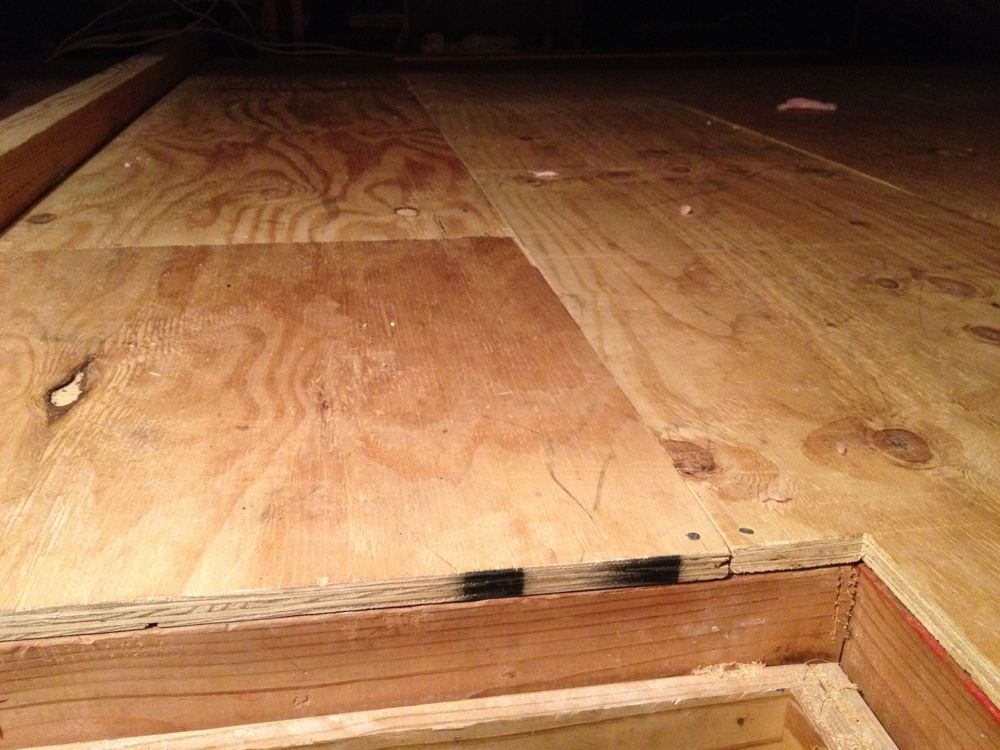
Makes sense, thanks guys. If I wanted to use conduit we could, it would make things look neater wouldn't it? We'll have to unscrew the 3/4" plywood and run the wires down through a small hole the ceiling drywall hidden by the fixture and staple it to the joist out of the way of the batt insulation, but not sure how to have it come out of each piece of plywood. I assume I would make small notices (not a hole) in case I wanted to remove the plywood for any reason, running it through a hole would mean the wire was attached to the plywood which would be a pain to work around.
 

tylernt

Well-known member
Joined
Jan 24, 2013
Messages
182
Location
Idaho, US
not sure how to have it come out of each piece of plywood. I assume I would make small notches
This attic has plywood flooring? If people are going to be walking around regularly or storing stuff, I would protect the wiring (running boards or conduit) even if there were no permanent stairs. Or drill through the center of the ceiling joists (don't notch joists) to run the cable under the plywood.

Not sure if code requires it, but I don't feel good about unprotected Romex on a plywood floor.
 

Rockuf8

Well-known member
Joined
Dec 24, 2012
Messages
1,166
Location
Northern NJ
No, I meant notch the side of the plywood for the wire to run through. We can easily attach the romex to a 4x10" lam beam we installed last month.

attic2.jpg


garage_ceiling7.jpg


garage_ceiling8.jpg


Sorry to the OP if I hijacked your thread.
 

Rockuf8

Well-known member
Joined
Dec 24, 2012
Messages
1,166
Location
Northern NJ
What about a small hole in the middle of each joist close to each bracket and running the wiring parallel to the lam beam? That's one way of running the wires from fixture to fixture, bad idea?
 

tylernt

Well-known member
Joined
Jan 24, 2013
Messages
182
Location
Idaho, US
The rules for drilling joists is you can only drill the middle vertical third -- the top third and bottom third take 99% of the load of holding the building up, so drilling in the middle does not significantly weaken it. (Does not apply to glue-lam beams, can't drill those at all except where the manufacturer tells you you can.)

I'm not aware of any rules regarding the left/right of a joist, but I would probably stay at least 6" from the bracket so the end of the joist (where half the load is bearing) doesn't collapse into toothpicks.
 

Rockuf8

Well-known member
Joined
Dec 24, 2012
Messages
1,166
Location
Northern NJ
The rules for drilling joists is you can only drill the middle vertical third -- the top third and bottom third take 99% of the load of holding the building up, so drilling in the middle does not significantly weaken it. (Does not apply to glue-lam beams, can't drill those at all except where the manufacturer tells you you can.)

I'm not aware of any rules regarding the left/right of a joist, but I would probably stay at least 6" from the bracket so the end of the joist (where half the load is bearing) doesn't collapse into toothpicks.

Then I think we should avoid driling holes in the joist and come up with another plan.
 

Rockuf8

Well-known member
Joined
Dec 24, 2012
Messages
1,166
Location
Northern NJ
You might ask about drilling the ends of a joist in a construction forum, they should know if it's ok or not.

Yeah, we can just run a piece of conduit and run wire in it, no biggie, he's bringing plastic and metal conduit. Thanks for your help
 
To avoid these ads, REGISTER NOW!
Top Bottom