To avoid these ads, REGISTER NOW!

romex in conduit

Highbeam

Well-known member
Joined
Feb 15, 2011
Messages
2,292
Location
Mt Rainier foothills, WA
I am near Puyallup but under L&I and got all permits for my electrical in the pole barn within the last couple of years. A few permits in fact.

No, I would not try and shove much NM-B through conduit. Even if the fill was legal it's a pain. THHN is cheap.

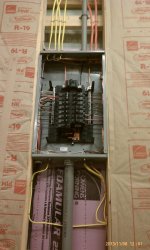
Before I covered the walls I had the final inspections including the service entrance signed off.

Wish I had more photos. The wires were not nailed to the girts but to and through the studs. I decided to go around the back of the big poles vs. drilling holes through them.
 

Attachments
  • IMAG0834.jpg
    IMAG0834.jpg
    104.4 KB · Views: 44
Last edited:
To avoid these ads, REGISTER NOW!

checkthisout

Well-known member
Joined
Sep 5, 2008
Messages
5,232
L&I told you that stapling wire to the under side of your wind girts was acceptable? That's how I hope to do mine, but I probably need to get the inspector out to confirm.

It's fine. The assumption is that all your siding is installed so nobody is gonna be driving nails or screws in from the outside of the wall.

It needs to sit at least 1-1/4 inches in from the edge of the girts or studs on the inside wall. If it's less than that you need to put nail plates wherever it passes through framing.
 

checkthisout

Well-known member
Joined
Sep 5, 2008
Messages
5,232
It is a pole building, no studs,
I do get what you are saying but it is alittle tougher on a pole building. No studs 18 inches on center, grits spaced out 2 feet, then they are on end. You would only have 1 1/2 to run your wires plus, you would have to protect them from the outside also. So a stray nail doesn't go through the siding into your wire. Similar to metal plates on studs.

I'm going to do the conduit.
Yes, I went by labor and industries this morning. A lot nicer then mason county planning department

You could frame in a cavity above your breaker box with a single 2x6 and handful of nails to pass the wires up to the ceiling and then cut a piece of leftover tin (how about the cover sheet that came on your roofing and siding?) and screw it over the cavity.

You can then remove it in the future and easily install more wiring and you don't have to deal with the limitations of conduit including threading wire, fittings and glue.

That would take 10 minutes including cutting the wood and driving the screws.
 

tarmy

Well-known member
Joined
May 28, 2014
Messages
4,670
Location
Nor Cal
Make sure your bargain NM cable is marked on the jacket as NM-B. If it is old, it may not be the -B variation, and code no longer addresses the use of the earlier versions.

The fill calculations for cable such as NM are simple. You take the MAJOR diameter of the cable (measuring the widest way) and calculate the area of a CIRCLE based on this diameter. That is how the code has you arrive at the cross section area of elliptical cables such as NM.

My handy dandy digital caliper tells me that the roll of Southwire® Romex® NM-B is .408 across the widest way. Google tells me (I'm lazy this evening) that this is .13 sq/in of area for a circle that is .408 in diameter. Double this and you get .26 sq/in.

The inside cross sectional area of 3/4 PVC sch 80 conduit is .41 sq/in based on a diameter of .722. Now, the code says that jacketed cables and cords are considered one conductor for the purposes of fill, and the code also says that the max allowed % of fill for two conductors is 31%. 31% of .41 is .1271 sq/in which is way below the .26 sq/in area of two sections of Romex.

So, NO, you cannot legally, by the NEC, run two sections of NM-B in a 3/4 sch 80 PVC. In fact, you would need to go to 1" sch 40 PVC conduit in order to get the two sections of NM cable in by code.

Charles
I have a garage with 3/4" emt with two 12/2 Romex
in them...is this ok?
 
Last edited:
OP
B

brian1210

Member
Joined
May 16, 2015
Messages
16
Running wires between 6x8 posts and siding on top of grits?
From the electricians I have talk to, they believe that is a bad idea. For the simple fact, if you do any siding work, there is no protection, stray nail. I thought about doing that myself. Did you ground your metal siding?

2 romex in 3/4. I am planing on running 2 inch pvc from panel to 10 feet up. So I add more later on but from my light circuit will have 2 pieces romex running through it. One for outside and for inside. 3 gang box 1 for gfi, and 2 light switches. Power coming in horizontal and 2 going vertical out to the lights. So one stick, cost from 3/4 to 1 inch is not much of a difference. I will go 1inch

Nailing on the bottom/under the wind grit is acceptable by l&i
 
To avoid these ads, REGISTER NOW!

checkthisout

Well-known member
Joined
Sep 5, 2008
Messages
5,232
Running wires between 6x8 posts and siding on top of grits?

Do you mean girts? The girts are the horizontal 2x6's that run between your posts, spaced vertically usually every two feet. Depending on building, they usually have 2x4's flat nailed to the outside and the siding is then attached on top of this. Does that sound like your building?

After reading this it sounds like you just have 2x4"s flat nailed to the posts without 2x6's.

The solution is still similar making a horizontal stud cavity using 2 2x6"s for horizontal runs and switch mount and a vertical stud cavity to get up to the ceiling. You can put it next to a post to save a stick of wood.


From the electricians I have talk to, they believe that is a bad idea. For the simple fact, if you do any siding work, there is no protection, stray nail. I thought about doing that myself. Did you ground your metal siding?

How is it any different than any other building? You actually have an extra measure of protection given the fact that you usually have a 2x4 nailed on top of the 2x6 giving you an 1.5 inches. All wiring is run in the wall. Wiring is done after siding. How is there any danger of damaging a wire?

2 romex in 3/4. I am planing on running 2 inch pvc from panel to 10 feet up. So I add more later on but from my light circuit will have 2 pieces romex running through it. One for outside and for inside. 3 gang box 1 for gfi, and 2 light switches. Power coming in horizontal and 2 going vertical out to the lights. So one stick, cost from 3/4 to 1 inch is not much of a difference. I will go 1inch

Nailing on the bottom/under the wind grit is acceptable by l&i

Sounds good......but sticks of wood are cheap. The cost of the wood would be less than the cost of the glue for the conduit.....just say'n. :p
 
Last edited:

PugetDude

ALLIANCE MEMBER
Joined
Mar 13, 2013
Messages
22,358
Location
Superstition Mountains, AZ
Have a friend in Spokane that just went through this.
He just covered the wires below the trusses with 1x4 fence boards for the final inspection, passed with no problem.
 

Highbeam

Well-known member
Joined
Feb 15, 2011
Messages
2,292
Location
Mt Rainier foothills, WA
Running wires between 6x8 posts and siding on top of grits?
From the electricians I have talk to, they believe that is a bad idea. For the simple fact, if you do any siding work, there is no protection, stray nail. I thought about doing that myself. Did you ground your metal siding?

That's ridiculous. You are required to have 1.25 inches of clearance before you need nail plates. Between the 6x8 posts and the siding is a girt that is 1.5" thick. That leaves you 0.25" to place your wire.

I did not ground my metal siding. That too is ridiculous.
 
To avoid these ads, REGISTER NOW!
Top Bottom