The contractor that built my garage also put on drip edge and underlayment on so it was water sealed until we roofed. I noticed that the underlayment goes over the drip edge on the eaves and every website I've seen says that the underlayment should be underneath the drip edge on the eaves so I'm wondering thoughts on putting window flashing on along the eaves to create a seal so is no chance of water could get in between the drip edge and the underlayment? That might be a much easier and cheaper way then to tear off the drip edge and re-install new overtop of the underlayment?


You are using an out of date browser. It may not display this or other websites correctly.
You should upgrade or use an alternative browser.
You should upgrade or use an alternative browser.
Roof drip edge
- Thread starter rwgust
- Start date
Evilunclegrimace
Well-known member
Your contractor did the correct detail. Water runs down hill. If the drip edge is on top of the underlayment at the eaves it is a possible place of entry if any water gets under the shingles.The underlayment should be under the drip edge on the rakes.
I might have my terminology backwards, but basically the underlayment is over the metal flashing on all 4 sides. And I'm wondering what to do since it's over the flashing on the rakes, was thinking about applying window flashing to make a good seal. It's a 18'x24' garage.
Last edited:
readhead
Well-known member
Should be over the drip edge on the eaves and under the drip edge on the rake.
matt_i
Well-known member
I might have my terminology backwards, but basically the underlayment is over the metal flashing on all 4 sides. And I'm wondering what to do since it's over the flashing on the rakes, was thinking about applying window flashing to make s good deal. It's a 18'x24' garage
I disagree with this and agree with Uncle Grimace (he seems friendly and good today
 )
)Ideally in modern times one is using peel and stick ice+water shield on all the edges.
Drip edge goes on first on the bare plywood/osb on the lowest edge. Then goes on ice+water horizontally. Then ice+ water vertically climbing/angled upwards to the peak. Then drip edge goes vertically climbing/angled upwards towards the peak, lapping over top of horizontal i+w. Wrap/bend horizontal drip edge "tail" inside at the corners. Angled upwards tail goes outside.
If your contractor has not done the first/lowest edge detail correctly, I would recommend another 12" minimum lap of peel & stick ice+water. Grace brand would be my choice there. If applied smoothly and J-rolled, in my mind it is 99.5% as good as if it was done correctly to start. The stuff is good.
readhead
Well-known member
I generally do any valleys first then two rows up from the eave. Of course you can do the whole roof. If the budget allows, go for it.
BlackTalon
Well-known member
Honestly I would not cover the whole thing with I&WS. It is a pretty effective vapor retarder, and full coverage increases the likelihood of condensation forming within the sheathing, leading to deterioration of the deck. I have seen this in both residential and institutional applications over the last few years. Stick with the I&WS around the edges, ridge, etc., and go with felt over the main field of the roof.
OP . . . . you've left out two key pieces of information:
. . . 1) Location ??? . . . what weather do you have ?? Update GJ Profile.
. . . 2) Slope of roof ??? . . . this will dictate coverage of I&WS.
Sounds to me like your contractor did it properly. Main source of leaks anyway will be roof penetrations like heater flues, etc. How well did the roofing contractor do those ?? Was there any tar used at all ??
. . . 1) Location ??? . . . what weather do you have ?? Update GJ Profile.
. . . 2) Slope of roof ??? . . . this will dictate coverage of I&WS.
Sounds to me like your contractor did it properly. Main source of leaks anyway will be roof penetrations like heater flues, etc. How well did the roofing contractor do those ?? Was there any tar used at all ??
matt_i
Well-known member
If you are looking for something better than felt....I sourced Grace Tri-Flex which is a tough synthetic underlayment for the remainder of the roof after the i+w. Lapped over the pre-cut ridge slot, it kept the building dry for roughly a month while I finished the roof and other things. Just be careful as its slippery when wet.
Im pretty sure GAF has a competitive Cobra product.
Im pretty sure GAF has a competitive Cobra product.
Your contractor did the correct detail. Water runs down hill. If the drip edge is on top of the underlayment at the eaves it is a possible place of entry if any water gets under the shingles.The underlayment should be under the drip edge on the rakes.
Like Matt, I agree and it's what I have done.
Falcon67
Well-known member
If you are looking for something better than felt....I sourced Grace Tri-Flex which is a tough synthetic underlayment for the remainder of the roof after the i+w. Lapped over the pre-cut ridge slot, it kept the building dry for roughly a month while I finished the roof and other things. Just be careful as its slippery when wet.
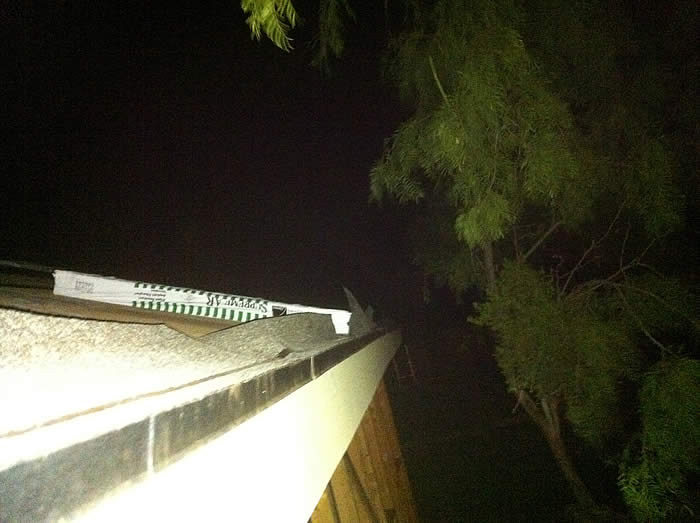
Yes, yes, and yes. Used that, good stuff. Comes in a 250' roll as I recall. Ran out just before the peak and covered the peak with 30 lb roll felt. Then we had a bit of a wind. The Grace stayed put, the felt was ripped to pieces. Also, I loaded several shingle bundles on the roof for an early start. Heat wicked moisture out of the bundles and some slid down the roof and tore up the starter strip. That was a WTF start over deal. On a 4:12 pitch even.
Last edited:
Kevin54
MEMBER EMERITUS
Around here, they will run the felt underlayment on the roof first, then the drip edge is installed. By doing so, it keeps any wind from grabbing the edge of the felt paper and ripping it all off. Then the ice guard goes on top of the drip edge.
Also I have never seen ice guard run up the roof at the gable end. It is always ran at the bottom of the roof (gutter side) for at least the first three feet. This prevents damage from an ice dam backing up and damaging the roof. Ice dams are created where the water from snow melt runs down the roof during the day but when the water hits the gutters will freeze. This will build up over a matter of days until the gutters are all the way full of ice. Then you have more snow, some sunshine later, snow melting off the roof, then running down to where it hits the eaves (overhang) that is not insulated and cold, building up ice there. If the weather is right, this will be repeated over the period of a few days and ice will start working its way back up the roof. Ice guard prevents the damage to the roofs plywood / OSB.
One way to prevent ice dams is gutter heater heat tape, but that can be expensive. Not only in the heat tape itself, but in the running of the electric for it.
Also I have never seen ice guard run up the roof at the gable end. It is always ran at the bottom of the roof (gutter side) for at least the first three feet. This prevents damage from an ice dam backing up and damaging the roof. Ice dams are created where the water from snow melt runs down the roof during the day but when the water hits the gutters will freeze. This will build up over a matter of days until the gutters are all the way full of ice. Then you have more snow, some sunshine later, snow melting off the roof, then running down to where it hits the eaves (overhang) that is not insulated and cold, building up ice there. If the weather is right, this will be repeated over the period of a few days and ice will start working its way back up the roof. Ice guard prevents the damage to the roofs plywood / OSB.
One way to prevent ice dams is gutter heater heat tape, but that can be expensive. Not only in the heat tape itself, but in the running of the electric for it.
snow and ice protection is needed if used over heated space along the bottom edge esp.
If not heated I would use on bottom edge anyway, cheap protection, but would not bother on sides. I cut off the tabs on 3 tab shingles, run the left over piece up with the tar along the edge to help increase the wind damage to the shingles. Remember that snow and ice protection should be at least 3 feet from the wall edge, if you have an overhang you will need more that one layer to meet code.
If not heated I would use on bottom edge anyway, cheap protection, but would not bother on sides. I cut off the tabs on 3 tab shingles, run the left over piece up with the tar along the edge to help increase the wind damage to the shingles. Remember that snow and ice protection should be at least 3 feet from the wall edge, if you have an overhang you will need more that one layer to meet code.
csp
Well-known member
Also I have never seen ice guard run up the roof at the gable end.
This would be the case when ice & water shield is used on the entire roof, not just the bottom 3 feet.
Seems counterproductive to have ice & water shield placed on top of roofing paper. It's supposed to be applied directly to the roof deck.
DalyArcher
Well-known member
all the manufactuer info I read and looked at on line before doing my roof said drip edge on the eave, then ice and water shield on top, drip edge goes OVER the membrane and felt at the rake edge.
http://www.iko.com/wp-content/uploa...ormShield#U0081-Armourgard-Application-EN.pdf
http://www.iko.com/wp-content/uploa...ormShield#U0081-Armourgard-Application-EN.pdf
Evilunclegrimace
Well-known member
Yes, yes, and yes. Used that, good stuff. Comes in a 250' roll as I recall. Ran out just before the peak and covered the peak with 30 lb roll felt. Then we had a bit of a wind. The Grace stayed put, the felt was ripped to pieces. Also, I loaded several shingle bundles on the roof for an early start. Heat wicked moisture out of the bundles and some slid down the roof and tore up the starter strip. That was a WTF start over deal. On a 4:12 pitch even.
This is why I use Titanium UDL 25 or 30. It has mesh woven in to it for traction and is not near as slippery as grace.
If you are looking for something better than felt....I sourced Grace Tri-Flex which is a tough synthetic underlayment for the remainder of the roof after the i+w. Lapped over the pre-cut ridge slot, it kept the building dry for roughly a month while I finished the roof and other things. Just be careful as its slippery when wet.
Im pretty sure GAF has a competitive Cobra product.
This is some great stuff...and FWIW the web site offers an extensive DIY section that has lots of info and detailed videos of all the roofing processes regardless of whose products you use(Look under Residential Roofing, then DIY Center)
http://www.gaf.com/Roofing/Residential/Products/Roof_Deck_Protection/Deck_Armor
matt_i
Well-known member
I think a 12" strip is going to be better than nothing at all. Grace Vycor (door+window) is about the same thing as the i+w just not as wide.
Tucko
Well-known member
I've always installed it by running a small strip of underlayment, then the drip edge on top. The final underlayment goes on top of the drip edge metal, effectively "sandwiching" the metal...
larry4406
Well-known member
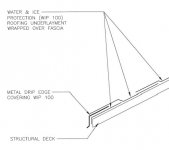
On the houses the company I work for builds, we use the attached detail on the eves (gutter boards).
A short bottom course of ice and water guard is applied and it partially overlaps the facia (later obscured by the gutter). This seals the facia to roof sheathing gap eliminating a common source of ice damning.
Then the drip edge is applied, followed by an overlapping course of ice and water guard.
We run ice and water guard a minimum of 3' up the roof. For shallow roofs (3:12 or less) we cover the roof 100% with ice and water guard.
A short bottom course of ice and water guard is applied and it partially overlaps the facia (later obscured by the gutter). This seals the facia to roof sheathing gap eliminating a common source of ice damning.
Then the drip edge is applied, followed by an overlapping course of ice and water guard.
We run ice and water guard a minimum of 3' up the roof. For shallow roofs (3:12 or less) we cover the roof 100% with ice and water guard.
Attachments
Been a roofing contractor for 25+yrs.....
1. Ice & water first course (3ft) direct to sheeting.
2. Felt on the rest.
3. Drip edge over the ice & water shield.
4. Self adhesive starter strip like this one....

I've been using this EXACT starter, installed in the manner outlined above for years, on countless roofs. It really is problem solved when done like this.
1. Ice & water first course (3ft) direct to sheeting.
2. Felt on the rest.
3. Drip edge over the ice & water shield.
4. Self adhesive starter strip like this one....
I've been using this EXACT starter, installed in the manner outlined above for years, on countless roofs. It really is problem solved when done like this.