To avoid these ads, REGISTER NOW!

Roof truss structural help needed

ben5243

Active member
Joined
Jul 7, 2017
Messages
36
Location
Everett, WA
Hi all,

I apologize as this isn't 100% garage related but I wasn't sure where else to find a collection of folks knowledgeable about these sorts of things... maybe we can just pretend this is in the garage? ;)

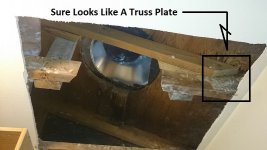
Bought the house a year ago, first house. This was missed in the home inspection unfortunately. When someone installed the original wood stove they cut both top and bottom cords of the engineered roof truss to avoid using offsets in the stove pipe and save a few hundred bucks. I estimate this was done at some point in the 80s. The house was built in 75. The bracing they did is structurally useless.

The stove has since been replaced right after we moved in and the same location was used. But I still have this hanging over my head at night. (like literally... I sleep under the other side of this truss)

I 100% know I will need a structural engineer on this and have contacted several already but they are all swamped into February and don't seem interested. No one will comment on how big of a project this will be and I'm going crazy wondering if this is going to cost a small fortune to fix or if it will be a simple task of just bracing what is already there and moving the stove pipe over with offsets.

I doubt anyone will find this useful but the trusses are fink type, all 2x4, 24ft span, 24inch o.c. with a 4/12 pitch.

Is anyone familiar with this stuff or have experience dealing with broken or cut truss members that can share their story? I want to get started remodeling that closet and expand a bathroom and build a chase around the new stove pipe but too afraid to move any walls right now and afraid the budget will be blown out of the water by this.

Anyway... here's one of the many surprises left for us by the previous owners:
38808718902_14155c6b13_c.jpg


Here's the current state which I imagine will need offsets to move it between the trusses
38123835844_668d88e83a_c.jpg


(The reason I cut out such a large piece of drywall in the first place was to remove about 50 lbs of bird nesting material built up around the original stove pipe)
 
To avoid these ads, REGISTER NOW!

Jlbc212

Well-known member
Joined
Dec 7, 2013
Messages
1,530
Location
Northeast MA
In consideration of the fact that the roof hasn't fallen in yet, if it were mine, I would sister another 2x4 along the bottom chord and also make sure the 2x4 that was placed along the top chord is really attached well to the cut top chord. Simply stated trusses work because of the triangle principal - three sides (in this case truss chords) of defined length can only form one shape. When anyone one of the sides or connecting points gets cut or breaks, the triangle is subject to change shape and fail. By sistering 2x4's to the top and bottom chord in essence you are restoring those legs of the triangle. To repeat, just make sure the sister pieces are well attached.
 

firebirdparts

Well-known member
Joined
Jun 8, 2016
Messages
10,584
Location
Kingsport, TN
I agree with Jack.

We have several "truss modification" threads going on GJ already, and if you look at those you'll see if the truss requires modification by the truss company, with stamped drawings, they cut members on the job site and just glue and screw beside the original. It's not fancy.
 
OP
B

ben5243

Active member
Joined
Jul 7, 2017
Messages
36
Location
Everett, WA
It hasn't fallen yet, but what I think is happening is because there is no longer a connection on the bottom chord (completing the triangle) to handle the tension of that section, the top of the truss is actually being held up via the sheathing of the 2 adjacent trusses and the bottom of the truss is resting on an interior wall that is not meant to be load bearing (as it is parallel with the floor joists below and sits between joists on top of subfloor).

I would just leave it (and have for a year) because it's been that way for 30ish years but I want to move the wall that the truss is on and I believe is transferring a portion of the weight to the floor joists. I believe that mostly because the ceiling below those floor joists pop and crack louder than I consider normal when the house heats up or cools off at night.

I did a lot of google research on various methods to modify trusses but haven't come back with much. I am really hoping when I get an engineer to look at it he recommends something simple like this:
39ae56fa9f326dc144e00c5e78056230.jpg


Going back to the basic triangle theory though, it really just is a matter of creating a connection that can handle the compression force of the top chord, and the tension forces of the bottom chord. I'm just going to need to do it in a way that still leaves me with enough clearance to get a stove pipe up between the trusses with proper clearance to combustibles and then move and repair the roof penetration.
 

Pluribus

Well-known member
Joined
Dec 16, 2012
Messages
2,143
Location
Skagit County, WA
If it was mine, I'd sister/offset on the cut truss, and brace it by putting in some tie-ins to the adjacent trusses.

To get it between the trusses and restore the truss in its original location, you're going to have to change the roof penetration, which is a whole bunch of additional work. Then again, doesn't sound like it was done properly if you've got bird nesting material there. Just buying offset flue piping won't solve the issue from what I see in the photos, unless I'm missing something in perspective.

Interestingly, Everett calls for a 25# PSF snow load, which seems surprisingly high. Still, I would DIY this if it were me.

Did you pay for an inspection? Whoever inspected this was negligent, and at a minimum, they should refund your money.

Edit: See you added some info in a new post. If you're changing the roof penetration, then I guess you could repair damaged section with replacement insert pieces in original location, then sister on both sides. Can't imagine that you wouldn't be able to figure out some kind of combo of mechanical fastening and adhesive to handle tension load.
 
Last edited:

redneckcharlie

Well-known member
Joined
Dec 26, 2009
Messages
125
First off, that is not as bad as it looks. The stress on that cut truss isnt going to cause a collapse, sag maybe. That’s an easy repair that you do not need a structural engineer for. You can easily brace what is there and install some lateral supports to transfer some of the weight to the adjoining truss’s. In essence you are creating a header situation for the chimney penetration, much the same way if you were installing a skylight in the middle of a truss.
 
OP
B

ben5243

Active member
Joined
Jul 7, 2017
Messages
36
Location
Everett, WA
The roof penetration was completely redone with a new boot before installing the new stove pipe because the old one was leaking. We forced the sellers to hold back money in escrow so we could do that and replace the stove pipe. The birds were getting in through the eaves which had already been fixed but all the old nesting material was a surprise to us the night before install day.

We did have an inspection and unfortunately this was not the only thing that was missed or was purposely hidden/undisclosed by the sellers. This corner of the attic is completely inaccessible due to the shallow roof pitch and the large insulation block around the old stove pipe so I don't blame the inspector on this one.

All in all, I expect to pay at least $500-1000 for an engineer to provide a repair drawing, an unknown amount to actually make the repairs, $4-500 in class A stove pipe elbows and adjustable section and another $500+ for our preferred roofer to come move and repair the roof penetration.
 
OP
B

ben5243

Active member
Joined
Jul 7, 2017
Messages
36
Location
Everett, WA
First off, that is not as bad as it looks. The stress on that cut truss isnt going to cause a collapse, sag maybe. That’s an easy repair that you do not need a structural engineer for. You can easily brace what is there and install some lateral supports to transfer some of the weight to the adjoining truss’s. In essence you are creating a header situation for the chimney penetration, much the same way if you were installing a skylight in the middle of a truss.

I looked into that but couldn't find any "prescriptive" examples of how to box out trusses like you would do for joists to install an attic door. The consensus seems to be that engineered trusses are designed to support exactly what they need to and not a bit more. Floor joists you can cut and add a header because there is a huge safety factor in prescriptive designs. Same with common ceiling joists and rafters which are different than engineered trusses.

So because one truss is cut, each adjacent truss is supporting 150% of its designed load. I am starting to get the feeling I can safely just sister high grade lumber to repair those members as long as the connections meet or exceed the original strength, but I'm fairly certain bracing them to adjacent trusses would never ever pass a structural inspection.
 

T_R

Well-known member
Joined
Jul 2, 2015
Messages
902
Location
Maine
I'd just make nice square cuts where they hacked it. Then fill in what is missing with jointing plates and sister it on both sides at least a few feet past the cuts. Then forget about it.

IMO nothing it at risk of imminent failure there. If you have involved inspectors and building codes, disregard this and do what they say.
 

tim_

Active member
Joined
Jul 27, 2017
Messages
30
Location
Central MA, USA
If he has the seller's money in escrow to fix this right, I'd follow his plan and not DIY.

(if it were on me to fix, I'd sister as other suggest, or move the pipe and patch on both sides of the cut truss with glued plywood)
 
To avoid these ads, REGISTER NOW!

wssix99

Well-known member
Joined
Mar 2, 2011
Messages
5,156
Location
Chicago, IL
I agree that this should be easy. If you remove that 2X4 slapped on the side of the top chord, you can put proper gussets on both sides to tie the top and bottom chords back together.

This might be something as simple as plywood or something more involved, like what you posted above.

Not a big deal that you have the cut right now - your roof will just be weak in that area. Depending on your snow/weather, it could be greater maintenance issue than a structural one, but it should still be fixed. (There was a reason the structure was put there, originally.)

I would feel confident in paying for an engineer to sign off on the gusset plan. That way, you have it in your pocket in the event you sell the house and a future inspector raises questions about it.
 
OP
B

ben5243

Active member
Joined
Jul 7, 2017
Messages
36
Location
Everett, WA
I'd just make nice square cuts where they hacked it. Then fill in what is missing with jointing plates and sister it on both sides at least a few feet past the cuts. Then forget about it.

IMO nothing it at risk of imminent failure there. If you have involved inspectors and building codes, disregard this and do what they say.

That is part of the issue, I'll be expanding a bathroom and converting it to a full bath and building a chase around the stove pipe. Because the bathroom is going from 3/4 bath to full bath, I'd like to permit it and I'm concerned about the mechanical inspector looking too closely at the chase and if I do my own repair and cover it up with drywall, maybe he will want to check it out? If I wasn't going to have a mechanical inspector looking in this room, I would likely just take all these suggestions and fix it and forget it.

tim_ said:
If he has the seller's money in escrow to fix this right, I'd follow his plan and not DIY.

(if it were on me to fix, I'd sister as other suggest, or move the pipe and patch on both sides of the cut truss with glued plywood)

The money in escrow was for repairs to the roof and a new wood stove and chimney. That money has long been spent.

I agree that this should be easy. If you remove that 2X4 slapped on the side of the top chord, you can put proper gussets on both sides to tie the top and bottom chords back together.

This might be something as simple as plywood or something more involved, like what you posted above.

Not a big deal that you have the cut right now - your roof will just be weak in that area. Depending on your snow/weather, it could be greater maintenance issue than a structural one, but it should still be fixed. (There was a reason the structure was put there, originally.)

I would feel confident in paying for an engineer to sign off on the gusset plan. That way, you have it in your pocket in the event you sell the house and a future inspector raises questions about it.

Thanks, we will probably sell in the next couple years and that has also weighed into this. I just wish we had found all the major problems we are now dealing with so we could have walked away. Oh well. At least I have a garage now which is all I wanted...

I definitely feel better that this should be a relatively simple fix. Now I just need to find a structural engineer who has time to do this.
 

GMCGarage

Well-known member
Joined
Jan 31, 2017
Messages
1,264
I know I am basing this off one picture, but If I was designing a fix, I would fill in the gap, add a sistered 2x4 on the side we see, and then a piece of plywood each side glued and screwed. Its at the end, so more shear than bending. A couple of pieces of plywood each side will strengthen that beyond its original design.
 

gsmith22

Well-known member
Joined
Jul 14, 2015
Messages
337
Location
Central NJ
hire the structural engineer to provide a fix. You might pay them $1000 for their time and preparation of details to fix the truss. The fix will end up being simple like sistering members and attaching with bolts/nails etc. I don't see any reason why you wouldn't be able to perform the actual fix yourself once the engineer has told you what you need to do. Don't be the engineer. If you attempt to "engineer" the fix, and it fails later on, you will be liable and your homeowners insurance would likely deny any claim. If you hire an engineer and they give you bad advice, then their errors and omissions insurance will have to pay up and their will be a trail of paperwork backing the claim up.
 

01-7700

Well-known member
Joined
Oct 19, 2017
Messages
142
Location
Maine USA
hire the structural engineer to provide a fix. You might pay them $1000 for their time and preparation of details to fix the truss. The fix will end up being simple like sistering members and attaching with bolts/nails etc. I don't see any reason why you wouldn't be able to perform the actual fix yourself once the engineer has told you what you need to do. Don't be the engineer. If you attempt to "engineer" the fix, and it fails later on, you will be liable and your homeowners insurance would likely deny any claim. If you hire an engineer and they give you bad advice, then their errors and omissions insurance will have to pay up and their will be a trail of paperwork backing the claim up.

Unless the engineers fix is not done to the absolute letter - then it would be a workmanship issue which would free the engineer from any claims - the fault would go to the contractor's insurance. If you do it yourself, it would fall to the homeowners and they wouldn't pay for faulty work causing a problem.

If it were me I would do it without an engineer or contractor.
 
Last edited:

The Tool Tyrant

ALLIANCE MEMBER
Joined
Dec 19, 2011
Messages
2,182
Location
Bonita, Ca. (San Diego)
WOW, Now THAT is some real stupidity in action :shocking:

You've read the many above posts, all you need to do is tie the truss chords back together by sistering. If you can get 12' material into the attic, go ahead and run both sistering 2x4's (DF Sel. Com.) full length, nailing with 16 (shorts) at 6"o/c staggered. You don't need an engineer to tell you this. Noth'n to it, but to do it! :beer:
 

lakeroadster

Well-known member
Joined
Jan 19, 2015
Messages
5,166
Location
Central Colorado
... we will probably sell in the next couple years and that has also weighed into this.

Since an engineered truss was modified it would be money well spent to follow through with having an engineer provide you with a stamped drawing detailing an engineered fix.

The it will be a non-issue when you sell the home. One less thing to have to fret about.

If the next buyers home inspector is worth their salt, they'll see the repair and want documentation it was repaired correctly.

Good luck to you :thumbup:
 

6768rogues

Banned
Joined
Nov 28, 2007
Messages
4,524
Location
Western NY
First of all, that does not look to me like an engineered truss. It could be but I can't see it all. It looks like a rafter and ceiling joist with a vertical brace nailed between them. If it were mine, I would sister new same sized members along side the cut members. Allow for as much overlap as you can and still get the framing members in place, optimally at least twice the amount missing but more if possible. Then through bolt the new and old ones. Bolts hold a lot more than lags. Space the bolts so that they cannot be a hinge point, then forget about it.
 
To avoid these ads, REGISTER NOW!
Top Bottom