To avoid these ads, REGISTER NOW!

Roofing drip edge question

Walkers

Well-known member
Joined
May 17, 2021
Messages
3,912
Location
Cave Creek Az
I have building framed up and getting ready for steel roofing. I installed the Titanium PSu 30 membrane to keep everything dry, but did not have my drip edge at the time. Now I need to install it. Opinions on installing it over the membrane with sealant of some sort? Cut it away, install drip edge, then tape? Any better ideas?
 
To avoid these ads, REGISTER NOW!

cgrutt

Well-known member
Joined
Mar 4, 2016
Messages
8,201
Under the underlayment at eves over the underlayment at rakes. Haven't heard of the underlayment you are using assuming it's adhesive backed? If so you may be able to heat it up a bit to get it to release. Nail drip edge to eaves and put the underlayment over it reseal with a roofing cement if you need to. The drip edge should go on top of the underlayment up rakes.
 
OP
W

Walkers

Well-known member
Joined
May 17, 2021
Messages
3,912
Location
Cave Creek Az
I know that’s what it should do, hence the issue I’m asking about. It is a very good adhesive, you’re not just pulling it back, it’s on there, and there is 300 feet of it at the eaves. The gable ends ge a different type of trim., so not like you are going to use a heat gun and manipulate it.
 

cgrutt

Well-known member
Joined
Mar 4, 2016
Messages
8,201
I don't know what to tell you. The underlayment is secondary layer of protection you want any water that makes it way behind your roofing to shed off. If the drip edge is on top of the underlayment at the eves any water is likely to flow under it or into nails and rot out the bottom edge of your sheathing, your facia and/or siding. Don't know if roofing/flashing cement will adhere to top of your underlayment or not but you may want to see if gluing the drip edge to top of underlayment is an option. I would definitely run some roofing tar over any nails even if it doesnt adhere to underlayment or maybe nail it and run a strip of flashing tape over top of drip edge and onto the underlayment. Good luck.
 

JSutter

Well-known member
Joined
Jan 11, 2019
Messages
151
Install it on top, tape the seam.

Make sure there is a gap between the drip edge and fascia.
 

PCustoms

Well-known member
Joined
Jul 23, 2011
Messages
22,458
Location
VT
Related question: anyone have a good pic of the correct drip edge/membrane/roof panel configuration?

Seems most people around here don't use drip edge with metal roofs...
 
To avoid these ads, REGISTER NOW!

CraigStu

Well-known member
Joined
May 22, 2014
Messages
4,017
Location
Blacksburg, Va
I am thinking that in theory, since it is fairly stiff you could just extend the metal roofing, what maybe 2inches beyond any wood and feel it's OK. The roofing being it's own drip edge. But I wouldn't. Decades ago I built a playhouse for our daughter. Plywood for the roof w/ about 8inch overhangs to keep rain out of the window openings that had no windows. I painted the plywood including the outer edge w/ 2 coats before installing. Then I did standard shingles and figured I'd overhang the edge by 1.5inches so that would be my drip edge. Of course the sun made the shingle overhang sag but I figured, hey better drip edge. 12-15years later the outer 2-3 inches of the plywood was rotted. I didn't worry about it much as daughter had long ago stopped using the playhouse. But time to sell the house and I was glad for the 8inch overhang. I cut 3 inches off the roof edges, plywood and shingles all at once, and slipped a drip edge under the shingles. Should have done that when I built it.
 

Bert_

Well-known member
Joined
Dec 24, 2016
Messages
9,710
Location
NW Iowa
I've sort of come to the conclusion that the underlayment should wrap around the edge of the sheathing and the drip edge should go on top.

I've seen water wick under the edge of a shingle and if the edge of the underlayment is there too it goes right under that too. If the underlayment wraps around the edge of the sheathing it can't happen.
 

cgrutt

Well-known member
Joined
Mar 4, 2016
Messages
8,201
I've sort of come to the conclusion that the underlayment should wrap around the edge of the sheathing and the drip edge should go on top.

I've seen water wick under the edge of a shingle and if the edge of the underlayment is there too it goes right under that too. If the underlayment wraps around the edge of the sheathing it can't happen.

But it would go onto the dripedge and eventually fall to ground or gutter if drop edge was underneath underlayment no?
 

Bert_

Well-known member
Joined
Dec 24, 2016
Messages
9,710
Location
NW Iowa
But it would go onto the dripedge and eventually fall to ground or gutter if drop edge was underneath underlayment no?

My back entry, low 3.5/12 pitch. OSB sheathing was wet and rotten.

Details become less important with steeper pity. If drip edge went 6" up on the sheathing I might like it. I don't like it when you can pick up the edge of the shingle and expose wood only 2" back.
 

MongoTA

Well-known member
Joined
Mar 10, 2018
Messages
993
Location
CT
What a couple other guys have already mentioned...install the drip edge over the existing membrane, then tape the seam with an additional strip of membrane or flashing tape wide enough to cover the nails going through the drip edge and getting a good lap with the membrane on the roof. You can hit that with a roller for good adhesion.

Also, it's not completely It's not uncmmon on some installations to run the membrane past the end of the roof sheathing and down the fascia. Install the drip edge so the gutter (if there will be one) can be tucked behind the drip. The membrane on the fascia will isolate the fascia from the gutter.

If the edge of the roof sheathing overhangs the fascia by a bit, I'll go with a wider drip. If I'm not bending my own I'll buy something wide like an F5 or in some cases an F8.

FWIW, I first ran a strip of membrane on my fascia, up and on to the bottom part of the roof sheathing. THEN I installed the eave drip edge on top of that strip of membrane, holding it off the fascia a bit so the gutter could slide between the two. THEN I installed a full width piece of membrane on the roof, covering the drip edge. When I shingled, the bottom edge of the starter shingles overhung the bottom edge of the roof sheathing by about 1/4". The bottom edge of the first course of shingles overhung the starter course by about 1/8". Roof is due for a replacment, I'm now at 30 years. No negative issues with any of the detailing in that area.

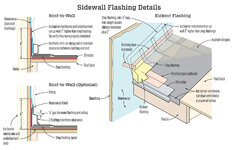
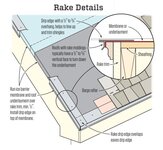
Lemme find a picture...did find drawings, here are a couple of techniques from JLC. Adjust as necessary for your area and for the materials you are using. Just another version of how things could overap:

Eave Detail with Gutter:
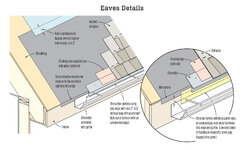
JLC roof flashing3.jpg
Sidewall & Eave no Gutter:
JLCroof flashing2.jpg

Rake & Eave Detail:

roof flashing JLC.jpg
 
Last edited:

Bert_

Well-known member
Joined
Dec 24, 2016
Messages
9,710
Location
NW Iowa
What a couple other guys have already mentioned...install the drip edge over the existing membrane, then tape the seam with an additional strip of membrane or flashing tape wide enough to cover the nails going through the drip edge and getting a good lap with the membrane on the roof. You can hit that with a roller for good adhesion.

Also, it's not completely It's not uncmmon on some installations to run the membrane past the end of the roof sheathing and down the fascia. Install the drip edge so the gutter (if there will be one) can be tucked behind the drip. The membrane on the fascia will isolate the fascia from the gutter.

If the edge of the roof sheathing overhangs the fascia by a bit, I'll go with a wider drip. If I'm not bending my own I'll buy something wide like an F5 or in some cases an F8.

FWIW, I first ran a strip of membrane on my fascia, up and on to the bottom part of the roof sheathing. THEN I installed the eave drip edge on top of that strip of membrane, holding it off the fascia a bit so the gutter could slide between the two. THEN I installed a full width piece of membrane on the roof, covering the drip edge. When I shingled, the bottom edge of the starter shingles overhung the bottom edge of the roof sheathing by about 1/4". The bottom edge of the first course of shingles overhung the starter course by about 1/8". Roof is due for a replacment, I'm now at 30 years. No negative issues with any of the detailing in that area.

Lemme find a picture...did find drawings, here are a couple of techniques from JLC. Adjust as necessary for your area and for the materials you are using. Just another version of how things could overap:

Eave Detail with Gutter:

JLC roof flashing3.jpg
Sidewall & Eave no Gutter:
JLCroof flashing2.jpg

Rake & Eave Detail:

roof flashing JLC.jpg

That's a pretty nice detail.
 
To avoid these ads, REGISTER NOW!
Top Bottom