To avoid these ads, REGISTER NOW!

Rotary screw compressor recommendation

MacMcMacmac

Well-known member
Joined
Oct 21, 2014
Messages
1,583
Location
canada
Thanks for the info.

Do you happen to have a video of this in action?

Would make understanding exactly how this works easier.


This is a throttle valve opening on startup. This is an Elgi compressor, which I have no direct experience with. In this video the compressor shuts off when the throttle closes, but in constant run mode it would keep running with the plate closed to stop pumping. You see what looks like holes drilled through the bolts holding the valve plate. This is probably where it gets its startup air, since it will need to pump air into the controls to open the valve plate. Screws and vanes cannot run completely unloaded since it will draw a deep vacuum in the compressor element and cause a lot of noise, as well as a lack of oil flow, so they are always pumping some air to satisfy their requirements. Any excess air will be blown down through a muffler or back to the inlet to keep pressures in check, otherwise the pressure would continue to creep up and the safety valves would pop.
 
To avoid these ads, REGISTER NOW!
OP
D

drummerdimitri

Well-known member
Joined
May 31, 2012
Messages
257
Location
Beirut, Lebanon

This is a throttle valve opening on startup. This is an Elgi compressor, which I have no direct experience with. In this video the compressor shuts off when the throttle closes, but in constant run mode it would keep running with the plate closed to stop pumping. You see what looks like holes drilled through the bolts holding the valve plate. This is probably where it gets its startup air, since it will need to pump air into the controls to open the valve plate. Screws and vanes cannot run completely unloaded since it will draw a deep vacuum in the compressor element and cause a lot of noise, as well as a lack of oil flow, so they are always pumping some air to satisfy their requirements. Any excess air will be blown down through a muffler or back to the inlet to keep pressures in check, otherwise the pressure would continue to creep up and the safety valves would pop.

Ok, that paint a clearer picture thanks.

So how much power does the compressor consume while its venting excess pressure from the tank? Does this happen all the time?
 

STREETFIGHTER50

Well-known member
Joined
Sep 24, 2013
Messages
89
I’d go with a Ingersoll Rand or Atlas Copco oil flooded rotary. I’ve seen some nice Kaesers as well. Oil-free Copcos I’ve seen at several dental buildings.
 

MacMcMacmac

Well-known member
Joined
Oct 21, 2014
Messages
1,583
Location
canada
Ok, that paint a clearer picture thanks.

So how much power does the compressor consume while its venting excess pressure from the tank? Does this happen all the time?

No. It only vents air when the valve is closed and the compressor is pumping just enough air to keep the oil pumping. When the compressor is on load the venting is stopped.

Some compressors have an open/shut valve, others have a modulating valve that gradually closes the inlet valve as the pressure in the systems approaches the maximum setpoint.
 
OP
D

drummerdimitri

Well-known member
Joined
May 31, 2012
Messages
257
Location
Beirut, Lebanon
No. It only vents air when the valve is closed and the compressor is pumping just enough air to keep the oil pumping. When the compressor is on load the venting is stopped.

Some compressors have an open/shut valve, others have a modulating valve that gradually closes the inlet valve as the pressure in the systems approaches the maximum setpoint.

I might have skipped over the CFM rating a little.

If the 10 HP Atlas Copco that I'm considering purchasing is rated at 38.2 CFM, does that mean it can output that much airflow at its rated 145 PSI pressure or is it at 90 PSI as rated by other manufacturers? (piston compressors).
 

MacMcMacmac

Well-known member
Joined
Oct 21, 2014
Messages
1,583
Location
canada
Ratings should be at 100psig. Some companies use 90psig to tweak the ratings as much as possible.
 
To avoid these ads, REGISTER NOW!
OP
D

drummerdimitri

Well-known member
Joined
May 31, 2012
Messages
257
Location
Beirut, Lebanon
Ratings should be at 100psig. Some companies use 90psig to tweak the ratings as much as possible.

In the quotation I received, it is marked as 38.2 CFM @ 145 PSI working pressure.

Can I safely assume that it is meant as 145 PSI and not 90 or 100 PSI?

I've attached the technical specifications from the brochure so maybe a more conclusive result can be attained.
 

Attachments

  • Specs.jpg
    Specs.jpg
    24.8 KB · Views: 17

MacMcMacmac

Well-known member
Joined
Oct 21, 2014
Messages
1,583
Location
canada
In the quotation I received, it is marked as 38.2 CFM @ 145 PSI working pressure.

Can I safely assume that it is meant as 145 PSI and not 90 or 100 PSI?

I've attached the technical specifications from the brochure so maybe a more conclusive result can be attained.

Compressors make at most 4 cfm per hp at 100psig. Anyone claiming more is blowing smoke. Recips are the most efficient in making air, but have the shortest working life and are more prone it mechanical issues due to the nature of how they operate.

So 38cfm from 10hp seems to be accurate. 38cfm AND 145psi working pressure seems reasonable. 38cfm AT 145psi is probably optimistic.

We have two large centrifugals here. One is 11,250hp. One is 10,000hp. The smaller compressor has a 47000cfm capacity, the bigger has a 32000cfm capacity. The bigger one makes 340psig. The smaller makes 102psig. Output will always fall at higher pressures.

There are so many factors involved in measuring output that it is pretty much irrelevant what any company claims for their equipment since each will take the optimal scenario for it's working conditions.

4cfm per hp @100psig is the standard. There is basic physics involved in how much work is required to compress air from ambient to full discharge pressure that no company or engineer is going to magically defy. You can rest assured Atlas Copco is getting as much air from 10hp as any other company.
 
OP
D

drummerdimitri

Well-known member
Joined
May 31, 2012
Messages
257
Location
Beirut, Lebanon
Compressors make at most 4 cfm per hp at 100psig. Anyone claiming more is blowing smoke. Recips are the most efficient in making air, but have the shortest working life and are more prone it mechanical issues due to the nature of how they operate.

So 38cfm from 10hp seems to be accurate. 38cfm AND 145psi working pressure seems reasonable. 38cfm AT 145psi is probably optimistic.

We have two large centrifugals here. One is 11,250hp. One is 10,000hp. The smaller compressor has a 47000cfm capacity, the bigger has a 32000cfm capacity. The bigger one makes 340psig. The smaller makes 102psig. Output will always fall at higher pressures.

There are so many factors involved in measuring output that it is pretty much irrelevant what any company claims for their equipment since each will take the optimal scenario for it's working conditions.

4cfm per hp @100psig is the standard. There is basic physics involved in how much work is required to compress air from ambient to full discharge pressure that no company or engineer is going to magically defy. You can rest assured Atlas Copco is getting as much air from 10hp as any other company.

Surely as you stated there is an trend across the industry for how much cfm you get per HP so they can't possibly claim 38.2 CFM at 145 PSI while others of similar HP numbers run the same CFM at 100 PSI. That would mean it would produce around 55 CFM at 100 PSI which would be impossible unless they use a radically new and much more efficient method of compressing air other than what is commonly available today.

Now once I get my compressor, what would be the best way to measure how much CFM it is delivering at any given output pressure? Will some kind of flow meter with a pressure gauge attached to a dusting gun do the trick or is more complex than that?

Not that it really matters, but for the sake of satisfying my curiosity.
 

MacMcMacmac

Well-known member
Joined
Oct 21, 2014
Messages
1,583
Location
canada
You would put a pipe on the discharge of the compressor with a tee in it. Put a gauge in the tee so you can see the discharge pressure. You would then send the air through an appropriately sized orifice and see how much pressure the compressor can hold. There are many tables online to convert flow through an orifice to cfm. You can play around with this calculator to see what size of orifice you might shoot for.

https://www.tlv.com/global/TI/calculator/air-flow-rate-through-orifice.html

https://www.engineersedge.com/fluid_flow/discharge-air-orifice.htm

You'll notice the equations on both pages. Ambient conditions play a part in the amount of air delivered. The shape and accuracy of the orifice also affects the results, but this should get you in the ballpark. We used to test flow Hydrovanes after rebuilding them and they were almost always spot-on to factory specs.
 
OP
D

drummerdimitri

Well-known member
Joined
May 31, 2012
Messages
257
Location
Beirut, Lebanon
You would put a pipe on the discharge of the compressor with a tee in it. Put a gauge in the tee so you can see the discharge pressure. You would then send the air through an appropriately sized orifice and see how much pressure the compressor can hold. There are many tables online to convert flow through an orifice to cfm. You can play around with this calculator to see what size of orifice you might shoot for.

https://www.tlv.com/global/TI/calculator/air-flow-rate-through-orifice.html

https://www.engineersedge.com/fluid_flow/discharge-air-orifice.htm

You'll notice the equations on both pages. Ambient conditions play a part in the amount of air delivered. The shape and accuracy of the orifice also affects the results, but this should get you in the ballpark. We used to test flow Hydrovanes after rebuilding them and they were almost always spot-on to factory specs.

Great, thanks for that! :D
 

Judges4u

New member
Joined
Apr 30, 2021
Messages
2
Location
MD
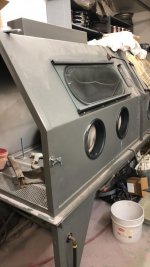
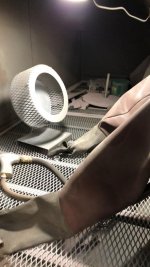
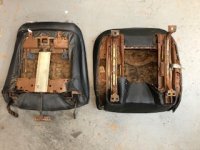
I'm new to the forum, and you may have already bought a compressor, but I have indepth experience with using an IR Model UP6-7.5TAS-125 W/ 80 GAL Tank I bought new in 2006 for $7400.00 (2021 new models are about $8K) and has never given me any problems until a week ago. The unit is a dual rotary screw system with drier single phase 230 Volt because I didn't have access to a 230 Volt 3 phase pole at my residence. Nevertheless, the unit pumps out 125 PSI constant for the past 16 years. I run aluminum oxide extensively (buy 3 GAL buckets at Tractor Supply), glass bead when I need a sheen on aluminum parts. The 125 PSI constant is superb for blasting any type of metal very quickly, and the stream is so strong I can blast the inside of a differetial with ease. I designed a blasting clamshell cabinet with two stations so I can drop in doors, differentials, etc. and move from one stattion to the other for differentials, and has four large locking casters on the compressor, blasting cabinet and dust filter system to roll the entire assembly anywhere I want for cleaning, etc. I use Home Depot LED Halogen lights with magnetic bases so I can move around if required. In 2006 LEDs were not available so I had fluorescent. The air is about 99.9% dry and perfect for painting cars with primer or base coat clear coat, laquer and enamel, and latex to for fences, etc. A most versatile compressor and worth every penny IMO. The compressor is apart for repairs so I can't send pics of mine, but you can see a 2021 model in the pics I posted. You can see a set of seats from a 70 GTO that were very rusty and looking like factory new now thanks to my IR compressor. I'll post more pics tomorrow. I hope you can get a few ideas from my post. Happy blasting! Jim
 

Attachments

  • Capture.jpg
    Capture.jpg
    61.7 KB · Views: 13
  • IMG_0794.jpg
    IMG_0794.jpg
    84 KB · Views: 15
  • 1619058081181438.jpg
    1619058081181438.jpg
    64.8 KB · Views: 15
  • 1619058090930346.jpg
    1619058090930346.jpg
    73.3 KB · Views: 15
  • IMG_8550.jpg
    IMG_8550.jpg
    29.7 KB · Views: 15
  • IMG_8551.jpg
    IMG_8551.jpg
    26.4 KB · Views: 16
Last edited:
To avoid these ads, REGISTER NOW!
Top Bottom