To avoid these ads, REGISTER NOW!

Rotor locater bolts

Graymills - Craig

Well-known member
Joined
Jun 15, 2010
Messages
362
Location
Chicago, IL
Not quite sure where this goes, but "Tools" seems as good as any.

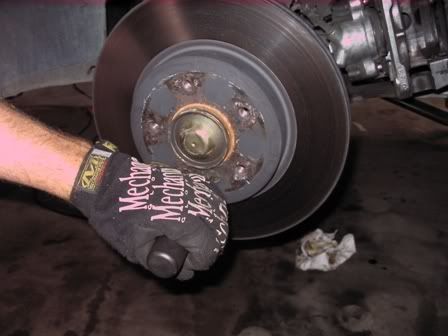
Does anyone have experience with stuck rotor locater bolts? Whoever did the brakes last time stripped out the allen key hole, and the bolt was really rusted in there. I drilled out the head of the bolt and removed the rotor, but the shaft of the bolt is shot. Heat, penetrant, no use. Does drilling out to the edge of the threads and retapping make sense?
 
To avoid these ads, REGISTER NOW!

amolaver

Well-known member
Joined
Mar 10, 2009
Messages
835
are you talking about a bolt that goes through a rotor and is keyed to a wheel (like a 350z) or a flat head that is countersunk into the disc to 'hold' the rotor.

either way, they are totally unnecessary. the rotor may feel like it has slop when there is no wheel mounted, but once the wheel is bolted up, the rotor is, by design, completely captive.

and those screws/bolts always rust/seize. did brakes on my wife's mazda 6 and the oem's had the flush-headed philips. needed an impact screwdriver to get it moving... new rotors (non-OEM) don't even have a hole for the screw.

can you post a picture?

ahm
 
OP
G

Graymills - Craig

Well-known member
Joined
Jun 15, 2010
Messages
362
Location
Chicago, IL
are you talking about a bolt that goes through a rotor and is keyed to a wheel (like a 350z) or a flat head that is countersunk into the disc to 'hold' the rotor.

either way, they are totally unnecessary. the rotor may feel like it has slop when there is no wheel mounted, but once the wheel is bolted up, the rotor is, by design, completely captive.

and those screws/bolts always rust/seize. did brakes on my wife's mazda 6 and the oem's had the flush-headed philips. needed an impact screwdriver to get it moving... new rotors (non-OEM) don't even have a hole for the screw.

can you post a picture?

ahm

It's the countersunk one that "holds" the rotor to the wheel. Correct that it's not crucial, but since this car has lug bolts rather than lug nuts, mounting the wheel is a bear without it.
 

autopts

Well-known member
Joined
Jul 4, 2009
Messages
2,268
I was told those countersunk screws are a one time shot. They were used on the assembly line to keep the rotors from falling off when it was up above the line. You don't need them. Napa has some of them for those with a mind set that they have to have them.
 

lipadj46

Well-known member
Joined
Jan 25, 2010
Messages
1,044
It's the countersunk one that "holds" the rotor to the wheel. Correct that it's not crucial, but since this car has lug bolts rather than lug nuts, mounting the wheel is a bear without it.

That sounds like a pain in the ***. Are the lug bolts aftermarket? I guess you could drill it out and rethread the hole the next size up. Next time try an impact driver to get them out.
 

amolaver

Well-known member
Joined
Mar 10, 2009
Messages
835
It's the countersunk one that "holds" the rotor to the wheel. Correct that it's not crucial, but since this car has lug bolts rather than lug nuts, mounting the wheel is a bear without it.

do yourself a favor and do as most of the bmw racers do...convert to studs/nuts. the bolts are one of those things the german engineers saw on paper as better through some FEA program w/o thought to just how large of a PITA they are practically. i know ARP makes a nice extended stud conversion kit, HRP or bimmerworld probably carry it.

in all likelyhood, your rotors are not actually warped, but picked up deposits of pad as they overheated. regardless, they are very difficult to return to service - some folks run a set of hawk blues to cut the excess material from the rotor). point being - change pad compounds. what are you running now (car-wise) and what is your track experience?

ahm
 

unclemoak

Well-known member
Joined
Nov 14, 2010
Messages
213
Location
Wisconsin
I ran into this problem when helping a friend put rotors on his Honda. What a total pain in the ***. We ended up just drilling them out and didn't even bother re-tapping the holes.

Right after we put rotors on his car, in an effort to avoid the problem on my own car. I replaced all the bolts on my car with stainless ones with a thorough coating of nickle anti-seize.
 

KenS

Well-known member
Joined
Oct 21, 2007
Messages
726
Photos would really help here.

Do the lug bolts thread through the rotor and into the axle flange? If so, why not fab a couple studs to screw into the flange, and use them to align and temporarily hold the rotor-- and wheel-- in place while you install the remaining lug bolts. Then screw out the two temporary studs and install the remaining bolts. Near the end of this video: is a technique to temporarily hold the rotor while reinstalling the calipers. You could do the same using one of your temporary studs.
 
OP
G

Graymills - Craig

Well-known member
Joined
Jun 15, 2010
Messages
362
Location
Chicago, IL
That sounds like a pain in the ***. Are the lug bolts aftermarket? I guess you could drill it out and rethread the hole the next size up. Next time try an impact driver to get them out.

For some reason, German cars use lug bolts. I never really understood why, since the advantage of having studs on the hub (as is traditional) is that you can mount the wheel on them and simply zip up the lug nuts.

It's even worse on the fronts, since they free-wheel. Now you have to support the tire/wheel, line up the holes, insert the lug bolt, and tighten - all while the wheel spins... :wtf:
 

psychoclaw84

Well-known member
Joined
May 14, 2009
Messages
142
Location
Valley of the Sun
I think you are trying to remove a broken bolt from the axle housing or hub.

On my honda accord, I converted my hub from a Accord style to the Acura 2.3 CL Hub. This included replacing the hub and bearings which solved the broken bolt problem.

I am not sure if you are wanting to replace the hub, but it sounds like you are set on a repair not replacement. Replacement would be the easiest route to take, but it costs more money and time to perform repairs.
 
OP
G

Graymills - Craig

Well-known member
Joined
Jun 15, 2010
Messages
362
Location
Chicago, IL
do yourself a favor and do as most of the bmw racers do...convert to studs/nuts. the bolts are one of those things the german engineers saw on paper as better through some FEA program w/o thought to just how large of a PITA they are practically. i know ARP makes a nice extended stud conversion kit, HRP or bimmerworld probably carry it.

in all likelyhood, your rotors are not actually warped, but picked up deposits of pad as they overheated. regardless, they are very difficult to return to service - some folks run a set of hawk blues to cut the excess material from the rotor). point being - change pad compounds. what are you running now (car-wise) and what is your track experience?

ahm

Alas, the rotors are already changed...

It's an E36 M3. It's actually my daily driver, but I do HSX with it. My track car's a '62 Healey Sprite.

The conversion idea is interesting, especially because I change sets of tires about once a month (snow-to-performance and back, plus semi-slicks when tracked). I'll look into that. I usually buy from Pelican, so I'll see what they have.
 
OP
G

Graymills - Craig

Well-known member
Joined
Jun 15, 2010
Messages
362
Location
Chicago, IL
I ran into this problem when helping a friend put rotors on his Honda. What a total pain in the ***. We ended up just drilling them out and didn't even bother re-tapping the holes.

Right after we put rotors on his car, in an effort to avoid the problem on my own car. I replaced all the bolts on my car with stainless ones with a thorough coating of nickle anti-seize.

I've thought of the anti-seize (my parts guy couldn't find the countersunk bolts in SS), but I was warned that putting that on the lugs could result in over-torquing. Is that true?
 
OP
G

Graymills - Craig

Well-known member
Joined
Jun 15, 2010
Messages
362
Location
Chicago, IL
Photos would really help here.

Do the lug bolts thread through the rotor and into the axle flange? If so, why not fab a couple studs to screw into the flange, and use them to align and temporarily hold the rotor-- and wheel-- in place while you install the remaining lug bolts. Then screw out the two temporary studs and install the remaining bolts. Near the end of this video: is a technique to temporarily hold the rotor while reinstalling the calipers. You could do the same using one of your temporary studs.

Brilliant idea! If the tapping doesn't work, I'll do this. Thanks!
 

hofferwood

Well-known member
Joined
May 8, 2010
Messages
922
Location
DownRiver Michigan
Quick one,
Bolt the rotors up(no wheel), drill a couple holes close to orig. Tap in a couple "Roll pins".
All done, no tapping(threading)
Chuck
 

amolaver

Well-known member
Joined
Mar 10, 2009
Messages
835
http://www.vorshlag.com/index.php?cPath=1_4_158

not too bad - $5.50 or $6/stud. just makes life easier :)

and yes, anti-seize (or grease or any lubricant) can lead to overtorquing. torque specs (for wheels) are almost always given 'dry'. having any lubricant on there means that torquing to the same spec results in significantly higher clamp loads. to the point that you might break a stud/bolt...

ahm
 

littlekillertoad

Well-known member
Joined
Jun 30, 2010
Messages
283
Location
Orlando, Florida
This happened to me. I torqued off the head of the locator screw that held one of my rotors in. We rotated the rotor and drilled/tapped a new hole. It's been working great.

Just drill it out and re-tap it. If it's what I think it is, it's not a high stress screw anyway - it's just used to hold the rotor in place while you're putting the wheel on.
 
To avoid these ads, REGISTER NOW!

Seanbev24

Well-known member
Joined
Mar 25, 2010
Messages
1,000
Location
Lynnwood, Wa
Photos would really help here.

Do the lug bolts thread through the rotor and into the axle flange? If so, why not fab a couple studs to screw into the flange, and use them to align and temporarily hold the rotor-- and wheel-- in place while you install the remaining lug bolts. Then screw out the two temporary studs and install the remaining bolts. Near the end of this video: is a technique to temporarily hold the rotor while reinstalling the calipers. You could do the same using one of your temporary studs.

Yep, I just went to the hardware store and bought some bolts of the right size and cut the heads off. I keep them in the bottom of my cart. Whenever I remove the first lug bolt, I thread in one of my studs. It keeps the wheel from wanting to fall when you get the last lug out, and it saves my back trying to get the wheel back on.

The 2 main sizes for euro cars are M12 x 1.50 and M14 x 1.50
 
OP
G

Graymills - Craig

Well-known member
Joined
Jun 15, 2010
Messages
362
Location
Chicago, IL
Hey, if nothing else, this has given me an excuse to buy a new metric die/tap set, new studs, some Locktite Red, and a few other things. New tools = never bad.

:bounce:
 

GDA

Well-known member
Joined
Nov 19, 2006
Messages
935
Location
Dallas, Texas
Antiseize and this simple tool, a hand impact driver, is your best friend. Never had an issue with one again.

PicsSept23004.jpg
 

hofferwood

Well-known member
Joined
May 8, 2010
Messages
922
Location
DownRiver Michigan
I knew you guys were clever! If I understand, you're suggesting what is effectively a dowel, right?

Quick one,
Bolt the rotors up(no wheel), drill a couple holes close to orig. Tap in a couple "Roll pins".
All done, no tapping(threading)
Chuck

Yep, and as a bonus, It'll confuse the hell out of the next owner:lol_hitti
But, go ahead and buy the "Stuff" fer next time.
Chuck
 

amolaver

Well-known member
Joined
Mar 10, 2009
Messages
835
obviously, there is a way to make more money using bolts rather than studs :) :lol_hitti
 

wafrederick

Well-known member
Joined
Jul 3, 2010
Messages
6,049
Location
Holton,Mi
The lugbolts are a real PITA to line up.Holding the tire while lining up the lugbolt holes and starting the lugbolts can be a hassle.
 

MrMark

Well-known member
Joined
Jan 25, 2010
Messages
4,626
Location
Southern Cal.
Mercedes Benz cars come with that wheel alignment tool in the trunk tool kit. I never use it though, as the MB wheels fit so securely on the hub-centric wheel hub that you don't need it. Just eyeball the holes as you put the wheels on and mount the wheel. It isn't going anywhere. You can adjust slightly by reaching through and grabbing the rotor and turning slightly until it lines up.

Not a problem in practice.
 

dwm

Well-known member
Joined
Aug 28, 2010
Messages
861
Location
Southeast Michigan
Mercedes Benz cars come with that wheel alignment tool in the trunk tool kit. I never use it though, as the MB wheels fit so securely on the hub-centric wheel hub that you don't need it. Just eyeball the holes as you put the wheels on and mount the wheel. It isn't going anywhere. You can adjust slightly by reaching through and grabbing the rotor and turning slightly until it lines up.

Not a problem in practice.

BMWs come with the tool too, but many people seem to lose bits and pieces of their trunk tool kits.

The nicest wheel pin for BMWs is made by Ron Stygar. I have 4 of them, in stainless steel. Of course I don't use them anymore since I installed studs from TC Kline.

I believe the main reason for bolts on the European cars is a mix of things. Cosmetics, cost (no pressing of studs, just thread the hub flange), no stud threads to chew up the fancy wheels when mounting/unmounting (instead you have a big heavy bolt that might get dropped on the lip :)), Euro cars are historically lighter than domestics and hence had smaller and lighter wheels (holding up a wheel for a MINI Cooper is a heck of a lot easier than a wheel on an F350), and the hubcentric usually makes mounting and unmounting fairly easy and does a good job of centering the wheel. I'm not holding up the whole weight of the wheel, I'm just holding it on the hubcentric while I get the first bolt started. In my own experience, bolts also makes it easy to keep the surface of the hub clean to minimize runout from having crud between the wheel and the hub.

I find the rotor bolt convenient, but I take my rotors off a few times a year and my wheels off many times a year. I also have non-OEM fixed calipers that are fussier about runout than the original floating calipers. Those who don't remove their rotors frequently will have the rotor seized to the hub pretty good and hence the rotor isn't likely to fall out of position when removing a wheel, hence no need for a rotor retaining bolt. On a BMW, those who almost never take their wheels off and don't use anti-seize on the hubcentric will be using a large mallet or the like to remove their wheels, or resorting to the tried and true method of loosening the bolts and driving the car 20 feet and slamming on the brakes to break the galvanic bond between the wheel and the hub. :)
 
Last edited:

mtkst19

Well-known member
Joined
Sep 20, 2009
Messages
1,248
Location
blitzburgh pa
usually the rotor set screws come out easy as soon as the head is drilled off. At worse i have to cut a slot into the bolt and use a flat head to wind it out or use vice grips. I prefer using the set screws that have an Allen head to them. impact driver is key though on the Phillips head versions.

I never use anti-seize either. **** gets everywhere. last thing i want to do is track it into a customers interior. You know how hard it is to get off your body when you get it on you, let alone someones 50k+ car interior. Couple that w/ the fact that it can run. antiseize on the face of a rotor or whatever im sure is not good.

if you want something to not stick normally a light coat of wheel bearing grease on the threads is enough to do it. if the wheels stick to the hub, clean off the aluminum center bore of the rim and the hub then light skim coat of grease.

the high temp bearing grease trick works for "problem" area bolts too. Cars like 944 na or turbo, 924 or 928 the water pump bolts freeze in the block. any car i have done multiple times in its history the bolts come out because i faithfully lightly coat those bolts w/ grease. better than drilling out bolts in the block every time.


i also 2nd using hawk blue pads. they are pretty much the go to street/track warrior pad. plus it is cool when you have screeching brakes as loud as those pads on the street :) downfall to blues is if you have a car you like--the brake dust can do a number on your paint job. as the metal in the brake dust basically acts as a welding/grinding sparks on the paint. yet everyone who i have talke dinto switching to blues has never gone back.

only thing i can say about putting on wheels is practice :) . if the car is racked, i usually lift the rim up one hand and have my cordless impact ready w/ a lugbolt in the other. if car is on the ground, i will balance the rim on the tip of my boot/shoe while using one hand to guide and other hand ready w/ a cordless impact. either case--cordless impact is used just to snug bolts--then go over and hand tq each lug w/ a tq wrench.

older benzes had metal "wheel hanger" studs in the service kits. a lot nicer than those found in late model kits. I would be surprised if they can support the weight of the wheel and tire as flimsy as they look. I dunno though, never used any of them.
 

dwm

Well-known member
Joined
Aug 28, 2010
Messages
861
Location
Southeast Michigan
Call me crazy, but I'd NEVER leave Hawk Blues on my car for the street. Fine at the track, but they come off for the street. The dust, when coupled with rain, will trash a lot of stuff in very little time (good way to create lots of rust on suspension parts and fasteners). Haven't tried the DTC-60 but I'd expect the same.
 

amolaver

Well-known member
Joined
Mar 10, 2009
Messages
835
err,+1 on dwm's comments. blues are good track pads but will eat a set of rotors if driven on the street - super abrasive at low temps. i'm not aware of any 'real' track pads that can be street driven. my reference to them before was in using their low temp abrasiveness as a way to 'clean' the deposits left by whatever pads were used on the track that overheated. once they scour a set of rotors (less than 10 miles of local driving is probably enough), you remove them and put 'normal' street pads on. the dtc60's have been a nice change for me from the blues and carbotechs - more pedal effort than blues, less than carbotechs, but lots more feel than blues. happy with them so far.

ahm
 
To avoid these ads, REGISTER NOW!
Top Bottom