To avoid these ads, REGISTER NOW!

ruler types

BTL-A4

Well-known member
Joined
Feb 28, 2018
Messages
1,252
Location
Santa Clarita
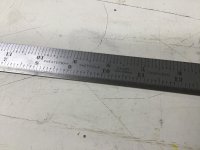
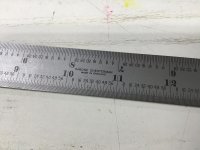
When I was looking for metal rulers for my lathe and mill, I saw that there are number designations: 4R has 1/32", 1/64", 1/8" and 1/16" graduations. There are also:
1, 3, 4, 5, 6, 7 9, 10, 11 but no 2, 8 or 12-15. Anyone know why? I tried looking it up but had no luck. I'm just curious what the standard numbering system might be.
 
To avoid these ads, REGISTER NOW!

theoldwizard1

Well-known member
Joined
Feb 22, 2011
Messages
43,106
Location
SE MI
First, it is not a "ruler", it is a "scale".

American fractions are common, but you can find ones in 1/10th of an inch.
 

BD1

Well-known member
Joined
Mar 18, 2007
Messages
4,602
Location
north side
I was told a Ruler is the leader of a country. [emoji23]
Rule, tape measure, and scale


Sent from my iPhone using Tapatalk
 

Willie Makeit

Well-known member
Joined
Dec 30, 2013
Messages
906
there's a reason machinists carry a 6" scale in their shirt pocket ALL the time. most guys "in the trade" for more than about 2 weeks scan use a scale down to about 1/32 (.030-ish)
 

cvairwerks

Well-known member
Joined
Aug 12, 2016
Messages
7,196
Location
Within hearing distance of Texas Motor Speedway
Used to have a hard time convincing the new kids in our work area that they could see a .010" mismatch and could feel a .003" with a little practice. The most obstinate ones saw the light when they were able to prove to themselves the capability with a surface plate and a sheet of paper. Most 20 pound bond paper is .003" thick.
 

larry_g

Well-known member
Joined
Apr 28, 2007
Messages
16,872
Location
oregon
https://www.starrett.com/docs/educational/tools-rules---bulletin-1211.pdf

Above is a training guide from Starrett that may help you in your quest for knowledge.

According to Starrett it is a rule not a scale. A scale is used commonly by Architects and wood butchers. Calling a rule a scale is a colloquialism, like calling an adjustable wrench a crescent wrench.

Now if you wander the results of a google search you can find all sorts of disagreements to what to call these things. As long as you and someone else understand what your talking about all is good. As seen above in other posts this could turn into a Ford vs Chevy vs Dodge vs Ridgeline pissin match.

lg
no neat sig line
 
Last edited:

Bigblue&Goldie

Well-known member
Joined
Mar 12, 2009
Messages
10,670
Location
AZ
Here is a good breakdown for you:

https://littlemachineshop.com/images/gallery/instructions/steelrules.pdf

This is a tool you get what you pay for. I think my 6" is a Mitutoyo and I can't remember what my 12" is. 4r and 5r seem to be the most common, but it's a preference thing. When I went to manual machining school the instructor had us cut a piece of stock on a big horizontal bandsaw using a scale for setup with the goal of 1/32" accuracy. This was easily done to my surprise as I'm a measure twice, cut 4 times guy......
 
OP
B

BTL-A4

Well-known member
Joined
Feb 28, 2018
Messages
1,252
Location
Santa Clarita
From Wikipedia:
In scientific and engineering terminology, a device to measure linear distance and create proportional linear measurements is called a scale. A device for drawing straight lines is a straight edge or ruler. In common usage both are referred to as a ruler.

Back to my original question: what is the numbering system based on? Some numbers seem to be missing, not used; for example: is there a 2R ruler/scale?
 
OP
B

BTL-A4

Well-known member
Joined
Feb 28, 2018
Messages
1,252
Location
Santa Clarita
https://www.starrett.com/docs/educational/tools-rules---bulletin-1211.pdf

Above is a training guide from Starrett that may help you in your quest for knowledge.

According to Starrett it is a rule not a scale. A scale is used commonly by Architects and wood butchers. Calling a rule a scale is a colloquialism, like calling an adjustable wrench a crescent wrench.

Now if you wander the results of a google search you can find all sorts of disagreements to what to call these things. As long as you and someone else understand what your talking about all is good. As seen above in other posts this could turn into a Ford vs Chevy vs Dodge vs Ridgeline pissin match.

lg
no neat sig line

Thanks for the link. I didn't see anything in it that answered my questions, but it was still interesting. Cheers!

You are right about the rule v scale argument.
 

larry_g

Well-known member
Joined
Apr 28, 2007
Messages
16,872
Location
oregon
Thanks for the link. I didn't see anything in it that answered my questions, but it was still interesting. Cheers!

You are right about the rule v scale argument.

I'm going to make an assumption here that the the different graduation are from different industries that use the rules. Some of the graduations put zero in the middle and measure out both directions. Some of the graduations are for reading with vernier scales, as the one that is on my old milling machine.

lg
no neat sig line
 
Last edited:

Showkey

"MEMBER EMERITUS"
Joined
Aug 9, 2014
Messages
8,638
Location
Wausau WI
I have had these for over 40 years. Standard tool for wood working. Have a 18” and 36” 1/32 and 1/64 on one side 1/10 and 1/100 on the back. 1/100 not very useful used for splitting 10ths if that your choice.

As far as accuracy that brings up the topic of marking. Marking with a fat pencil in 64ths is not good choice. A razor Knife point 1/32 and below. There’s an art to marking so consistency reliability demands solid technique and habits.

106366EF-E223-4352-9F2E-370537B29840.jpg

3FFDDB4B-E4A9-4AAB-A7DC-DE30A46E5825.jpgi
 
Last edited:

ttpete

Well-known member
Joined
Mar 8, 2011
Messages
6,737
Location
Dearborn, MI
Draftsmen used scales when making scaled drawings. The most common scale was triangular in shape with 6 different faces.
 

matt_i

Well-known member
Joined
Mar 14, 2008
Messages
10,725
Location
SE Michigan
The scale that's right for you is a lot of personal preference.

I am partial to the semi flex ones over the rigid scales. I don't like the end-hook. I carry the ~6" inch/metric version with me. 64ths is more useful than 1/10ths as a personal preference.

A lot of 6" scales that have inch/metric are not 6" but rather 150 mm which is in the 5.9" range.
 

RTM

Well-known member
Joined
May 13, 2019
Messages
13,091
Location
SF Bay Area
Here's the Starrett book on rules....R denotes a labeling style, while the number indicates what the graduations on the rule are and how they are laid out.l]


Thanks, I was trying to find my copy to post. I've only ever found 4R and 5R in the wild so far.
 
To avoid these ads, REGISTER NOW!

californiaHank

Well-known member
Joined
Nov 20, 2015
Messages
487
there's a reason machinists carry a 6" scale in their shirt pocket ALL the time. most guys "in the trade" for more than about 2 weeks scan use a scale down to about 1/32 (.030-ish)

Me too. But, opinion's divided on which one makes the best coffee stirrer - a Starrett or a Mitutoyo.
 

cvairwerks

Well-known member
Joined
Aug 12, 2016
Messages
7,196
Location
Within hearing distance of Texas Motor Speedway
Something that people rarely remember to do is treat rules that have 32'ds or smaller graduations as calibrated tools. Repeated hard impacts on the ends or dropping them on hard surfaces can lead to having the corners and ends mushroomed or bent. If you don't believe it, take an old, well used rule and look at it under a 5x or 10x glass and see the deformation.

One of the hardest things I had to make the new kids understand, was to not trust the rule ends when laying out a line that needed anything better than 1/8" accuracy. You always need to use a rule longer than the part being laid out and start measuring from a mark away from the end and adjust your count for this... A 10" measurement would start with aligning the 1" mark with the reference point and the cut line marked at 11" on the scale.

For quick reference measurements, or very rough layout work, it's not as important about the difference that the damaged ends can cause.

Treat a good scale well and it will last a long time. They are getting expensive and no one really wants to abuse a quality tool. As an example, I use a 24" flexible rule, 16R graduations. When I bought mine, back in 1986, it was probably $30. Currently listed as $132 now, direct from Starrett.
https://www.starrett.com/metrology/product-detail/C316R-24

BTW...I'm not looking forward to writing a check for a kilobuck to get the 72" rule that need for a couple of projects.
 

Indexmill

Well-known member
Joined
Apr 12, 2013
Messages
1,413
Location
Central NC
As a mechanical engineer, I call these scales and use the ones with the 1/100 (0.010") graduations. It is pretty easy to measure with them to 1 division (0.010"). Then get the calipers...
 

Dumber than lumber

Well-known member
Joined
Dec 19, 2015
Messages
1,875
I think Starrett has far more credibility on this than Wikipedia.
How many measuring device patents do you think Wikipedia has?
Point made.
 

CR888

Well-known member
Joined
Feb 19, 2017
Messages
1,198
Some people confuse rules with scales. A scale is a measuring device used by architect's & engineers that assists them making drawings to scale other than full size. A rule is used to measure actual sizes.
This is quoted from a PDF posted in this thread which I found interesting. I know y'all like USA made everything but I have a few rules made in Japan by Toledo tools in the same style PEC (USA) makes which are etched with a nice Satin finish rather than milled like the Starrett ones. Japan certainly can make a decent rule, and I'm a Starrett kinda guy when it comes to precision measuring tools.
 

Citation

Well-known member
Joined
Jan 20, 2016
Messages
3,212
Location
Indy
After seeing this discussion earlier I looked up scales vs rule vs ruler.

Scale is something used to scale sizes. So if you ever did scaled drawing by hand then you might have used a ruler looking thing with 2x, 4x etc markings. That's a scale.

A rule is a set of marks used to measure. My Leatherman has a rule on the side.

A ruler is a rectangular thing with a ruled edge. So it's 100% correct to call the these things a ruler. The term rule seems to be used to distinguish high quality, precise rulers from things like yard sticks and a kid's 12' school ruler.
 
Last edited:

schiada96

Member
Joined
Jun 25, 2014
Messages
11
After seeing this discussion earlier I looked up scales vs rule vs ruler.

Scale is something used to scale sizes. So if you ever did scaled drawing by hand then you might have used a ruler looking thing with 2x, 4x etc markings. That's a scale.

A rule is a set of marks used to measure. My Leatherman has a rule on the side.

A ruler is a rectangular thing with a ruled edge. So it's 100% correct to call the these things a ruler. The term rule seems to be used to distinguish high quality, precise rulers from things like yard sticks and a kid's 12' school ruler.


Webster’s definition is scale ,I’ve always called them a scale.


Sent from my iPhone using Tapatalk
 

ttpete

Well-known member
Joined
Mar 8, 2011
Messages
6,737
Location
Dearborn, MI
Back in the day if you worked for a printer in the composing room your unit of measurement were Pica's and Points. There were 12 points in a Pica and 6 Pica's to the inch. The thing that you measured with was called a Line Gauge, or a Pica Pole. Every apron had a pocket specifically sewn into it to accommodate the Line Gauge. See attached pics.

The official measure of a Point was 0.013837 so "officially" there were 72.27 Points to the inch. Well, that got rounded off to 72 points and 6 Picas per inch. Points were the measurement for height, and Picas were the measurement for length/width.

For example, you might set a Business Card in 18 Point type (height) , but the width would be 21 Picas, or 3-1/2 inches. All the length/width measurements did not exactly correspond to the inch counterparts because 0.013837 x 72 = 0.9962. For shorter lengths it didn't matter much but for longer lengths that .0037 per inch added up. And at 12 inches it was easy to see. But from a practical typesetting standpoint there were very few occasions where anything got over 6" in width so it wasn't that big of a deal.

Then along came the Linotype around the 1900's and they rounded off the official Point to 0.014" so anything set in Linotype points didn't correspond to anything set using hand set type. That's all ancient history now, but the measurement of type height is still expressed as Points.

So now you know "The rest of the story."

.

My wife was a newspaper copy editor for 42 years. She started in the hot type era and left in 2013. Her pica pole's around somewhere.
 

MikeF2316

Well-known member
Joined
Dec 29, 2012
Messages
9,605
Location
Thornhill, ON
I learned the whole ruler/scale argument in Grade 7 science class with the "A ruler is the leader of a country" arguement. They also taught us to measure starting from 1 and subtracting 1 from whatever you read. The second lesson I took to heart and do so to this day, although I've been known to start from numbers other than 1!
 

Joebass

Well-known member
Joined
May 16, 2019
Messages
118
Location
Ny
I have several starrett rules from 6" to 12", all 4R and satin chrome. Also have a flexible Lufkin 36" satin chrome we use for layout on the tanks we fabricate. And of course the blades for my starret hardened combination squares from 12" to 24". Also 4R and satin chrome. I wouldn't have the regular type. Satin chrome is a must.
 

Citation

Well-known member
Joined
Jan 20, 2016
Messages
3,212
Location
Indy
Webster’s definition is scale ,I’ve always called them a scale.


Sent from my iPhone using Tapatalk

The third item down sounds like a the ruler we are discussing.
https://www.merriam-webster.com/dictionary/ruler

The 4th down is what we have been calling a rule
https://www.merriam-webster.com/dictionary/rule
That definition points to the definition above.

Finally, noun 3 covers things here
https://www.merriam-webster.com/dictionary/scale

Of course, I've found that sometimes within a trade vs the public at large people have different definitions for the same things.
 

larry_g

Well-known member
Joined
Apr 28, 2007
Messages
16,872
Location
oregon
Are we going to have someone from the textile industry chime in here and explain some of their measurement systems?

lg
no neat sig line
 

pstemari

Well-known member
Joined
Jan 7, 2012
Messages
903
Location
Seattle
Back in the day if you worked for a printer in the composing room your unit of measurement were Pica's and Points. There were 12 points in a Pica and 6 Pica's to the inch. The thing that you measured with was called a Line Gauge, or a Pica Pole. Every apron had a pocket specifically sewn into it to accommodate the Line Gauge. See attached pics.

...

.

Oh ugh. Pica poles. Yes, the oddness came about when the pica was defined as 0.166", approximating 1/6". It really matter a lot which unit has an exact definition: all these ratios with factors of 3 can only have an exact definition definition in one direction.

The survey foot (almost dead after sixty years of phase out) vs international foot is an example of the same thing, but those are much closer. Survey feet (based on 39.37 inches per meter) can be converted to metric exactly but metric can't be converted to an exact measurements in survey feet. International feet (based on 0.0254 meters per inch) are the other way around.

Sent from my Pixel XL using Tapatalk
 

schiada96

Member
Joined
Jun 25, 2014
Messages
11
Noun 2 -b fits here think . I’m acting like a aerospace sheet metal fab guy lol.


Sent from my iPhone using Tapatalk
 
To avoid these ads, REGISTER NOW!
Top Bottom