To avoid these ads, REGISTER NOW!

Run natural gas line underground

FlameOut

Well-known member
Joined
Jan 12, 2008
Messages
428
Location
Pittsburgh, Pennsylvania
On my new garage, I need to run water, electric and gas lines underground (It's about 10' from my house). I found the plastic pipe I need for the water lines, and the conduit for the electric, but what do I use for the gas line?

I noticed when the gas company is replacing lines, they use those rolls of plastic pipe, but I couldn't find it at my local Home Depot.
 
To avoid these ads, REGISTER NOW!

HoosierBuddy

Well-known member
Joined
May 9, 2006
Messages
2,930
Location
Southern Indiana
The gas company will be using polyethylene.

Call them and see if they will make you up a short section with two anodeless service risers, which are long ells that bring you above ground and transition you to steel NPT fittings. Normally, PE pipe is joined by heat fusion using special tooling (and or fittings) that melts the pipe together. However, they do make mechanical couplings that work well. I've used many Perfection stab couplings and have never had a problem. There are other brands too.

The PE pipe itself is not allowed to come above ground. It has to be buried with the above ground portion steel. The anodeless service risers accomplish that for you.

If you can't come up with PE, my next choice would be to bury bare steel. Start with a single 21' joint and bend the ends up as risers so you won't have to leave any threads underground. If you pad it with some sand and bury it in decent dirt (no lime, cinders, etc.) it'll last a long time. It will rust through eventually though. I've seen bare lines go 30 years.

What messes a lot of people up is they try to coat it with something before they bury it. That'll work great too...but coated steel pipe has to be cathodically protected (a magnisium anode attached and buried with it) or it will rust through much faster than a bare steel line.

Too much information I'd guess. The PE is the way to go if you can get it. Put a tracer wire in with it so you can locate it with a cable locator in a pinch. Put a shut off valve above ground on the supply side so it can be shut off if it gets cut.

Phil
 

Yak22

Well-known member
Joined
Feb 19, 2009
Messages
71
when I did a remodel, the builder buried copper pipe... Im not sure if this is good or bad, but it works.
 

rickairmedic

Well-known member
Joined
May 31, 2005
Messages
4,165
Location
louisville ,Ky
Yak are you on propane or natural gas . Propane is fine with copper however natural gas and copper dont mix the copper will develop pinholes which will of course leak .

Rick
 

dipper

Well-known member
Joined
Jun 27, 2007
Messages
759
Location
Rochester, NY
i ran polyethylene for my garage, but it was expensive!!! the pipe was cheap but the two compression ends were $50 each. Being only 10', I would just bury 3/4" or 1" black pipe and be done with it. All the pipe and fittings are available locally.
 

HoosierBuddy

Well-known member
Joined
May 9, 2006
Messages
2,930
Location
Southern Indiana
I should have said something else about Polyethylene gas pipe.

It says "gas" on it. It is SDR 11 or thereabouts. DON'T use polyethyelene water pipe (aka "black roll pipe") for gas. It isn't allowed and it's a bad idea besides.

Phil
 

Chris 50

Well-known member
Joined
Feb 4, 2007
Messages
86
Location
LaPorte IN.
HoosierBuddy, I ran PE for my shop about 130' or so and have yet to tie into the shop. Should the compression fitting lie horizontal with the PE in the trench and a 90 degree elbow and pipe stemming to above grade, or should I let the PE curve upwards with the compression fitting going vertical, half in/half out of the ground, and keep all the rest of the pipe above grade?
 

HoosierBuddy

Well-known member
Joined
May 9, 2006
Messages
2,930
Location
Southern Indiana
I wouldn't use a compression coupling hooked to a piece of steel. I'd use an anodeless service riser. That's basically a 3-foot ell that has PE on one end that can either be fused or connnected to your existing line with a stab coupling. The PE runs into a steel casing that protects it from damage. There is a compression coupling inside the steel casing that connects it to a steel pipe that goes up.

So, it transitions you from horizontal to vertical and plastic to steel. It's called an "anodeless" riser because by its nature it doesn't require a magnisium anode to protect it from rusting.

The other way to do it would be to bend a piece of steel into a riser and use a compression coupling on the horizontal underground. Both the compression coupling and the steel will be subject to rusting. Definitely bring your gas line above ground and go through the building wall above grade regardless of what else you do.

Phil
 

Yak22

Well-known member
Joined
Feb 19, 2009
Messages
71
Yak are you on propane or natural gas . Propane is fine with copper however natural gas and copper dont mix the copper will develop pinholes which will of course leak .

Rick

Natural gas...

Bummer... well, I guess I'll just enjoy it while it lasts... :)
 
OP
F

FlameOut

Well-known member
Joined
Jan 12, 2008
Messages
428
Location
Pittsburgh, Pennsylvania
I was told I can't even buy the PE line unless you are a licensed plumber

Phil, you said: Definitely bring your gas line above ground and go through the building wall above grade regardless of what else you do

So I shouldn't run the line underground, atop my footer, through lower course of block and up in the inside of the garage, through the concrete floor?

I may just run the gas line after my final inspection. The wiring and water don't seem to be much of a problem, but this gas line sure is starting to be a pain
 

calsaxe

Member
Joined
May 4, 2007
Messages
6
I just finished running a 125 foot run of polyethylene pipe for natural gas. I was told that I had to have a licensed contractor purchase the PE pipe, the elbow radiuses, and the couplers. When I called the sales office at Ferguson's plumbing here in Sacramento, the guy told me that I could just purchase it myself...so I drove right over and picked up everything I needed. As others have mentioned, it's not the PE that costs much, it's the couplers and the radiuses.

If you are going to direct bury hard pipe instead, I think you're supposed to use the green pipe (coated black pipe). I was told that black pipe was supposed to be wrapped before burying. Just my opinion but I would run the gas line underground outside the foundation, bring it above grade, and then enter the structure through the wall. There's just something about the finality of everything when the concrete of the foundation and stem wall hardens. At least if something goes wrong in the future and you need to get to a leak underground, I would feel better cracking out an external concrete pad than jacking up the foundation, especially if you have your foundation poured with rebar.

In the end, it was about $600 to run 125 feet of PE, two 90 degree radiuses, and two couplers. The black pipe would have been about $100 cheaper and the green pipe would have been a couple of hundred dollars more expensive. Make sure that your gas pipe is at least 18" below grade, preferably 24".

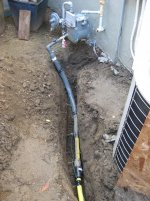
Here's a picture of one end of my PE pipe before I tied it into my house. The radius comes with a foot of PE pipe attached. You can see the black "egg shaped" coupler that attaches the radius to the PE pipe. The green wire is a tracer.

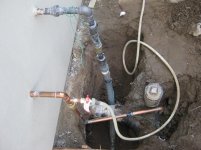
The other picture is where the gas line ties into my addition. Each end has a shut off valve, and a plug for a "future".

Good luck!
 

Attachments

  • IMG_1423.jpg
    IMG_1423.jpg
    148.7 KB · Views: 1,430
  • IMG_1420.jpg
    IMG_1420.jpg
    145.5 KB · Views: 1,292

HoosierBuddy

Well-known member
Joined
May 9, 2006
Messages
2,930
Location
Southern Indiana
I'm not an expert on the national fuel code.

However, I have done a little research on fuel line entrances to buildings and my take on it is the code requires the entrance to be above grade for new construction.

Phil
 

HoosierBuddy

Well-known member
Joined
May 9, 2006
Messages
2,930
Location
Southern Indiana
Calsaxe...looks right to me. Anodeless risers. Tracer wire. A shut off. Above ground entrance. Pipe is coated that goes through the wall. Looks pro.

Phil
 

calsaxe

Member
Joined
May 4, 2007
Messages
6
Thanks Hoosier!

Always good to have confirmation in the form of a second opinion. I'm glad to hear that it "looks" pro because my body wasn't feeling like a pro...I was hurting for a couple of days after trying to tighten all of the gas fittings!!!
 

Chris 50

Well-known member
Joined
Feb 4, 2007
Messages
86
Location
LaPorte IN.
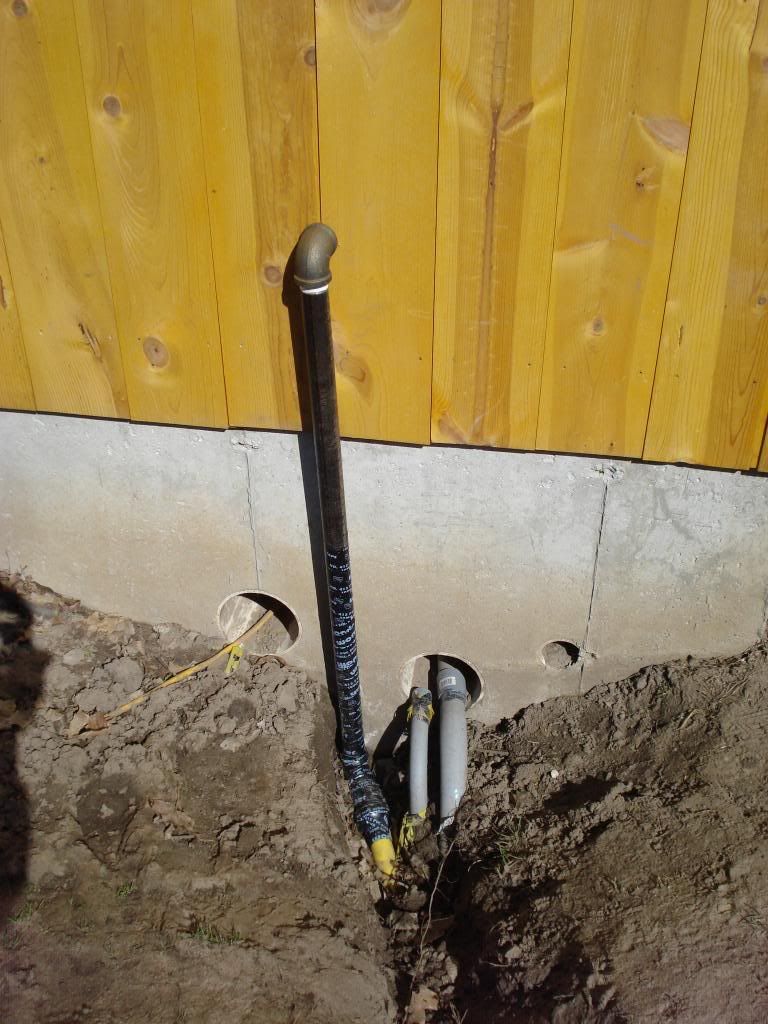
Well, here's what I've got. Put the compression fitting on the PE, put a 90* on it and ran it up. It comes through the wall above the concrete wall.The supplier I bought everything from said as long as I wrapped everything below grade with the PVC tape, it would be fine.

DSC03038-1.jpg


DSC03040-1.jpg
 
Last edited:

fatboy99

Well-known member
Joined
Apr 23, 2009
Messages
908
Location
Indiana
Chris
I just looked thrue the garage build pic's did you pressure test the gas line's before you closed up the wall's? the pic of the gas line elbo looked like it was sealed with tefflon tape A BIG NO NO Id hate to see your hard work go up in a bang or Anyone getting injured or Worse Yet Killed
Brad
 
To avoid these ads, REGISTER NOW!

Chris 50

Well-known member
Joined
Feb 4, 2007
Messages
86
Location
LaPorte IN.
Brad,
The line will be about 20"+ below grade when it's all covered over. I didn't run a tracer, however, the purpose is to have an electical signal to locate the line, right? The power feed is run in the same trench for the whole length which should do the same thing. I didn't know about the teflon tape. I was told the stuff for gas line was just thicker and that I just needed to wrap it a few extra times. I'm not tied in yet at the service end. Assuming I was doing this right (teflon tape), I got all joints plenty tight and didn't think a leakdown test would reveal a problem. Now that I'm answering your questions though, I'm starting to get that sinking feeling. How bad did I screw this up?
 
Last edited:

fireguy

Well-known member
Joined
May 25, 2008
Messages
530
Gas is supposed to disolve the teflon, causing leaks. I have run gas (licensed for natural, not propane) about 25 years. I have not seen any problems with teflon. But, just because I have not seen any problems, does not mean it is possible.

The reason for the trace wire is so you will find the wire before you find the pipe. That is important, as nicking the metal pipe can lead to corrosion and a leaky pipe. You do not want to have free gas in the basement when the appliance lights off. Boom!
 

mrb

Well-known member
Joined
Dec 31, 2008
Messages
3,734
where do those pvc sleeves through the concrete go? The PE gas line appears to curve sharply right out of the transition / coupling. I thought it was supposed to travel a bit straight first so there isnt sideways pressure on the coupling. You should have added the tracer wire. It has nothing to do with your electrical lines, the gas co has a transmitter they connect to it, and they use a metal detector looking thing that is a receiver to locate the line.

I dont remember exactly what the required seperation is, but you cant have your gas and electric in the same trench as you appear to have. I think its something like 6in vertical seperation and 12in horizontal. Dont remember exactly.

I hope you pulled a permit and had this inspected.
 

fatboy99

Well-known member
Joined
Apr 23, 2009
Messages
908
Location
Indiana
Chris
Cap off one end of the line ans install a pressure gauge and a schrader valve fitting (avail at NAPA) pressureize and let set see if you have ANY drop most of the service guy's at work air test at 50psi.
Fireguy
My exwife's house gas line was sealed with tefflon tape it leaked at every joint it had to be all dissassembled and resealed. there is a tefflon tape rated for gas it's yellow in color if i remember right it's not allowed in Indiana ill ask one of the guy's tonight at work to make sure on that .
Brad
 

Chris 50

Well-known member
Joined
Feb 4, 2007
Messages
86
Location
LaPorte IN.
fireguy and mrb,
Even though I probably should have run the tracer, the electical line in the trench should do the same thing. You would either be able to detect the electrical current or, disconnect the wires on one end with the power off and hook the transmitter directly to it just like a tracer. And the only metal pipe is at the end.

mrb,
The PVC sleeves lead through the wall into a small open area of the slab allowing water, septic and electric into the shop.
DSC02997.jpg

The PE doesn't curve as much as it might appear in the pic. It's actually pretty straight. Also it's my understanding that running the two utilities in the same trench as I have done is acceptable here in LaPorte. The electric is run through gray PVC and is down about 3' and the gas is about a foot above it. A foot or so above that, I ran caution tape.

fatboy99,
I fully intend to pressure test the line. 50psi for 24 hours. If it's good for that long, I will leave it hooked up longer just to see what I get. If I end up redoing the joints, yellow teflon tape with pipe dope is the correct way from a couple sources.
 

mrb

Well-known member
Joined
Dec 31, 2008
Messages
3,734
the gas co isnt going to use one of your electric lines with their tracer. You should have run the tracer wire, but its too late now. So is the trench, I have never seen anywhere that allows you to run gas and electric in the same trench without maintaining a minimum separation.

As far as the teflon tape, if you end up reworking it (which I would even if the pressure test holds -the issue I think is that the gas breaks down the tape) I would use pipe dope only (the proper pipe dope that is ok for gas) I dont think you want to use both.

Is that piece of EMT going to the hole your wire to the gound rod?
 

mrb

Well-known member
Joined
Dec 31, 2008
Messages
3,734
Yes........don't tell me that's an issue to?

well, you asked... :)

What code cycle are you under? 2005 or 2008? You most likely should have bonded the rebar. This is called a UFER ground and is usually required. You can google it for more info. The ground rod needs to be all the way in the ground, you cant have a foot or two of it sticking up.

Do you have 3 wires or 4 wires going to that subpanel? Can you post a picture of the inside of it?
 

fatboy99

Well-known member
Joined
Apr 23, 2009
Messages
908
Location
Indiana
Chris i talked to one of the servicemen he said tefflon tape could be used but he wouldnt reccomend it a lot of the leak call's he respond's to are taped joint's
Brad
 

Chris 50

Well-known member
Joined
Feb 4, 2007
Messages
86
Location
LaPorte IN.
well, you asked... :)

What code cycle are you under? 2005 or 2008? You most likely should have bonded the rebar. This is called a UFER ground and is usually required. You can google it for more info. The ground rod needs to be all the way in the ground, you cant have a foot or two of it sticking up.

Do you have 3 wires or 4 wires going to that subpanel? Can you post a picture of the inside of it?

When all my utilities are in, the hole that the ground rod is in will be back filled and a thin layer of concrete poured on top. This would leave the rod only sticking up a couple inches. I have 3 wires coming from the house to the subpanel. This is the best pic I have.
DSC03066-1.jpg


Chris i talked to one of the servicemen he said tefflon tape could be used but he wouldnt reccomend it a lot of the leak call's he respond's to are taped joint's
Brad

Yeah. At this point, I'm going to pressure test it as is just out of curiosity, but regardless, I'll take it back apart and redo it. Some of the things that I have (or haven't) done here may not be technically right, but this is the one thing that I feel could truely be a safety issue.
 

Chris 50

Well-known member
Joined
Feb 4, 2007
Messages
86
Location
LaPorte IN.
Oh and to FlameOut, who actually started this post. I didn't intend to hijack your thread, although I'm sure your learning plenty from my mistakes! :tard:
 

mrb

Well-known member
Joined
Dec 31, 2008
Messages
3,734
Do you have any metallic path from this garage to the house? Tv cable, a water pipe, etc? Or is the garage attached to the house by a breezeway or anything? What code cycle are you under? I think you need 4 wires, not 3.

Do you have neutral and ground isolated in the subpanel? It looks like it but I cant tell from the pic. You could have a dangerous situation here if you do.
 

Chris 50

Well-known member
Joined
Feb 4, 2007
Messages
86
Location
LaPorte IN.
There is nothing connecting the house to the shop. Code cycle? I haven't the foggiest. The electrician I hired to run the EMT, pull wires and make all connections does residential electrical for a living in Lake County In. where the codes are strict compared to LaPorte county where I live. I did pull a permit for this job, however the town is pretty forgiving of code out here. I am confident that the electrical was done correctly. I'll try and get a better pic of the panel later.
 

mrb

Well-known member
Joined
Dec 31, 2008
Messages
3,734
appears as though you are under 2005 NEC.

So you have no phone line, cable tv line, water line or anything else with metal in it between the house and garage?
 

mrb

Well-known member
Joined
Dec 31, 2008
Messages
3,734
in the panel, is the neutral bonded to the ground?
 

HoosierBuddy

Well-known member
Joined
May 9, 2006
Messages
2,930
Location
Southern Indiana
Chris i talked to one of the servicemen he said tefflon tape could be used but he wouldnt reccomend it a lot of the leak call's he respond's to are taped joint's
Brad


I've never heard (in the 16 years I've been working for a gas company) that teflon tape is prohibited OR that it will be broken down by natural gas.

I've personnally tried teflon tape for gas and have had very little luck with it. A good quality pipe sealant (aka "pipe dope") is much easier to use and will give you better results. I think this has become more important in the last few years as imported pipe fittings have replaced domestically produced stuff. At least initially (in 2006ish) we were getting a lot of anecdotal evidence of poor quality control in the threads on some fittings leading to leaks. In some cases the only way to fix the leak was to replace the fitting. A good quality pipe sealant will cut down on this issue dramatically. We use Leak Lock at work. The recommended application method is to put it on BOTH internal and external threads, allow it to tack and then assemble the fitting. It slows you down a lot to do it that way, but it really does work well.

Regarding power and gas in the same ditch? If it's allowed by code it shouldn't be. If somone is excavating and cuts one or the other they'll have an issue. If they cut the gas and the power at the same time...they'll have a fire almost certainly. I think a lot of people think every time a gas line gets cut a fire results. Actually, I can count on 1 finger the number of times I've seen an underground gas line that was cut catch on fire and I've seen well over a hundred get cut. If you cut a power line at the same time as you cut the gas line and it sparks (and it WILL spark) you'd increase your chances of a fire by a large amount. So...I wouldn't do it. Chances are it won't be a problem, but why risk it.

Phil


Phil
 

Chris 50

Well-known member
Joined
Feb 4, 2007
Messages
86
Location
LaPorte IN.
Phil,
Good info. Like I said, I will reseal the gas line with pipe dope the way you said. As far as the gas and electric in one trench, it may not be "right", but I don't think I'll be digging it up. If someone were to excavate in the area later, an underground survey would at least reveal the electric. To avoid the electric, you would be avoiding the gas. Again, I'm not saying it's right, but I don't feel it's much of a danger.

mrb,
Here's a better pic of the inside of the sub-panel.

DSC03256.jpg
 

mrb

Well-known member
Joined
Dec 31, 2008
Messages
3,734
it looks to me like the neutral is not bonded to the can, this is super dangerous with a 3 wire setup. There is no path to clear a fault. The install really should have had 4 wires, but it sounds like (under 2005 code and no metallic path from detached structure to house) you are ok with 3, but without proper bonding you could have a pretty dangerous situation.

The rod is a grounding electrode and does nothing to clear a fault. With the improperly bonded setup, things can become energized that shouldnt.
 
To avoid these ads, REGISTER NOW!
Top Bottom