Who ever built my house must not have liked garages as my 2 car garage has 1 GFI outlet and that is it. Unfortunately it is on the other side of the garage from my workshop and has a fridge and freezer plugged into it. My plan is to run a dedicated circuit to the garage and install some outlets around the walls by my work area. I already ran a 220 outlet for my compressor so i have a hole to my breaker box outside already done, I just need to run wire, conduit and outlets. My question is what size wire and what size breaker can I use. I want to run at least 4 more outlets and they will only be used to run small power tools, battery chargers and possibly a 110 welder from time to time. I also know I would have to have a GFI in the series. Any help is appreciated.

You are using an out of date browser. It may not display this or other websites correctly.
You should upgrade or use an alternative browser.
You should upgrade or use an alternative browser.
Running outlets in a garage.
- Thread starter skon1212
- Start date
Ihateclevernames
Well-known member
Wow. That sounds similar to my situation. I only had 2 in a common wall between the garage and basement.
So you have the 220 dedicated to your compressor already done?
What size garage do you have? If I were you, I would look at adding more in order to avoid power strips and what have you.
If you are thinking 4, I would add 4 double gang outlet boxes (surface mounted in a metal box or plastic) and have 2 outlets in each place.
You can accomplish this by running a single dedicated 20A circuit, using some 12 gauge wire. Figure out how long your wiring will be, and add 10% to that figure. Pick up the following:
Appropriate length of 12 gauge wire, sheathed in black, white, and bare copper (ground)
8 x 20 Amp outlets
8 x 4 x boxes with covers
Appropriate length of conduit and fittings that will allow you to attach it to your boxes
Wire nuts, yellow and red
20 Amp breaker for your panel box
Do not run romex (yellow sheathed) cable through your conduit, as it will be a violation of code. Get the single 12 gauge wires and run them through your conduit.
I am not a licensed electrician, however this is pretty straight forward. There are other ways, this is just the way I prefer. I am sure others will chime in as well.
Good luck!
So you have the 220 dedicated to your compressor already done?
What size garage do you have? If I were you, I would look at adding more in order to avoid power strips and what have you.
If you are thinking 4, I would add 4 double gang outlet boxes (surface mounted in a metal box or plastic) and have 2 outlets in each place.
You can accomplish this by running a single dedicated 20A circuit, using some 12 gauge wire. Figure out how long your wiring will be, and add 10% to that figure. Pick up the following:
Appropriate length of 12 gauge wire, sheathed in black, white, and bare copper (ground)
8 x 20 Amp outlets
8 x 4 x boxes with covers
Appropriate length of conduit and fittings that will allow you to attach it to your boxes
Wire nuts, yellow and red
20 Amp breaker for your panel box
Do not run romex (yellow sheathed) cable through your conduit, as it will be a violation of code. Get the single 12 gauge wires and run them through your conduit.
I am not a licensed electrician, however this is pretty straight forward. There are other ways, this is just the way I prefer. I am sure others will chime in as well.
Good luck!
zmaxmotorsports
Well-known member
Forget the yellow wirenuts,get tan ones.
No need for 20 receptacles if there's more than one on the circuit you can use 15s.
How about a picture of the garage and panel location?
No need for 20 receptacles if there's more than one on the circuit you can use 15s.
How about a picture of the garage and panel location?
I don't really have a pic of my garage but here is the panel. Where I wrote on the pic is where I ran my compressor wires. The garage is right on the other side of the panel and on the wall I want to run outlets. Also there are 2 50 amp breakers that have been added since the pic was taken.
Yes my compressor is on a dedicated 220.
Yes my compressor is on a dedicated 220.
Attachments
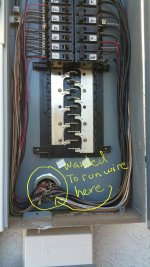
nadogail
Well-known member
Sounds like your builder chose the lowest cost, minimum specification, way to wire the garage.
Reminds me of houses I have purchased. One light bulb, one receptacle in a semi convenient location, and an electric garage door opener.
It seems that every builder is giving you the least for the most.
Reminds me of houses I have purchased. One light bulb, one receptacle in a semi convenient location, and an electric garage door opener.
It seems that every builder is giving you the least for the most.
wyliesdiesels
Well-known member
Wow. That sounds similar to my situation. I only had 2 in a common wall between the garage and basement.
So you have the 220 dedicated to your compressor already done?
What size garage do you have? If I were you, I would look at adding more in order to avoid power strips and what have you.
If you are thinking 4, I would add 4 double gang outlet boxes (surface mounted in a metal box or plastic) and have 2 outlets in each place.
You can accomplish this by running a single dedicated 20A circuit, using some 12 gauge wire. Figure out how long your wiring will be, and add 10% to that figure. Pick up the following:
Appropriate length of 12 gauge wire, sheathed in black, white, and bare copper (ground)
8 x 20 Amp outlets
8 x 4 x boxes with covers
Appropriate length of conduit and fittings that will allow you to attach it to your boxes
Wire nuts, yellow and red
20 Amp breaker for your panel box
Do not run romex (yellow sheathed) cable through your conduit, as it will be a violation of code. Get the single 12 gauge wires and run them through your conduit.
I am not a licensed electrician, however this is pretty straight forward. There are other ways, this is just the way I prefer. I am sure others will chime in as well.
Good luck!
That is NOT true. It is a rumor that never seems to go away.
BTW Romex is a brand of NM-b cable.
I don't really have a pic of my garage but here is the panel. Where I wrote on the pic is where I ran my compressor wires. The garage is right on the other side of the panel and on the wall I want to run outlets. Also there are 2 50 amp breakers that have been added since the pic was taken.
Yes my compressor is on a dedicated 220.
what is the HP rating of the compressor?
Nominal voltage is 120/240 not 110/220. 220v hasnt been used for decades...
And i would use a new hole in the panel. That one is quite full
Last edited:
The compressor is a 3.2 HP Sears 60 gallon.
As far as the 220 or 240 goes, I tend to say 220 because in another post there was a big argument over whether or not 220 or 240 is correct so to me they seem to be interchangeable until I start working a big project or run out of panel space.
The hole in the panel is pretty full but actually has more room than what you think.
As far as the 220 or 240 goes, I tend to say 220 because in another post there was a big argument over whether or not 220 or 240 is correct so to me they seem to be interchangeable until I start working a big project or run out of panel space.
The hole in the panel is pretty full but actually has more room than what you think.
wyliesdiesels
Well-known member
Measure the voltage between the 2 hot legs in a panel- it will be about 240v.
If u get 220v reading with no load on the panel, then youve got issues.
If u get 220v reading with no load on the panel, then youve got issues.
Dick in Wisconsin
Well-known member
Put the compressor on a dedicated 20amp circuit, even though it might only draw 15amps. I think you need to provide the most reliable source of juice to a machine like a compressor.
Run 20amp circuits, breakers, and outlets to the rest of the garage. Don't be afraid to run multiple circuits if might be running multiple tools at the same time. 12 gauge wire.
First outlet on all the circuits must be a GFCI.
Run 20amp circuits, breakers, and outlets to the rest of the garage. Don't be afraid to run multiple circuits if might be running multiple tools at the same time. 12 gauge wire.
First outlet on all the circuits must be a GFCI.
wyliesdiesels
Well-known member
Nema 5-20r (20a) outlets arent necessary!
Last edited:
tuip
Well-known member
I went overboard with outlets .. all will be 20A but I know that quite a few will end up being covered by storage so having extra that are going to be available will be awesome. The new NEC code requires ALL outlets in a garage to be GFCI ... that includes the one in the ceiling for your garage door opener if you have one.
whitetrash1
Well-known member
I need to really do my electric in my garage. I have nothing for outlets...
I think that's the standard these days. I have 1 outlet in mine. Not even garage door opener outlets. I plan to add about 3 to each wall and 2-220s but my panel is pretty much full so I'll have to run a sub panel.

theoldwizard1
Well-known member
What would be the best way to wire the outlet run? In Series or Parallel?
You CAN NOT RUN 120V AC OUTLETS IN SERIES ! ONLY PARALLEL !!
No offense buddy, but if you as a question like that, you probably should NOT be doing your own electrical work.

And that picture ... well. "Pig tailing" all outlet might be the may they are teaching apprentices but I don't think it is required by current code and BILLIONS of outlet have been wired NOT using pig tail.
Spend a couple of bucks extra and buy outlets that have screw hold downs on the side. Do NOT use the "back stab" connection. Back stabs are quick and easy to install and work ... for awhile, but are prone to failure.
Last edited:
theoldwizard1
Well-known member
IIRC, there is an exception to the rule about GFCI in garages for refrigerators and freezers. Too many false trips that ruined hundreds of dollars in food. I think the code says it must be a dedicated circuit or at least the outlet must not be readily accessible (i.e. behind the appliance).... my 2 car garage has 1 GFI outlet and that is it. Unfortunately it is on the other side of the garage from my workshop and has a fridge and freezer plugged into it.
You CAN NOT RUN 120V AC OUTLETS IN SERIES ! ONLY PARALLEL !!
No offense buddy, but if you as a question like that, you probably should NOT be doing your own electrical work.
And that picture ... well. "Pig tailing" all outlet might be the may they are teaching apprentices but I don't think it is required by current code and BILLIONS of outlet have been wired NOT using pig tail.
Spend a couple of bucks extra and buy outlets that have screw hold downs on the side. Do NOT use the "back stab" connection. Back stabs are quick and easy to install and work ... for awhile, but are prone to failure.
When I wrote series, I should have deleted it. I have wired a few things following schematics and I am learning more about wiring. This seems like an easy thing to do as long as I have a plan to look at. I wired my compressor just fine and have wired several fixtures. Just never run more than one outlet. Not offended, but trying to learn and do it right the first time. I plan on getting the side screw outlets as well.
IIRC, there is an exception to the rule about GFCI in garages for refrigerators and freezers. Too many false trips that ruined hundreds of dollars in food. I think the code says it must be a dedicated circuit or at least the outlet must not be readily accessible (i.e. behind the appliance).
Yep the outlet is behind the freezer and the only other thing running off that circuit is an outside outlet right on the other side of the wall of the garage from GFCI. It has only tripped twice in 2 years.
Dick in Wisconsin
Well-known member
You CAN NOT RUN 120V AC OUTLETS IN SERIES ! ONLY PARALLEL !!
No offense buddy, but if you as a question like that, you probably should NOT be doing your own electrical work.
And that picture ... well. "Pig tailing" all outlet might be the may they are teaching apprentices but I don't think it is required by current code and BILLIONS of outlet have been wired NOT using pig tail.
Spend a couple of bucks extra and buy outlets that have screw hold downs on the side. Do NOT use the "back stab" connection. Back stabs are quick and easy to install and work ... for awhile, but are prone to failure.
DO NOT USE "backstabbed outlets". Especially in a garage/shop. Like theoldwizard says, spend a couple of extra dollars and buy the "pro" outlets with the ability to "backwire". Much, much better connection.
wyliesdiesels
Well-known member
The spec grade backwire outlets with the clamping plate are labeled heavy duty at home depot. They cost around $6 each. The leviton part number is 5252.
Pardon my threadjacking, but I'd like to build on this question.
I've always heard "12awg for a 20A circuit", but at what point does conductor length necessitate upsizing the wire? I have a 30X56 pole barn, and want to run outlets around the perimeter. My plan is two circuits, so neighboring outlets are on different circuits. The run adds up to 172', not counting the length at the boxes for wiring. Is 12awg still okay, or do I need to go 10awg?
I've always heard "12awg for a 20A circuit", but at what point does conductor length necessitate upsizing the wire? I have a 30X56 pole barn, and want to run outlets around the perimeter. My plan is two circuits, so neighboring outlets are on different circuits. The run adds up to 172', not counting the length at the boxes for wiring. Is 12awg still okay, or do I need to go 10awg?
wyliesdiesels
Well-known member
At 172' VD will be bad even with #10. U will need at least #8 if not #6.
A subpanel would suit you way better in this case.
The cost of all the large wire for branch circuits is gonna add up.
I would definitely put in a subpanel.
A subpanel would suit you way better in this case.
The cost of all the large wire for branch circuits is gonna add up.
I would definitely put in a subpanel.
Stevie-Ray
Well-known member
I hope to God that's NOT what they are teaching apprentices these days. They certainly weren't in '94. Simply more joints to fail. And side screw hold-downs for sure. I've never had a failure with these, including replacing many failed ones that were of the stab type. The clamping type is also very good.And that picture ... well. "Pig tailing" all outlet might be the may they are teaching apprentices but I don't think it is required by current code and BILLIONS of outlet have been wired NOT using pig tail.
Spend a couple of bucks extra and buy outlets that have screw hold downs on the side. Do NOT use the "back stab" connection. Back stabs are quick and easy to install and work ... for awhile, but are prone to failure.
Last edited:
tuip
Well-known member
also make sure your first outlet in your run is a gfci outlet.
I thought ALL outlets have to be GFCI in a garage according to code?
http://publicecodes.cyberregs.com/icod/irc/2012/icod_irc_2012_39_sec002.htm
Dick in Wisconsin
Well-known member
I thought ALL outlets have to be GFCI in a garage according to code?
http://publicecodes.cyberregs.com/icod/irc/2012/icod_irc_2012_39_sec002.htm
E3902.2 Garage and accessory building receptacles.
All 125-volt, single-phase, 15- or 20-ampere receptacles installed in garages and grade-level portions of unfinished accessory buildings used for storage or work areas shall have ground-fault circuit-interrupter protection for personnel.
The operative word is "protection". Whether the "protection" is having a GFCI outlet as the first one in the circuit and the rest of the circuit is wired to the LOAD terminals (protecting the entire circuit) or having each outlet being a GFI outlet ... the end result is the same.
tuip
Well-known member
Interesting and technically that indeed correct .. my electrician who I consult gave me a different opinion. I already picked up a box of GFCIs so it won't make much of a difference for me 
cpttuna
Well-known member
20X20 garage. one outlet on each wall on it's own circuit and a 220 outlet for the welder.
I personally like two 20A outlet circuits for the garage. Alternate outlets on each circuit so that you can have two tools plugged in to the two outlets closest to you and not trip anything.
Sent from my iPhone using Tapatalk
Sent from my iPhone using Tapatalk
QwikKotaTx
Well-known member
E3902.2 Garage and accessory building receptacles.
All 125-volt, single-phase, 15- or 20-ampere receptacles installed in garages and grade-level portions of unfinished accessory buildings used for storage or work areas shall have ground-fault circuit-interrupter protection for personnel.
The operative word is "protection". Whether the "protection" is having a GFCI outlet as the first one in the circuit and the rest of the circuit is wired to the LOAD terminals (protecting the entire circuit) or having each outlet being a GFI outlet ... the end result is the same.
What if the house was built in 1998 for example? I thought that was a new code addition in the last several years? I can not add outlets unless they are GFCI but if they already exist and are not, that is ok? Do the outlets and wire have manufacturing dates stamped on them?
wyliesdiesels
Well-known member
What if the house was built in 1998 for example? I thought that was a new code addition in the last several years? I can not add outlets unless they are GFCI but if they already exist and are not, that is ok? Do the outlets and wire have manufacturing dates stamped on them?
GFCIs have been required in garages since at least 1996. My garage has them.
tlmartin84
Well-known member
When my MIG is running on the 110V setting, if I have anything else plugged up I will end up kicking the 20A breaker from time to time.
Everyone else here has covered the rest, I would just make sure you had a circuit for it. Not necessarily dedicated, but a few so that it can be plugged up seperately when in use.
Everyone else here has covered the rest, I would just make sure you had a circuit for it. Not necessarily dedicated, but a few so that it can be plugged up seperately when in use.