Over the last year I acquired a halfway decent Delta drill press, and a harbor freight style combination mill lathe, both based on opportunity. The garage they have been in is unconditioned, and they have both developed some serious surface rust on all non-painted surfaces. My new shop will be completed in the next month or two, so they will be rescued from the humidity. At that point I'm wondering what the process will be to rescue these, particularly the lathe. Should I just take them apart and break out the DA sander, then oil them, or am I in for some serious dimensional considerations?

You are using an out of date browser. It may not display this or other websites correctly.
You should upgrade or use an alternative browser.
You should upgrade or use an alternative browser.
Rust on mill, drill press
- Thread starter esanford
- Start date
Handwork, green scotch-brite, a little oil (I generally use Wd-40) and some elbow grease. This is my general approach to cleaning all surface rust on machinery.
Without any images it is difficult if not impossible to recommend disassembly of even a restoration effort when a simple cleaning might be all that is needed.
Without any images it is difficult if not impossible to recommend disassembly of even a restoration effort when a simple cleaning might be all that is needed.
WisJim
Well-known member
I'm in a similar situation, not able to move into the new shop yet, and having recently purchased a South Bend lathe at a garage sale for a price I couldn't pass up. I got it home, set it on plastic on a pallet and sprayed it down thoroughly with a oily spray that left a good oil film on everything. Hopefully that will help prevent further corrosion until it's in the new shop and I can deal with it.
Nutria
Well-known member
One more vote for maroon ScotchBrite and WD40-- hand only. Follow up with paste wax, and you should be good to go.
Took a while to get back to this. Got some pics. Scotch Brite and oil? Anything I should check in the way of bearings, etc, before I turn it on for the first time?
Attachments
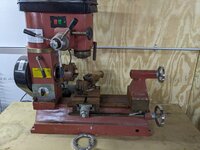


DO NOT use a DA or any sander of any sort on the precision surfaces. In fact, you want to avoid abrasives around machine tools in general.
WD-40 or similar + scotch brite pads is plenty to clean it up. Then just keep the thing overly lubricated all the time, way oil or wd-40 or fluid film or anything, just give it a spray every couple months if you aren't using the machine.
As for before you turn it on, make sure that the gearboxes all have the right oil at the right level, don't run anything under power until you can turn it by hand smoothly (you can rotate the chuck on a lathe by hand and it will turn the entire machine), and if something isn't smooth or is crunchy or is stiff - take it apart, clean it, re-lube it, and then adjust it (most moving bits on a lathe have ways to adjustment them).
WD-40 or similar + scotch brite pads is plenty to clean it up. Then just keep the thing overly lubricated all the time, way oil or wd-40 or fluid film or anything, just give it a spray every couple months if you aren't using the machine.
As for before you turn it on, make sure that the gearboxes all have the right oil at the right level, don't run anything under power until you can turn it by hand smoothly (you can rotate the chuck on a lathe by hand and it will turn the entire machine), and if something isn't smooth or is crunchy or is stiff - take it apart, clean it, re-lube it, and then adjust it (most moving bits on a lathe have ways to adjustment them).
RaisedByWolves
Well-known member
Oof!Took a while to get back to this. Got some pics. Scotch Brite and oil? Anything I should check in the way of bearings, etc, before I turn it on for the first time?
People saying not to use abrasives and then recommending scotch brite cracks me up. Scotch brite is plastic imbedded with an abrasive.
Also, while WD will work, it lubricates. You want kerosene or at least diesel fuel, these will let the abrasives cut and make the work go quicker.
I would fully disassemble that, start off removing the heavy rust with 230 grit, and finish with 400-600 grit all being done slowly and by hand with maybe a paint stirrer to back the paper up for the flat parts.
Mix up some "Eds Red" (look it up) and soak the chuck and tailstock along with other stuck parts and let that soak for a week. By soak I don't mean you have to submerge the parts, just wet them anytime you walk by.
Then once you have everything shiny, fully clean it with hot soapy water and dry with compressed air and coat with WD to prevent flash rust, then reassemble.
Been doing everything from automotive engine rebuilding to tool and die for 40yrs, and abrasives are always used, albeit with great care and in the proper fashion. The key is the item being disassembled so as to allow proper cleaning before reassembly.