To avoid these ads, REGISTER NOW!

Rust Removal by Electrolysis

brianpgriset

Well-known member
Joined
Sep 29, 2006
Messages
1,036
Location
Beaumont, TX
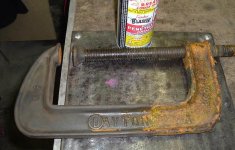
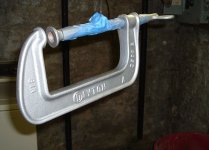
This method of removing rust has been mentioned on here a few times but not a whole lot, so I thought I'd go ahead and share my experience. Basically I got a whole bunch of really nice big old C-Clamps recently that worked fined but were in poor cosmetic condition. I was ready to bust out the angle grinder and wire wheel but rememberd seeing this online and wanted to give it a try. There are many benefits. It cleans every nook and cranny, easy to clean up, very very cheap, and its fire and forget; set the peice in the alkaline solution and apply a DC voltage and walk away. Also it requires NO elbow grease whatsoever. I used a wire brush for 2 minutes for this c-clamp to remove a bit of stubborn paint. ALOT easier than wire wheels! Come back a few hours later and you've got a clean part.

Check out the pics below. The results are impressive. It only takes a handful of supplies. A plastic container that can fit most or all of the part to be cleaned, Sodium Corbonate (called "washing soda" at your local gocery, about $3 for a lb.), a battery charger (or other 12V DC supply), water, some scrap metal to be used as the anode, and some steel wire/bar to support the peice to be cleaned. It only takes about 1/2 cup of sodium carbonate per 5 gal. of water, and the alkaline solution can be used forever, but its nice to replace it every once in awhile. Also, this will work for ANY sized object. the only things that will differ are the size of the tank, and youll need a charger that able to provide more amps.

If you guys want to give it a try just search for electrolysis rust removal in your favorite search engine and youll get alot of results. The only things a can think of worth mentioning are:

Do this in a well ventilated area as hydrogen gas (HIGHLY flamable, aka hindenburg) is evolved in small amounts. Be careful not to shock yourself. Dont touch or immerse your hands in the water. Check the amperage drawn by the chargerto assure it is in its safe operating range. DONT use stainless steel as the anode as it will release toxic chemicals into the water. Use plain old mild steel. Be SURE you use the correct polarity, otherwise the part you were trying to clean will be dissolved into nothing!

Otherwise, next time you plan on being out in the garage for a few hours and have some rusty odds and ends to clean, get 'em out, set up your electrolysis rig, and by the time your ready to finish, your part will be all clean!!!:beer:
 

Attachments

  • DSCF0536.jpg
    DSCF0536.jpg
    70.3 KB · Views: 195
  • DSCF0533.JPG
    DSCF0533.JPG
    70.7 KB · Views: 274
  • DSCF0534.JPG
    DSCF0534.JPG
    74.9 KB · Views: 225
  • DSCF0537.JPG
    DSCF0537.JPG
    67 KB · Views: 265
To avoid these ads, REGISTER NOW!

strizzy

Well-known member
Joined
Apr 4, 2006
Messages
572
Location
Western NY
Very, very cool. Thanks for posting everything; might have to give this a try for myself sometime now...
 

ImportTuner

Super Moderator
Staff member
Joined
Jan 9, 2007
Messages
5,855
Location
SF Bay Area
Wow, pretty cool; how long did you have to leave the clamp in and what is the amperage of your battery charger?
 

george4

Well-known member
Joined
Feb 18, 2006
Messages
773
Location
N California
I have used this method several times with good results. I use the 10 amp setting on my charger. A light wire brushing before and after helps. The parts are so clean that they easily rust if not dried and oiled immediately after removal.
 
OP
B

brianpgriset

Well-known member
Joined
Sep 29, 2006
Messages
1,036
Location
Beaumont, TX
ImportTuner said:
Wow, pretty cool; how long did you have to leave the clamp in and what is the amperage of your battery charger?

I had the clamp in for about 3 hours. The charger was pushing about 4 amps through the circuit. If you want to change the amperage there are several simple was to do so. Moving the part closer or farther from the anode will change the resistance. Also, you can drop the current by simply putting a 12V light bulb in series as well.
 

Itzkwik

Well-known member
Joined
Mar 19, 2006
Messages
539
Location
Montpelier, VA
brianpgriset said:
Be SURE you use the correct polarity, otherwise the part you were trying to clean will be dissolved into nothing!
From looking at your pics, the negative goes on the anode and the positive clamps to the part you want the rust removed from?
 

george4

Well-known member
Joined
Feb 18, 2006
Messages
773
Location
N California
ImportTuner said:
So, the picture is wrong? ..... according to the article ..
Not sure about the picture but I have used this procedure several times, always negative to article to be cleaned. Positive to sacrificial metal. I use steel fencing to line the bucket with a positive connection for the sacrificial. Hang items to be cleaned from a board across the top of bucket attached to negative.
 

goodfellow

Well-known member
Joined
Dec 17, 2006
Messages
2,288
Location
NoVA
george4 said:
Not sure about the picture but I have used this procedure several times, always negative to article to be cleaned. Positive to sacrificial metal. I use steel fencing to line the bucket with a positive connection for the sacrificial. Hang items to be cleaned from a board across the top of bucket attached to negative.


That makes sense -- electrons flow from negative to positive and thus creates the cleaning action on the rusted part. I guess the hyrodgen is a by-product of electrolysis and really has nothing to do with the cleaning itself.

Is there a formula for setting voltage and amperage in proportion to surface area in order to get the maximum cleaning efficiency.

The reason I ask, is that I have a line on a Lamda DC power supply that's adjustable from 0-36v and 0-25a -- that would make a good power source for cleaning and even plating.
 
Last edited:

george4

Well-known member
Joined
Feb 18, 2006
Messages
773
Location
N California
goodfellow said:
That makes sense -- electrons flow from negative to positive and thus creates the cleaning action on the rusted part. I guess the hyrodgen is a by-product of electrolysis and really has nothing to do with the cleaning itself.

Is there a formula for setting voltage and amperage in proportion to surface area in order to get the maximum cleaning efficiency.

The reason I ask, is that I have a line on a Lamda DC power supply that's adjustable from 0-36v and 0-25a -- that would make a good power source for cleaning and even plating.
I am sure that someone could calculate that but not me. I just used my battery charger, 12v with 2 or 10 amp switch, I use 10 amps. Definitely more bubbles coming up with 10 amps. I understand the benefit with this method is that you are removing just rust not good metal as with a wire brush or acid.
 
OP
B

brianpgriset

Well-known member
Joined
Sep 29, 2006
Messages
1,036
Location
Beaumont, TX
Sorry about the picture, I'm just holding the two alligator clips in that, the NEGATIVE is to the peice to be cleaned always.

Also, since you have that very nice DC power supply, like you said you can adjust the current to suit the surface area to be cleaned. On the link I listed below, the author suggests 1mA per square centimeter. This article was the best I could find on the web, and he does a great job explaining every detail of the cleaning processes. Take a look.

http://myweb.tiscali.co.uk/andyspatch/rust.htm
 
To avoid these ads, REGISTER NOW!

ImportTuner

Super Moderator
Staff member
Joined
Jan 9, 2007
Messages
5,855
Location
SF Bay Area
I was at the local Safeway and could not find anything called "soda crystal" in the washing section; what am I suppose to be looking for? Thanks
 

goodfellow

Well-known member
Joined
Dec 17, 2006
Messages
2,288
Location
NoVA
ImportTuner said:
I was at the local Safeway and could not find anything called "soda crystal" in the washing section; what am I suppose to be looking for? Thanks


I'm not sure here, but I think it's Borax
 

george4

Well-known member
Joined
Feb 18, 2006
Messages
773
Location
N California
ImportTuner said:
I was at the local Safeway and could not find anything called "soda crystal" in the washing section; what am I suppose to be looking for? Thanks
**** and Span (powder).
 
OP
B

brianpgriset

Well-known member
Joined
Sep 29, 2006
Messages
1,036
Location
Beaumont, TX
Arm & Hammer sells it under the name "washing soda". Baking soda has also been found to work by others, but I havent tried.

Chemically, you need to find sodium carbonate (washing soda) or sodium bicarbonate (baking soda).
 

InPrimer

Well-known member
Joined
Jul 10, 2007
Messages
651
Location
lake Havasu AZ
I had to de-rust bumper brackets on my 37 Chevy, they are spring steel and riveted into a "Y" configuration, in other words a PITA to clean ,after using this method they were essentially clean, good method for weird shaped items to remove rust
 

cambell

Well-known member
Joined
Sep 27, 2007
Messages
109
After reading this thread I'm getting alittle scaired. See, a few years ago I made a electronic gun barrel cleaner that uses electrolysis. In all the webpages I found it says to hook up the positive to the gun (part being cleaned) and the negative to the scrap metal. I have used this device that I made on all of my guns and now i'm thinking I may have f'd them up. Here is a link to what I made, any of you pro's out there please tell me if you think these instructions are wrong as far as polarity. http://www.frfrogspad.com/copclean.pdf I hope I didnt mess up my barrels.
 

cambell

Well-known member
Joined
Sep 27, 2007
Messages
109
I think I might have found my answer. Rust is a anion (negative charge) and thats why for rust removal you use the negative lead for the part being cleaned. Copper and lead is a cation (positive charge), so for gun cleaning you would use the positive terminal for the part being cleaned.
 

Kestas

Well-known member
Joined
Dec 27, 2007
Messages
50
Location
The Motor City
Essentially, you're turning the entire part into an anode. This method not only removes rust, but also dissolves the base metal. It non-selectively dissolves the part. This is not much different than pickling steel in acid to remove heat treat scale as is commercially done by steel manufacturers.

Commercial steel producers have to deal with rusty metal on a continuous basis. They don't use electrolysis. They just soak it in acid for a while.

One caveat with using either of these methods on high strength steel is that the material will crack from hydrogen embrittlement if you try to use the tool too soon. You either have to wait about 5 days or bake the part in the oven at 300°F for a couple hours to drive out the hydrogen.
 

rsanter

Well-known member
Joined
Dec 22, 2007
Messages
18,487
Location
visalia ca
To bad I dont have anything big enough to dip my roadrunner in.

I saw where a guy used a kids swimming pool and suspended the cab of his truck in the tub such that one section at a time was derusted
roof, firewall, right side, left side, back.....

worked well

if the bottom of your car is rusty, perhaps you could make a pool of the right size with large plastic sheet and a surrounding of bricks or something like that


bob
 

george4

Well-known member
Joined
Feb 18, 2006
Messages
773
Location
N California
Essentially, you're turning the entire part into an anode. This method not only removes rust, but also dissolves the base metal. It non-selectively dissolves the part. This is not much different than pickling steel in acid to remove heat treat scale as is commercially done by steel manufacturers.
Do you have any reference for this, it was my understanding that it did not disolve the base metal? My observations have not shown the part to be cleaned showed degradation.
 

Jononon

Well-known member
Joined
Nov 28, 2006
Messages
1,636
Essentially, you're turning the entire part into an anode.

Cathode, this is an electrolytic cell, -ve is cathodic. Were the part anodic, it would be further oxidized, not reduced.

This method not only removes rust, but also dissolves the base metal. It non-selectively dissolves the part.

No, it non-selectively dissolves the sacrificial anode, hence the use of rebar or other similarly low value steel.

This is also why stainless steel MUST NOT be used as the anode or the container, since chromium is highly toxic in soluble forms.
 

cambell

Well-known member
Joined
Sep 27, 2007
Messages
109
Well you guys kinda lost me, but I did an experiment and got my answer. I took a bullet and a piece of steel and used a plastic container. hooked the leads up one way and I copper plated my piece of steel. I reversed the leads and I rediposited the copper back on the bullet and removed it from the steel.
 

arthur1920

Well-known member
Joined
Feb 11, 2008
Messages
89
Arm & Hammer sells it under the name "washing soda". Baking soda has also been found to work by others, but I havent tried.

Chemically, you need to find sodium carbonate (washing soda) or sodium bicarbonate (baking soda).


any pool store should have small containers on Sodium Carbonate (1 lb).
 
To avoid these ads, REGISTER NOW!
Top Bottom