To avoid these ads, REGISTER NOW!

Rust removal the easy way

toolfanatic

Well-known member
Joined
Feb 14, 2011
Messages
72
Location
Ireland
I've used vinegar and a commercial descaler (phosporic acid) with great results. I was a great fan of electrolysis but I got sick of the mess (although it is great for complex shapes and fine detail). I usually wash any tools in the dishwasher first to degrease them before their pickling bath of vinegar or descaler. I found the product works far better if it is heated up first and periodically. Brass brush and green nylon scrubs for the cleaning followed by Autosol chrome polish for a nice finish. Works a treat.
 
To avoid these ads, REGISTER NOW!

Outlawmws

Well-known member
Joined
Aug 9, 2011
Messages
39,131
Location
The Badlands
I just tried vinegar rust removal for the first timeon a bunch of steel punches. Soaked them for 24 hrs. It worked pretty good, but every part had a thick layer of black on them. Is this normal? I wire wheeled it off but is there a better way? Is this preventable?

Both processes require some scrubbing either with a STIFF nylon brush, or a brass wire brush. Both produce a black crud, as a by product. (So does the molasses process) I wear rubber gloves as it is somewhat messy.

Meaning both Electrolysis and vinegar...
 

nealbirch

New member
Joined
Nov 15, 2014
Messages
1
The black stuff is essentially black rust, I use this to put a non-(red)rusting surface on my Opinel Carbone (carbon steel) knife. it prevents further oxidation, but it will wear off with use. I wrap my oil-free blade with a warm to hot vinegar wrap, it takes a couple of hours. Since I use the knife to cut my cigars, I generally clean it with ethanol to remove the oil it picks up from my hands and the things I cut with the knife. After the vinegar soak, I clean it again with alcohol. I should probably coat it with olive oil or coconut oil, I suppose, but I just clean it off with grain alcohol every couple weeks and rewrap it for a few hours.
 

22george

Well-known member
Joined
Jan 26, 2011
Messages
1,634
Location
SW Ohio
l've used molasses with good results. 9 parts water 1 part molasses. Takes several weeks for pitted rust. After the mixture sets for a while, the stank is a lot worse than vinegar :lol_hitti :lol_hitti
 

Qualitytools

Well-known member
Joined
Apr 30, 2014
Messages
2,850
Location
SOCAL
I just discovered that I left one of my impact sockets out under the hood of my project car for several months and now it has rust on the outside. Will soaking in vinegar remove the black finish on the socket? any one had this situation before? Tips of any kind are greatly appreciated. Thanks :) :)
 

404

Well-known member
Joined
Aug 23, 2014
Messages
3,463
Location
Mass
Removing rust from a Chrome object using Oxalic Acid

Does not attack the chrome.


n8n

Well-known member
Joined
Mar 11, 2014
Messages
3,607
Location
Curtis Bay, MD
Don't use vinegar or other acid on cast iron unless it's a very brief dip. Learned that one the hard way trying to derust an old Packard V-8 water manifold. Then I discovered electrolysis and never looked back... now vinegar does have its place in the arsenal, just like oven cleaner followed by electrolysis is great for stuff you're going to repaint.
 

pendragon1998

Well-known member
Joined
Mar 24, 2012
Messages
3,733
Location
NE Georgia
I use electrolysis for unplated steel and cast iron and I've had luck with vinegar on plated steel. I try and keep paste wax on any bare, unplated metal in my unheated garage. If I keep it waxed, I don't have trouble with rust.
 

IT_Architect

Active member
Joined
Sep 8, 2014
Messages
41
Removing rust from a Chrome object using Oxalic Acid Does not attack the chrome.
Thanks for the link. I had forgotten all about that stuff. The armed services uses oxalic acid as part of their cooling system maintenance kits for vehicles. After the antifreeze is removed, filled with water, and up to temperature, the oxalic acid packet it poured into the cooling system and you let it run for 30 to 45 minutes. Next you drain and refill with water, bring it back up to temperature, and pour in the packet of conditioner and do the same. The conditioner, whatever it is, neutralizes the acid. Then you drain and refill with antifreeze and and do a reserve alkalinity test. The RAT is tested every year and recorded in maintenance records. The results are astounding. Filthy, restricted, hopeless looking cooling systems come out like factory new, and no longer have problems achieving excellent RAT levels. Everything but the the old antifreeze went down the drain. The mechanics used no protective measures and noticed no effects. It is nothing like being around muriatic/hydrochloric acid or anything like that. They use oxalic acid vaporizers to treat bee hives for mites. Today, rubber gloves are worn for everything. Petroleum products, antifreeze, paint thinners, and many things a mechanic comes into contact with are health threats because they pass through the skin. Respirators are used even with touch-up spray.
 

Squddle

Banned
Joined
Aug 3, 2015
Messages
316
I usually use the vinegar method, but a couple times I used it, the tools came out all black and gooey. ? Guess it it the type of metal being de-rusted?
 

Squddle

Banned
Joined
Aug 3, 2015
Messages
316
I usually use the vinegar method, but a couple times I used it, the tools came out all black and gooey. ? Guess it it the type of metal being de-rusted? Not sure what metals will come out black and which ones will come out nice and shiney.
 

crerus75

Well-known member
Joined
May 2, 2011
Messages
301
I am going to keep recommending toiletbowl cleaner (any brand, doesn't matter, but I use TheWorks)

+1. I can get a quart of Works toilet bowl cleaner at the dollar store. $4 a gallon is a pretty good deal and it works for a long time.


I just tried vinegar rust removal for the first timeon a bunch of steel punches. Soaked them for 24 hrs. It worked pretty good, but every part had a thick layer of black on them. Is this normal? I wire wheeled it off but is there a better way? Is this preventable?

The black is iron acetate, mostly. It is a precipitate that forms whenever iron oxide and acid reacts. Wire brush it off-- it should come off fairly easily. Sometimes a nylon brush or even a damp rag will take it off. Different acids produce different precipitates-- iron oxalate for oxalic acid, iron phosphate for phosphoric, etc.

Oxalic acid is poisonous. Not recommended.

Oxalic acid is the active ingredient in molasses. While higher concentrations of oxalic acid are potentially toxic, the concentration found in molasses is non-toxic. Then again, a high enough concentration of any acid (including the dilute acetic acid in vinegar) is toxic. "Poisonous" is a relative term.
 
To avoid these ads, REGISTER NOW!

crerus75

Well-known member
Joined
May 2, 2011
Messages
301
I usually use the vinegar method, but a couple times I used it, the tools came out all black and gooey. ? Guess it it the type of metal being de-rusted? Not sure what metals will come out black and which ones will come out nice and shiney.
That "goo" is a precipitate that forms whenever an acid undergoes a chemical reaction with iron oxide (rust). It's normal, and typically you won't get shiny metal straight out of the acid. A few minutes with a wire brush will get clean, shiny metal.

No metal that I'm aware of usually comes out shiny. Iron or steel usually requires wire brushing. Copper will often come out of acid with a salmon pink color, but wire brushing will leave it gleaming like a new penny. If you do a lot of copper with a batch of acid, subsequent steel pieces dipped in that acid may come out copper plated (had this happen once with some gasoline blowtorch parts).

I neutralize the acid by dipping the metal in a strong base (a 5 gallon bucket full of Purple Power), rinse, and wire brush. I then usually wipe the tool down with WD40 or some sort of oil. This keeps them clean and rust free.
 
Last edited:

Jim Pelosi

Well-known member
Joined
Nov 30, 2015
Messages
79
Krud Kutter makes an awesome rust dissolver. Great for dipping. Usually only takes about 15 minutes for light rust. Leave in for 30 if you want an etch for painting. It's about $8 for 2 quarts. I filter it with a coffee filter when I'm done and put it back in the bottle.

Sent from my SM-G360P using Tapatalk
 

rick carpenter

Well-known member
Joined
Jan 20, 2011
Messages
3,768
Location
Huntsville, East Texas
I neutralize the acid by dipping the metal in a strong base (a 5 gallon bucket full of Purple Power), rinse, and wire brush. I then usually wipe the tool down with WD40 or some sort of oil. This keeps them clean and rust free.

Yes, neutralize after an acidic bath. Then use a brass wire wheel. A trick I used on a speeder wrench in a molasses bath one time was to get a length of flex vacuum cleaner hose, put the tool in there, and secure the ends up. Then pour in the molasses mix, cover the ends, and wait. This prevented a big stanky tub of molasses being left open in the garage.
 

anndel

Well-known member
Joined
Oct 28, 2015
Messages
3,270
Location
Hawaii, USA
I hate the smell of vinegar but will try the lemon juice and/or molasses method. Thanks for the tip.
 

Karl_B

Well-known member
Joined
Oct 13, 2013
Messages
428
Location
Killeen, TX
I had excellent results with vinegar, followed by hot water and a nylon brush, then WD-40 to remove the water before any rust set in. This was all on tools I use, so I haven't done anything else. It seems getting them dirty and wiping them down with a rag keeps them coated enough to not rust again. Humidity here isn't as bad as the coasts.
 

oldskool ron

Member
Joined
Feb 1, 2016
Messages
9
Put about 10-15% molasses to water and mix it up. Set the rusty part in and let it set. It is a conversion process, and like electrolysis won't damage the base iron/steel. It is SLOW however, but does a great job.

My first test piece was a hatchet head that was rusted from being buried, and you know how that gets... I set it in a molasses solution in a Tupperware container, and set that covered on the hood of parked rig I have, in the sun and let it cook for a few days. The warm but not too hot heat helps in this case. Since it was deeply rusted I took it out after a few days and brushed off the loose stuff with a tooth brush. A few days later I took i tout again, and it was about 98% clean, fresh metal after a quick brushing, and truthfully the parts that was not "fresh" looking was the black oxide stuff that was too deep to brush out. That head was really a mess...

ive never used vinegar but always use molasiss I do a 6 part water 1 part molasis an get great results .as you said it is bit slow but so am I so its suits me plus I get the goo cheap as im in the rural sector .another thing I use on slight rusty bits is some steelwool with soap in it and some hi octane fuel dip the wool in an scrub an most times the surface rust comes off an if there are any little pits I grab a handful of alfoil an rub it over the bad areas an it fills the pits so the rust has a hard time formin again .best rust remover I had was the ex wife but she was a damb good wallet remover as well lol
 

Bennylava

Well-known member
Joined
Apr 17, 2012
Messages
870
Location
Cleburne, TX
If you're always battling rust OP, just hit the metal parts with some duplicolor automotive clear coat. 90% of the metal doesn't make contact with you're working with so it'll stay there pretty well.
 

CKaicer

New member
Joined
May 27, 2020
Messages
2
Location
Melbourne, Australia
Hi All,

New member here from Melbourne, Australia.

Awesome thread - and thanks for the guidance, advice and support so far.

I have a very rusted old fireplace insert I am restoring;
vIk8xn2

rIyKzTU

dMIAXfo

7hqSn7m


The wet areas in the images above are 8% vinegar, not water.

My plan is the following:
- 24 hours of 8% soaked vinegar
- use a Bosch GEB 1000CE Power brush with a Twisted Wire Wheel Brush to remove the rust flakes and surface rust
- coat the surfaces in Ranex Rustbuster for a minimum of 24hrs
- paint 2 coats with Pot Belly Black paint

Thoughts?

Any other methods of a quicker or more thorough restoration method are appreciated.

Many thanks!
 

goforbroke

Well-known member
Joined
Jan 8, 2019
Messages
85
Location
Montgomery County, PA
I’ve been restoring cast iron barbell weights with the vinegar method, it’s a lot less labor intensive with vinegar opposed to the other methods of wire wheel WD40 etc...
I’m using concentrated vinegar of 30%, Ace hardware, Lowe’s, and HD sell it. I just soak the weights in a huge tub of the vinegar and like 20 gallons of water. Removes heavy rust within a couple days. The only annoying part is dealing with flash rust if you let them air dry(don’t do that) which I stopped doing and now towel dry them off before I paint them.
 

Outlawmws

Well-known member
Joined
Aug 9, 2011
Messages
39,131
Location
The Badlands
CK your images are not showing. With Imgur you have to drop the "S" off the "HTTPS" in the URL for them to show here.
 

CKaicer

New member
Joined
May 27, 2020
Messages
2
Location
Melbourne, Australia
CK your images are not showing. With Imgur you have to drop the "S" off the "HTTPS" in the URL for them to show here.

Thank you for the heads up! I also couldn't post because of the 5 post minimum rule

Here are the links to the images:
imgur.com/vIk8xn2
imgur.com/rIyKzTU
imgur.com/dMIAXfo
imgur.com/7hqSn7m

Like I said in my previous post, the wet is 8% vinegar, not water.

The grinding is easier once the vinegar has dried off overnight, but it's still taking a long time and repeat power-brush applications.

I'm finding the vinegar drips down too much and doesn't stay (damn gravity!), so I'm thinking of using a gel rust remover as well, that I'd paint on, wrap in cling-wrap, leave overnight and then wipe/power-brush off the next day.

Or, a large shallow bath to do electrolysis in. Like a clam-shell sandpit (cheap and easily accessible).

Cheers.
 

JKU

Member
Joined
May 10, 2020
Messages
17
Location
Planet Earth
Haven't tried it on tools but I use Ospho (available at Ace) when the trail scars get rusty on my Jeep and I need paint touch ups. Dab it on, watch the rust disappear. No sanding or grinding and eroding the metal.
 

driftpin

Well-known member
Joined
Dec 22, 2016
Messages
11,192
Location
Miami-Dade/Broward Co. Florida
I've used vinegar, the cleaning concentration, which is higher than the food-grade. I used Heinz, 6% for these projects below. There are some very-high concentrations, I've seen as-high as 30% but I've never used that. If you do choose to use that, I suggest checking hourly, until you get the results you want.

I was-given a plastic toolbox of mixed sockets and wrenches (pic #1) which went-into a cleaning vinegar bath for a couple of days, and they tools cleaned-up well (pic #2). When I removed them and rinsed/dried them, I hit them with a wire brush, and then shot them with PB Blaster, wiped them-down, and sorted them, and stored them. They're just back-ups. They came-out much-better, and they were east to identify, the sockets were a mixed-lot of MAC, S-K and proto, and others.

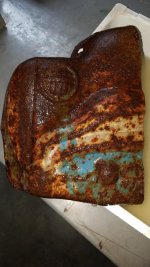
Another cleaning vinegar project I did was something to hang in the garage, a pedal car front end piece, from a Murray 'sad-face'. The entire thing was consumed by rust, I cut-off the only part which looked like it was worth saving (pic #3), and threw it into the cleaning vinegar (pic #4). Again, a thorough rinse and dry, then I shot it with Martin Senour paint (pic #5). I want the pits and holes, but not the rust.

I used the same vinegar for both the tools and the pedal car face.
 

Attachments

  • Rusty tools.01.jpg
    Rusty tools.01.jpg
    147 KB · Views: 60
  • Rusty tools.01-after vinegar.jpg
    Rusty tools.01-after vinegar.jpg
    149 KB · Views: 64
  • pedal car-rusty.jpg
    pedal car-rusty.jpg
    94.2 KB · Views: 62
  • pedal car-vinegar.jpg
    pedal car-vinegar.jpg
    87.2 KB · Views: 57
  • Pedal car-painted.jpg
    Pedal car-painted.jpg
    118.6 KB · Views: 59
Last edited:

MaximRecoil

Well-known member
Joined
Feb 28, 2011
Messages
161
Location
Maine, USA
For rusty tools with a black oxide finish (impact sockets commonly have a black oxide finish, for example), don't try to remove the rust, because anything you do that will remove rust (red iron oxide) will also remove the original finish (black iron oxide). Just boil the tool in water for about 5 minutes to convert the red rust to black oxide, then, optionally, you can gently card off any excess iron oxide with fine steel wool (e.g., 0000).

You can even use this method to make old tools that have most of their original black oxide finish worn off, look new again. If doing that, you intentionally induce surface rust by spraying the tool with a chemical such as hydrogen peroxide mixed with table salt, which will quickly cause red rust to form, then you boil the tool in water to convert it to black oxide, card off the excess, and repeat the process until the tool is as black as you want it to be (for more details, this site has a good guide). This is known as "rust bluing" ("bluing" is simply a [primarily] gun industry term which denotes a black oxide finish). Rust bluing is the original, and easiest, method of bluing.

Your black oxide-finished tools were originally blued with a "hot salts bluing" method, which is dangerous (the salts used are highly caustic) and requires constant monitoring to tightly regulate the temperature and ratio of the hot salts solution. However, rust bluing accomplishes the same thing; it's just not typically used by factories anymore because the repeated rusting and carding process is very time consuming, especially on something with a complex shape like a revolver.
 

BFHtime

Well-known member
Joined
Mar 31, 2012
Messages
983
Any suggestions for large parts like the interior of a car that needs rust removal?
 

Outlawmws

Well-known member
Joined
Aug 9, 2011
Messages
39,131
Location
The Badlands
get and old doughboy swim pool and make a giant E-tank - you will need a rolling gantry crane...

A DC arc welder will be needed as a power supply....
 
To avoid these ads, REGISTER NOW!
Top Bottom