
You are using an out of date browser. It may not display this or other websites correctly.
You should upgrade or use an alternative browser.
You should upgrade or use an alternative browser.
Safety Glass rated helmet/face shield?
- Thread starter jeejay
- Start date
JJThrasher
Well-known member
Pretty sure they all say that for liability.
No, I think it's because the ones that say that ****. It's like saying you have to wear safety contact lenses under safety glasses, for liability.Pretty sure they all say that for liability.
Last edited:
Leaflessshadetree
Well-known member
It's because most face shields leave large gaps on the sides.

Welding helmets say it too. The Uvex one looks to cover the sides, but pics show safety glasses underneath.

That's the I use in my shop...
Safety glasses protect your eyes, while face shields protect your face. That is what we teach in our shop classes. Face shields allow a lot of room for things to still get to your eyes. This is especially true if something were to puncture or crack the face shield. If you are working in a shop you should always have safety glasses on. They make great ones that you will forget you are wearing. If they bother you so much, you should just spend a little more and buy a quality set of safety glasses. They could be well worth the expense. Mine have saved my eyes on at least 3 occasions.
I guess they're not all the same. Looking at the Zekler site (referring to European standards), it says:
Additional test for protection to withstand high-velocity particles
A 6 mm diameter steel ball is used and is fired at the protective glass.
Low energy impact 45 m/s is marked with “F”. (Glasses, Goggles, Visors)
Medium energy impact 120 m/s is marked with “B”. (Goggles, Visors)
High energy impact 190 m/s is marked with “A”. (Visor)
So I think they're saying an "A" visor would have greater impact resistance than glasses or goggles (higher vs lower energy), but the most common ones around look to be "F" visors... I just don't like reading a sticker on the so-called grinder face shields that basically say they don't shield your face while using a grinder! What the hell is it for then?
Additional test for protection to withstand high-velocity particles
A 6 mm diameter steel ball is used and is fired at the protective glass.
Low energy impact 45 m/s is marked with “F”. (Glasses, Goggles, Visors)
Medium energy impact 120 m/s is marked with “B”. (Goggles, Visors)
High energy impact 190 m/s is marked with “A”. (Visor)
So I think they're saying an "A" visor would have greater impact resistance than glasses or goggles (higher vs lower energy), but the most common ones around look to be "F" visors... I just don't like reading a sticker on the so-called grinder face shields that basically say they don't shield your face while using a grinder! What the hell is it for then?
Seems like semantics, if you're facing what's being worked on, a face shield should protect the entire face (including the eyes) if it's rated for that type of protection. Maybe if it were a chainsaw and you had stuff flying upward and under the shield, something could bounce into your eyes (or even then you'd more likely be tilting the shield down while looking to protect that area), but other than looking away from the work and leaving the shield open to flying particles I don't see it happening (unless the shield is too flimsy to begin with; a sticker on one said it didn't provide extra ordinary protection from flying particles and safety glasses were necessary, but I'm thinking a better shield is necessary if you want to protect the rest of your face at all).Safety glasses protect your eyes, while face shields protect your face.
Last edited:
Wamsutta
Well-known member
This one you could probably get by without safety glasses, but it'd be hot as hell.

machine_punk
Well-known member
I wear the UVEX shield -AND- Safety glasses. Stuff routinely gets past the shield (well, and the glasses, actually).
I ALWAYS wear my prescription safety glasses in the shop and also add the shield with any higher-risk activities, like using a wire wheel or grinder.
KDub
I ALWAYS wear my prescription safety glasses in the shop and also add the shield with any higher-risk activities, like using a wire wheel or grinder.
KDub
Wamsutta
Well-known member
I need to get a face shield for running the weedeater with. My safety glasses are saving my eyes, but the little rocks are pelting my face.
Wamsutta, you may want to consider a mesh shield...
https://www.amazon.com/Pyramex-S1060-Shield-Steel-Visor/dp/B00YA27E6C/ref=sr_1_4?s=hi&ie=UTF8&qid=1471927488&sr=1-4&keywords=chainsaw+face+shield
https://www.amazon.com/Pyramex-S1060-Shield-Steel-Visor/dp/B00YA27E6C/ref=sr_1_4?s=hi&ie=UTF8&qid=1471927488&sr=1-4&keywords=chainsaw+face+shield
Interesting. Looks like Honeywell and Sellstrom make those. Sellstrom mentions high impact standards, and Honeywell mentions heat resistance.This one you could probably get by without safety glasses, but it'd be hot as hell.
I checked the Sellstrom spec sheet though and it says protective eyewear is required (and sold separately). I think the only high impact resistant parts of it are the top and bottom, since the face shield goes clear behind the ear (why else would additional eyewear be required)... the thing is, they make the shields very thin to be replaceable (which they need to be, because they're very thin).
Last edited:
Superbec
Well-known member
I would change the title into :
Chronicles of the blind but adventurous weekend worrier
Chapter 1
How to not look silly

You can get full face breathing protection that don't require eye protection and ,it's hot, sweaty , foggy and after half hour of grinding makes you question you life choices
Chronicles of the blind but adventurous weekend worrier
Chapter 1
How to not look silly
You can get full face breathing protection that don't require eye protection and ,it's hot, sweaty , foggy and after half hour of grinding makes you question you life choices
I'll probably go with some kind of anti-riot or ballistic face shield, obviously they're a lot thicker and designed to take a beating. Otherwise I don't even see the point in wearing one. That's what I meant by silly. Not in looks but the notion of form following function, well by comparison the others would function more like a splash guard, apart from the additional safety glasses.
Maybe not all of them though, I looked around some more, and Sustainable Supply gives the visor thickness for those. Most are 0.04", compared to either 0.105" or 0.25" for riot visors, and 1" thick for ballistic. One there by Oberon is listed as 0.105" thick, so that may be an option for a thicker work type without the combat helmet (it attaches to headgear or hard hat). Also found in a description that "visors must be worn with ANSI approved eyewear for OSHA compliance", so it's the regulation (and at your discretion beyond the workplace).
Actually, I checked the Oberon catalog and all of their face shields say 0.08" thick, except the economy model at 0.04". Wow, 1 vs 2 millimeters! I'm doubting anyone makes a heavy duty face shield of that type (maybe they don't bother because safety glasses are required underneath). Seems strange to me though.
Maybe not all of them though, I looked around some more, and Sustainable Supply gives the visor thickness for those. Most are 0.04", compared to either 0.105" or 0.25" for riot visors, and 1" thick for ballistic. One there by Oberon is listed as 0.105" thick, so that may be an option for a thicker work type without the combat helmet (it attaches to headgear or hard hat). Also found in a description that "visors must be worn with ANSI approved eyewear for OSHA compliance", so it's the regulation (and at your discretion beyond the workplace).
Actually, I checked the Oberon catalog and all of their face shields say 0.08" thick, except the economy model at 0.04". Wow, 1 vs 2 millimeters! I'm doubting anyone makes a heavy duty face shield of that type (maybe they don't bother because safety glasses are required underneath). Seems strange to me though.
Last edited:
geartow
Well-known member
http://www.ebay.com/itm/Jackson-Safety-Monogoggle-SHIELD-Splash-Safety-Goggles-Face-Shield-Each-/291456109906?hash=item43dc234d52:m:mLeQPA27mo1WcBkGgkL56xQ
Saw these at the state fair in the please be a prepper for diaster display
Saw these at the state fair in the please be a prepper for diaster display
Splash protection... what about flying metal? I'd like to see all of these things put to the test (easy enough to draw conclusions aside, it's all about the same material, and safety standards are the minimum amount of it). I'm thinking .25" would be my minimum shield thickness to cover things flying at my face (now that I ponder it). Looking at a riot shield of that thickness, it has a V-50 rating, which is halfway ballistic (only half of multiple bullets fired would penetrate it at 850 fps, so lower velocity materials coming at me probably wouldn't at all). I tried to look that up too, and found a book which says "the velocity of the projectile from a low-power tool must not exceed 98.5 m/s, otherwise the tool would be classed as high-power". That's up to 323 fps for a projectile from a low-power tool, not sure if there's a limit for high-power, but if the face shield were three times thinner like the best workshop types available, it wouldn't necessarily stop a low-power projectile, even. The quarter inch shield would likely stop double this velocity, which could cover a tool's higher power projectiles as well.
Last edited:
Wamsutta
Well-known member
Wamsutta, you may want to consider a mesh shield...
https://www.amazon.com/Pyramex-S1060-Shield-Steel-Visor/dp/B00YA27E6C/ref=sr_1_4?s=hi&ie=UTF8&qid=1471927488&sr=1-4&keywords=chainsaw+face+shield
Thank you, that's exactly what I need.
Wamsutta
Well-known member
An air conditioned face shield:

IUEC Medic
Well-known member
I know someone who was wearing a face sheild, goggles, and safety glasses and still landed in the ER to have a metal shaving removed from his eye.
Those shavings can find there way into some tiny tiny spaces. I don't know about you, but there's nothing silly about wearing glasses under a shield. My eyes mean a lot to me and my career.
That being said, the air conditioned face sheild would probably do the trick, assuming it's hermetically sealed.
Those shavings can find there way into some tiny tiny spaces. I don't know about you, but there's nothing silly about wearing glasses under a shield. My eyes mean a lot to me and my career.
That being said, the air conditioned face sheild would probably do the trick, assuming it's hermetically sealed.
Also, pay attention to safety ratings and make sure they are sufficient for the work you're doing. Using a grinder where there's a risk of blade explosion you want something military rated, not just ANSI.
Here's some reading: http://blog.safetyglassesusa.com/how-to-identify-ballistic-rated-eyewear/
Everything in here is military rated: http://www.peosoldier.army.mil/equipment/eyewear/
Here's some reading: http://blog.safetyglassesusa.com/how-to-identify-ballistic-rated-eyewear/
Everything in here is military rated: http://www.peosoldier.army.mil/equipment/eyewear/
Finky198
Well-known member
+1 on the UVEX I have and like the Turbo Shield, but I still gotta wear saftey glasses for most jobs...
For small parts?
Maybe making a blast shield / cabinet the encases your work similar to a sandblasting cabinet is in you future... I thought about something like this for a while built into a bench... it could double as a small spray booth... with proper ventilation
For small parts?
Maybe making a blast shield / cabinet the encases your work similar to a sandblasting cabinet is in you future... I thought about something like this for a while built into a bench... it could double as a small spray booth... with proper ventilation
Last edited:
Right, I'm not against anyone wearing both (obviously they should if OSHA requires it), just wondering what's out there for an all in one, myself.
Looks like the "demining" or fragmentation visors are a good mixture of both, featuring 6mm thick high velocity impact resistance, and they're attached to headgear alone.

Another pic shows how they extend upward farther than industrial or 'workwear' ones (as I'd call them), to deflect fragments above and around the face, with a thicker shield by far (some fit over a helmet as well).

Doesn't look like they require safety glasses underneath, as far as regulations go in that line of work (it's no wonder). Of course those are somewhat difficult to order unless you're part of a task force (or official humanitarian effort). I'll see though, a couple appear to be on the market for anyone interested (in spending a little more, for something bomb proof)!
Interestingly enough, Paulson International makes both these and industrial face shields, however the industrial ones are only 1.9mm thick (a pretty good indication that none of those exceed the lower standard by much). I don't think industrial accidents would necessarily involve three times less impact though (call me crazy)... it does weigh a couple pounds more than the average face shield.
Looks like the "demining" or fragmentation visors are a good mixture of both, featuring 6mm thick high velocity impact resistance, and they're attached to headgear alone.
Another pic shows how they extend upward farther than industrial or 'workwear' ones (as I'd call them), to deflect fragments above and around the face, with a thicker shield by far (some fit over a helmet as well).
Doesn't look like they require safety glasses underneath, as far as regulations go in that line of work (it's no wonder). Of course those are somewhat difficult to order unless you're part of a task force (or official humanitarian effort). I'll see though, a couple appear to be on the market for anyone interested (in spending a little more, for something bomb proof)!
Interestingly enough, Paulson International makes both these and industrial face shields, however the industrial ones are only 1.9mm thick (a pretty good indication that none of those exceed the lower standard by much). I don't think industrial accidents would necessarily involve three times less impact though (call me crazy)... it does weigh a couple pounds more than the average face shield.
Last edited:
bob15
Well-known member
Wamsutta, you may want to consider a mesh shield...
https://www.amazon.com/Pyramex-S1060-Shield-Steel-Visor/dp/B00YA27E6C/ref=sr_1_4?s=hi&ie=UTF8&qid=1471927488&sr=1-4&keywords=chainsaw+face+shield
Thank you, that's exactly what I need.
Actually, I think this Peltor would be better for the weedwacker because it also has ear muffs to protect the ears.

http://www.hillas.com/Categories/3M-Safety-Products-Head-and-Face-Protection/3M-Peltor-Brush-Defender-Visor-System-Face-Protection-V40AH31A-1P-with-H31A-Ear-Muff-1-ea-cs.html?gclid=CIq-xODK2M4CFUEmhgodzaAFDQ
Looks like the "demining" or fragmentation visors are a good mixture
over a helmet as well).
Doesn't look like they require safety glasses underneath

Oh whatever, are you the fashion police? Everybody's going for the best tool specs, but then some want to scoff at the best spec specs.
Might be nice (no luck ordering one of those so far), but it looks like I can get a 6.4mm (1/4") x 8" helmet mount face shield for $20, so that's even better in a couple of ways (well, I'll see what else it might fit before looking at brain buckets).
Might be nice (no luck ordering one of those so far), but it looks like I can get a 6.4mm (1/4") x 8" helmet mount face shield for $20, so that's even better in a couple of ways (well, I'll see what else it might fit before looking at brain buckets).
Last edited:
Thanks. I was also reading about some tests set up to compare demining visors. Perhaps what's most pertinent to the discussion of material thickness is the following result: "By performing tests with visors that range in thickness, it has been demonstrated that even a small increase in visor thickness can tremendously affect the ability of a visor to prevent high velocity fragmentation from reaching the face of a deminer. In the tests performed for this study, it was demonstrated that by increasing visor thickness from 5 to 5.7mm, one could decrease the chance of a fragment penetration by over eight times."Also, pay attention to safety ratings and make sure they are sufficient for the work you're doing. Using a grinder where there's a risk of blade explosion you want something military rated, not just ANSI.
Here's some reading: http://blog.safetyglassesusa.com/how-to-identify-ballistic-rated-eyewear/
Everything in here is military rated: http://www.peosoldier.army.mil/equipment/eyewear/
Industrial face shields are just one or two millimeters thick (and don't claim to stop power tool fragmentation). There doesn't seem to be anything in between that and mil spec (5+ mm for those). I'm kind of surprised not to have found a single heavy duty industrial face shield out there, after reading the sticker on one basically saying it wasn't going to work, and it implied that none of them do...
in the back of my mind I expected them to be as substantial as they look, guess not.Maybe those who come up with industrial standards figure the sum total of a tool guard + minmal face shield + minimal safety glasses would equal a thicker visor, but I gather from tests like the V50, and equipment comparisons based on it, that a single guard of appropriate thickness around the face is going to be much more effective. Also, the demining tests concluded that working as far away as possible from the point of origin of high velocity fragmentation would help, and since people are generally working closer to power tools, I don't suppose a quarter inch is much thicker than necessary for 100% effectiveness at stopping lower velocity fragments (or at least you may not have to replace it every time that happened, as scratches can be removed from this material). The standards for mine clearance operations say the fragmentation visor has a V50 rating of 1476 fps, and ideally should be used at a demolition safety distance upwards of 300 meters (furthermore, they do comprise face and eye protection all in one).
Going back and comparing data between other shields, the industrial tests referred to by Zekler use a steel ball fired at 623 feet per second to rate face shields for high energy impact, while the quarter inch riot visors are rated at 50% protection from bullets fired at 850 feet per second, and you have to figure that a fragmented tool can be sharper than a steel ball too (so I don't think the industrial tests are as realistic, even if they do rate comparitively high impact resistance with thinner material), especially if you're going for 100% protection from lower fps fragments at close range (all of the tests are ballistic in nature, whether or not the face shields are rated this way). So then, what are industrial shields rated for? Ball bearings breaking loose, like missing socks flying out of the clothes dryer...

Last edited:
catalytic
Well-known member
Actually, I think this Peltor would be better for the weedwacker because it also has ear muffs to protect the ears.
http://www.hillas.com/Categories/3M-Safety-Products-Head-and-Face-Protection/3M-Peltor-Brush-Defender-Visor-System-Face-Protection-V40AH31A-1P-with-H31A-Ear-Muff-1-ea-cs.html?gclid=CIq-xODK2M4CFUEmhgodzaAFDQ
^^ I have used several brands of these for logging (with the helmets attached, though). You would be surprised at how much you can bend them if you push your finger (or a tree branch) into one (some brands more than others). Some I've tried are less like wearing wire mesh armor and more like wearing a window screen in front of your face. In other words, I'd stick with safety goggles under this type, too.
However, I also want full face protection with no safety goggles quite frequently when grinding and doing other stuff where I worry that, if I wear safety goggles with no face protection, I might emerge a lot uglier with my vision perfectly intact to notice. In these cases, I wear this 3M 6000 series full face cartridge respirator, which is actually really comfortable:
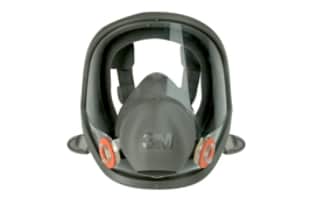
I feel a LOT more protected in this than I do in the logging wire-mesh type. You can try punching your face while wearing it -- you'll feel very safe from yourself. Not sure how it does against bullets -- haven't tried.
I don't mind breathing through the filters although it gets tiresome sometimes, but you can just us it without filters. If I can stand the extra heat here working outside in SoCal, you'll be fine. I also have a fill PAPR powered respirator, which is a lot cooler to work in due to the airflow, but I only take that out for the nasty stuff since it's a pain to connect the parts and lug it around.
Last edited:
Not sure (those sit pretty far off), depends on how the face shield fits and what I'm working with, but there are all kinds of horrible power tool vs face accidents pictured out there (that safety glasses do not prevent), along with one at the throat (in which some kind of protection was worn, and obviously wasn't adequate).If you're going to this extent to protect your face, are you also wearing throat protection like the mil spec pics above?
Looked up cut resistance too, and it seems that keeping a distance from powered spinning things is best, like holding something in a clamp instead of the hands.
Q. Should cut-resistant gloves be used to protect one from cuts from powered/mechanical equipment like powered saws and drills?
A. Manufacturers of cut-resistant gloves will not suggest the use of cut-resistant gloves for protection against powered devices. Gloves are typically tested for use with non-powered blades and sharps only. The use of a cut-resistant glove with powered equipment could potentially harm an individual. If the moving blade catches the glove, it could result in a person getting pulled into moving machinery. Moving machine parts have the potential for causing severe workplace injuries, such as crushed fingers or hands, amputations, burns or blindness. Safeguards are essential for protecting workers from these preventable injuries. Any machine part, function or process that may cause injury must be safeguarded, especially when the operation of a machine or accidental contact with it can injure the operator or others in the vicinity. These hazards must be either eliminated or controlled.
Last edited:
bob15
Well-known member
^^ I have used several brands of these for logging (with the helmets attached, though). You would be surprised at how much you can bend them if you push your finger (or a tree branch) into one (some brands more than others). Some I've tried are less like wearing wire mesh armor and more like wearing a window screen in front of your face. In other words, I'd stick with safety goggles under this type, too.
However, I also want full face protection with no safety goggles quite frequently when grinding and doing other stuff where I worry that, if I wear safety goggles with no face protection, I might emerge a lot uglier with my vision perfectly intact to notice. In these cases, I wear this 3M 6000 series full face cartridge respirator, which is actually really comfortable:
I feel a LOT more protected in this than I do in the logging wire-mesh type. You can try punching your face while wearing it -- you'll feel very safe from yourself. Not sure how it does against bullets -- haven't tried.
I don't mind breathing through the filters although it gets tiresome sometimes, but you can just us it without filters. If I can stand the extra heat here working outside in SoCal, you'll be fine. I also have a fill PAPR powered respirator, which is a lot cooler to work in due to the airflow, but I only take that out for the nasty stuff since it's a pain to connect the parts and lug it around.
I agree that with a weedwacker safety glasses are still a must. The idea of the mesh shield is keep the face from being pelted by small stones and such. I was not, nor recommend using the mesh shield without glasses on a weedeater.
I also use the Peltor helmet/ear muff/mesh shield for wood cutting. Mine is a steel mesh which seems to work better than the "plastic-type" in the woods, especially considering the steel mesh doesn't bend. Not sure if anyone still makes a steel wire mesh on a chainsaw-type helmet.
Thanks. I was also reading about some tests set up to compare demining visors. Perhaps what's most pertinent to the discussion of material thickness is the following result: "By performing tests with visors that range in thickness, it has been demonstrated that even a small increase in visor thickness can tremendously affect the ability of a visor to prevent high velocity fragmentation from reaching the face of a deminer. In the tests performed for this study, it was demonstrated that by increasing visor thickness from 5 to 5.7mm, one could decrease the chance of a fragment penetration by over eight times."
Industrial face shields are just one or two millimeters thick (and don't claim to stop power tool fragmentation). There doesn't seem to be anything in between that and mil spec (5+ mm for those). I'm kind of surprised not to have found a single heavy duty industrial face shield out there, after reading the sticker on one basically saying it wasn't going to work, and it implied that none of them do...
Maybe those who come up with industrial standards figure the sum total of a tool guard + minmal face shield + minimal safety glasses would equal a thicker visor, but I gather from tests like the V50, and equipment comparisons based on it, that a single guard of appropriate thickness around the face is going to be much more effective. Also, the demining tests concluded that working as far away as possible from the point of origin of high velocity fragmentation would help, and since people are generally working closer to power tools, I don't suppose a quarter inch is much thicker than necessary for 100% effectiveness at stopping lower velocity fragments (or at least you may not have to replace it every time that happened, as scratches can be removed from this material). The standards for mine clearance operations say the fragmentation visor has a V50 rating of 1476 fps, and ideally should be used at a demolition safety distance upwards of 300 meters (furthermore, they do comprise face and eye protection all in one).
Going back and comparing data between other shields, the industrial tests referred to by Zekler use a steel ball fired at 623 feet per second to rate face shields for high energy impact, while the quarter inch riot visors are rated at 50% protection from bullets fired at 850 feet per second, and you have to figure that a fragmented tool can be sharper than a steel ball too (so I don't think the industrial tests are as realistic, even if they do rate comparitively high impact resistance with thinner material), especially if you're going for 100% protection from lower fps fragments at close range (all of the tests are ballistic in nature, whether or not the face shields are rated this way). So then, what are industrial shields rated for? Ball bearings breaking loose, like missing socks flying out of the clothes dryer...
I'm reminded of this (****):
Didn't find specs on that shield at a glance, but got the Paulson DK5-X.250AF face shield in the mail (it's unmistakably thick, yet doesn't feel too heavy). They have a video describing its fitment and all (designed for PASGT helmets in particular which feature a front brim, I suppose it would fit a hard hat with a projecting rim fairly well, other than sealing it maybe). Come to find it was superseded by the DK6 which includes a brim shaped bracket for a more universal fit to helmets (I'll probably try both since that's on sale for $5 more). Looking at their other video for this new one, I think the NOS DK5 might actually fit an inch lower off the front (or the demonstrator didn't push the DK6 down all the way), and each is designed to clear a gas mask or respirator underneath. Not as likely to fog up at that angle I guess, well the AF versions are also anti-fog somehow (I think that's inherent in polycarbonate anyway, as it is said to absorb a certain amount of moisture, unless the treatment prevents this and I'm thinking of it backwards). Then there's the DK7, which has a lower profile vertical angle, with a flat bracket (yet it's a two inch shorter visor, and they have shorter versions of the others also, for use with larger than average respiration devices).I wear this 3M 6000 series full face cartridge respirator, which is actually really comfortable:
Their higher end shield is made of nylon instead of lexan and is said to be 20% lighter with a relatively high ballistic rating too (although I don't know if there's a similar procedure for removing scratches, like the one noted for poly shield in the field, and beyond that the scratch resistant types are said to be more brittle at high impact). Somewhere there are tear off lens covers which fit both of the longer models. Either type I'm sure is high end on specs compared to industrial standards, not to knock those too much (or myself actually). I think their demining visor is the longest type of face shield (13 inches extra over all), larger than two of these put together. I might have bumped into everything with it though (being prone to hitting my head, if wearing a helmet even... I'll have to see how those and hard hats compare between standards also).
 In the meantime, I did have a bump cap laying around here, so it had to be done... the face shield actually stayed on it, even though the brim wasn't full width, or thickness, or strapped completely tight. However, the weight of the visor, while not being too cumbersome in and of itself, will create an imbalance if you don't have a chin ******** any helmet or headgear (as that could go flyng like a toupee in the wind). They said the same about a demining visor with headgear (in 30% of use case scenarios), but didn't put a chin ******** that because it might almost take your head off in a blast (though it shields fragments before heading north, while the bump cap would just go south). Speaking of which, if the shield angle deflects fragments upward, I'd probably want the helmet to match its impact rating (elementary, you know, the bump caps are not safety rated, yet they're as thick as industrial face shields get, or apart from caps, most safety shields are the same material, so it's down to being thick headed in one way or another).
Here we are: a hard hat ballistic test. Well yeah, they don't work against moderate to high velocity fragments (falling things are going a lot slower, and power tools are used at closer range). The point is there's nothing in between the two, so I'm looking at the ballistic wear, thanks.
Last edited:
K-Dog
Well-known member
. I don't know about you, but there's nothing silly about wearing glasses under a shield. My eyes mean a lot to me and my career.
.
THIS X100.
I get called "captain safety" at work sometimes due to the lengths I go for safety.
My response is always " I would rather retire on a beach as opposed to a hospital bed. "
You got me there, the 1/4" shield is only 50 times safer (I'll estimate, based on the test showing an eight fold improvement for each .7mm increase in thickness).THIS X100.