To avoid these ads, REGISTER NOW!

Same style 220 plug for 20 amp and 50/60 amp circuits?

bedn0009

Well-known member
Joined
Mar 1, 2014
Messages
309
Location
Hudson, Wisconsin U.S.A.
Hi. I have a table saw on a 220 v, 20 amp circuit. It uses an L6-20 plug and receptacle.

I'm having an electrician add a new dedicated circuit for a plasma cutter in a different part of my shop and I'll likely put a 50 or 60 amp breaker and associated heavy wire there. I want to make.

Is there a single type of receptacle that I can use for both? I want to be able to move the table saw to this new receptacle if I want. I'd like both receptacles to be the same, although one of them is on a much higher amp circuit.

Thanks for your help.
 
To avoid these ads, REGISTER NOW!

wyliesdiesels

Well-known member
Joined
Aug 14, 2012
Messages
20,216
Location
Modesto, CA
Hi. I have a table saw on a 220 v, 20 amp circuit. It uses an L6-20 plug and receptacle.

I'm having an electrician add a new dedicated circuit for a plasma cutter in a different part of my shop and I'll likely put a 50 or 60 amp breaker and associated heavy wire there. I want to make.

Is there a single type of receptacle that I can use for both? I want to be able to move the table saw to this new receptacle if I want. I'd like both receptacles to be the same, although one of them is on a much higher amp circuit.

Thanks for your help.
no theyre different for a reason. because of the rated current.
 

bronc076

Well-known member
Joined
Jul 17, 2023
Messages
190
Location
Ozarks
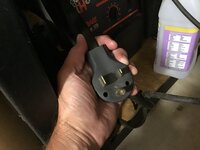
Your plasma cutter will probably have a NEMA 6-50 50amp plug like on a welder, see pic below. From a functionality perspective you can either change the plug on your table saw or buy a L6-20 outlet and a 6-50 plug, a foot of the appropriate wire and have your electrician make you an adapter cable. Then you can plug the table saw into the outlet for the plasma cutter.

The down side to this Is if there is a short in the cord on the table saw it may not trip the breaker before fire occurs. We all do this on 110V circuits all the time plugging low current draw, small gauge wire items into 15 amp circuits. inspect The cord on your table saw and if it's not in good shape replace or repair it.

I Personally would make an adapter cable for the convenience factor and still be able to use the saw at its old location with the existing plug, but I'm pretty comfortable with electricity, have wired buildings, and pay attention to the condition of my equipment so I don't have a lot of electrical issues. If you are not comfortable with that then have your electrician install a 20 amp outlet in the same area. He should know the rules.

Or buy an adapter off Amazon or Home Depot. This link is long, not sure if it will work.


hope this helped.
 

Attachments

  • IMG_0957.jpeg
    IMG_0957.jpeg
    576.8 KB · Views: 9
Last edited:

nadogail

Well-known member
Joined
Jan 23, 2009
Messages
32,228
Location
Coronado, CA
You can plug a 20 Amp Load into a 50 Amp Circuit, I have installed 50 Amp plugs on all of my low current 220 amp devices, all of my 220 Receptacles will power the highest load in the shop. The light current loads that are on plugs can be plugged into any 220 circuit.

Some 220 loads are hardwired to their own dedicated circuit.
 

wyliesdiesels

Well-known member
Joined
Aug 14, 2012
Messages
20,216
Location
Modesto, CA
You can plug a 20 Amp Load into a 50 Amp Circuit, I have installed 50 Amp plugs on all of my low current 220 amp devices, all of my 220 Receptacles will power the highest load in the shop. The light current loads that are on plugs can be plugged into any 220 circuit.

Some 220 loads are hardwired to their own dedicated circuit.
Not if the manufacturer says it must be on a 20a circuit
 

nadogail

Well-known member
Joined
Jan 23, 2009
Messages
32,228
Location
Coronado, CA
If I plug a 20 Amp saw into a 30 amp circuit it will run just fine and I will not be complaining about it to the manufacturer..
My half amp portable lamp works just fine when plugged into a 15 Amp outlet.
 

cherokee

Well-known member
Joined
Mar 2, 2010
Messages
980
Location
Kansas City MO
Not if the manufacturer says it must be on a 20a circuit
Why?

I am doing the same thing it sounds like a lot of people are doing. Using "low" amp draw stuff on higher amp draw circuits. I figured it would be like plugging in a .5a USB charger into a 15a 110 outlet. My understanding was it can flow that much current but not more.

I have not had a problem plugging 20a things into 50a circuits, unplug the electric heater in the summer and do it all the time.
 
To avoid these ads, REGISTER NOW!

Kezorm

Well-known member
Joined
Aug 18, 2021
Messages
174
Location
Twin Cities, MN
Why?

I am doing the same thing it sounds like a lot of people are doing. Using "low" amp draw stuff on higher amp draw circuits. I figured it would be like plugging in a .5a USB charger into a 15a 110 outlet. My understanding was it can flow that much current but not more.

I have not had a problem plugging 20a things into 50a circuits, unplug the electric heater in the summer and do it all the time.
Because equipment isn't necessarily rated to be plugged into a higher amp circuit. Sure, it will work fine. A 50A circuit will provide all the power that a 20A rated device needs - and then some. The "and then some" is where the problem lies. The 20A device doesn't care if it's plugged into a 20A circuit or a 1000A circuit... until something goes wrong with the equipment. A fault on a 20A circuit will trip the breaker. The same fault on a 50A circuit may result in a fire or worse because the breaker didn't trip.

Difference with the the half amp portable lamp or USB charger or little night light is that every device designed to plug into a standard 120V 15A receptacle is designed to do so. Every device plugged into 120V receptacle is tested / certified to operate safely up to a 20A circuit. Outside of 120V 15/20A receptacles, this assumption doesn't hold. Outside of 120V 15/20A, equipment should have a maximum overcurrent protection spec on the label and/or in the manual. Exceed this maximum overcurrent protection at your own risk.
 
Last edited:

cherokee

Well-known member
Joined
Mar 2, 2010
Messages
980
Location
Kansas City MO
Because equipment isn't necessarily rated to be plugged into a higher amp circuit. Sure, it will work fine. A 50A circuit will provide all the power that a 20A rated device needs - and then some. The "and then some" is where the problem lies. The 20A device doesn't care if it's plugged into a 20A circuit or a 1000A circuit... until something goes wrong with the equipment. A fault on a 20A circuit will trip the breaker. The same fault on a 50A circuit may result in a fire or worse because the breaker didn't trip.

Difference with the the half amp portable lamp or USB charger or little night light is that every device designed to plug into a standard 120V 15A receptacle is designed to do so. Every device plugged into 120V receptacle is tested / certified to operate safely up to a 20A circuit. Outside of 120V 15/20A receptacles, this assumption doesn't hold. Outside of 120V 15/20A, equipment should have a maximum overcurrent protection spec on the label and/or in the manual. Exceed this maximum overcurrent protection at your own risk.

I have never noticed this on the label, I will look for it when I get off work. I never knew this.

So to be clear at least in the US, every thing 110 is designed to "pop the breaker" if something happens no matter if it is a 15 or 20? For some reason that just does not sound right.
 

wyliesdiesels

Well-known member
Joined
Aug 14, 2012
Messages
20,216
Location
Modesto, CA
My 240v window shaker AC unit clearly states on the label that it is to be plugged into a 15a circuit.

Same goes for condenser units. They literally state the size of the circuit they are to be connected to…
 

Kezorm

Well-known member
Joined
Aug 18, 2021
Messages
174
Location
Twin Cities, MN
So to be clear at least in the US, every thing 110 is designed to "pop the breaker" if something happens no matter if it is a 15 or 20? For some reason that just does not sound right.
Yes, all 120V devices with 5-15 plug are designed to be safely connected to up to a 20A branch circuit. Not necessarily pop the breaker on fault, but certainly fail in a safe manner (e.g. blown fuse). Connected to >20A circuit, all bets are off.
 

Kezorm

Well-known member
Joined
Aug 18, 2021
Messages
174
Location
Twin Cities, MN
Recent example I ran into on my well pump controller - https://api.grundfos.com/literature/Grundfosliterature-6290514.pdf
This branch circuit was previously wired with a 20A breaker. Had to change out to 15A breaker. Yes, the pump would have operated perfectly fine on the 20A breaker (or a 30A breaker or a 50A breaker or connected directly to the service entrance conductors) with no negative effects. But, the manufacturer and NRTL (Nationally Recognized Testing Laboratory) have determined that the wiring / circuitry in the controller is not suitable to handle fault currents > 16A.
Screenshot 2023-07-20 at 12.43.32 PM.png
 

dave*99

Well-known member
Joined
May 5, 2009
Messages
4,331
Location
Coastal NJ
Consider this....

Imagine a 1/2HP 240V motor on a bandsaw. It only needs a few amps. And it has a typical 16ga. line cord attached. Maybe that cord is 12 feet long because it was extended.

You slap a 50A plug on it. And plug it into a 50A circuit.

The motor shorts out, not a dead short, but a couple of ohms. The resistance of the shorted motor in series with the 24 feet of 16ga wire adds up to about 6 ohms. 240V/6Ohms = 40A. And 40A*240V=9600Watts.

So now your motor and the line cord turns into a 9600W heater, or fire starter. Bad things happen.

That same saw plugged into a 20A circuit will trip the breaker under similar fault conditions.
 
To avoid these ads, REGISTER NOW!
Top Bottom