
You are using an out of date browser. It may not display this or other websites correctly.
You should upgrade or use an alternative browser.
You should upgrade or use an alternative browser.
School me on digital multimeters, $10 C'man vs. $150 Fluke
- Thread starter t100
- Start date
+1
A good set of probe leads will cost more than many of the cheap meters. Meters, especially probes leads, gets beat up with normal use. With a cheap meter, I won't have to worry too much. With a "quality precision instrument", I always have to be diligent.
If anything, I would consider the size of the control knobs buttons displays ... The user interface if you may. As a beginner, you just need basic functions.
I agree. The leads I have can interchange between probe and alligator clip.
I have several meters and still use the cheap one with the least bells and whistles the most.
kartracer55
Well-known member
- Joined
- Jun 21, 2005
- Messages
- 5,317
Im surprised nobody has made a mention of the materials being used. When you introduce a DMM to a circuit, you are not getting the TRUE reading of the circuit. While, granted, it will be close, it will be different. Ideally, a Voltmeter has infinite resistance and an Anmeter zero resistance. I would be willing to guess that a higher quality meter will have higher quality (and more expensive) components, and thus, a $200 fluke will likely be more accurate than a $10 craftsman. With that being said, most of the time, if your readings are off by, lets say, 2% due to this, it wont make a ****-bit of difference. Your wall socket will still be ABOUT 120 (110,115, whatever) etc etc.
The cheaper meter will do just fine for you with general stuff around the house and car. What you get with $higher meters is extra features, as everybody else has listed). You just need to be careful with what you are working on.
As I said, most important is to know what you are measuring and working on! If I were you, I would take some time to learn about circuits. Im not talking about ohms law kinda stuff. Thats fine and all, but capacitors and AC current are two things you are likely to encounter. The first in Automotive stuff, and later in the home. If you want some neat stuff to look up, look up "Electromotive Force" and "Internal resistance" and how it all fits together with batteries. Its kinda neat, particularly if you are looking to do anything automotive related. There is TONS of stuff to learn about circuits, I know a little tiny bit of it to get me by,mostly DC stuff, but some of the guys on here can definitely school you on this stuff all day.
The cheaper meter will do just fine for you with general stuff around the house and car. What you get with $higher meters is extra features, as everybody else has listed). You just need to be careful with what you are working on.
As I said, most important is to know what you are measuring and working on! If I were you, I would take some time to learn about circuits. Im not talking about ohms law kinda stuff. Thats fine and all, but capacitors and AC current are two things you are likely to encounter. The first in Automotive stuff, and later in the home. If you want some neat stuff to look up, look up "Electromotive Force" and "Internal resistance" and how it all fits together with batteries. Its kinda neat, particularly if you are looking to do anything automotive related. There is TONS of stuff to learn about circuits, I know a little tiny bit of it to get me by,mostly DC stuff, but some of the guys on here can definitely school you on this stuff all day.
A lot of good information in this thread.. I currently have the cheapest HF "Cen-Tech" digital multimeter and it's good enough for my (basic) use. Several people suggested getting a cheap multimeter and upgrading the leads, that sounds like something I'd like to do. My positive lead that came with my multimeter is so loose I gotta hold it in place. Any recommendations on leads? and where to get them?
Mickey O
Well-known member
Fluke 73, made in USA, bought it new over 20 years ago, used heavily for many years, still functions like new. Lets see some picture of your old (15 + years old) Harbor Freight meters.

Often the probe connection to the meter has slots cut onto the plug. Over time, they get "weak". Stick a small screw driver in there and spread them a bit.
Any electronic supply house will have probes. Do a google ....
As for meter accuracy .... know what you are measuring. If AC there are limits to the frequency response of a hand held meter. But then, you are dealing with a car or motorcycle, not debugging some digital circuit.
I still have the first digital meter I purchased when I was in college. 30 years of electrical engineering career, I still use that meter.
Any electronic supply house will have probes. Do a google ....
As for meter accuracy .... know what you are measuring. If AC there are limits to the frequency response of a hand held meter. But then, you are dealing with a car or motorcycle, not debugging some digital circuit.
I still have the first digital meter I purchased when I was in college. 30 years of electrical engineering career, I still use that meter.
MadMark
Well-known member
As for meter accuracy .... know what you are measuring. If AC there are limits to the frequency response of a hand held meter. But then, you are dealing with a car or motorcycle, not debugging some digital circuit.
30 years of electrical engineering career.
Excellent point, any EE will tell you the sampling rate of the meter has to be twice the frequency of what you are measuring, the Nyquist frequency (AC, does not apply to DC).
So if you are measuring AC or the waveform from a sensor, you may need to be carefull here.
Does anyone know what frequency response range you need for automotive sensors?
Thedroid
Well-known member
Depends on the Voltage your working with. A cheapo will get you buy on 12V and 120V, but if your dealing with 480V, then you really want a damn good meter. As far as the video goes, I didn't watch it, but if you accidently leave your leads plugged in to measure current, and you put it to 480V you will be toast. Fluke offer a measure of protection for this.
There is also a troubleshooting technique called on line troubleshooting where you leave the meter in the continuity mode, and measure live circuits. The better multimeters can do this the cheap ones cannot.
Fluke for me at work, and my Blue Point works nice at home.
There is also a troubleshooting technique called on line troubleshooting where you leave the meter in the continuity mode, and measure live circuits. The better multimeters can do this the cheap ones cannot.
Fluke for me at work, and my Blue Point works nice at home.
I have had a Fluke meter for over a decade, I had a Cman, and a cheap HF meter for travel purposes. The Cman and HF both lost their display in a year, or so time.
I have an older Actron meter, for my travel tools now, I think it was a Japan made meter, non-auto ranging, that one has been good, but it was 60 bucks at the time, not a Fluke meter, but aok.
With measurement tools, that is not the time to go cheap IMHO.
I have an older Actron meter, for my travel tools now, I think it was a Japan made meter, non-auto ranging, that one has been good, but it was 60 bucks at the time, not a Fluke meter, but aok.
With measurement tools, that is not the time to go cheap IMHO.
Looks like I'll just hold on to the Craftsman see how it goes. It has been a good meter for what I needed for 10 years, I replaced the battery for the first time this year.
at the same time, I'm keeping my eyes on used Fluke's and leads on ebay.
thanks fellas, definitely learned a lot from you guys
at the same time, I'm keeping my eyes on used Fluke's and leads on ebay.
thanks fellas, definitely learned a lot from you guys
If your working on 480v and don't know that you need CAT III or IV rated tools the first person that sees you will likely toss you off the work site for the safety of the rest of the crew. Most of the new stuff seems to be CAT rated, with the new shrouded banana connections, and the cost of good test leads is kinda high due to the newness.
Full decent set of test leads is close to $100.
http://www.testpath.com/Categories/Test-Lead-Kits-Automotive-for-Multimeter-3105.htm
I am NOT suggesting the $2 HF meter as anything but a spare throw it in the box meter, but the $24 does look like its decent quality, good enough for a primary use meter. Saving $20 for a primary use tool is not worth one moment of grief or uncertainty, and the $2 meters are bound to provide more than a few.
Part of the cheapness of modern meters is the use of integrated circuits and surface mount tiny components which have almost no current carrying capacity, as a consequence the meters all need to have an active front end, essentially a very high impedance amplifier that isolates the meter from the circuit under test.
Full decent set of test leads is close to $100.
http://www.testpath.com/Categories/Test-Lead-Kits-Automotive-for-Multimeter-3105.htm
I am NOT suggesting the $2 HF meter as anything but a spare throw it in the box meter, but the $24 does look like its decent quality, good enough for a primary use meter. Saving $20 for a primary use tool is not worth one moment of grief or uncertainty, and the $2 meters are bound to provide more than a few.
Part of the cheapness of modern meters is the use of integrated circuits and surface mount tiny components which have almost no current carrying capacity, as a consequence the meters all need to have an active front end, essentially a very high impedance amplifier that isolates the meter from the circuit under test.
t100:
If you can find a radio shack 22-168A meter I would suggest that you purchase it. It will be very inexpensive to purchase these days ($10 to $30 maybe?).
Here is what it looks like:
http://www.oddmix.com/elec/elt_rs_22168a_dmm.html
IMO, this is probably all the meter you will ever need. I have owned one since the mid 90's and have dropped it on concrete floors and it works fine. One cool aspect of the meter is that the datalogging comm protocol is online so you can write your own programs for custom datalogging features.
One interesting tidbit for the techy guys...the freq counter is extremely accurate to over 19.40MHz (verified with a tek scope 5 minutes ago)...in a meter that was $100 brand new ~13 years ago and is still kicking .
.
You can also have it calibrated and the service manual shows up on ebay now and then.
Mickey:
That is a good meter. I gave one to my dad many years ago and he destroyed it last week (no joke). User error though...and he knew it.
Kevin
If you can find a radio shack 22-168A meter I would suggest that you purchase it. It will be very inexpensive to purchase these days ($10 to $30 maybe?).
Here is what it looks like:
http://www.oddmix.com/elec/elt_rs_22168a_dmm.html
IMO, this is probably all the meter you will ever need. I have owned one since the mid 90's and have dropped it on concrete floors and it works fine. One cool aspect of the meter is that the datalogging comm protocol is online so you can write your own programs for custom datalogging features.
One interesting tidbit for the techy guys...the freq counter is extremely accurate to over 19.40MHz (verified with a tek scope 5 minutes ago)...in a meter that was $100 brand new ~13 years ago and is still kicking
. You can also have it calibrated and the service manual shows up on ebay now and then.
Mickey:
That is a good meter. I gave one to my dad many years ago and he destroyed it last week (no joke). User error though...and he knew it.
Kevin
Last edited:
kiall1987
Well-known member
buy a fluke 88 and be done with it
Excellent point, any EE will tell you the sampling rate of the meter has to be twice the frequency of what you are measuring, the Nyquist frequency (AC, does not apply to DC).
So if you are measuring AC or the waveform from a sensor, you may need to be carefull here.
Does anyone know what frequency response range you need for automotive sensors?
If the OP states that he will be pursuing a career in EE, then I would say buy something SLIGHTLY better, like $25 instead of $3. I am not saying he won't need something even more. I am just saying that at this point in his career, he won't need it for a long while. He can spend his money in better ways.
If the knob falls off, go buy another $3 meter. Take my word ... They don't all fall off on the first week. Go ahead, take that great leap into the unknown with $3.
Looking at the shop manuals of my 2007 Suzuki, I don't see any requirement for a sophisticated meter other than a basic DMM. Don't know much about car sensors but I suspect it is not too far different.
Last edited:
Coach James
Well-known member
For my students I have a few Sperry and several Cen tech meters. I can get 3 HF meters for the price on one Sperry. Aside from the Cen Tech's blowing fuses, they are fine for the DC circuitry I am teaching them.
Coach
Coach
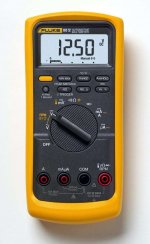
I've got one for sale on eBay right now:buy a fluke 88 and be done with it
http://cgi.ebay.com/ebaymotors/ws/e...443396135&viewitem=&sspagename=STRK:MESELX:IT
The way I figure it, I don't deserve this meter....it belongs in the hands of a pro tech; so it's off to eBay.
I have General DAMP 3505 that I use, which is MORE that enough to confuse me. It will do dwell, temp, duty cycle, and all the normal VOM functions. It also came with all sorts of probes, including an amp pickup. When new, the full kit still cost less than half of what the Fluke set cost, and not worth nearly anything to sell on eBay; so it's the one I kept.
kiall1987
Well-known member
isnt that a older model compared to the 88v ? yours has blue buttonsI've got one for sale on eBay right now:
http://cgi.ebay.com/ebaymotors/ws/e...443396135&viewitem=&sspagename=STRK:MESELX:IT
The way I figure it, I don't deserve this meter....it belongs in the hands of a pro tech; so it's off to eBay.
I have General DAMP 3505 that I use, which is MORE that enough to confuse me. It will do dwell, temp, duty cycle, and all the normal VOM functions. It also came with all sorts of probes, including an amp pickup. When new, the full kit still cost less than half of what the Fluke set cost, and not worth nearly anything to sell on eBay; so it's the one I kept.
Attachments
Last edited:
isnt that a older model compared to the 88v ? yours has blue buttons
I would guess you are correct. This came out of a tool collection of a tech that retired a few years ago. Still a great meter, and it will probably sell for less than 1/3 of a new one.
kiall1987
Well-known member
Ok i was just informing you incase anyone bought it and complained! but still a great meter
Last edited:
I wouldn't buy the cheapest meter for automotive work, they only have about 2M ohms resistance. You want atleast 20M ohms. Buy one specifically for auto work that has tach, dwell, etc. Equus has one that's pretty cheap. Cman should also have one for general household work. Those are rated pretty high resistances. (115V, 60 hz is household volts, feq. respectively).
Scopes would be useful to look at signals comming from/to the ECU (down or up edge, freq, etc. for trouble codes.)
For circuit board work, you would probably want a bench type DMM.
Scopes would be useful to look at signals comming from/to the ECU (down or up edge, freq, etc. for trouble codes.)
For circuit board work, you would probably want a bench type DMM.
Meters are going to continue to get better, and cheaper. Within 10 years my guess is scopemeters will become MUCH more common, maybe not, most techs seem to hate meter work, and scope use is much worse in terms of small mistakes messing things up.
The HF or this Equus 3340 should be more than plenty for most, $80 at several sources. Fluke 88VA is $380, if you really need it, your going to know it.
http://www.amazon.com/dp/B000KIMHRQ/?tag=atomicindus08-20
The HF or this Equus 3340 should be more than plenty for most, $80 at several sources. Fluke 88VA is $380, if you really need it, your going to know it.
http://www.amazon.com/dp/B000KIMHRQ/?tag=atomicindus08-20
Attachments

Mickey O
Well-known member
Mickey:
That is a good meter. I gave one to my dad many years ago and he destroyed it last week (no joke). User error though...and he knew it.
Kevin
That one I have pictured was dropped in a flooded elevator pit and stopped working 3 or so year into owning it, I sent it back to Fluke, they repaired it no charge and sent it back. I don't know if they will do it 20 years later but what have you got to lose, call them up and see what they say. If he blew it checking amps sometimes it's just the fuse.